StableSR: a time-aware encoder for a frozen diffusion prior (IJCV 2024)
Optional · paper guide 8 of 11 for DLCV 09A.1 · Blind and Real-World Image Super-Resolution. Citation numbers refer to the reference list at the bottom of this page.
Navigate: this page and this track: Navigate: this page and this track
On this page
- SRMD: one network for many known degradations (CVPR 2018)
- IKC: iterative kernel correction (CVPR 2019)
- KernelGAN: kernel estimation with an internal GAN (NeurIPS 2019)
- DAN: unfolding the alternating optimization (NeurIPS 2020)
- DASR: contrastive degradation representations (CVPR 2021)
- BSRGAN: a practical degradation model (ICCV 2021)
- Real-ESRGAN: high-order degradation with pure synthetic data (ICCVW 2021)
- StableSR: a time-aware encoder for a frozen diffusion prior (IJCV 2024)
- DiffBIR: remove the degradation, then regenerate (ECCV 2024)
- SeeSR: degradation-aware semantic prompts (CVPR 2024)
- SUPIR: scaling up the prior, the data and the text (CVPR 2024)
Deep Learning for Computer Vision
Challenge
A pretrained diffusion model knows much about natural appearance but does not automatically know which details belong to one degraded photograph. StableSR seeks to retain that prior while adding enough image guidance to preserve the input’s structure [26]. Retraining the complete model risks changing the useful prior and increases adaptation cost. Using an unchanged conditioning signal at every noise level is also questionable: early and late denoising stages need different information.
The work therefore separates three jobs: condition the frozen denoiser, control reconstruction fidelity at decoding, and coordinate patches when the image is larger than the training resolution. These jobs address different failure modes and should not be collapsed into a single “diffusion upscaler” box.
Method
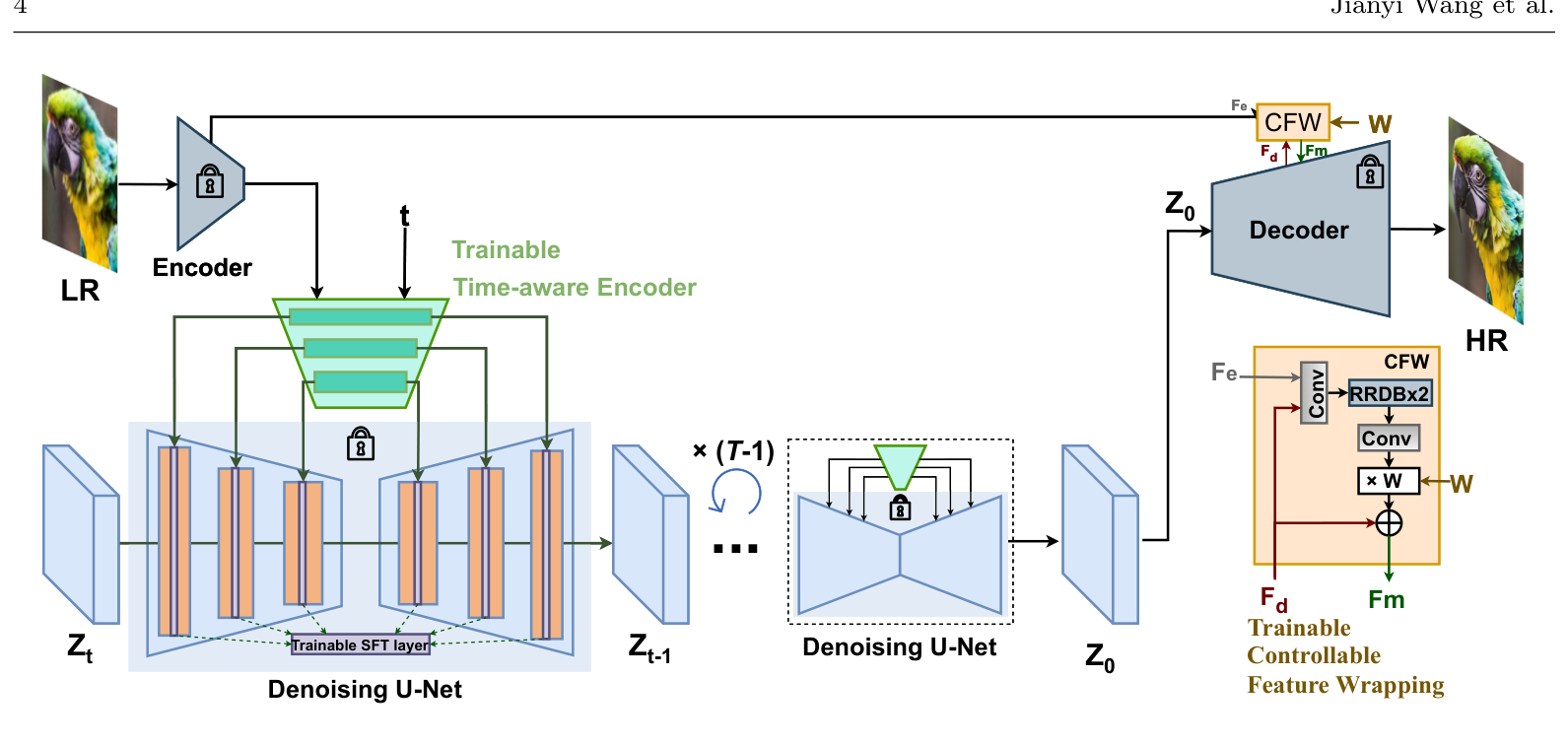
Figure source: [26], arXiv:2305.07015v4, PDF page 4. Original PDF.
Time-aware image encoder. The degraded input, enlarged to the desired output size, enters an encoder with a diffusion-time embedding. At multiple scales it supplies features to spatial feature transform layers inside the frozen denoiser. A representative modulation is
Here is the conditioning image, the noise level’s timestep, the encoder feature at scale , a frozen denoiser feature tensor, and a trainable convolutional mapping. The scale and shift tensors match the feature dimensions; multiplies corresponding entries. The encoder and modulation layers learn while the pretrained diffusion parameters stay fixed. The time input lets conditioning adapt as image content emerges, rather than assuming the same correction is useful at all noise levels.
Controllable feature wrapping. Random sampling and autoencoder compression can move the output away from the input. A separately trained decoder connector uses input encoder features and decoder features :
Here is a learned residual correction with parameters , the modified decoder feature, and a user-set coefficient. This is a feature correction, not pixel blending with a bicubic output. The authors generate latent reconstruction examples first, then train this connector while keeping the diffusion stage fixed. Its memory cost makes it optional.
Color correction. Per-channel mean/variance alignment corrects global color drift. An alternative replaces low-frequency components of the generated image with those of the input using a wavelet decomposition. Neither operation restores missing high-frequency evidence. They constrain color appearance after generation and can preserve input defects if those defects occupy the retained frequencies.
Aggregation sampling. Independent patch generation can create incompatible overlapping textures. StableSR instead predicts denoising updates for overlapping latent patches at every step, combines them with normalized Gaussian weights, and advances one shared latent image. This couples overlap regions throughout sampling. It is different from generating complete tiles independently and blending only the final images.
Training and inference. The prior is Stable Diffusion 2.1 [41]; image guidance uses the diffusion noise-prediction objective. The default inference reported here uses 200 denoising steps and a null text prompt. Training pairs use the Real-ESRGAN degradation pipeline [17]. At a 512 × 512 output resolution the latent grid has 64 × 64 spatial positions; conditioning must align with those positions and the denoiser’s multi-scale feature grids.
Results
On the paper’s 3,000 synthetic DIV2K validation pairs, Table 1 reports PSNR 23.26 dB, LPIPS 0.3114, FID 24.44, CLIPIQA 0.6771 and MUSIQ 65.92. Real-ESRGAN+ in the same table gives PSNR 24.47 dB and FID 49.16. These show a trade in that comparison, not superiority on every measure. RealSR results are 24.65 dB PSNR and 0.3002 LPIPS; DRealSR results are 28.03 dB and 0.3284. Resolution, crop selection and degradation settings belong with these numbers: another paper’s different synthetic benchmark is not directly comparable.
Ablations
Table 3 compares time awareness and color correction. With time awareness but no color correction, RealSR PSNR is 22.24 dB and LPIPS 0.3180; the default with pixel color correction gives 24.65 dB and 0.3002. Removing time awareness while retaining pixel correction gives 24.65 dB but worse LPIPS 0.3157. Equal PSNR therefore hides a perceptual difference.
Table 4 sweeps feature-wrapping strength. On synthetic DIV2K, gives PSNR 22.68 and FID 25.83; gives 23.26 and 24.44; gives 24.17 and 24.05; gives 23.14 and 26.14. The control is not a monotonic metric slider. An intermediate setting can improve several measurements simultaneously, while excessive feature correction can worsen them. The paper also shows that patch aggregation reduces visible tile inconsistency.
Conclusion
Frozen generative priors can be adapted with time-dependent image guidance, and fidelity can be controlled separately at decoding. Coordinating tiles during sampling is essential for large-image use.
Problems
Inference remains expensive, color correction is imperfect, and the learned prior can invent text, faces or texture. The connector adds memory use, and test resolution changes behavior. Improved perceptual ratings do not certify scene accuracy. One-step methods reduce the repeated denoising cost, but introduce their own approximation and training constraints; see the following SR chapter.
References
- N. Efrat, D. Glasner, A. Apartsin, B. Nadler and A. Levin, “Accurate Blur Models vs. Image Priors in Single Image Super-Resolution,” in Proc. IEEE ICCV, 2013, pp. 2832–2839. doi · CVF
- K. Zhang, W. Zuo and L. Zhang, “Learning a Single Convolutional Super-Resolution Network for Multiple Degradations,” CVPR, 2018. paper
- A. Liu, Y. Liu, J. Gu, Y. Qiao, C. Dong, “Blind Image Super-Resolution: A Survey and Beyond,” IEEE TPAMI (early access), 2022. source
- Honggang Chen, Xiaohai He, Linbo Qing, Yuanyuan Wu, Chao Ren, Ray E. Sheriff, Ce Zhu, “Real-world single image super-resolution: A brief review,” Information Fusion, 2022. source
- B. B. Moser, A. S. Shanbhag, F. Raue, S. Frolov, S. Palacio and A. Dengel, “Diffusion Models, Image Super-Resolution, and Everything: A Survey,” IEEE Transactions on Neural Networks and Learning Systems, vol. 36, no. 7, pp. 11793–11813, 2025. doi · arXiv
- Y. Xu, S. R. Tseng, Y. Tseng, H. Kuo, Y. Tsai, “Unified Dynamic Convolutional Network for Super-Resolution with Variational Degradations,” CVPR, 2020. source
- K. Zhang, L. Van Gool, R. Timofte, “Deep Unfolding Network for Image Super-Resolution,” CVPR, 2020. source
- J. Gu, H. Lu, W. Zuo and C. Dong, “Blind Super-Resolution With Iterative Kernel Correction,” CVPR, 2019. paper
- Z. Luo, Y. Huang, S. Li, L. Wang and T. Tan, “Unfolding the Alternating Optimization for Blind Super Resolution,” NeurIPS, 2020. paper
- Z. Luo, H. Huang, L. Yu, Y. Li, H. Fan and S. Liu, “Deep Constrained Least Squares for Blind Image Super-Resolution,” CVPR, 2022. paper
- T. Michaeli, M. Irani, “Nonparametric Blind Super-resolution,” Proceedings of the IEEE International Conference on Computer Vision, 2013. source
- S. Bell-Kligler, A. Shocher and M. Irani, “Blind Super-Resolution Kernel Estimation using an Internal-GAN,” NeurIPS, 2019. paper
- A. Shocher, N. Cohen and M. Irani, “‘Zero-Shot’ Super-Resolution Using Deep Internal Learning,” in Proc. IEEE/CVF CVPR, 2018, pp. 3118–3126. doi · arXiv
- L. Wang, Y. Wang, X. Dong, Q. Xu, J. Yang, W. An and Y. Guo, “Unsupervised Degradation Representation Learning for Blind Super-Resolution,” CVPR, 2021. paper
- B. Xia, Y. Zhang, Y. Wang, Y. Tian, W. Yang, R. Timofte and L. Van Gool, “Knowledge Distillation Based Degradation Estimation for Blind Super-Resolution,” ICLR, 2023. paper
- K. Zhang, J. Liang, L. Van Gool, R. Timofte, “Designing a Practical Degradation Model for Deep Blind Image Super-Resolution,” Proceedings of the IEEE/CVF International Conference on Computer Vision, 2021. source
- X. Wang, L. Xie, C. Dong, Y. Shan, “Real-ESRGAN: Training Real-World Blind Super-Resolution With Pure Synthetic Data,” Proceedings of the IEEE/CVF International Conference on Computer Vision, 2021. source
- J. Liang, H. Zeng, L. Zhang, “Efficient and Degradation-Adaptive Network for Real-World Image Super-Resolution,” ECCV, 2022. source
- J. Cai, H. Zeng, H. Yong, Z. Cao, L. Zhang, “Toward Real-World Single Image Super-Resolution: A New Benchmark and a New Model,” Proceedings of the IEEE/CVF International Conference on Computer Vision, 2019. source
- P. Wei, Z. Xie, H. Lu, Z. Zhan, Q. Ye, W. Zuo, L. Lin, “Component Divide-and-Conquer for Real-World Image Super-Resolution,” ECCV, 2020. source
- C. Chen, Z. Xiong, X. Tian, Z. Zha, F. Wu, “Camera Lens Super-Resolution,” Proceedings of the IEEE/CVF Conference on Computer Vision and Pattern Recognition, 2019. source
- Y. Yuan, S. Liu, J. Zhang, Y. Zhang, C. Dong, L. Lin, “Unsupervised Image Super-Resolution using Cycle-in-Cycle Generative Adversarial Networks,” CVPR Workshops, 2018. source
- A. Bulat, J. Yang, G. Tzimiropoulos, “To learn image super-resolution, use a GAN to learn how to do image degradation first,” ECCV, 2018. source
- M. Fritsche, S. Gu, R. Timofte, “Frequency Separation for Real-World Super-Resolution,” ICCV Workshops, 2019. source
- X. Ji, Y. Cao, Y. Tai, C. Wang, J. Li, F. Huang, “Real-World Super-Resolution via Kernel Estimation and Noise Injection,” Proceedings of the IEEE/CVF Conference on Computer Vision and Pattern Recognition Workshops, 2020. source
- J. Wang, Z. Yue, S. Zhou, K. C. K. Chan, C. C. Loy, “Exploiting Diffusion Prior for Real-World Image Super-Resolution,” IJCV, 2024. source
- X. Lin, J. He, Z. Chen, et al., “DiffBIR: Towards Blind Image Restoration with Generative Diffusion Prior,” ECCV, 2024. source
- T. Yang, R. Wu, P. Ren, X. Xie, L. Zhang, “Pixel-Aware Stable Diffusion for Realistic Image Super-resolution and Personalized Stylization,” ECCV, 2024. source
- R. Wu, T. Yang, L. Sun, Z. Zhang, S. Li, L. Zhang, “SeeSR: Towards Semantics-Aware Real-World Image Super-Resolution,” Proceedings of the IEEE/CVF Conference on Computer Vision and Pattern Recognition, 2024. source · supplementary experiments
- F. Yu, J. Gu, Z. Li, et al., “Scaling Up to Excellence: Practicing Model Scaling for Photo-Realistic Image Restoration In the Wild,” CVPR, 2024. source
- Z. Yue, J. Wang, C. C. Loy, “ResShift: Efficient Diffusion Model for Image Super-resolution by Residual Shifting,” NeurIPS, 2023. source
- X. Wang, K. Yu, C. Dong, C. C. Loy, “Recovering Realistic Texture in Image Super-Resolution by Deep Spatial Feature Transform,” Proceedings of the IEEE Conference on Computer Vision and Pattern Recognition, 2018. source
- K. He, H. Fan, Y. Wu, S. Xie, R. Girshick, “Momentum Contrast for Unsupervised Visual Representation Learning,” CVPR, 2020. source
- X. Wang, K. Yu, S. Wu, J. Gu, Y. Liu, C. Dong, Y. Qiao and C. C. Loy, “ESRGAN: Enhanced Super-Resolution Generative Adversarial Networks,” in Proc. ECCV Workshops, 2018 (Lecture Notes in Computer Science, 2019), pp. 63–79. doi · arXiv
- O. Ronneberger, P. Fischer and T. Brox, “U-Net: Convolutional Networks for Biomedical Image Segmentation,” in Proc. MICCAI, 2015, pp. 234–241. doi · arXiv
- T. Miyato, T. Kataoka, M. Koyama, Y. Yoshida, “Spectral Normalization for Generative Adversarial Networks,” ICLR, 2018. source
- J. Liang, H. Zeng, L. Zhang, “Details or Artifacts: A Locally Discriminative Learning Approach to Realistic Image Super-Resolution,” Proceedings of the IEEE/CVF Conference on Computer Vision and Pattern Recognition, 2022. source
- A. Ignatov, N. Kobyshev, R. Timofte, K. Vanhoey, L. Van Gool, “DSLR-Quality Photos on Mobile Devices with Deep Convolutional Networks,” ICCV, 2017. source
- A. Lugmayr, M. Danelljan, R. Timofte, “Unsupervised Learning for Real-World Super-Resolution,” arXiv preprint, 2019. source
- A. Lugmayr, M. Danelljan, R. Timofte, et al., “NTIRE 2020 Challenge on Real-World Image Super-Resolution: Methods and Results,” CVPR Workshops, 2020. source
- R. Rombach, A. Blattmann, D. Lorenz, P. Esser, B. Ommer, “High-Resolution Image Synthesis with Latent Diffusion Models,” CVPR, 2022. source
- L. Zhang, A. Rao, M. Agrawala, “Adding Conditional Control to Text-to-Image Diffusion Models,” ICCV, 2023. source
- Y. Ai, X. Zhou, H. Huang, X. Han, Z. Chen, Q. You, H. Yang, “DreamClear: High-Capacity Real-World Image Restoration with Privacy-Safe Dataset Curation,” NeurIPS, 2024. source
- Z. Duan, J. Zhang, X. Jin, et al., “DiT4SR: Taming Diffusion Transformer for Real-World Image Super-Resolution,” ICCV, 2025. source
- R. Wu, L. Sun, Z. Ma, L. Zhang, “One-Step Effective Diffusion Network for Real-World Image Super-Resolution,” NeurIPS, 2024. source
- Y. Wang, W. Yang, X. Chen, et al., “SinSR: Diffusion-Based Image Super-Resolution in a Single Step,” CVPR, 2024. source
- E. Agustsson and R. Timofte, “NTIRE 2017 Challenge on Single Image Super-Resolution: Dataset and Study,” in Proc. IEEE CVPR Workshops, 2017, pp. 1122–1131. doi · CVF
- Z. Wang, A. C. Bovik, H. R. Sheikh and E. P. Simoncelli, “Image Quality Assessment: From Error Visibility to Structural Similarity,” IEEE Transactions on Image Processing, vol. 13, no. 4, pp. 600–612, 2004. doi
- R. Zhang, P. Isola, A. A. Efros, E. Shechtman and O. Wang, “The Unreasonable Effectiveness of Deep Features as a Perceptual Metric,” in Proc. IEEE/CVF CVPR, 2018, pp. 586–595. doi · arXiv
- K. Ding, K. Ma, S. Wang, E. P. Simoncelli, “Image Quality Assessment: Unifying Structure and Texture Similarity,” IEEE TPAMI, 2022. source
- A. Mittal, R. Soundararajan and A. C. Bovik, “Making a “Completely Blind” Image Quality Analyzer,” IEEE Signal Processing Letters, vol. 20, no. 3, pp. 209–212, 2013. doi
- J. Ke, Q. Wang, Y. Wang, P. Milanfar, F. Yang, “MUSIQ: Multi-scale Image Quality Transformer,” ICCV, 2021. source
- S. Yang, T. Wu, S. Shi, S. Lao, Y. Gong, M. Cao, J. Wang, Y. Yang, “MANIQA: Multi-dimension Attention Network for No-Reference Image Quality Assessment,” CVPR Workshops, 2022. source
- J. Wang, K. C. K. Chan, C. C. Loy, “Exploring CLIP for Assessing the Look and Feel of Images,” AAAI, 2023. source
- M. Heusel, H. Ramsauer, T. Unterthiner, B. Nessler, S. Hochreiter, “GANs Trained by a Two Time-Scale Update Rule Converge to a Local Nash Equilibrium,” NeurIPS, 2017. source
- R. Timofte, S. Gu, J. Wu, L. Van Gool, “NTIRE 2018 Challenge on Single Image Super-Resolution: Methods and Results,” Proceedings of the IEEE Conference on Computer Vision and Pattern Recognition Workshops, 2018. source
- J. Cai, S. Gu, R. Timofte, L. Zhang, “NTIRE 2019 Challenge on Real Image Super-Resolution: Methods and Results,” Proceedings of the IEEE/CVF Conference on Computer Vision and Pattern Recognition Workshops, 2019. source
- A. Lugmayr, M. Danelljan, R. Timofte, et al., “AIM 2019 Challenge on Real-World Image Super-Resolution: Methods and Results,” ICCV Workshops, 2019. source
- P. Wei, H. Lu, R. Timofte, et al., “AIM 2020 Challenge on Real Image Super-Resolution: Methods and Results,” ECCV Workshops, 2020. source
- Z. Chen, K. Liu, J. Gong, J. Wang, L. Sun, Z. Wu, R. Timofte, Y. Zhang et al., “NTIRE 2025 Challenge on Image Super-Resolution (×4): Methods and Results,” in Proc. IEEE/CVF CVPR Workshops, 2025, pp. 1525–1535. doi · arXiv
- Le Zhang, Ao Li, Qibin Hou, Ce Zhu, Yonina C. Eldar, “Deep-Learning-Empowered Super Resolution: A Comprehensive Survey and Future Prospects,” Proceedings of the IEEE, 2025. source
- W. Ren, R. Goyal, Z. Hu, T. T. Aumentado-Armstrong, I. Mohomed and A. Levinshtein, “Hallucination Score: Towards Mitigating Hallucinations in Generative Image Super-Resolution,” arXiv:2507.14367, 2025. arXiv
- Real-ESRGAN contributors, “Real-ESRGAN model and ×4-plus training configuration,” official source, accessed 2026-11-02. model · configuration
- D. P. Kingma, J. Ba, “Adam: A Method for Stochastic Optimization,” ICLR, 2015. source
- M. Bevilacqua, A. Roumy, C. Guillemot and M.-L. Alberi Morel, “Low-Complexity Single-Image Super-Resolution based on Nonnegative Neighbor Embedding,” in Proc. BMVC, 2012, pp. 135.1–135.10. doi
- R. Zeyde, M. Elad and M. Protter, “On Single Image Scale-Up Using Sparse-Representations,” in Curves and Surfaces, Lecture Notes in Computer Science, Springer, 2012, pp. 711–730. doi
- D. Martin, C. Fowlkes, D. Tal and J. Malik, “A Database of Human Segmented Natural Images and Its Application to Evaluating Segmentation Algorithms and Measuring Ecological Statistics,” in Proc. IEEE ICCV, 2001, vol. 2, pp. 416–423. doi
- J.-B. Huang, A. Singh and N. Ahuja, “Single Image Super-Resolution from Transformed Self-Exemplars,” in Proc. IEEE CVPR, 2015, pp. 5197–5206. doi · CVF
- J. Kim, J. K. Lee and K. M. Lee, “Accurate Image Super-Resolution Using Very Deep Convolutional Networks,” in Proc. IEEE CVPR, 2016, pp. 1646–1654. doi · arXiv
- C. Ledig, L. Theis, F. Huszár, J. Caballero, A. Cunningham, A. Acosta, A. Aitken, A. Tejani, J. Totz, Z. Wang and W. Shi, “Photo-Realistic Single Image Super-Resolution Using a Generative Adversarial Network,” in Proc. IEEE CVPR, 2017, pp. 105–114. doi · arXiv
- R. Timofte, E. Agustsson, L. Van Gool, M.-H. Yang, L. Zhang et al., “NTIRE 2017 Challenge on Single Image Super-Resolution: Methods and Results,” in Proc. IEEE CVPR Workshops, 2017, pp. 1110–1121. doi · CVF
- Y. Matsui, K. Ito, Y. Aramaki, A. Fujimoto, T. Ogawa, T. Yamasaki and K. Aizawa, “Sketch-Based Manga Retrieval Using Manga109 Dataset,” Multimedia Tools and Applications, vol. 76, no. 20, pp. 21811–21838, 2017. doi
- KernelGAN contributors, “Adversarial losses and kernel constraints,” official source, accessed 2026-11-02. loss definitions · alternating updates
- X. Mao, Q. Li, H. Xie, R. Y. K. Lau, Z. Wang, S. P. Smolley, “Least Squares Generative Adversarial Networks,” ICCV, 2017. source
- DASR contributors, “MoCo logits and contrastive cross-entropy implementation,” official DASR source, commit
51524af8021c94a502ee002e135867a1b75dc7d0, accessed 2026-11-02. encoder · loss - Y. Zhang, K. Li, K. Li, L. Wang, B. Zhong and Y. Fu, “Image Super-Resolution Using Very Deep Residual Channel Attention Networks,” in Proc. ECCV, 2018, pp. 294–310. doi · arXiv
- K. Simonyan and A. Zisserman, “Very Deep Convolutional Networks for Large-Scale Image Recognition,” in Proc. ICLR, 2015. arXiv
- Y. Zhang, X. Huang, J. Ma, et al., “Recognize Anything: A Strong Image Tagging Model,” CVPR Workshops, 2024. source
- E. J. Hu, Y. Shen, P. Wallis, Z. Allen-Zhu, Y. Li, S. Wang, L. Wang, W. Chen, “LoRA: Low-Rank Adaptation of Large Language Models,” ICLR, 2022. source
- D. Podell, Z. English, K. Lacey, A. Blattmann, T. Dockhorn, J. Müller, J. Penna, R. Rombach, “SDXL: Improving Latent Diffusion Models for High-Resolution Image Synthesis,” ICLR, 2024. source
- H. Liu, C. Li, Q. Wu, Y. J. Lee, “Visual Instruction Tuning,” NeurIPS, 2023. source
- T. Karras, M. Aittala, T. Aila, S. Laine, “Elucidating the Design Space of Diffusion-Based Generative Models,” NeurIPS, 2022. source