Real-ESRGAN: high-order degradation with pure synthetic data (ICCVW 2021)
Optional · paper guide 7 of 11 for DLCV 09A.1 · Blind and Real-World Image Super-Resolution. Citation numbers refer to the reference list at the bottom of this page.
Navigate: this page and this track: Navigate: this page and this track
On this page
- SRMD: one network for many known degradations (CVPR 2018)
- IKC: iterative kernel correction (CVPR 2019)
- KernelGAN: kernel estimation with an internal GAN (NeurIPS 2019)
- DAN: unfolding the alternating optimization (NeurIPS 2020)
- DASR: contrastive degradation representations (CVPR 2021)
- BSRGAN: a practical degradation model (ICCV 2021)
- Real-ESRGAN: high-order degradation with pure synthetic data (ICCVW 2021)
- StableSR: a time-aware encoder for a frozen diffusion prior (IJCV 2024)
- DiffBIR: remove the degradation, then regenerate (ECCV 2024)
- SeeSR: degradation-aware semantic prompts (CVPR 2024)
- SUPIR: scaling up the prior, the data and the text (CVPR 2024)
Deep Learning for Computer Vision
Challenge
Real-ESRGAN addresses a practical failure of bicubic-trained perceptual SR: a model may enhance JPEG blocks, ringing and noise as if they were useful texture [17]. A training pipeline must reproduce these defects before a network can learn to suppress them. The work also asks whether a discriminator designed for a relatively narrow synthetic task provides enough spatial feedback when the degradation distribution becomes much wider.
Its “high-order” model means repeating degradation processes. It does not mean taking higher derivatives or using a higher-order numerical solver. The published system uses two rounds, with milder ranges in the second round, to approximate repeated camera and image-editing operations without reconstructing each photograph’s actual history.
Method
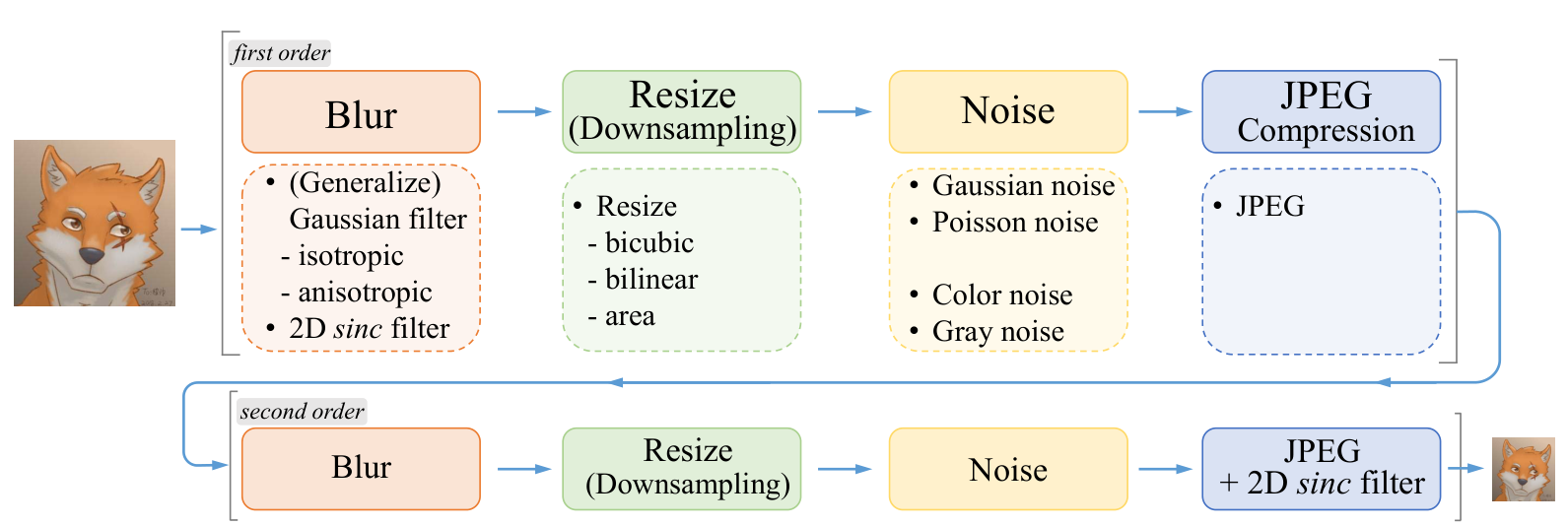
Figure source: [17], arXiv:2107.10833v2, PDF page 4. Original PDF.
Repeated observation synthesis. Each round includes blur, random resize, Gaussian or Poisson noise and JPEG. Blur is sampled from ordinary Gaussian, generalized Gaussian and plateau-shaped kernels, with probabilities 0.7, 0.15 and 0.15 before the sinc alternative. Kernel support uses odd sizes 7–21. The first Gaussian width range is 0.2–3; the second is 0.2–1.5. Additional shapes expand the family beyond Gaussian blur. Noise includes grayscale and color cases; resizing can enlarge, shrink or retain dimensions, because an intermediate enlargement is a plausible part of a multi-stage processing history.
Ringing synthesis. Finite radial sinc kernels generate overshoot around edges. They can replace a blur kernel and also appear in the final processing stage. In the released implementation, the final choice swaps JPEG with the pair “resize to target size, then sinc” [63]. It does not independently shuffle all three operations. The sinc filter’s negative lobes matter: a positive Gaussian kernel only smooths a step, whereas alternating lobes can overshoot it. Training on these halos discourages their subsequent enhancement.
Generator. The main ×4 model keeps the ESRGAN residual-in-residual dense-block architecture [34]. Learned processing mainly takes place at LR resolution before output enlargement. The paper also describes pixel-unshuffle variants for smaller scale factors. A familiar backbone makes the data-generation and discriminator changes central to the design.
Discriminator. A U-Net structure [35] produces spatial realness feedback instead of one global image-style judgment. Skip connections combine local details and broader context. Spectral normalization constrains layer amplification and stabilizes adversarial training [36]. A dense discriminator alone can make training less stable and encourage unnatural texture; the normalization is therefore part of the design, not a cosmetic addition.
Two-stage training. Real-ESRNet is trained with L1 loss, then initializes the Real-ESRGAN generator. The second stage minimizes
Here measures pixel error, the perceptual term compares pretrained VGG features [77], and the adversarial term encourages realistic local appearance. The paper uses multiple pre-activation feature levels with weights 0.1, 0.1, 1, 1, 1. A pool of 180 training pairs mixes samples generated in different batches, improving degradation diversity when a batch shares a resize factor. Sharpening training targets produces the Real-ESRGAN+ variant; this is a changed target distribution, not an extra postprocessing stage.
Results
The original experiments emphasize real images and visual comparisons. The supplementary NIQE table reports:
| Set | BSRGAN | Real-ESRGAN | Real-ESRGAN+ |
|---|---|---|---|
| RealSR Canon | 5.7489 | 4.5899 | 4.5314 |
| RealSR Nikon | 5.9920 | 5.0753 | 5.0247 |
| DRealSR | 6.1362 | 4.9796 | 4.8458 |
| DPED iPhone | 5.9906 | 5.4352 | 5.2631 |
Lower is better for NIQE [51]; these are the paper’s benchmark outputs, not measurements from this tutorial. The images come from the cited real-data collections [19], [20], [38]. A lower no-reference score measures agreement with that metric’s image statistics. It is not a guarantee of identity preservation, correct text or absence of hallucination.
Ablations
Four controlled visual studies explain the design. Replacing the second-order model with a first-order model leaves more wall noise and field blur. Removing sinc kernels amplifies existing ringing around text and lines. Replacing the normalized U-Net discriminator with the earlier discriminator loses local texture; an unnormalized U-Net introduces unnatural texture and instability. Removing generalized Gaussian and plateau kernels changes most examples only slightly, but leaves some real blur insufficiently corrected. The paper presents these mainly as image comparisons, without a numerical effect size for each component; assigning a universal PSNR gain to them would misrepresent the evidence.
Conclusion
The method combines realistic training defects with spatial adversarial feedback. Its practical advance is that a standard feed-forward generator can handle varied real inputs when training includes repeated degradation and ringing.
Problems
The paper explicitly shows twisted lines, GAN artifacts and failures on out-of-distribution damage. A discriminator can reward convincing false detail. The teaching pipeline earlier in this chapter is deliberately simplified; matching its output does not reproduce the official training distribution. For controlled reproduction, use the released model and configuration, including degradation ranges, target sharpening and the exact choice of checkpoint [63].
References
- N. Efrat, D. Glasner, A. Apartsin, B. Nadler and A. Levin, “Accurate Blur Models vs. Image Priors in Single Image Super-Resolution,” in Proc. IEEE ICCV, 2013, pp. 2832–2839. doi · CVF
- K. Zhang, W. Zuo and L. Zhang, “Learning a Single Convolutional Super-Resolution Network for Multiple Degradations,” CVPR, 2018. paper
- A. Liu, Y. Liu, J. Gu, Y. Qiao, C. Dong, “Blind Image Super-Resolution: A Survey and Beyond,” IEEE TPAMI (early access), 2022. source
- Honggang Chen, Xiaohai He, Linbo Qing, Yuanyuan Wu, Chao Ren, Ray E. Sheriff, Ce Zhu, “Real-world single image super-resolution: A brief review,” Information Fusion, 2022. source
- B. B. Moser, A. S. Shanbhag, F. Raue, S. Frolov, S. Palacio and A. Dengel, “Diffusion Models, Image Super-Resolution, and Everything: A Survey,” IEEE Transactions on Neural Networks and Learning Systems, vol. 36, no. 7, pp. 11793–11813, 2025. doi · arXiv
- Y. Xu, S. R. Tseng, Y. Tseng, H. Kuo, Y. Tsai, “Unified Dynamic Convolutional Network for Super-Resolution with Variational Degradations,” CVPR, 2020. source
- K. Zhang, L. Van Gool, R. Timofte, “Deep Unfolding Network for Image Super-Resolution,” CVPR, 2020. source
- J. Gu, H. Lu, W. Zuo and C. Dong, “Blind Super-Resolution With Iterative Kernel Correction,” CVPR, 2019. paper
- Z. Luo, Y. Huang, S. Li, L. Wang and T. Tan, “Unfolding the Alternating Optimization for Blind Super Resolution,” NeurIPS, 2020. paper
- Z. Luo, H. Huang, L. Yu, Y. Li, H. Fan and S. Liu, “Deep Constrained Least Squares for Blind Image Super-Resolution,” CVPR, 2022. paper
- T. Michaeli, M. Irani, “Nonparametric Blind Super-resolution,” Proceedings of the IEEE International Conference on Computer Vision, 2013. source
- S. Bell-Kligler, A. Shocher and M. Irani, “Blind Super-Resolution Kernel Estimation using an Internal-GAN,” NeurIPS, 2019. paper
- A. Shocher, N. Cohen and M. Irani, “‘Zero-Shot’ Super-Resolution Using Deep Internal Learning,” in Proc. IEEE/CVF CVPR, 2018, pp. 3118–3126. doi · arXiv
- L. Wang, Y. Wang, X. Dong, Q. Xu, J. Yang, W. An and Y. Guo, “Unsupervised Degradation Representation Learning for Blind Super-Resolution,” CVPR, 2021. paper
- B. Xia, Y. Zhang, Y. Wang, Y. Tian, W. Yang, R. Timofte and L. Van Gool, “Knowledge Distillation Based Degradation Estimation for Blind Super-Resolution,” ICLR, 2023. paper
- K. Zhang, J. Liang, L. Van Gool, R. Timofte, “Designing a Practical Degradation Model for Deep Blind Image Super-Resolution,” Proceedings of the IEEE/CVF International Conference on Computer Vision, 2021. source
- X. Wang, L. Xie, C. Dong, Y. Shan, “Real-ESRGAN: Training Real-World Blind Super-Resolution With Pure Synthetic Data,” Proceedings of the IEEE/CVF International Conference on Computer Vision, 2021. source
- J. Liang, H. Zeng, L. Zhang, “Efficient and Degradation-Adaptive Network for Real-World Image Super-Resolution,” ECCV, 2022. source
- J. Cai, H. Zeng, H. Yong, Z. Cao, L. Zhang, “Toward Real-World Single Image Super-Resolution: A New Benchmark and a New Model,” Proceedings of the IEEE/CVF International Conference on Computer Vision, 2019. source
- P. Wei, Z. Xie, H. Lu, Z. Zhan, Q. Ye, W. Zuo, L. Lin, “Component Divide-and-Conquer for Real-World Image Super-Resolution,” ECCV, 2020. source
- C. Chen, Z. Xiong, X. Tian, Z. Zha, F. Wu, “Camera Lens Super-Resolution,” Proceedings of the IEEE/CVF Conference on Computer Vision and Pattern Recognition, 2019. source
- Y. Yuan, S. Liu, J. Zhang, Y. Zhang, C. Dong, L. Lin, “Unsupervised Image Super-Resolution using Cycle-in-Cycle Generative Adversarial Networks,” CVPR Workshops, 2018. source
- A. Bulat, J. Yang, G. Tzimiropoulos, “To learn image super-resolution, use a GAN to learn how to do image degradation first,” ECCV, 2018. source
- M. Fritsche, S. Gu, R. Timofte, “Frequency Separation for Real-World Super-Resolution,” ICCV Workshops, 2019. source
- X. Ji, Y. Cao, Y. Tai, C. Wang, J. Li, F. Huang, “Real-World Super-Resolution via Kernel Estimation and Noise Injection,” Proceedings of the IEEE/CVF Conference on Computer Vision and Pattern Recognition Workshops, 2020. source
- J. Wang, Z. Yue, S. Zhou, K. C. K. Chan, C. C. Loy, “Exploiting Diffusion Prior for Real-World Image Super-Resolution,” IJCV, 2024. source
- X. Lin, J. He, Z. Chen, et al., “DiffBIR: Towards Blind Image Restoration with Generative Diffusion Prior,” ECCV, 2024. source
- T. Yang, R. Wu, P. Ren, X. Xie, L. Zhang, “Pixel-Aware Stable Diffusion for Realistic Image Super-resolution and Personalized Stylization,” ECCV, 2024. source
- R. Wu, T. Yang, L. Sun, Z. Zhang, S. Li, L. Zhang, “SeeSR: Towards Semantics-Aware Real-World Image Super-Resolution,” Proceedings of the IEEE/CVF Conference on Computer Vision and Pattern Recognition, 2024. source · supplementary experiments
- F. Yu, J. Gu, Z. Li, et al., “Scaling Up to Excellence: Practicing Model Scaling for Photo-Realistic Image Restoration In the Wild,” CVPR, 2024. source
- Z. Yue, J. Wang, C. C. Loy, “ResShift: Efficient Diffusion Model for Image Super-resolution by Residual Shifting,” NeurIPS, 2023. source
- X. Wang, K. Yu, C. Dong, C. C. Loy, “Recovering Realistic Texture in Image Super-Resolution by Deep Spatial Feature Transform,” Proceedings of the IEEE Conference on Computer Vision and Pattern Recognition, 2018. source
- K. He, H. Fan, Y. Wu, S. Xie, R. Girshick, “Momentum Contrast for Unsupervised Visual Representation Learning,” CVPR, 2020. source
- X. Wang, K. Yu, S. Wu, J. Gu, Y. Liu, C. Dong, Y. Qiao and C. C. Loy, “ESRGAN: Enhanced Super-Resolution Generative Adversarial Networks,” in Proc. ECCV Workshops, 2018 (Lecture Notes in Computer Science, 2019), pp. 63–79. doi · arXiv
- O. Ronneberger, P. Fischer and T. Brox, “U-Net: Convolutional Networks for Biomedical Image Segmentation,” in Proc. MICCAI, 2015, pp. 234–241. doi · arXiv
- T. Miyato, T. Kataoka, M. Koyama, Y. Yoshida, “Spectral Normalization for Generative Adversarial Networks,” ICLR, 2018. source
- J. Liang, H. Zeng, L. Zhang, “Details or Artifacts: A Locally Discriminative Learning Approach to Realistic Image Super-Resolution,” Proceedings of the IEEE/CVF Conference on Computer Vision and Pattern Recognition, 2022. source
- A. Ignatov, N. Kobyshev, R. Timofte, K. Vanhoey, L. Van Gool, “DSLR-Quality Photos on Mobile Devices with Deep Convolutional Networks,” ICCV, 2017. source
- A. Lugmayr, M. Danelljan, R. Timofte, “Unsupervised Learning for Real-World Super-Resolution,” arXiv preprint, 2019. source
- A. Lugmayr, M. Danelljan, R. Timofte, et al., “NTIRE 2020 Challenge on Real-World Image Super-Resolution: Methods and Results,” CVPR Workshops, 2020. source
- R. Rombach, A. Blattmann, D. Lorenz, P. Esser, B. Ommer, “High-Resolution Image Synthesis with Latent Diffusion Models,” CVPR, 2022. source
- L. Zhang, A. Rao, M. Agrawala, “Adding Conditional Control to Text-to-Image Diffusion Models,” ICCV, 2023. source
- Y. Ai, X. Zhou, H. Huang, X. Han, Z. Chen, Q. You, H. Yang, “DreamClear: High-Capacity Real-World Image Restoration with Privacy-Safe Dataset Curation,” NeurIPS, 2024. source
- Z. Duan, J. Zhang, X. Jin, et al., “DiT4SR: Taming Diffusion Transformer for Real-World Image Super-Resolution,” ICCV, 2025. source
- R. Wu, L. Sun, Z. Ma, L. Zhang, “One-Step Effective Diffusion Network for Real-World Image Super-Resolution,” NeurIPS, 2024. source
- Y. Wang, W. Yang, X. Chen, et al., “SinSR: Diffusion-Based Image Super-Resolution in a Single Step,” CVPR, 2024. source
- E. Agustsson and R. Timofte, “NTIRE 2017 Challenge on Single Image Super-Resolution: Dataset and Study,” in Proc. IEEE CVPR Workshops, 2017, pp. 1122–1131. doi · CVF
- Z. Wang, A. C. Bovik, H. R. Sheikh and E. P. Simoncelli, “Image Quality Assessment: From Error Visibility to Structural Similarity,” IEEE Transactions on Image Processing, vol. 13, no. 4, pp. 600–612, 2004. doi
- R. Zhang, P. Isola, A. A. Efros, E. Shechtman and O. Wang, “The Unreasonable Effectiveness of Deep Features as a Perceptual Metric,” in Proc. IEEE/CVF CVPR, 2018, pp. 586–595. doi · arXiv
- K. Ding, K. Ma, S. Wang, E. P. Simoncelli, “Image Quality Assessment: Unifying Structure and Texture Similarity,” IEEE TPAMI, 2022. source
- A. Mittal, R. Soundararajan and A. C. Bovik, “Making a “Completely Blind” Image Quality Analyzer,” IEEE Signal Processing Letters, vol. 20, no. 3, pp. 209–212, 2013. doi
- J. Ke, Q. Wang, Y. Wang, P. Milanfar, F. Yang, “MUSIQ: Multi-scale Image Quality Transformer,” ICCV, 2021. source
- S. Yang, T. Wu, S. Shi, S. Lao, Y. Gong, M. Cao, J. Wang, Y. Yang, “MANIQA: Multi-dimension Attention Network for No-Reference Image Quality Assessment,” CVPR Workshops, 2022. source
- J. Wang, K. C. K. Chan, C. C. Loy, “Exploring CLIP for Assessing the Look and Feel of Images,” AAAI, 2023. source
- M. Heusel, H. Ramsauer, T. Unterthiner, B. Nessler, S. Hochreiter, “GANs Trained by a Two Time-Scale Update Rule Converge to a Local Nash Equilibrium,” NeurIPS, 2017. source
- R. Timofte, S. Gu, J. Wu, L. Van Gool, “NTIRE 2018 Challenge on Single Image Super-Resolution: Methods and Results,” Proceedings of the IEEE Conference on Computer Vision and Pattern Recognition Workshops, 2018. source
- J. Cai, S. Gu, R. Timofte, L. Zhang, “NTIRE 2019 Challenge on Real Image Super-Resolution: Methods and Results,” Proceedings of the IEEE/CVF Conference on Computer Vision and Pattern Recognition Workshops, 2019. source
- A. Lugmayr, M. Danelljan, R. Timofte, et al., “AIM 2019 Challenge on Real-World Image Super-Resolution: Methods and Results,” ICCV Workshops, 2019. source
- P. Wei, H. Lu, R. Timofte, et al., “AIM 2020 Challenge on Real Image Super-Resolution: Methods and Results,” ECCV Workshops, 2020. source
- Z. Chen, K. Liu, J. Gong, J. Wang, L. Sun, Z. Wu, R. Timofte, Y. Zhang et al., “NTIRE 2025 Challenge on Image Super-Resolution (×4): Methods and Results,” in Proc. IEEE/CVF CVPR Workshops, 2025, pp. 1525–1535. doi · arXiv
- Le Zhang, Ao Li, Qibin Hou, Ce Zhu, Yonina C. Eldar, “Deep-Learning-Empowered Super Resolution: A Comprehensive Survey and Future Prospects,” Proceedings of the IEEE, 2025. source
- W. Ren, R. Goyal, Z. Hu, T. T. Aumentado-Armstrong, I. Mohomed and A. Levinshtein, “Hallucination Score: Towards Mitigating Hallucinations in Generative Image Super-Resolution,” arXiv:2507.14367, 2025. arXiv
- Real-ESRGAN contributors, “Real-ESRGAN model and ×4-plus training configuration,” official source, accessed 2026-11-02. model · configuration
- D. P. Kingma, J. Ba, “Adam: A Method for Stochastic Optimization,” ICLR, 2015. source
- M. Bevilacqua, A. Roumy, C. Guillemot and M.-L. Alberi Morel, “Low-Complexity Single-Image Super-Resolution based on Nonnegative Neighbor Embedding,” in Proc. BMVC, 2012, pp. 135.1–135.10. doi
- R. Zeyde, M. Elad and M. Protter, “On Single Image Scale-Up Using Sparse-Representations,” in Curves and Surfaces, Lecture Notes in Computer Science, Springer, 2012, pp. 711–730. doi
- D. Martin, C. Fowlkes, D. Tal and J. Malik, “A Database of Human Segmented Natural Images and Its Application to Evaluating Segmentation Algorithms and Measuring Ecological Statistics,” in Proc. IEEE ICCV, 2001, vol. 2, pp. 416–423. doi
- J.-B. Huang, A. Singh and N. Ahuja, “Single Image Super-Resolution from Transformed Self-Exemplars,” in Proc. IEEE CVPR, 2015, pp. 5197–5206. doi · CVF
- J. Kim, J. K. Lee and K. M. Lee, “Accurate Image Super-Resolution Using Very Deep Convolutional Networks,” in Proc. IEEE CVPR, 2016, pp. 1646–1654. doi · arXiv
- C. Ledig, L. Theis, F. Huszár, J. Caballero, A. Cunningham, A. Acosta, A. Aitken, A. Tejani, J. Totz, Z. Wang and W. Shi, “Photo-Realistic Single Image Super-Resolution Using a Generative Adversarial Network,” in Proc. IEEE CVPR, 2017, pp. 105–114. doi · arXiv
- R. Timofte, E. Agustsson, L. Van Gool, M.-H. Yang, L. Zhang et al., “NTIRE 2017 Challenge on Single Image Super-Resolution: Methods and Results,” in Proc. IEEE CVPR Workshops, 2017, pp. 1110–1121. doi · CVF
- Y. Matsui, K. Ito, Y. Aramaki, A. Fujimoto, T. Ogawa, T. Yamasaki and K. Aizawa, “Sketch-Based Manga Retrieval Using Manga109 Dataset,” Multimedia Tools and Applications, vol. 76, no. 20, pp. 21811–21838, 2017. doi
- KernelGAN contributors, “Adversarial losses and kernel constraints,” official source, accessed 2026-11-02. loss definitions · alternating updates
- X. Mao, Q. Li, H. Xie, R. Y. K. Lau, Z. Wang, S. P. Smolley, “Least Squares Generative Adversarial Networks,” ICCV, 2017. source
- DASR contributors, “MoCo logits and contrastive cross-entropy implementation,” official DASR source, commit
51524af8021c94a502ee002e135867a1b75dc7d0, accessed 2026-11-02. encoder · loss - Y. Zhang, K. Li, K. Li, L. Wang, B. Zhong and Y. Fu, “Image Super-Resolution Using Very Deep Residual Channel Attention Networks,” in Proc. ECCV, 2018, pp. 294–310. doi · arXiv
- K. Simonyan and A. Zisserman, “Very Deep Convolutional Networks for Large-Scale Image Recognition,” in Proc. ICLR, 2015. arXiv
- Y. Zhang, X. Huang, J. Ma, et al., “Recognize Anything: A Strong Image Tagging Model,” CVPR Workshops, 2024. source
- E. J. Hu, Y. Shen, P. Wallis, Z. Allen-Zhu, Y. Li, S. Wang, L. Wang, W. Chen, “LoRA: Low-Rank Adaptation of Large Language Models,” ICLR, 2022. source
- D. Podell, Z. English, K. Lacey, A. Blattmann, T. Dockhorn, J. Müller, J. Penna, R. Rombach, “SDXL: Improving Latent Diffusion Models for High-Resolution Image Synthesis,” ICLR, 2024. source
- H. Liu, C. Li, Q. Wu, Y. J. Lee, “Visual Instruction Tuning,” NeurIPS, 2023. source
- T. Karras, M. Aittala, T. Aila, S. Laine, “Elucidating the Design Space of Diffusion-Based Generative Models,” NeurIPS, 2022. source