SRMD: one network for many known degradations (CVPR 2018)
Optional · paper guide 1 of 11 for DLCV 09A.1 · Blind and Real-World Image Super-Resolution. Citation numbers refer to the reference list at the bottom of this page.
Navigate: this page and this track: Navigate: this page and this track
On this page
- SRMD: one network for many known degradations (CVPR 2018)
- IKC: iterative kernel correction (CVPR 2019)
- KernelGAN: kernel estimation with an internal GAN (NeurIPS 2019)
- DAN: unfolding the alternating optimization (NeurIPS 2020)
- DASR: contrastive degradation representations (CVPR 2021)
- BSRGAN: a practical degradation model (ICCV 2021)
- Real-ESRGAN: high-order degradation with pure synthetic data (ICCVW 2021)
- StableSR: a time-aware encoder for a frozen diffusion prior (IJCV 2024)
- DiffBIR: remove the degradation, then regenerate (ECCV 2024)
- SeeSR: degradation-aware semantic prompts (CVPR 2024)
- SUPIR: scaling up the prior, the data and the text (CVPR 2024)
Deep Learning for Computer Vision
Challenge
By 2017, CNN super-resolvers were trained and tested almost only on bicubic downsampling, and their quality collapsed when the real blur differed. Classical MAP methods could handle any kernel and noise level but needed slow optimization and hand-tuned parameters. Zhang, Zuo and Zhang ask whether one feed-forward CNN can handle many degradations, including spatially varying ones, if it is told what the degradation is, and whether such a model trained on synthetic data is useful on real images [2].
Method
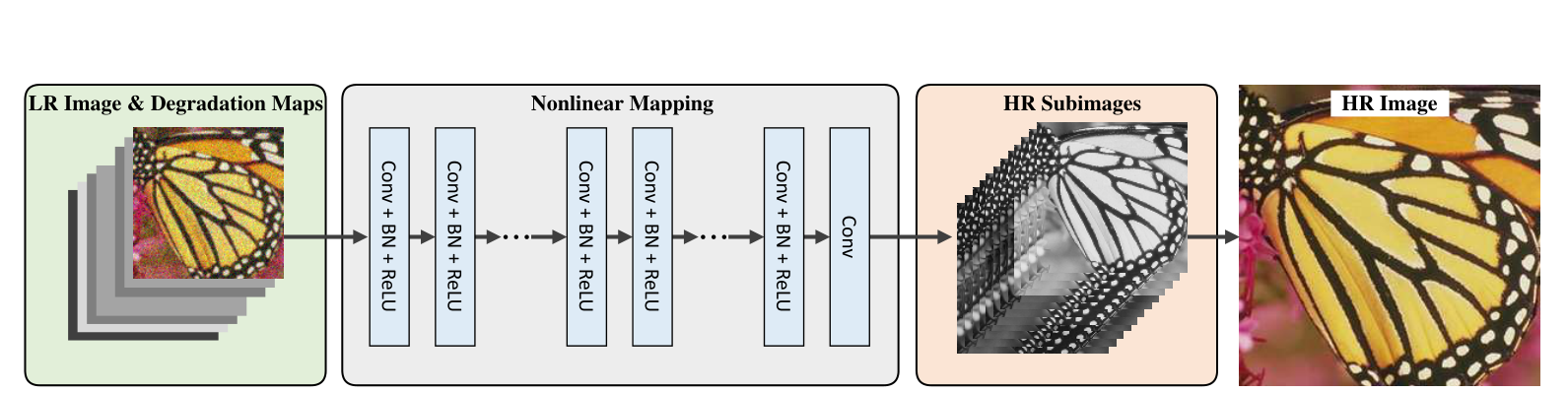
Figure source: [2], Published paper PDF, PDF page 5. Original PDF.
Degradation model. The paper uses
where is the HR image, the blur kernel, the bicubic downsampler with scale factor , and additive white Gaussian noise of level . With a delta kernel and this is exactly the bicubic benchmark, so the bicubic setting is a special case. The authors also discuss the alternative order but use the first model.
The MAP view, and why the network needs the kernel. The MAP estimate is
where the first term is data fidelity, an image prior and a trade-off weight. Its solution is a function ; since can be absorbed into , the goal is to learn with network parameters . A bicubic-trained network instead learns for one fixed , which is why it fails elsewhere.
Dimensionality stretching. The three inputs have different shapes: an image of size , a kernel and a scalar. SRMD (1) vectorizes the kernel into numbers, (2) projects it with PCA onto dimensions, (3) appends to get a vector of length , and (4) “stretches” each entry into a constant map. The result, a tensor of degradation maps, is concatenated with the LR image. For the training kernels, keeps about 99.8% of the energy. Because the maps need not be constant, the same network accepts spatially varying kernels and noise.
Network. A plain CNN of 12 convolution layers with 128 channels (Conv + batch normalization + ReLU, except the last layer) maps the -channel input to channels, and a sub-pixel convolution (pixel shuffle) rearranges them into the output. There is no residual learning and no bicubic pre-upsampling, the latter because interpolating a noisy input makes the noise harder to model. One model is trained per scale factor. A noise-free variant, SRMDNF, removes the noise-map input and is fine-tuned on noise-free data.
Training data. Isotropic Gaussian kernels of fixed size with widths in , and for , , (step 0.1), plus anisotropic Gaussians (rotation in , eigenvalue scaling from 0.5 to 6, 8 and 10); for the paper also includes kernels that approximate a direct (non-bicubic) downsampler, fitted by solving . Noise levels lie in . HR images: 800 DIV2K training images [47] plus 5,144 images from two other public photo collections, used in RGB. Each epoch samples LR patches of with a random kernel and noise level; the loss is the mean squared error, optimized with Adam [64].
Why not a blind model? The paper argues against simply training one network on all degradations without the maps: shifting the HR image by a pixel and the kernel by a pixel the other way gives the same LR image, so a blind network averages over shifted candidates and over-smooths, and it generalizes poorly. The maps “anchor” the network and let a user trade fidelity against smoothness by changing the supplied noise level.
Results
Bicubic degradation (PSNR on Set5 [65], Set14 [66], BSD100 [67], Urban100 [68] in RGB). SRMDNF reaches 37.79 / 34.12 / 31.96 dB on Set5 at / / , against 37.56 / 33.67 / 31.35 dB for VDSR [69], and SRMD (with noise maps) 37.53 / 33.86 / 31.59 dB. So the general model is competitive even in the setting specialized networks were built for.
General degradations (Set5, Table 2). The decisive comparison uses isotropic kernels of width 0.2, 1.3 and 2.6 and noise levels 0, 15, 50. With width 1.3 and no noise, the bicubic-trained VDSR drops to 30.57 / 30.24 / 29.72 dB ( / / ), while SRMD gets 37.04 / 33.77 / 31.56 dB and SRMDNF 37.45 / 34.16 / 31.99 dB. With width 2.6 and noise 15, SRMD reaches 28.48 / 27.55 / 26.82 dB, ahead of a cascade of a separate denoiser and SRMDNF (21.33 / 23.85 dB at / ) and of a model-based method that uses a CNN denoiser as its prior (26.44 / 25.67 / 24.36 dB). For the classical Gaussian of width 1.6 with direct downsampling at , SRMDNF reaches 34.01 dB against 33.38 dB for that model-based method.
Speed. Under the paper’s MATLAB/MatConvNet setup on a Titan X Pascal GPU, SRMD takes 0.084, 0.042 and 0.027 s for a output at , , , against 0.174 s for VDSR, because it works at LR resolution.
Spatially variant and real images. With noise and kernel-width maps that vary across the image, SRMD restores the image when given the matching maps. On real images (a JPEG-compressed cat, the “Chip” image) the authors search a grid of kernel widths (0.1 to 2.4) and noise levels (0 to 75) by eye and obtain sharper, cleaner results than VDSR and two other baselines; there is no ground truth for these.
Ablations
The paper has no separate ablation table. The closest controlled comparisons are: (1) SRMD versus SRMDNF on noise-free inputs, where removing the noise channel and fine-tuning gains 0.26 to 0.37 dB on Set5 at width 0.2 (37.53 to 37.79 dB at ; 31.59 to 31.96 dB at ), showing a small cost of the generality; (2) the cascade “denoiser + SRMDNF” versus joint SRMD, where the gap grows with kernel width, showing the benefit of joint denoising and SR; and (3) a Y-channel SRMDNF retrained on 291 images for , which still reaches 33.97 dB on Set5, showing that the gain is not only due to more training data.
Conclusion
A single plain CNN conditioned on stretched degradation maps matches specialized bicubic networks and handles many kernels, noise levels and spatial variation. The key idea, concatenating degradation information as constant maps, became a standard way of conditioning restoration networks on degradation parameters.
Problems
- The kernel must come from somewhere. SRMD is non-blind; on real images the authors chose parameters by visual grid search. Errors in the supplied kernel produce ringing (too wide) or blur (too narrow), as the paper itself notes. IKC adds an estimator and corrector for this (IKC).
- Conditioning only at the input weakens in deep networks; IKC’s SFTMD injects the kernel at every block and gains up to several dB.
- Narrow degradation family. Gaussian kernels and Gaussian noise do not cover JPEG or camera processing, which BSRGAN and Real-ESRGAN later model (BSRGAN).
- Batch normalization and MSE reflect 2017 practice; later networks drop BN and use L1 or perceptual losses.
References
- N. Efrat, D. Glasner, A. Apartsin, B. Nadler and A. Levin, “Accurate Blur Models vs. Image Priors in Single Image Super-Resolution,” in Proc. IEEE ICCV, 2013, pp. 2832–2839. doi · CVF
- K. Zhang, W. Zuo and L. Zhang, “Learning a Single Convolutional Super-Resolution Network for Multiple Degradations,” CVPR, 2018. paper
- A. Liu, Y. Liu, J. Gu, Y. Qiao, C. Dong, “Blind Image Super-Resolution: A Survey and Beyond,” IEEE TPAMI (early access), 2022. source
- Honggang Chen, Xiaohai He, Linbo Qing, Yuanyuan Wu, Chao Ren, Ray E. Sheriff, Ce Zhu, “Real-world single image super-resolution: A brief review,” Information Fusion, 2022. source
- B. B. Moser, A. S. Shanbhag, F. Raue, S. Frolov, S. Palacio and A. Dengel, “Diffusion Models, Image Super-Resolution, and Everything: A Survey,” IEEE Transactions on Neural Networks and Learning Systems, vol. 36, no. 7, pp. 11793–11813, 2025. doi · arXiv
- Y. Xu, S. R. Tseng, Y. Tseng, H. Kuo, Y. Tsai, “Unified Dynamic Convolutional Network for Super-Resolution with Variational Degradations,” CVPR, 2020. source
- K. Zhang, L. Van Gool, R. Timofte, “Deep Unfolding Network for Image Super-Resolution,” CVPR, 2020. source
- J. Gu, H. Lu, W. Zuo and C. Dong, “Blind Super-Resolution With Iterative Kernel Correction,” CVPR, 2019. paper
- Z. Luo, Y. Huang, S. Li, L. Wang and T. Tan, “Unfolding the Alternating Optimization for Blind Super Resolution,” NeurIPS, 2020. paper
- Z. Luo, H. Huang, L. Yu, Y. Li, H. Fan and S. Liu, “Deep Constrained Least Squares for Blind Image Super-Resolution,” CVPR, 2022. paper
- T. Michaeli, M. Irani, “Nonparametric Blind Super-resolution,” Proceedings of the IEEE International Conference on Computer Vision, 2013. source
- S. Bell-Kligler, A. Shocher and M. Irani, “Blind Super-Resolution Kernel Estimation using an Internal-GAN,” NeurIPS, 2019. paper
- A. Shocher, N. Cohen and M. Irani, “‘Zero-Shot’ Super-Resolution Using Deep Internal Learning,” in Proc. IEEE/CVF CVPR, 2018, pp. 3118–3126. doi · arXiv
- L. Wang, Y. Wang, X. Dong, Q. Xu, J. Yang, W. An and Y. Guo, “Unsupervised Degradation Representation Learning for Blind Super-Resolution,” CVPR, 2021. paper
- B. Xia, Y. Zhang, Y. Wang, Y. Tian, W. Yang, R. Timofte and L. Van Gool, “Knowledge Distillation Based Degradation Estimation for Blind Super-Resolution,” ICLR, 2023. paper
- K. Zhang, J. Liang, L. Van Gool, R. Timofte, “Designing a Practical Degradation Model for Deep Blind Image Super-Resolution,” Proceedings of the IEEE/CVF International Conference on Computer Vision, 2021. source
- X. Wang, L. Xie, C. Dong, Y. Shan, “Real-ESRGAN: Training Real-World Blind Super-Resolution With Pure Synthetic Data,” Proceedings of the IEEE/CVF International Conference on Computer Vision, 2021. source
- J. Liang, H. Zeng, L. Zhang, “Efficient and Degradation-Adaptive Network for Real-World Image Super-Resolution,” ECCV, 2022. source
- J. Cai, H. Zeng, H. Yong, Z. Cao, L. Zhang, “Toward Real-World Single Image Super-Resolution: A New Benchmark and a New Model,” Proceedings of the IEEE/CVF International Conference on Computer Vision, 2019. source
- P. Wei, Z. Xie, H. Lu, Z. Zhan, Q. Ye, W. Zuo, L. Lin, “Component Divide-and-Conquer for Real-World Image Super-Resolution,” ECCV, 2020. source
- C. Chen, Z. Xiong, X. Tian, Z. Zha, F. Wu, “Camera Lens Super-Resolution,” Proceedings of the IEEE/CVF Conference on Computer Vision and Pattern Recognition, 2019. source
- Y. Yuan, S. Liu, J. Zhang, Y. Zhang, C. Dong, L. Lin, “Unsupervised Image Super-Resolution using Cycle-in-Cycle Generative Adversarial Networks,” CVPR Workshops, 2018. source
- A. Bulat, J. Yang, G. Tzimiropoulos, “To learn image super-resolution, use a GAN to learn how to do image degradation first,” ECCV, 2018. source
- M. Fritsche, S. Gu, R. Timofte, “Frequency Separation for Real-World Super-Resolution,” ICCV Workshops, 2019. source
- X. Ji, Y. Cao, Y. Tai, C. Wang, J. Li, F. Huang, “Real-World Super-Resolution via Kernel Estimation and Noise Injection,” Proceedings of the IEEE/CVF Conference on Computer Vision and Pattern Recognition Workshops, 2020. source
- J. Wang, Z. Yue, S. Zhou, K. C. K. Chan, C. C. Loy, “Exploiting Diffusion Prior for Real-World Image Super-Resolution,” IJCV, 2024. source
- X. Lin, J. He, Z. Chen, et al., “DiffBIR: Towards Blind Image Restoration with Generative Diffusion Prior,” ECCV, 2024. source
- T. Yang, R. Wu, P. Ren, X. Xie, L. Zhang, “Pixel-Aware Stable Diffusion for Realistic Image Super-resolution and Personalized Stylization,” ECCV, 2024. source
- R. Wu, T. Yang, L. Sun, Z. Zhang, S. Li, L. Zhang, “SeeSR: Towards Semantics-Aware Real-World Image Super-Resolution,” Proceedings of the IEEE/CVF Conference on Computer Vision and Pattern Recognition, 2024. source · supplementary experiments
- F. Yu, J. Gu, Z. Li, et al., “Scaling Up to Excellence: Practicing Model Scaling for Photo-Realistic Image Restoration In the Wild,” CVPR, 2024. source
- Z. Yue, J. Wang, C. C. Loy, “ResShift: Efficient Diffusion Model for Image Super-resolution by Residual Shifting,” NeurIPS, 2023. source
- X. Wang, K. Yu, C. Dong, C. C. Loy, “Recovering Realistic Texture in Image Super-Resolution by Deep Spatial Feature Transform,” Proceedings of the IEEE Conference on Computer Vision and Pattern Recognition, 2018. source
- K. He, H. Fan, Y. Wu, S. Xie, R. Girshick, “Momentum Contrast for Unsupervised Visual Representation Learning,” CVPR, 2020. source
- X. Wang, K. Yu, S. Wu, J. Gu, Y. Liu, C. Dong, Y. Qiao and C. C. Loy, “ESRGAN: Enhanced Super-Resolution Generative Adversarial Networks,” in Proc. ECCV Workshops, 2018 (Lecture Notes in Computer Science, 2019), pp. 63–79. doi · arXiv
- O. Ronneberger, P. Fischer and T. Brox, “U-Net: Convolutional Networks for Biomedical Image Segmentation,” in Proc. MICCAI, 2015, pp. 234–241. doi · arXiv
- T. Miyato, T. Kataoka, M. Koyama, Y. Yoshida, “Spectral Normalization for Generative Adversarial Networks,” ICLR, 2018. source
- J. Liang, H. Zeng, L. Zhang, “Details or Artifacts: A Locally Discriminative Learning Approach to Realistic Image Super-Resolution,” Proceedings of the IEEE/CVF Conference on Computer Vision and Pattern Recognition, 2022. source
- A. Ignatov, N. Kobyshev, R. Timofte, K. Vanhoey, L. Van Gool, “DSLR-Quality Photos on Mobile Devices with Deep Convolutional Networks,” ICCV, 2017. source
- A. Lugmayr, M. Danelljan, R. Timofte, “Unsupervised Learning for Real-World Super-Resolution,” arXiv preprint, 2019. source
- A. Lugmayr, M. Danelljan, R. Timofte, et al., “NTIRE 2020 Challenge on Real-World Image Super-Resolution: Methods and Results,” CVPR Workshops, 2020. source
- R. Rombach, A. Blattmann, D. Lorenz, P. Esser, B. Ommer, “High-Resolution Image Synthesis with Latent Diffusion Models,” CVPR, 2022. source
- L. Zhang, A. Rao, M. Agrawala, “Adding Conditional Control to Text-to-Image Diffusion Models,” ICCV, 2023. source
- Y. Ai, X. Zhou, H. Huang, X. Han, Z. Chen, Q. You, H. Yang, “DreamClear: High-Capacity Real-World Image Restoration with Privacy-Safe Dataset Curation,” NeurIPS, 2024. source
- Z. Duan, J. Zhang, X. Jin, et al., “DiT4SR: Taming Diffusion Transformer for Real-World Image Super-Resolution,” ICCV, 2025. source
- R. Wu, L. Sun, Z. Ma, L. Zhang, “One-Step Effective Diffusion Network for Real-World Image Super-Resolution,” NeurIPS, 2024. source
- Y. Wang, W. Yang, X. Chen, et al., “SinSR: Diffusion-Based Image Super-Resolution in a Single Step,” CVPR, 2024. source
- E. Agustsson and R. Timofte, “NTIRE 2017 Challenge on Single Image Super-Resolution: Dataset and Study,” in Proc. IEEE CVPR Workshops, 2017, pp. 1122–1131. doi · CVF
- Z. Wang, A. C. Bovik, H. R. Sheikh and E. P. Simoncelli, “Image Quality Assessment: From Error Visibility to Structural Similarity,” IEEE Transactions on Image Processing, vol. 13, no. 4, pp. 600–612, 2004. doi
- R. Zhang, P. Isola, A. A. Efros, E. Shechtman and O. Wang, “The Unreasonable Effectiveness of Deep Features as a Perceptual Metric,” in Proc. IEEE/CVF CVPR, 2018, pp. 586–595. doi · arXiv
- K. Ding, K. Ma, S. Wang, E. P. Simoncelli, “Image Quality Assessment: Unifying Structure and Texture Similarity,” IEEE TPAMI, 2022. source
- A. Mittal, R. Soundararajan and A. C. Bovik, “Making a “Completely Blind” Image Quality Analyzer,” IEEE Signal Processing Letters, vol. 20, no. 3, pp. 209–212, 2013. doi
- J. Ke, Q. Wang, Y. Wang, P. Milanfar, F. Yang, “MUSIQ: Multi-scale Image Quality Transformer,” ICCV, 2021. source
- S. Yang, T. Wu, S. Shi, S. Lao, Y. Gong, M. Cao, J. Wang, Y. Yang, “MANIQA: Multi-dimension Attention Network for No-Reference Image Quality Assessment,” CVPR Workshops, 2022. source
- J. Wang, K. C. K. Chan, C. C. Loy, “Exploring CLIP for Assessing the Look and Feel of Images,” AAAI, 2023. source
- M. Heusel, H. Ramsauer, T. Unterthiner, B. Nessler, S. Hochreiter, “GANs Trained by a Two Time-Scale Update Rule Converge to a Local Nash Equilibrium,” NeurIPS, 2017. source
- R. Timofte, S. Gu, J. Wu, L. Van Gool, “NTIRE 2018 Challenge on Single Image Super-Resolution: Methods and Results,” Proceedings of the IEEE Conference on Computer Vision and Pattern Recognition Workshops, 2018. source
- J. Cai, S. Gu, R. Timofte, L. Zhang, “NTIRE 2019 Challenge on Real Image Super-Resolution: Methods and Results,” Proceedings of the IEEE/CVF Conference on Computer Vision and Pattern Recognition Workshops, 2019. source
- A. Lugmayr, M. Danelljan, R. Timofte, et al., “AIM 2019 Challenge on Real-World Image Super-Resolution: Methods and Results,” ICCV Workshops, 2019. source
- P. Wei, H. Lu, R. Timofte, et al., “AIM 2020 Challenge on Real Image Super-Resolution: Methods and Results,” ECCV Workshops, 2020. source
- Z. Chen, K. Liu, J. Gong, J. Wang, L. Sun, Z. Wu, R. Timofte, Y. Zhang et al., “NTIRE 2025 Challenge on Image Super-Resolution (×4): Methods and Results,” in Proc. IEEE/CVF CVPR Workshops, 2025, pp. 1525–1535. doi · arXiv
- Le Zhang, Ao Li, Qibin Hou, Ce Zhu, Yonina C. Eldar, “Deep-Learning-Empowered Super Resolution: A Comprehensive Survey and Future Prospects,” Proceedings of the IEEE, 2025. source
- W. Ren, R. Goyal, Z. Hu, T. T. Aumentado-Armstrong, I. Mohomed and A. Levinshtein, “Hallucination Score: Towards Mitigating Hallucinations in Generative Image Super-Resolution,” arXiv:2507.14367, 2025. arXiv
- Real-ESRGAN contributors, “Real-ESRGAN model and ×4-plus training configuration,” official source, accessed 2026-11-02. model · configuration
- D. P. Kingma, J. Ba, “Adam: A Method for Stochastic Optimization,” ICLR, 2015. source
- M. Bevilacqua, A. Roumy, C. Guillemot and M.-L. Alberi Morel, “Low-Complexity Single-Image Super-Resolution based on Nonnegative Neighbor Embedding,” in Proc. BMVC, 2012, pp. 135.1–135.10. doi
- R. Zeyde, M. Elad and M. Protter, “On Single Image Scale-Up Using Sparse-Representations,” in Curves and Surfaces, Lecture Notes in Computer Science, Springer, 2012, pp. 711–730. doi
- D. Martin, C. Fowlkes, D. Tal and J. Malik, “A Database of Human Segmented Natural Images and Its Application to Evaluating Segmentation Algorithms and Measuring Ecological Statistics,” in Proc. IEEE ICCV, 2001, vol. 2, pp. 416–423. doi
- J.-B. Huang, A. Singh and N. Ahuja, “Single Image Super-Resolution from Transformed Self-Exemplars,” in Proc. IEEE CVPR, 2015, pp. 5197–5206. doi · CVF
- J. Kim, J. K. Lee and K. M. Lee, “Accurate Image Super-Resolution Using Very Deep Convolutional Networks,” in Proc. IEEE CVPR, 2016, pp. 1646–1654. doi · arXiv
- C. Ledig, L. Theis, F. Huszár, J. Caballero, A. Cunningham, A. Acosta, A. Aitken, A. Tejani, J. Totz, Z. Wang and W. Shi, “Photo-Realistic Single Image Super-Resolution Using a Generative Adversarial Network,” in Proc. IEEE CVPR, 2017, pp. 105–114. doi · arXiv
- R. Timofte, E. Agustsson, L. Van Gool, M.-H. Yang, L. Zhang et al., “NTIRE 2017 Challenge on Single Image Super-Resolution: Methods and Results,” in Proc. IEEE CVPR Workshops, 2017, pp. 1110–1121. doi · CVF
- Y. Matsui, K. Ito, Y. Aramaki, A. Fujimoto, T. Ogawa, T. Yamasaki and K. Aizawa, “Sketch-Based Manga Retrieval Using Manga109 Dataset,” Multimedia Tools and Applications, vol. 76, no. 20, pp. 21811–21838, 2017. doi
- KernelGAN contributors, “Adversarial losses and kernel constraints,” official source, accessed 2026-11-02. loss definitions · alternating updates
- X. Mao, Q. Li, H. Xie, R. Y. K. Lau, Z. Wang, S. P. Smolley, “Least Squares Generative Adversarial Networks,” ICCV, 2017. source
- DASR contributors, “MoCo logits and contrastive cross-entropy implementation,” official DASR source, commit
51524af8021c94a502ee002e135867a1b75dc7d0, accessed 2026-11-02. encoder · loss - Y. Zhang, K. Li, K. Li, L. Wang, B. Zhong and Y. Fu, “Image Super-Resolution Using Very Deep Residual Channel Attention Networks,” in Proc. ECCV, 2018, pp. 294–310. doi · arXiv
- K. Simonyan and A. Zisserman, “Very Deep Convolutional Networks for Large-Scale Image Recognition,” in Proc. ICLR, 2015. arXiv
- Y. Zhang, X. Huang, J. Ma, et al., “Recognize Anything: A Strong Image Tagging Model,” CVPR Workshops, 2024. source
- E. J. Hu, Y. Shen, P. Wallis, Z. Allen-Zhu, Y. Li, S. Wang, L. Wang, W. Chen, “LoRA: Low-Rank Adaptation of Large Language Models,” ICLR, 2022. source
- D. Podell, Z. English, K. Lacey, A. Blattmann, T. Dockhorn, J. Müller, J. Penna, R. Rombach, “SDXL: Improving Latent Diffusion Models for High-Resolution Image Synthesis,” ICLR, 2024. source
- H. Liu, C. Li, Q. Wu, Y. J. Lee, “Visual Instruction Tuning,” NeurIPS, 2023. source
- T. Karras, M. Aittala, T. Aila, S. Laine, “Elucidating the Design Space of Diffusion-Based Generative Models,” NeurIPS, 2022. source