DiffBIR: remove the degradation, then regenerate (ECCV 2024)
Optional · paper guide 9 of 11 for DLCV 09A.1 · Blind and Real-World Image Super-Resolution. Citation numbers refer to the reference list at the bottom of this page.
Navigate: this page and this track: Navigate: this page and this track
On this page
- SRMD: one network for many known degradations (CVPR 2018)
- IKC: iterative kernel correction (CVPR 2019)
- KernelGAN: kernel estimation with an internal GAN (NeurIPS 2019)
- DAN: unfolding the alternating optimization (NeurIPS 2020)
- DASR: contrastive degradation representations (CVPR 2021)
- BSRGAN: a practical degradation model (ICCV 2021)
- Real-ESRGAN: high-order degradation with pure synthetic data (ICCVW 2021)
- StableSR: a time-aware encoder for a frozen diffusion prior (IJCV 2024)
- DiffBIR: remove the degradation, then regenerate (ECCV 2024)
- SeeSR: degradation-aware semantic prompts (CVPR 2024)
- SUPIR: scaling up the prior, the data and the text (CVPR 2024)
Deep Learning for Computer Vision
Challenge
Conditioning a generative model on a damaged image can make the model faithfully reproduce the damage. DiffBIR separates degradation removal from detail generation [27]. A conventional restoration module first produces a cleaner, structurally informative image; a diffusion module then adds plausible detail. The intended generality spans blind SR and other restoration tasks, although the benchmark numbers below concern SR.
This separation is a useful design hypothesis, not proof that all two-stage pipelines outperform all joint models. The first stage may already erase content. The second stage cannot recover evidence that neither the observation nor its condition retains, and may replace it with a learned guess.
Method
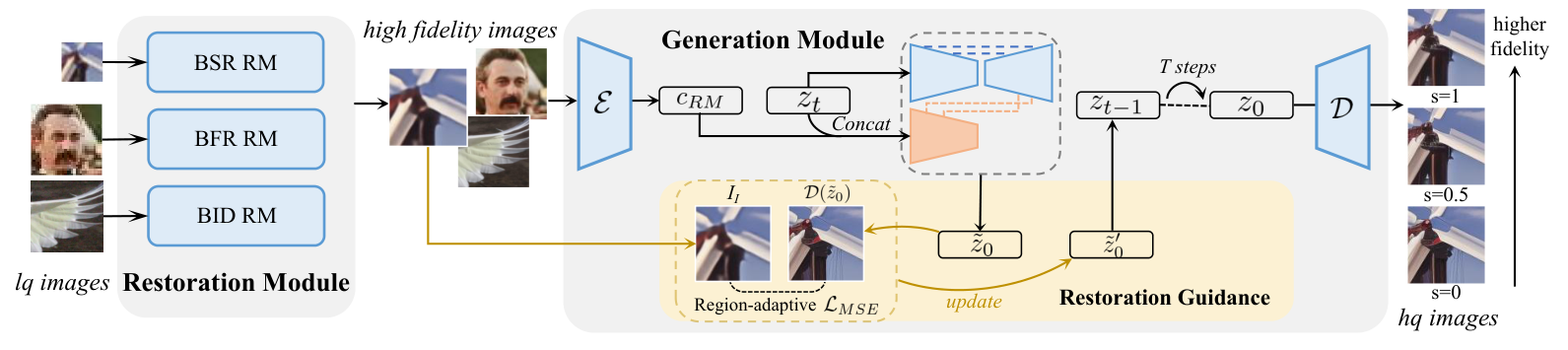
Figure source: [27], arXiv:2308.15070v3, PDF page 4. Original PDF.
Restoration module. Synthetic HR–LR pairs train a regression model to suppress degradation and keep image structure. The paper uses a broad first-order degradation family for this module rather than assuming that more degradation stages automatically give the best conditions. During deployment the module can be replaced by a task-specific restorer. Thus the diffusion stage learns to consume restored conditions, not the exact internals of one preceding network.
Condition encoding. The restored image is encoded by the pretrained, frozen autoencoder encoder to obtain . Here is the observed input and the first-stage restorer. Encoding the image with the same representation used by the generative prior helps preserve spatial and color relationships. A new shallow image encoder need not produce an equally compatible latent space.
IRControlNet. A trainable copy of the pretrained denoiser’s encoder and middle block receives the concatenation , where is the current noisy latent. Extra input-channel weights start at zero. Multi-scale control features enter the frozen denoiser’s middle and skip features through zero-initialized convolutional connectors [42]. Including lets the control path respond to the current noisy state; copying pretrained weights supplies a useful initialization rather than learning the whole condition path from scratch.
Generation objective. With prompt condition , noise and timestep , the adaptation minimizes
The expectation is over training images, sampled timesteps and noise. Only the control path and its connectors are updated; denotes the complete conditioned predictor, including its frozen backbone. A clean-condition representation helps direct the prior without asking it to interpret every noise pattern as image content.
Region-adaptive guidance. At inference, predict a clean latent , decode it with , and compare it with using
Here in the denominator are image dimensions, while the tensor inside the norm is a spatial weight map; to avoid this overloaded notation in an implementation, name the latter weight_map. It is large in smooth regions and smaller in regions with strong patch-level gradients. A gradient update of the clean latent therefore discourages invented sky texture more strongly than detailed texture in a textured region. A user-selected guidance scale controls this correction at sampling time. This control needs decoder evaluation and gradients; it is not a free postprocessing slider.
Results
Table 2 on the paper’s synthetic DIV2K validation benchmark gives the following guidance-scale sweep:
| Scale | PSNR ↑ | SSIM ↑ | LPIPS ↓ | MUSIQ ↑ |
|---|---|---|---|---|
| 0 | 20.5824 | 0.4277 | 0.3939 | 73.1019 |
| 0.5 | 21.5808 | 0.4794 | 0.3935 | 68.6657 |
| 1 | 21.9154 | 0.4986 | 0.4263 | 61.1476 |
The stronger pull improves pixel fidelity while reducing this no-reference quality score; LPIPS is slightly better at the middle setting than at either endpoint. RealSRSet without reference images is evaluated using predicted quality. A favorable predicted score on that set cannot establish that the invented details are correct.
Ablations
Table 6 removes the restoration module. On the synthetic validation experiment, PSNR changes from 23.0078 to 22.8481, SSIM from 0.5198 to 0.5039, and LPIPS from 0.4026 to 0.4076. On RealSRSet, MUSIQ changes from 64.7319 to 62.5683. These are ablation settings, not the same row as the main benchmark above.
The condition-network studies remove the noisy-latent input, copied initialization, or skip-feature control. On the paper’s validation set, the default has PSNR 22.9865 and MANIQA 0.2689; removing gives 23.1461 and 0.2611. Removing copied initialization gives 22.8818 and 0.2384. Controlling decoder features instead gives 22.9721 and 0.2686, with more channel-related overhead. Higher PSNR for the first variant is not a refutation of conditioning’s role: the paper also observes smoother outputs and slower convergence. Separate experiments compare the pretrained condition encoder with a shallow alternative and compare degradation distributions; these support representation compatibility and appropriate range, not a universal preference for a fixed pipeline order.
Conclusion
Removing visible damage before applying a powerful generative prior makes the condition easier to interpret. Compatible latent encoding, pretrained control initialization and spatially selective sampling guidance each serve a different purpose.
Problems
The first-stage image can be wrong; region guidance then pulls toward that error. Stronger guidance can suppress realistic texture, while weaker guidance permits semantic changes. The model remains multi-step and inherits pretrained-prior biases. Prompt choices, crop sizes and guidance settings must accompany comparisons. Its output is a reconstruction hypothesis, not recovered high-resolution evidence.
References
- N. Efrat, D. Glasner, A. Apartsin, B. Nadler and A. Levin, “Accurate Blur Models vs. Image Priors in Single Image Super-Resolution,” in Proc. IEEE ICCV, 2013, pp. 2832–2839. doi · CVF
- K. Zhang, W. Zuo and L. Zhang, “Learning a Single Convolutional Super-Resolution Network for Multiple Degradations,” CVPR, 2018. paper
- A. Liu, Y. Liu, J. Gu, Y. Qiao, C. Dong, “Blind Image Super-Resolution: A Survey and Beyond,” IEEE TPAMI (early access), 2022. source
- Honggang Chen, Xiaohai He, Linbo Qing, Yuanyuan Wu, Chao Ren, Ray E. Sheriff, Ce Zhu, “Real-world single image super-resolution: A brief review,” Information Fusion, 2022. source
- B. B. Moser, A. S. Shanbhag, F. Raue, S. Frolov, S. Palacio and A. Dengel, “Diffusion Models, Image Super-Resolution, and Everything: A Survey,” IEEE Transactions on Neural Networks and Learning Systems, vol. 36, no. 7, pp. 11793–11813, 2025. doi · arXiv
- Y. Xu, S. R. Tseng, Y. Tseng, H. Kuo, Y. Tsai, “Unified Dynamic Convolutional Network for Super-Resolution with Variational Degradations,” CVPR, 2020. source
- K. Zhang, L. Van Gool, R. Timofte, “Deep Unfolding Network for Image Super-Resolution,” CVPR, 2020. source
- J. Gu, H. Lu, W. Zuo and C. Dong, “Blind Super-Resolution With Iterative Kernel Correction,” CVPR, 2019. paper
- Z. Luo, Y. Huang, S. Li, L. Wang and T. Tan, “Unfolding the Alternating Optimization for Blind Super Resolution,” NeurIPS, 2020. paper
- Z. Luo, H. Huang, L. Yu, Y. Li, H. Fan and S. Liu, “Deep Constrained Least Squares for Blind Image Super-Resolution,” CVPR, 2022. paper
- T. Michaeli, M. Irani, “Nonparametric Blind Super-resolution,” Proceedings of the IEEE International Conference on Computer Vision, 2013. source
- S. Bell-Kligler, A. Shocher and M. Irani, “Blind Super-Resolution Kernel Estimation using an Internal-GAN,” NeurIPS, 2019. paper
- A. Shocher, N. Cohen and M. Irani, “‘Zero-Shot’ Super-Resolution Using Deep Internal Learning,” in Proc. IEEE/CVF CVPR, 2018, pp. 3118–3126. doi · arXiv
- L. Wang, Y. Wang, X. Dong, Q. Xu, J. Yang, W. An and Y. Guo, “Unsupervised Degradation Representation Learning for Blind Super-Resolution,” CVPR, 2021. paper
- B. Xia, Y. Zhang, Y. Wang, Y. Tian, W. Yang, R. Timofte and L. Van Gool, “Knowledge Distillation Based Degradation Estimation for Blind Super-Resolution,” ICLR, 2023. paper
- K. Zhang, J. Liang, L. Van Gool, R. Timofte, “Designing a Practical Degradation Model for Deep Blind Image Super-Resolution,” Proceedings of the IEEE/CVF International Conference on Computer Vision, 2021. source
- X. Wang, L. Xie, C. Dong, Y. Shan, “Real-ESRGAN: Training Real-World Blind Super-Resolution With Pure Synthetic Data,” Proceedings of the IEEE/CVF International Conference on Computer Vision, 2021. source
- J. Liang, H. Zeng, L. Zhang, “Efficient and Degradation-Adaptive Network for Real-World Image Super-Resolution,” ECCV, 2022. source
- J. Cai, H. Zeng, H. Yong, Z. Cao, L. Zhang, “Toward Real-World Single Image Super-Resolution: A New Benchmark and a New Model,” Proceedings of the IEEE/CVF International Conference on Computer Vision, 2019. source
- P. Wei, Z. Xie, H. Lu, Z. Zhan, Q. Ye, W. Zuo, L. Lin, “Component Divide-and-Conquer for Real-World Image Super-Resolution,” ECCV, 2020. source
- C. Chen, Z. Xiong, X. Tian, Z. Zha, F. Wu, “Camera Lens Super-Resolution,” Proceedings of the IEEE/CVF Conference on Computer Vision and Pattern Recognition, 2019. source
- Y. Yuan, S. Liu, J. Zhang, Y. Zhang, C. Dong, L. Lin, “Unsupervised Image Super-Resolution using Cycle-in-Cycle Generative Adversarial Networks,” CVPR Workshops, 2018. source
- A. Bulat, J. Yang, G. Tzimiropoulos, “To learn image super-resolution, use a GAN to learn how to do image degradation first,” ECCV, 2018. source
- M. Fritsche, S. Gu, R. Timofte, “Frequency Separation for Real-World Super-Resolution,” ICCV Workshops, 2019. source
- X. Ji, Y. Cao, Y. Tai, C. Wang, J. Li, F. Huang, “Real-World Super-Resolution via Kernel Estimation and Noise Injection,” Proceedings of the IEEE/CVF Conference on Computer Vision and Pattern Recognition Workshops, 2020. source
- J. Wang, Z. Yue, S. Zhou, K. C. K. Chan, C. C. Loy, “Exploiting Diffusion Prior for Real-World Image Super-Resolution,” IJCV, 2024. source
- X. Lin, J. He, Z. Chen, et al., “DiffBIR: Towards Blind Image Restoration with Generative Diffusion Prior,” ECCV, 2024. source
- T. Yang, R. Wu, P. Ren, X. Xie, L. Zhang, “Pixel-Aware Stable Diffusion for Realistic Image Super-resolution and Personalized Stylization,” ECCV, 2024. source
- R. Wu, T. Yang, L. Sun, Z. Zhang, S. Li, L. Zhang, “SeeSR: Towards Semantics-Aware Real-World Image Super-Resolution,” Proceedings of the IEEE/CVF Conference on Computer Vision and Pattern Recognition, 2024. source · supplementary experiments
- F. Yu, J. Gu, Z. Li, et al., “Scaling Up to Excellence: Practicing Model Scaling for Photo-Realistic Image Restoration In the Wild,” CVPR, 2024. source
- Z. Yue, J. Wang, C. C. Loy, “ResShift: Efficient Diffusion Model for Image Super-resolution by Residual Shifting,” NeurIPS, 2023. source
- X. Wang, K. Yu, C. Dong, C. C. Loy, “Recovering Realistic Texture in Image Super-Resolution by Deep Spatial Feature Transform,” Proceedings of the IEEE Conference on Computer Vision and Pattern Recognition, 2018. source
- K. He, H. Fan, Y. Wu, S. Xie, R. Girshick, “Momentum Contrast for Unsupervised Visual Representation Learning,” CVPR, 2020. source
- X. Wang, K. Yu, S. Wu, J. Gu, Y. Liu, C. Dong, Y. Qiao and C. C. Loy, “ESRGAN: Enhanced Super-Resolution Generative Adversarial Networks,” in Proc. ECCV Workshops, 2018 (Lecture Notes in Computer Science, 2019), pp. 63–79. doi · arXiv
- O. Ronneberger, P. Fischer and T. Brox, “U-Net: Convolutional Networks for Biomedical Image Segmentation,” in Proc. MICCAI, 2015, pp. 234–241. doi · arXiv
- T. Miyato, T. Kataoka, M. Koyama, Y. Yoshida, “Spectral Normalization for Generative Adversarial Networks,” ICLR, 2018. source
- J. Liang, H. Zeng, L. Zhang, “Details or Artifacts: A Locally Discriminative Learning Approach to Realistic Image Super-Resolution,” Proceedings of the IEEE/CVF Conference on Computer Vision and Pattern Recognition, 2022. source
- A. Ignatov, N. Kobyshev, R. Timofte, K. Vanhoey, L. Van Gool, “DSLR-Quality Photos on Mobile Devices with Deep Convolutional Networks,” ICCV, 2017. source
- A. Lugmayr, M. Danelljan, R. Timofte, “Unsupervised Learning for Real-World Super-Resolution,” arXiv preprint, 2019. source
- A. Lugmayr, M. Danelljan, R. Timofte, et al., “NTIRE 2020 Challenge on Real-World Image Super-Resolution: Methods and Results,” CVPR Workshops, 2020. source
- R. Rombach, A. Blattmann, D. Lorenz, P. Esser, B. Ommer, “High-Resolution Image Synthesis with Latent Diffusion Models,” CVPR, 2022. source
- L. Zhang, A. Rao, M. Agrawala, “Adding Conditional Control to Text-to-Image Diffusion Models,” ICCV, 2023. source
- Y. Ai, X. Zhou, H. Huang, X. Han, Z. Chen, Q. You, H. Yang, “DreamClear: High-Capacity Real-World Image Restoration with Privacy-Safe Dataset Curation,” NeurIPS, 2024. source
- Z. Duan, J. Zhang, X. Jin, et al., “DiT4SR: Taming Diffusion Transformer for Real-World Image Super-Resolution,” ICCV, 2025. source
- R. Wu, L. Sun, Z. Ma, L. Zhang, “One-Step Effective Diffusion Network for Real-World Image Super-Resolution,” NeurIPS, 2024. source
- Y. Wang, W. Yang, X. Chen, et al., “SinSR: Diffusion-Based Image Super-Resolution in a Single Step,” CVPR, 2024. source
- E. Agustsson and R. Timofte, “NTIRE 2017 Challenge on Single Image Super-Resolution: Dataset and Study,” in Proc. IEEE CVPR Workshops, 2017, pp. 1122–1131. doi · CVF
- Z. Wang, A. C. Bovik, H. R. Sheikh and E. P. Simoncelli, “Image Quality Assessment: From Error Visibility to Structural Similarity,” IEEE Transactions on Image Processing, vol. 13, no. 4, pp. 600–612, 2004. doi
- R. Zhang, P. Isola, A. A. Efros, E. Shechtman and O. Wang, “The Unreasonable Effectiveness of Deep Features as a Perceptual Metric,” in Proc. IEEE/CVF CVPR, 2018, pp. 586–595. doi · arXiv
- K. Ding, K. Ma, S. Wang, E. P. Simoncelli, “Image Quality Assessment: Unifying Structure and Texture Similarity,” IEEE TPAMI, 2022. source
- A. Mittal, R. Soundararajan and A. C. Bovik, “Making a “Completely Blind” Image Quality Analyzer,” IEEE Signal Processing Letters, vol. 20, no. 3, pp. 209–212, 2013. doi
- J. Ke, Q. Wang, Y. Wang, P. Milanfar, F. Yang, “MUSIQ: Multi-scale Image Quality Transformer,” ICCV, 2021. source
- S. Yang, T. Wu, S. Shi, S. Lao, Y. Gong, M. Cao, J. Wang, Y. Yang, “MANIQA: Multi-dimension Attention Network for No-Reference Image Quality Assessment,” CVPR Workshops, 2022. source
- J. Wang, K. C. K. Chan, C. C. Loy, “Exploring CLIP for Assessing the Look and Feel of Images,” AAAI, 2023. source
- M. Heusel, H. Ramsauer, T. Unterthiner, B. Nessler, S. Hochreiter, “GANs Trained by a Two Time-Scale Update Rule Converge to a Local Nash Equilibrium,” NeurIPS, 2017. source
- R. Timofte, S. Gu, J. Wu, L. Van Gool, “NTIRE 2018 Challenge on Single Image Super-Resolution: Methods and Results,” Proceedings of the IEEE Conference on Computer Vision and Pattern Recognition Workshops, 2018. source
- J. Cai, S. Gu, R. Timofte, L. Zhang, “NTIRE 2019 Challenge on Real Image Super-Resolution: Methods and Results,” Proceedings of the IEEE/CVF Conference on Computer Vision and Pattern Recognition Workshops, 2019. source
- A. Lugmayr, M. Danelljan, R. Timofte, et al., “AIM 2019 Challenge on Real-World Image Super-Resolution: Methods and Results,” ICCV Workshops, 2019. source
- P. Wei, H. Lu, R. Timofte, et al., “AIM 2020 Challenge on Real Image Super-Resolution: Methods and Results,” ECCV Workshops, 2020. source
- Z. Chen, K. Liu, J. Gong, J. Wang, L. Sun, Z. Wu, R. Timofte, Y. Zhang et al., “NTIRE 2025 Challenge on Image Super-Resolution (×4): Methods and Results,” in Proc. IEEE/CVF CVPR Workshops, 2025, pp. 1525–1535. doi · arXiv
- Le Zhang, Ao Li, Qibin Hou, Ce Zhu, Yonina C. Eldar, “Deep-Learning-Empowered Super Resolution: A Comprehensive Survey and Future Prospects,” Proceedings of the IEEE, 2025. source
- W. Ren, R. Goyal, Z. Hu, T. T. Aumentado-Armstrong, I. Mohomed and A. Levinshtein, “Hallucination Score: Towards Mitigating Hallucinations in Generative Image Super-Resolution,” arXiv:2507.14367, 2025. arXiv
- Real-ESRGAN contributors, “Real-ESRGAN model and ×4-plus training configuration,” official source, accessed 2026-11-02. model · configuration
- D. P. Kingma, J. Ba, “Adam: A Method for Stochastic Optimization,” ICLR, 2015. source
- M. Bevilacqua, A. Roumy, C. Guillemot and M.-L. Alberi Morel, “Low-Complexity Single-Image Super-Resolution based on Nonnegative Neighbor Embedding,” in Proc. BMVC, 2012, pp. 135.1–135.10. doi
- R. Zeyde, M. Elad and M. Protter, “On Single Image Scale-Up Using Sparse-Representations,” in Curves and Surfaces, Lecture Notes in Computer Science, Springer, 2012, pp. 711–730. doi
- D. Martin, C. Fowlkes, D. Tal and J. Malik, “A Database of Human Segmented Natural Images and Its Application to Evaluating Segmentation Algorithms and Measuring Ecological Statistics,” in Proc. IEEE ICCV, 2001, vol. 2, pp. 416–423. doi
- J.-B. Huang, A. Singh and N. Ahuja, “Single Image Super-Resolution from Transformed Self-Exemplars,” in Proc. IEEE CVPR, 2015, pp. 5197–5206. doi · CVF
- J. Kim, J. K. Lee and K. M. Lee, “Accurate Image Super-Resolution Using Very Deep Convolutional Networks,” in Proc. IEEE CVPR, 2016, pp. 1646–1654. doi · arXiv
- C. Ledig, L. Theis, F. Huszár, J. Caballero, A. Cunningham, A. Acosta, A. Aitken, A. Tejani, J. Totz, Z. Wang and W. Shi, “Photo-Realistic Single Image Super-Resolution Using a Generative Adversarial Network,” in Proc. IEEE CVPR, 2017, pp. 105–114. doi · arXiv
- R. Timofte, E. Agustsson, L. Van Gool, M.-H. Yang, L. Zhang et al., “NTIRE 2017 Challenge on Single Image Super-Resolution: Methods and Results,” in Proc. IEEE CVPR Workshops, 2017, pp. 1110–1121. doi · CVF
- Y. Matsui, K. Ito, Y. Aramaki, A. Fujimoto, T. Ogawa, T. Yamasaki and K. Aizawa, “Sketch-Based Manga Retrieval Using Manga109 Dataset,” Multimedia Tools and Applications, vol. 76, no. 20, pp. 21811–21838, 2017. doi
- KernelGAN contributors, “Adversarial losses and kernel constraints,” official source, accessed 2026-11-02. loss definitions · alternating updates
- X. Mao, Q. Li, H. Xie, R. Y. K. Lau, Z. Wang, S. P. Smolley, “Least Squares Generative Adversarial Networks,” ICCV, 2017. source
- DASR contributors, “MoCo logits and contrastive cross-entropy implementation,” official DASR source, commit
51524af8021c94a502ee002e135867a1b75dc7d0, accessed 2026-11-02. encoder · loss - Y. Zhang, K. Li, K. Li, L. Wang, B. Zhong and Y. Fu, “Image Super-Resolution Using Very Deep Residual Channel Attention Networks,” in Proc. ECCV, 2018, pp. 294–310. doi · arXiv
- K. Simonyan and A. Zisserman, “Very Deep Convolutional Networks for Large-Scale Image Recognition,” in Proc. ICLR, 2015. arXiv
- Y. Zhang, X. Huang, J. Ma, et al., “Recognize Anything: A Strong Image Tagging Model,” CVPR Workshops, 2024. source
- E. J. Hu, Y. Shen, P. Wallis, Z. Allen-Zhu, Y. Li, S. Wang, L. Wang, W. Chen, “LoRA: Low-Rank Adaptation of Large Language Models,” ICLR, 2022. source
- D. Podell, Z. English, K. Lacey, A. Blattmann, T. Dockhorn, J. Müller, J. Penna, R. Rombach, “SDXL: Improving Latent Diffusion Models for High-Resolution Image Synthesis,” ICLR, 2024. source
- H. Liu, C. Li, Q. Wu, Y. J. Lee, “Visual Instruction Tuning,” NeurIPS, 2023. source
- T. Karras, M. Aittala, T. Aila, S. Laine, “Elucidating the Design Space of Diffusion-Based Generative Models,” NeurIPS, 2022. source