Guide to the Modern view surveys
Optional · paper guide 1 of 4 for DLCV 06 · Text in Images: OCR and Document Understanding. Citation numbers refer to the reference list at the bottom of this page.
Navigate: this page and this track: Navigate: this page and this track
On this page
- Long, He and Yao, “Scene Text Detection and Recognition: The Deep Learning Era”
- Chen, Jin, Zhu, Luo and Wang, “Text Recognition in the Wild: A Survey”
- Cui, Xu, Lv and Wei, “Document AI: Benchmarks, Models and Applications”
- Zhang et al., “Document Parsing Unveiled”
- Liu et al., “OCRBench”
- Reading these papers critically
- References
Deep Learning for Computer Vision
Choose a reading by topic: Shape, Local keypoints, Texture, Matching.
Long, He and Yao, “Scene Text Detection and Recognition: The Deep Learning Era”
(IJCV 2021) [1] organizes detection into early deep methods, methods inspired by generic object detection, and methods based on sub-text components (characters, segments, kernels); recognition into CTC-based and encoder–decoder methods; then end-to-end systems and auxiliary techniques such as synthetic data and weak or semi-supervision. It also reviews the benchmarks and the evaluation protocols (IoU-based and DetEval-style matching, end-to-end vocabularies). Its conclusions: deep learning made oriented and curved text tractable, but most methods and datasets focus on English, languages with alphabets of tens of thousands of symbols remain hard, robustness to imperfect detection and generalization across datasets are open, and single-threshold F-scores should be complemented with AP.
Chen, Jin, Zhu, Luo and Wang, “Text Recognition in the Wild: A Survey”
(ACM Computing Surveys 2021) [2] concentrates on recognition. It separates segmentation-based methods (preprocessing, character segmentation, character recognition) from segmentation-free ones, and describes the latter by stage: image preprocessing, feature representation, sequence modeling and prediction (CTC or attention). Its most practical parts are the catalogue of synthetic and real datasets and the evaluation protocols for Latin text (word accuracy, end-to-end recognition and word spotting with three vocabularies) and for multilingual text (normalized edit distance).
Cui, Xu, Lv and Wei, “Document AI: Benchmarks, Models and Applications”
(arXiv 2021) [3] is a short review of document tasks — layout analysis, visual information extraction, document question answering and document image classification — with their benchmarks, tracing the methods from rule-based heuristics through statistical learning to deep, pre-trained multimodal models.
Zhang et al., “Document Parsing Unveiled”
(arXiv 2024) [4] reviews document parsing, the conversion of pages into structured, machine-readable form. Its taxonomy has two branches: modular pipelines (layout analysis followed by recognizers for text, tables, mathematical expressions and visual elements) and unified models driven by vision-language models. It summarizes metrics and benchmarks and names robustness to complex layouts, the reliability of VLM-based parsing and inference efficiency as the open challenges.
Liu et al., “OCRBench”
(Science China Information Sciences 2024) [22] is an evaluation rather than a survey. It tests large multimodal models on text recognition, scene-text and document question answering, key information extraction and handwritten mathematical expressions across 29 datasets, and finds them weakest on multilingual, handwritten, non-semantic and mathematical text.
Reading these papers critically
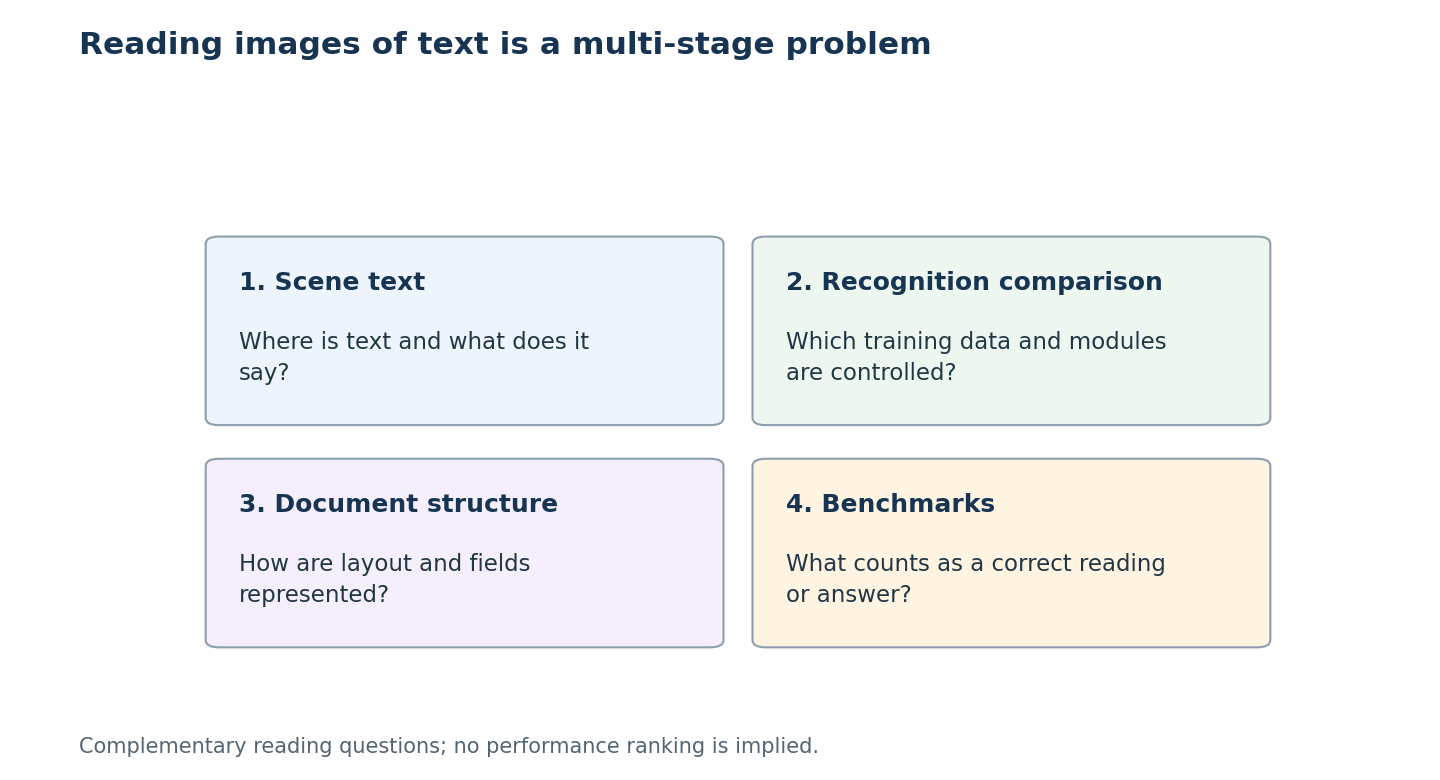
Scene-text recognition and document understanding overlap but do not use identical evidence or objectives. A cropped-word recognizer can assume localization has already succeeded. A page parser must also recover reading order, layout or structured fields. A multimodal benchmark may ask for an answer based on text rather than a complete transcription. The surveys and benchmarks in this guide should therefore be read as complementary views of a pipeline.
Compare results only after checking language/script coverage, synthetic and real training sources, crop/rectification assumptions, lexicon access and the matching rule. Exact string accuracy, edit distance, detection overlap and field extraction scores measure different failures. A model can improve one while missing important page structure or hallucinating a plausible answer. Benchmark collections also have finite coverage and possible training overlap. Use the recognition comparisons to control modules/data, the document surveys to understand output structure and the original benchmark definitions to decide what a reported score actually validates.
References
- S. Long, X. He and C. Yao, “Scene text detection and recognition: The deep learning era,” International Journal of Computer Vision, vol. 129, pp. 161–184, 2021. doi
- X. Chen, L. Jin, Y. Zhu, C. Luo and T. Wang, “Text recognition in the wild: A survey,” ACM Computing Surveys, vol. 54, no. 2, 2021. doi
- L. Cui, Y. Xu, T. Lv and F. Wei, “Document AI: Benchmarks, models and applications,” arXiv:2111.08609, 2021. arXiv
- Q. Zhang, B. Wang, V. S.-J. Huang, J. Zhang, Z. Wang, H. Liang, C. He and W. Zhang, “Document parsing unveiled: Techniques, challenges, and prospects for structured information extraction,” arXiv:2410.21169, 2024. arXiv
- D. Karatzas, F. Shafait, S. Uchida, M. Iwamura, L. Gomez i Bigorda, S. Robles Mestre, J. Mas et al., “ICDAR 2013 Robust Reading Competition,” in Proc. International Conference on Document Analysis and Recognition (ICDAR), pp. 1484–1493, 2013. doi
- D. Karatzas, L. Gomez-Bigorda, A. Nicolaou, S. Ghosh, A. Bagdanov, M. Iwamura, J. Matas et al., “ICDAR 2015 competition on Robust Reading,” in Proc. International Conference on Document Analysis and Recognition (ICDAR), pp. 1156–1160, 2015. doi
- J. Baek, G. Kim, J. Lee, S. Park, D. Han, S. Yun, S. J. Oh and H. Lee, “What is wrong with scene text recognition model comparisons? Dataset and model analysis,” in Proc. IEEE/CVF ICCV, pp. 4714–4722, 2019. doi
- N. Otsu, “A threshold selection method from gray-level histograms,” IEEE Transactions on Systems, Man, and Cybernetics, vol. 9, no. 1, pp. 62–66, 1979. doi
- J. Sauvola and M. Pietikäinen, “Adaptive document image binarization,” Pattern Recognition, vol. 33, no. 2, pp. 225–236, 2000. doi
- C. K. Ch’ng and C. S. Chan, “Total-Text: A comprehensive dataset for scene text detection and recognition,” in Proc. ICDAR, pp. 935–942, 2017. doi
- Y. Liu, L. Jin, S. Zhang, C. Luo and S. Zhang, “Curved scene text detection via transverse and longitudinal sequence connection,” Pattern Recognition, vol. 90, pp. 337–345, 2019. doi
- X. Zhou, C. Yao, H. Wen, Y. Wang, S. Zhou, W. He and J. Liang, “EAST: An efficient and accurate scene text detector,” in Proc. IEEE CVPR, pp. 2642–2651, 2017. doi
- W. Wang, E. Xie, X. Li, W. Hou, T. Lu, G. Yu and S. Shao, “Shape robust text detection with progressive scale expansion network,” in Proc. IEEE/CVF CVPR, pp. 9328–9337, 2019. doi
- M. Liao, Z. Wan, C. Yao, K. Chen and X. Bai, “Real-time scene text detection with differentiable binarization,” in Proc. AAAI Conference on Artificial Intelligence, vol. 34, pp. 11474–11481, 2020. doi
- Y. Baek, B. Lee, D. Han, S. Yun and H. Lee, “Character region awareness for text detection,” in Proc. IEEE/CVF CVPR, pp. 9357–9366, 2019. doi
- B. Shi, X. Bai and C. Yao, “An end-to-end trainable neural network for image-based sequence recognition and its application to scene text recognition,” IEEE TPAMI, vol. 39, no. 11, pp. 2298–2304, 2017. doi
- A. Graves, S. Fernández, F. Gomez and J. Schmidhuber, “Connectionist temporal classification: Labelling unsegmented sequence data with recurrent neural networks,” in Proc. ICML, pp. 369–376, 2006. doi
- B. Shi, M. Yang, X. Wang, P. Lyu, C. Yao and X. Bai, “ASTER: An attentional scene text recognizer with flexible rectification,” IEEE TPAMI, vol. 41, no. 9, pp. 2035–2048, 2019. doi
- M. Li, T. Lv, J. Chen, L. Cui, Y. Lu, D. Florencio, C. Zhang, Z. Li and F. Wei, “TrOCR: Transformer-based optical character recognition with pre-trained models,” in Proc. AAAI Conference on Artificial Intelligence, vol. 37, pp. 13094–13102, 2023. doi
- D. Bautista and R. Atienza, “Scene text recognition with permuted autoregressive sequence models,” in Proc. ECCV, pp. 178–196, 2022. doi
- S. Fang, H. Xie, Y. Wang, Z. Mao and Y. Zhang, “Read like humans: Autonomous, bidirectional and iterative language modeling for scene text recognition,” in Proc. IEEE/CVF CVPR, pp. 7094–7103, 2021. doi
- Y. Liu, Z. Li, M. Huang, B. Yang, W. Yu, C. Li, X.-C. Yin, C.-L. Liu, L. Jin and X. Bai, “OCRBench: On the hidden mystery of OCR in large multimodal models,” Science China Information Sciences, vol. 67, 2024. doi
- M. Jaderberg, K. Simonyan, A. Vedaldi and A. Zisserman, “Synthetic data and artificial neural networks for natural scene text recognition,” arXiv:1406.2227, 2014. arXiv
- A. Gupta, A. Vedaldi and A. Zisserman, “Synthetic data for text localisation in natural images,” in Proc. IEEE CVPR, pp. 2315–2324, 2016. doi
- X. Liu, D. Liang, S. Yan, D. Chen, Y. Qiao and J. Yan, “FOTS: Fast oriented text spotting with a unified network,” in Proc. IEEE/CVF CVPR, pp. 5676–5685, 2018. doi
- P. Lyu, M. Liao, C. Yao, W. Wu and X. Bai, “Mask TextSpotter: An end-to-end trainable neural network for spotting text with arbitrary shapes,” in Proc. ECCV, pp. 71–88, 2018. doi
- Y. Liu, H. Chen, C. Shen, T. He, L. Jin and L. Wang, “ABCNet: Real-time scene text spotting with adaptive Bezier-curve network,” in Proc. IEEE/CVF CVPR, pp. 9806–9815, 2020. doi
- X. Zhong, J. Tang and A. Jimeno Yepes, “PubLayNet: Largest dataset ever for document layout analysis,” in Proc. ICDAR, pp. 1015–1022, 2019. doi
- B. Pfitzmann, C. Auer, M. Dolfi, A. S. Nassar and P. Staar, “DocLayNet: A large human-annotated dataset for document-layout segmentation,” in Proc. ACM SIGKDD, pp. 3743–3751, 2022. doi
- Y. Xu, M. Li, L. Cui, S. Huang, F. Wei and M. Zhou, “LayoutLM: Pre-training of text and layout for document image understanding,” in Proc. ACM SIGKDD, pp. 1192–1200, 2020. doi
- R. Smith, “An overview of the Tesseract OCR engine,” in Proc. ICDAR, vol. 2, pp. 629–633, 2007. doi
- Y. Huang, T. Lv, L. Cui, Y. Lu and F. Wei, “LayoutLMv3: Pre-training for document AI with unified text and image masking,” in Proc. ACM International Conference on Multimedia, pp. 4083–4091, 2022. doi
- G. Jaume, H. K. Ekenel and J.-P. Thiran, “FUNSD: A dataset for form understanding in noisy scanned documents,” in Proc. ICDAR Workshops (OST), 2019. doi
- G. Kim, T. Hong, M. Yim, J. Nam, J. Park, J. Yim, W. Hwang, S. Yun, D. Han and S. Park, “OCR-free document understanding transformer,” in Proc. ECCV, pp. 498–517, 2022. doi
- K. Lee, M. Joshi, I. R. Turc, H. Hu, F. Liu, J. M. Eisenschlos, U. Khandelwal, P. Shaw, M.-W. Chang and K. Toutanova, “Pix2Struct: Screenshot parsing as pretraining for visual language understanding,” in Proc. ICML, PMLR vol. 202, pp. 18893–18912, 2023. PMLR
- L. Blecher, G. Cucurull, T. Scialom and R. Stojnic, “Nougat: Neural optical understanding for academic documents,” in Proc. ICLR, 2024. OpenReview · arXiv
- U.-V. Marti and H. Bunke, “The IAM-database: An English sentence database for offline handwriting recognition,” International Journal on Document Analysis and Recognition, vol. 5, pp. 39–46, 2002. doi
- C.-L. Liu, F. Yin, D.-H. Wang and Q.-F. Wang, “CASIA online and offline Chinese handwriting databases,” in Proc. ICDAR, pp. 37–41, 2011. doi
- B. Shi, C. Yao, M. Liao, M. Yang, P. Xu, L. Cui, S. Belongie, S. Lu and X. Bai, “ICDAR2017 competition on reading Chinese text in the wild (RCTW-17),” in Proc. ICDAR, pp. 1429–1434, 2017. doi · arXiv
- T.-L. Yuan, Z. Zhu, K. Xu, C.-J. Li, T.-J. Mu and S.-M. Hu, “A large Chinese text dataset in the wild,” Journal of Computer Science and Technology, vol. 34, pp. 509–521, 2019. doi · arXiv
- F. Xue and R. Ishida (eds.), “Requirements for Chinese Text Layout,” W3C Group Note (draft of 7 October 2026). W3C
- N. Nayef, Y. Patel, M. Busta, P. N. Chowdhury, D. Karatzas, W. Khlif, J. Matas et al., “ICDAR2019 Robust Reading Challenge on multi-lingual scene text detection and recognition — RRC-MLT-2019,” in Proc. ICDAR, pp. 1582–1587, 2019. doi · arXiv
- R. A. Wagner and M. J. Fischer, “The string-to-string correction problem,” Journal of the ACM, vol. 21, no. 1, pp. 168–173, 1974. doi
- M. Mathew, D. Karatzas and C. V. Jawahar, “DocVQA: A dataset for VQA on document images,” in Proc. IEEE/CVF WACV, pp. 2199–2208, 2021. doi
- A. Mishra, K. Alahari and C. V. Jawahar, “Scene text recognition using higher order language priors,” in Proc. BMVC, 2012. doi
- K. Wang, B. Babenko and S. Belongie, “End-to-end scene text recognition,” in Proc. IEEE ICCV, pp. 1457–1464, 2011. doi
- L. Ouyang, Y. Qu, H. Zhou, J. Zhu, R. Zhang, Q. Lin, B. Wang, Z. Zhao et al., “OmniDocBench: Benchmarking diverse PDF document parsing with comprehensive annotations,” in Proc. IEEE/CVF CVPR, pp. 24838–24848, 2025. CVF
- H. Wei, C. Liu, J. Chen, J. Wang, L. Kong, Y. Xu, Z. Ge, L. Zhao et al., “General OCR theory: Towards OCR-2.0 via a unified end-to-end model,” arXiv:2409.01704, 2024. arXiv
- J. Poznanski, A. Rangapur, J. Borchardt, J. Dunkelberger, R. Huff, D. Lin, C. Wilhelm et al., “olmOCR: Unlocking trillions of tokens in PDFs with vision language models,” arXiv:2502.18443, 2025. arXiv
- H. Wei, Y. Sun and Y. Li, “DeepSeek-OCR: Contexts optical compression,” arXiv:2510.18234, 2025. arXiv
- C. Wolf and J.-M. Jolion, “Object count/area graphs for the evaluation of object detection and segmentation algorithms,” International Journal of Document Analysis and Recognition, vol. 8, pp. 280–296, 2006. doi