DBNet: a reading guide
Optional · paper guide 3 of 4 for DLCV 06 · Text in Images: OCR and Document Understanding. Citation numbers refer to the reference list at the bottom of this page.
Navigate: this page and this track: Navigate: this page and this track
Challenge
Segmentation-based detectors handle curved text, but turning a probability map into separate word instances needed heuristic, slow post-processing (PSENet’s progressive expansion, for example), and the fixed binarization threshold was outside training [14].
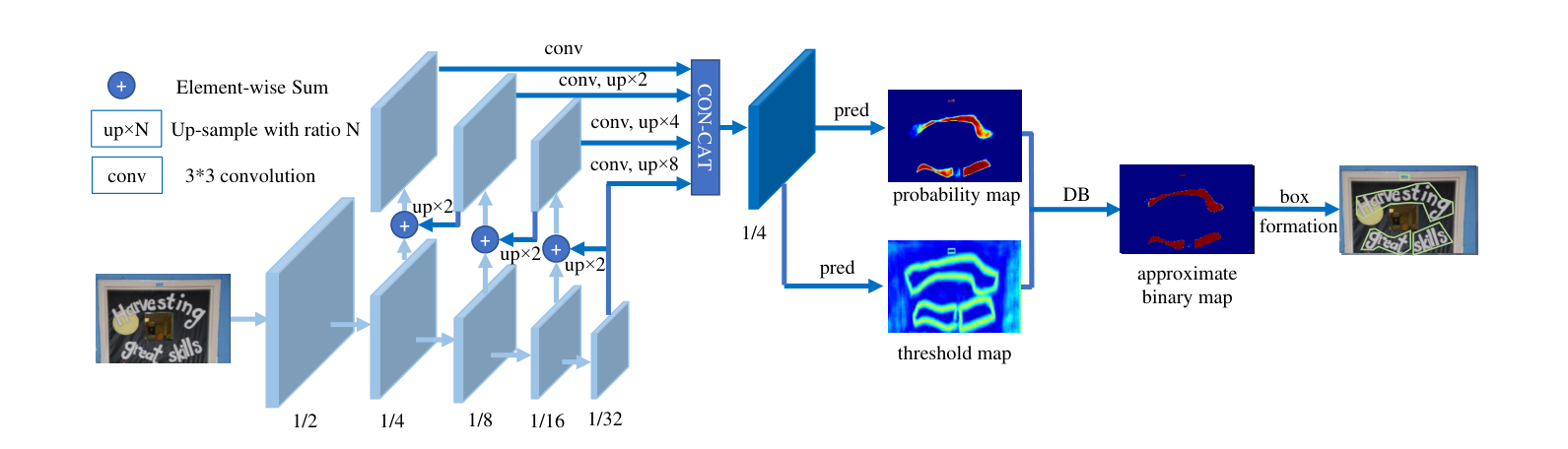
Figure source: [14], arXiv:1911.08947v2, PDF page 3. Original PDF.
Method
Put the binarization inside the network. Predict a probability map and a threshold map , combine them with the approximate step , , and supervise and with binary cross-entropy on shrunk text kernels and with an L1 loss in a band around each border, weighting the three losses 1 : 1 : 10. Hard negative mining keeps positives and negatives at a 1:3 ratio in the cross-entropy terms. Deformable convolutions in the backbone give a flexible receptive field for very long or very short words. At inference, binarize at 0.2, take connected components and expand them.
Results
Ablations on MSRA-TD500 and CTW1500 compare a plain segmentation baseline with and without DB and deformable convolution, for ResNet-18 and ResNet-50 backbones, and DB improves F-measure for both backbones on both datasets; a second ablation, on MLT-2017, tests whether supervising the threshold map helps. The paper then reports precision, recall, F-measure and frames per second on five benchmarks (Total-Text, CTW1500, ICDAR 2015, MSRA-TD500 and MLT-2017), at several input sizes.
Reading the evidence
Each benchmark table lists P, R, F and FPS; the number in brackets is the height of the input image, which changes both accuracy and speed, so compare rows at matching sizes. Speeds are measured with batch size 1 on one GPU and include post-processing, about 30% of the inference time; check whether competing methods’ speeds were measured on the same hardware or copied from their papers. Because the threshold branch is dropped at inference, a model trained with DB runs exactly as fast as the same model trained without it. The threshold-map ablation is the cleanest evidence for the “adaptive threshold” claim; the DB-versus-baseline ablation mixes the effect of the learned threshold with that of the extra supervision.
Problems
The learned threshold is not used at inference, so the separation of touching words at test time rests on how sharp has become. A word whose kernel is lost (very small or very thin text) cannot be recovered by expansion. The expansion ratio is a fixed constant (see the Supplementary note on polygons).
Conclusion
DBNet is the reference design for the segmentation branch of text detection in the main text, and it shows how moving a hand-tuned step into training can simplify inference.
References
- S. Long, X. He and C. Yao, “Scene text detection and recognition: The deep learning era,” International Journal of Computer Vision, vol. 129, pp. 161–184, 2021. doi
- X. Chen, L. Jin, Y. Zhu, C. Luo and T. Wang, “Text recognition in the wild: A survey,” ACM Computing Surveys, vol. 54, no. 2, 2021. doi
- L. Cui, Y. Xu, T. Lv and F. Wei, “Document AI: Benchmarks, models and applications,” arXiv:2111.08609, 2021. arXiv
- Q. Zhang, B. Wang, V. S.-J. Huang, J. Zhang, Z. Wang, H. Liang, C. He and W. Zhang, “Document parsing unveiled: Techniques, challenges, and prospects for structured information extraction,” arXiv:2410.21169, 2024. arXiv
- D. Karatzas, F. Shafait, S. Uchida, M. Iwamura, L. Gomez i Bigorda, S. Robles Mestre, J. Mas et al., “ICDAR 2013 Robust Reading Competition,” in Proc. International Conference on Document Analysis and Recognition (ICDAR), pp. 1484–1493, 2013. doi
- D. Karatzas, L. Gomez-Bigorda, A. Nicolaou, S. Ghosh, A. Bagdanov, M. Iwamura, J. Matas et al., “ICDAR 2015 competition on Robust Reading,” in Proc. International Conference on Document Analysis and Recognition (ICDAR), pp. 1156–1160, 2015. doi
- J. Baek, G. Kim, J. Lee, S. Park, D. Han, S. Yun, S. J. Oh and H. Lee, “What is wrong with scene text recognition model comparisons? Dataset and model analysis,” in Proc. IEEE/CVF ICCV, pp. 4714–4722, 2019. doi
- N. Otsu, “A threshold selection method from gray-level histograms,” IEEE Transactions on Systems, Man, and Cybernetics, vol. 9, no. 1, pp. 62–66, 1979. doi
- J. Sauvola and M. Pietikäinen, “Adaptive document image binarization,” Pattern Recognition, vol. 33, no. 2, pp. 225–236, 2000. doi
- C. K. Ch’ng and C. S. Chan, “Total-Text: A comprehensive dataset for scene text detection and recognition,” in Proc. ICDAR, pp. 935–942, 2017. doi
- Y. Liu, L. Jin, S. Zhang, C. Luo and S. Zhang, “Curved scene text detection via transverse and longitudinal sequence connection,” Pattern Recognition, vol. 90, pp. 337–345, 2019. doi
- X. Zhou, C. Yao, H. Wen, Y. Wang, S. Zhou, W. He and J. Liang, “EAST: An efficient and accurate scene text detector,” in Proc. IEEE CVPR, pp. 2642–2651, 2017. doi
- W. Wang, E. Xie, X. Li, W. Hou, T. Lu, G. Yu and S. Shao, “Shape robust text detection with progressive scale expansion network,” in Proc. IEEE/CVF CVPR, pp. 9328–9337, 2019. doi
- M. Liao, Z. Wan, C. Yao, K. Chen and X. Bai, “Real-time scene text detection with differentiable binarization,” in Proc. AAAI Conference on Artificial Intelligence, vol. 34, pp. 11474–11481, 2020. doi
- Y. Baek, B. Lee, D. Han, S. Yun and H. Lee, “Character region awareness for text detection,” in Proc. IEEE/CVF CVPR, pp. 9357–9366, 2019. doi
- B. Shi, X. Bai and C. Yao, “An end-to-end trainable neural network for image-based sequence recognition and its application to scene text recognition,” IEEE TPAMI, vol. 39, no. 11, pp. 2298–2304, 2017. doi
- A. Graves, S. Fernández, F. Gomez and J. Schmidhuber, “Connectionist temporal classification: Labelling unsegmented sequence data with recurrent neural networks,” in Proc. ICML, pp. 369–376, 2006. doi
- B. Shi, M. Yang, X. Wang, P. Lyu, C. Yao and X. Bai, “ASTER: An attentional scene text recognizer with flexible rectification,” IEEE TPAMI, vol. 41, no. 9, pp. 2035–2048, 2019. doi
- M. Li, T. Lv, J. Chen, L. Cui, Y. Lu, D. Florencio, C. Zhang, Z. Li and F. Wei, “TrOCR: Transformer-based optical character recognition with pre-trained models,” in Proc. AAAI Conference on Artificial Intelligence, vol. 37, pp. 13094–13102, 2023. doi
- D. Bautista and R. Atienza, “Scene text recognition with permuted autoregressive sequence models,” in Proc. ECCV, pp. 178–196, 2022. doi
- S. Fang, H. Xie, Y. Wang, Z. Mao and Y. Zhang, “Read like humans: Autonomous, bidirectional and iterative language modeling for scene text recognition,” in Proc. IEEE/CVF CVPR, pp. 7094–7103, 2021. doi
- Y. Liu, Z. Li, M. Huang, B. Yang, W. Yu, C. Li, X.-C. Yin, C.-L. Liu, L. Jin and X. Bai, “OCRBench: On the hidden mystery of OCR in large multimodal models,” Science China Information Sciences, vol. 67, 2024. doi
- M. Jaderberg, K. Simonyan, A. Vedaldi and A. Zisserman, “Synthetic data and artificial neural networks for natural scene text recognition,” arXiv:1406.2227, 2014. arXiv
- A. Gupta, A. Vedaldi and A. Zisserman, “Synthetic data for text localisation in natural images,” in Proc. IEEE CVPR, pp. 2315–2324, 2016. doi
- X. Liu, D. Liang, S. Yan, D. Chen, Y. Qiao and J. Yan, “FOTS: Fast oriented text spotting with a unified network,” in Proc. IEEE/CVF CVPR, pp. 5676–5685, 2018. doi
- P. Lyu, M. Liao, C. Yao, W. Wu and X. Bai, “Mask TextSpotter: An end-to-end trainable neural network for spotting text with arbitrary shapes,” in Proc. ECCV, pp. 71–88, 2018. doi
- Y. Liu, H. Chen, C. Shen, T. He, L. Jin and L. Wang, “ABCNet: Real-time scene text spotting with adaptive Bezier-curve network,” in Proc. IEEE/CVF CVPR, pp. 9806–9815, 2020. doi
- X. Zhong, J. Tang and A. Jimeno Yepes, “PubLayNet: Largest dataset ever for document layout analysis,” in Proc. ICDAR, pp. 1015–1022, 2019. doi
- B. Pfitzmann, C. Auer, M. Dolfi, A. S. Nassar and P. Staar, “DocLayNet: A large human-annotated dataset for document-layout segmentation,” in Proc. ACM SIGKDD, pp. 3743–3751, 2022. doi
- Y. Xu, M. Li, L. Cui, S. Huang, F. Wei and M. Zhou, “LayoutLM: Pre-training of text and layout for document image understanding,” in Proc. ACM SIGKDD, pp. 1192–1200, 2020. doi
- R. Smith, “An overview of the Tesseract OCR engine,” in Proc. ICDAR, vol. 2, pp. 629–633, 2007. doi
- Y. Huang, T. Lv, L. Cui, Y. Lu and F. Wei, “LayoutLMv3: Pre-training for document AI with unified text and image masking,” in Proc. ACM International Conference on Multimedia, pp. 4083–4091, 2022. doi
- G. Jaume, H. K. Ekenel and J.-P. Thiran, “FUNSD: A dataset for form understanding in noisy scanned documents,” in Proc. ICDAR Workshops (OST), 2019. doi
- G. Kim, T. Hong, M. Yim, J. Nam, J. Park, J. Yim, W. Hwang, S. Yun, D. Han and S. Park, “OCR-free document understanding transformer,” in Proc. ECCV, pp. 498–517, 2022. doi
- K. Lee, M. Joshi, I. R. Turc, H. Hu, F. Liu, J. M. Eisenschlos, U. Khandelwal, P. Shaw, M.-W. Chang and K. Toutanova, “Pix2Struct: Screenshot parsing as pretraining for visual language understanding,” in Proc. ICML, PMLR vol. 202, pp. 18893–18912, 2023. PMLR
- L. Blecher, G. Cucurull, T. Scialom and R. Stojnic, “Nougat: Neural optical understanding for academic documents,” in Proc. ICLR, 2024. OpenReview · arXiv
- U.-V. Marti and H. Bunke, “The IAM-database: An English sentence database for offline handwriting recognition,” International Journal on Document Analysis and Recognition, vol. 5, pp. 39–46, 2002. doi
- C.-L. Liu, F. Yin, D.-H. Wang and Q.-F. Wang, “CASIA online and offline Chinese handwriting databases,” in Proc. ICDAR, pp. 37–41, 2011. doi
- B. Shi, C. Yao, M. Liao, M. Yang, P. Xu, L. Cui, S. Belongie, S. Lu and X. Bai, “ICDAR2017 competition on reading Chinese text in the wild (RCTW-17),” in Proc. ICDAR, pp. 1429–1434, 2017. doi · arXiv
- T.-L. Yuan, Z. Zhu, K. Xu, C.-J. Li, T.-J. Mu and S.-M. Hu, “A large Chinese text dataset in the wild,” Journal of Computer Science and Technology, vol. 34, pp. 509–521, 2019. doi · arXiv
- F. Xue and R. Ishida (eds.), “Requirements for Chinese Text Layout,” W3C Group Note (draft of 7 October 2026). W3C
- N. Nayef, Y. Patel, M. Busta, P. N. Chowdhury, D. Karatzas, W. Khlif, J. Matas et al., “ICDAR2019 Robust Reading Challenge on multi-lingual scene text detection and recognition — RRC-MLT-2019,” in Proc. ICDAR, pp. 1582–1587, 2019. doi · arXiv
- R. A. Wagner and M. J. Fischer, “The string-to-string correction problem,” Journal of the ACM, vol. 21, no. 1, pp. 168–173, 1974. doi
- M. Mathew, D. Karatzas and C. V. Jawahar, “DocVQA: A dataset for VQA on document images,” in Proc. IEEE/CVF WACV, pp. 2199–2208, 2021. doi
- A. Mishra, K. Alahari and C. V. Jawahar, “Scene text recognition using higher order language priors,” in Proc. BMVC, 2012. doi
- K. Wang, B. Babenko and S. Belongie, “End-to-end scene text recognition,” in Proc. IEEE ICCV, pp. 1457–1464, 2011. doi
- L. Ouyang, Y. Qu, H. Zhou, J. Zhu, R. Zhang, Q. Lin, B. Wang, Z. Zhao et al., “OmniDocBench: Benchmarking diverse PDF document parsing with comprehensive annotations,” in Proc. IEEE/CVF CVPR, pp. 24838–24848, 2025. CVF
- H. Wei, C. Liu, J. Chen, J. Wang, L. Kong, Y. Xu, Z. Ge, L. Zhao et al., “General OCR theory: Towards OCR-2.0 via a unified end-to-end model,” arXiv:2409.01704, 2024. arXiv
- J. Poznanski, A. Rangapur, J. Borchardt, J. Dunkelberger, R. Huff, D. Lin, C. Wilhelm et al., “olmOCR: Unlocking trillions of tokens in PDFs with vision language models,” arXiv:2502.18443, 2025. arXiv
- H. Wei, Y. Sun and Y. Li, “DeepSeek-OCR: Contexts optical compression,” arXiv:2510.18234, 2025. arXiv
- C. Wolf and J.-M. Jolion, “Object count/area graphs for the evaluation of object detection and segmentation algorithms,” International Journal of Document Analysis and Recognition, vol. 8, pp. 280–296, 2006. doi