YOLOv9: programmable gradient information
Optional · paper guide 12 of 22 for DLCV 03A · One-Stage Detection, Read Through YOLOv4. Citation numbers refer to the reference list at the bottom of this page.
Navigate: this page and this track: Navigate: this page and this track
On this page
- YOLO v1: detection as a single regression
- YOLOv2 and YOLO9000: anchors, priors and joint training
- YOLOv3: three scales and Darknet-53
- SSD: multi-scale default boxes
- RetinaNet and the focal loss
- FCOS: per-pixel anchor-free detection
- CenterNet: objects as points
- YOLOR: explicit features and learned implicit representations
- YOLOX: anchor-free YOLO with SimOTA
- YOLOv6: a re-parameterized industrial detector
- YOLOv7: a trainable bag of freebies
- YOLOv9: programmable gradient information
- YOLOv10: NMS-free training with dual assignments
- YOLOv12: an attention-centric YOLO
- YOLOv13: hypergraph correlation
- YOLO26: a DFL-free end-to-end YOLO
- RT-DETR: a real-time DETR
- RT-DETRv2: a bag of freebies for RT-DETR
- D-FINE: boxes as refined distributions
- DEIM: dense one-to-one matching
- RF-DETR: architecture search on a DINOv2 backbone
- DEIMv2: DINOv3 features for real-time DETRs
Deep Learning for Computer Vision
Paper: C.-Y. Wang, I-H. Yeh and H.-Y. M. Liao, “YOLOv9: Learning what you want to learn using programmable gradient information,” ECCV 2024 [2]. Related part of YOLOv4: the backbone, whose CSP design YOLOv9 generalizes. Numbers below are from the arXiv version of the paper.
Challenge
As data passes through many layers, information about the input is lost: by the data-processing inequality the paper writes , where is mutual information, the input and , successive transformations [2]. When the information needed to compute the loss is gone, the gradients become unreliable and the network may learn false correlations. Reversible architectures keep all information but cost inference time, and deep supervision with auxiliary heads can make shallow features specialize and lose information needed elsewhere [2]. Lightweight models suffer most.
Method
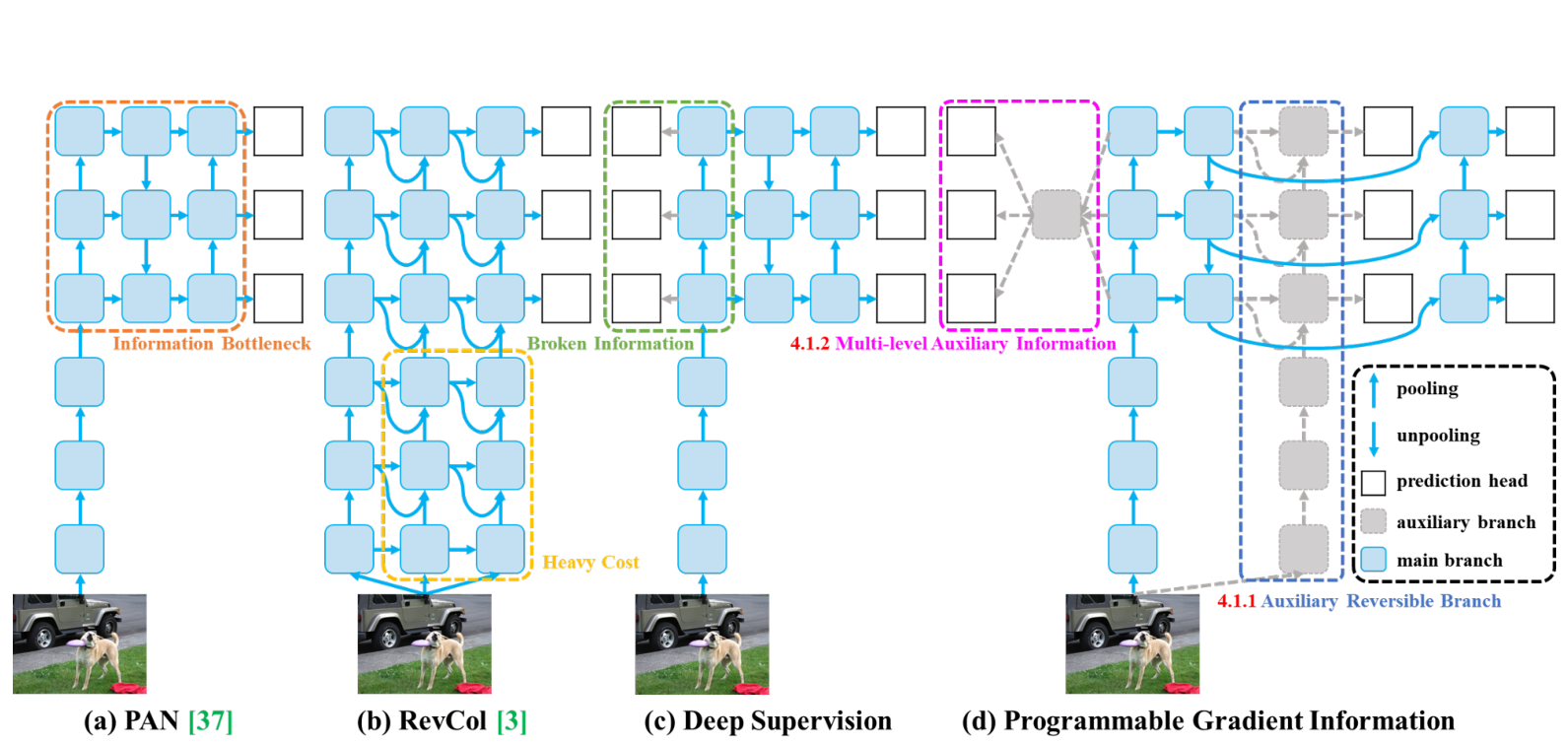
Figure source: [2], arXiv:2402.13616v2, PDF page 5. Original PDF.
Programmable gradient information (PGI). An auxiliary supervision framework with three parts [2]:
- the main branch, the network used at inference;
- an auxiliary reversible branch, used only during training, designed to retain useful input information and improve supervision. The motivating ideal is a reversible function with inverse satisfies , so this ideal transform loses no input information [2]. This identity motivates the architecture; it does not prove that every implemented feature tensor or gradient is lossless or correct. Because this branch is removed at inference, its cost is paid only in training;
- multi-level auxiliary information, an integration network between the auxiliary feature-pyramid heads and the main branch, which combines the gradients from the different prediction heads so that each pyramid level of the main branch receives information about all target objects rather than only those of its own size [2].
GELAN. The generalized efficient layer aggregation network combines CSPNet’s split–merge design with ELAN’s layer aggregation and allows any computational block inside; YOLOv9 uses CSP blocks with planned RepConv as computational blocks [2].
Training. Built on YOLOv7 and its anchor-free variant, trained from scratch for 500 epochs with linear warm-up in the first 3 epochs and Mosaic switched off for the last 15 epochs; the auxiliary loss follows YOLOv7’s auxiliary-head setting [2].
Follow the training graph. The main branch must work after the auxiliary branch is removed. Its predictions therefore cannot depend on an auxiliary activation at inference. The auxiliary loss instead changes the gradients used to learn the main branch’s parameters. This is the same distinction that makes ordinary auxiliary heads training-only: supervision influences learned weights without remaining in the final executable.
The information-theoretic inequality also needs a narrow interpretation. Processing cannot increase mutual information about the original input under the stated Markov structure, but useful detection features should discard irrelevant details. Retaining every input bit is not itself the detection objective. In deterministic continuous systems, mutual-information quantities require additional care and can be infinite. The inequality motivates avoiding harmful information loss; AP ablations, rather than an unmeasured mutual-information value, are the practical evidence for this implementation.
Results
Table 1 compares train-from-scratch detectors on COCO val by parameters, FLOPs and AP; it does not report latency [2]. YOLOv9-S reaches 46.8% AP with 7.1 M parameters and 26.4 GFLOPs, YOLOv9-C 53.0% with 25.3 M and 102.1 G, and YOLOv9-E 55.6% with 57.3 M and 189.0 G [2]. The paper states that YOLOv9-C matches the anchor-free YOLOv7’s 53% AP with 42% fewer parameters and 22% less computation, and that YOLOv9-E improves on YOLOv8-X by 1.7 AP with 16% fewer parameters [2].
Ablations
On COCO val [2]:
- Computational blocks in GELAN (Table 2, small model): plain convolutions 44.8% AP, residual blocks 44.3%, Darknet blocks 44.5%, CSP blocks 45.5%.
- Depth (Table 3): AP grows roughly linearly with ELAN and CSP depth beyond 2, so GELAN is “not sensitive to the depth”.
- PGI against deep supervision (Table 5): for GELAN-S, deep supervision lowers AP (46.7 → 46.5) while PGI raises it slightly (46.8); for GELAN-C, deep supervision gives 52.5 and PGI 53.0; for GELAN-E, 55.3 and 55.6.
- Roadmap (Table 6): YOLOv7 51.2% → anchor-free 53.0% → GELAN 53.2% → a deeper linkage 55.0% → PGI 55.6%.
In these experiments PGI outperforms ordinary deep supervision, including the small model where deep supervision slightly hurts. The results support the training design, while not directly measuring the proposed information-theoretic explanation.
Conclusion
YOLOv9 explains auxiliary supervision through information loss and proposes a training-only reversible branch (PGI) plus a flexible aggregation backbone (GELAN), achieving strong accuracy per parameter for train-from-scratch models.
Problems
The main comparison reports no speed, so the real-time claim rests on parameter and FLOP counts, which YOLOv4 itself showed to be poor proxies for GPU speed; YOLOv10 later measured YOLOv9-C at 10.57 ms on a T4 [17]. The information-bottleneck argument motivates the design but is not tested quantitatively, NMS is still required, and PGI makes training more expensive.
References
- C.-Y. Wang, A. Bochkovskiy and H.-Y. M. Liao, “YOLOv7: Trainable bag-of-freebies sets new state-of-the-art for real-time object detectors,” in Proc. IEEE/CVF CVPR, pp. 7464–7475, 2023. doi
- C.-Y. Wang, I-H. Yeh and H.-Y. M. Liao, “YOLOv9: Learning what you want to learn using programmable gradient information,” in Proc. ECCV, 2024. doi
- G. Jocher, “Ultralytics YOLOv5,” software (first released 2020; v7.0 released 22 November 2022). release · documentation
- G. Jocher, A. Chaurasia and J. Qiu, “Ultralytics YOLOv8,” software, version 8.0.0, 2023 (no paper). docs · code
- G. Jocher and J. Qiu, “Ultralytics YOLO11,” software, version 11.0.0, 2024 (no paper). docs · code
- J. Lu, J. Jia, J. Yawl and C. Zhang, “YOLOv14: Adaptive real-time object detection for diverse imaging conditions,” arXiv:2608.04720, 2026 (withdrawn by the authors, 20 August 2026). arXiv
- J. Redmon, S. Divvala, R. Girshick and A. Farhadi, “You only look once: Unified, real-time object detection,” in Proc. IEEE CVPR, pp. 779–788, 2016. doi · arXiv
- J. Redmon and A. Farhadi, “YOLO9000: Better, faster, stronger,” in Proc. IEEE CVPR, pp. 6517–6525, 2017. doi · arXiv
- J. Redmon and A. Farhadi, “YOLOv3: An incremental improvement,” tech. report, arXiv:1804.02767, 2018. arXiv
- W. Liu, D. Anguelov, D. Erhan, C. Szegedy, S. Reed, C. Fu, A. C. Berg, “SSD: Single Shot MultiBox Detector,” Lecture Notes in Computer Science / Computer Vision – ECCV 2016, 2016. doi · manuscript
- T.-Y. Lin, P. Goyal, R. Girshick, K. He and P. Dollár, “Focal loss for dense object detection,” in Proc. IEEE ICCV, pp. 2999–3007, 2017. doi
- Z. Tian, C. Shen, H. Chen, T. He, “FCOS: Fully Convolutional One-Stage Object Detection,” 2019 IEEE/CVF International Conference on Computer Vision (ICCV), 2019. doi · manuscript
- X. Zhou, D. Wang, P. Krähenbühl, “Objects as Points,” arXiv preprint, 2019. source
- C. Wang, I. Yeh, H. M. Liao, “You Only Learn One Representation: Unified Network for Multiple Tasks,” arXiv preprint, 2021. source
- Z. Ge, S. Liu, F. Wang, Z. Li and J. Sun, “YOLOX: Exceeding YOLO series in 2021,” arXiv:2107.08430, 2021. arXiv
- C. Li, L. Li, H. Jiang, K. Weng, Y. Geng et al., “YOLOv6: A single-stage object detection framework for industrial applications,” tech. report, arXiv:2209.02976, 2022. arXiv
- A. Wang, H. Chen, L. Liu, K. Chen, Z. Lin, J. Han and G. Ding, “YOLOv10: Real-time end-to-end object detection,” in Proc. NeurIPS, 2024. arXiv
- Y. Tian, Q. Ye and D. Doermann, “YOLOv12: Attention-centric real-time object detectors,” in Advances in Neural Information Processing Systems 38 (NeurIPS), 2025. proceedings · arXiv
- M. Lei, S. Li, Y. Wu, H. Hu, Y. Zhou et al., “YOLOv13: Real-time object detection with hypergraph-enhanced adaptive visual perception,” arXiv:2506.17733, 2025. arXiv
- G. Jocher, J. Qiu, M. Liu, S. Lyu, F. C. Akyon and M. E. Kalfaoglu, “Ultralytics YOLO26: Unified real-time end-to-end vision models,” arXiv:2606.03748, 2026 (software released January 2026). arXiv · docs
- Y. Zhao, W. Lv, S. Xu, J. Wei, G. Wang, Q. Dang, Y. Liu, J. Chen, “DETRs Beat YOLOs on Real-time Object Detection,” Proceedings of the IEEE/CVF Conference on Computer Vision and Pattern Recognition, 2024. source
- W. Lv, Y. Zhao, Q. Chang, K. Huang, G. Wang and Y. Liu, “RT-DETRv2: Improved baseline with bag-of-freebies for real-time detection transformer,” arXiv:2407.17140, 2024. arXiv
- Y. Peng, H. Li, P. Wu, Y. Zhang, X. Sun and F. Wu, “D-FINE: Redefine regression task in DETRs as fine-grained distribution refinement,” in Proc. ICLR, 2025. arXiv · code
- S. Huang, Z. Lu, X. Cun, Y. Yu, X. Zhou, X. Shen, “DEIM: DETR with Improved Matching for Fast Convergence,” Proceedings of the IEEE/CVF Conference on Computer Vision and Pattern Recognition, 2025. source
- I. Robinson, P. Robicheaux, M. Popov, D. Ramanan and N. Peri, “RF-DETR: Neural architecture search for real-time detection transformers,” in Proc. ICLR, 2026. arXiv
- S. Huang, Y. Hou, L. Liu, X. Yu and X. Shen, “Real-time object detection meets DINOv3,” arXiv:2509.20787, 2025 (revised 2026). arXiv
- A. Bochkovskiy, C.-Y. Wang and H.-Y. M. Liao, “YOLOv4: Optimal speed and accuracy of object detection,” arXiv:2004.10934, 2020. arXiv
- M. Tan, R. Pang, Q. V. Le, “EfficientDet: Scalable and Efficient Object Detection,” 2020 IEEE/CVF Conference on Computer Vision and Pattern Recognition (CVPR), 2020. doi · manuscript
- NVIDIA, “TensorRT documentation,” official documentation. link
- J. Deng, W. Dong, R. Socher, L. Li, Kai Li, Li Fei-Fei, “ImageNet: A large-scale hierarchical image database,” 2009 IEEE Conference on Computer Vision and Pattern Recognition, 2009. source
- K. Simonyan, A. Zisserman, “Very Deep Convolutional Networks for Large-Scale Image Recognition,” arXiv preprint, 2014. source
- K. He, X. Zhang, S. Ren, J. Sun, “Deep Residual Learning for Image Recognition,” arXiv preprint, 2015. source
- T.-Y. Lin, P. Dollár, R. Girshick, K. He, B. Hariharan and S. Belongie, “Feature pyramid networks for object detection,” in Proc. IEEE CVPR, 2017. doi
- S. Liu, L. Qi, H. Qin, J. Shi and J. Jia, “Path aggregation network for instance segmentation,” in Proc. IEEE/CVF CVPR, pp. 8759–8768, 2018. doi
- K. He, X. Zhang, S. Ren, J. Sun, “Spatial Pyramid Pooling in Deep Convolutional Networks for Visual Recognition,” Lecture Notes in Computer Science / Computer Vision – ECCV 2014, 2014. doi · manuscript
- C.-Y. Wang, H.-Y. M. Liao, I-H. Yeh, Y.-H. Wu, P.-Y. Chen and J.-W. Hsieh, “CSPNet: A new backbone that can enhance learning capability of CNN,” CVPR Workshops, 2020. arXiv · doi
- A. Bochkovskiy and contributors, “Darknet: YOLOv4 configuration and detection layer,” official implementation, accessed 2 November 2026. configuration · assignment and decoding
- M. Tan, Q. V. Le, “EfficientNet: Rethinking Model Scaling for Convolutional Neural Networks,” ICML, 2019. source · proceedings
- G. Huang, Z. Liu, L. Van Der Maaten, K. Q. Weinberger, “Densely Connected Convolutional Networks,” 2017 IEEE Conference on Computer Vision and Pattern Recognition (CVPR), 2017. doi · manuscript
- S. Xie, R. Girshick, P. Dollar, Z. Tu, K. He, “Aggregated Residual Transformations for Deep Neural Networks,” 2017 IEEE Conference on Computer Vision and Pattern Recognition (CVPR), 2017. doi · manuscript
- D. Misra, “Mish: A Self Regularized Non-Monotonic Activation Function,” BMVC, 2020. source
- P. Ramachandran, B. Zoph, Q. V. Le, “Searching for Activation Functions,” arXiv preprint, 2017. source
- J. Yu, Y. Jiang, Z. Wang, Z. Cao, T. Huang, “UnitBox: An Advanced Object Detection Network,” ACM Multimedia, 2016. source
- H. Rezatofighi, N. Tsoi, J. Gwak, A. Sadeghian, I. Reid, S. Savarese, “Generalized Intersection over Union: A Metric and A Loss for Bounding Box Regression,” arXiv preprint, 2019. source
- Z. Zheng, P. Wang, W. Liu, J. Li, R. Ye and D. Ren, “Distance-IoU loss: Faster and better learning for bounding box regression,” in Proc. AAAI, pp. 12993–13000, 2020. doi
- H. Zhang, M. Cisse, Y. N. Dauphin and D. Lopez-Paz, “mixup: Beyond empirical risk minimization,” in Proc. ICLR, 2018. arXiv
- S. Yun, D. Han, S. Chun, S. J. Oh, Y. Yoo, J. Choe, “CutMix: Regularization Strategy to Train Strong Classifiers With Localizable Features,” 2019 IEEE/CVF International Conference on Computer Vision (ICCV), 2019. doi · manuscript
- Nitish Srivastava, Geoffrey Hinton, Alex Krizhevsky, Ilya Sutskever, Ruslan Salakhutdinov, “Dropout: A Simple Way to Prevent Neural Networks from Overfitting,” Journal of Machine Learning Research, 2014. source
- G. Ghiasi, T. Lin, Q. V. Le, “DropBlock: A regularization method for convolutional networks,” NeurIPS, 2018. source · proceedings
- C. Szegedy, V. Vanhoucke, S. Ioffe, J. Shlens, Z. Wojna, “Rethinking the Inception Architecture for Computer Vision,” 2016 IEEE Conference on Computer Vision and Pattern Recognition (CVPR), 2016. doi · manuscript
- S. Ioffe and C. Szegedy, “Batch normalization: Accelerating deep network training by reducing internal covariate shift,” in Proc. ICML, PMLR vol. 37, pp. 448–456, 2015. link
- Z. Yao, Y. Cao, S. Zheng, G. Huang, S. Lin, “Cross-Iteration Batch Normalization,” 2021 IEEE/CVF Conference on Computer Vision and Pattern Recognition (CVPR), 2021. doi · manuscript
- S. Woo, J. Park, J. Lee, I. S. Kweon, “CBAM: Convolutional Block Attention Module,” Lecture Notes in Computer Science / Computer Vision – ECCV 2018, 2018. doi · manuscript
- I. Loshchilov, F. Hutter, “SGDR: Stochastic Gradient Descent with Warm Restarts,” ICLR, 2017. source
- T.-Y. Lin, M. Maire, S. Belongie, J. Hays, P. Perona, D. Ramanan, P. Dollár and C. L. Zitnick, “Microsoft COCO: Common objects in context,” in Proc. ECCV, pp. 740–755, 2014. doi
- COCO Consortium, “COCO detection evaluation,” official evaluation description. link
- ONNX, “Open Neural Network Exchange,” official project page. link
- B. Jacob, S. Kligys, B. Chen, M. Zhu, M. Tang, A. Howard, H. Adam and D. Kalenichenko, “Quantization and training of neural networks for efficient integer-arithmetic-only inference,” in Proc. IEEE/CVF CVPR, pp. 2704–2713, 2018. doi
- N. Carion, F. Massa, G. Synnaeve, N. Usunier, A. Kirillov and S. Zagoruyko, “End-to-end object detection with transformers,” in Proc. ECCV, 2020. doi
- H. W. Kuhn, “The Hungarian method for the assignment problem,” Naval Research Logistics Quarterly, vol. 2, pp. 83–97, 1955. doi
- J. Terven, D.-M. Córdova-Esparza and J.-A. Romero-González, “A comprehensive review of YOLO architectures in computer vision: From YOLOv1 to YOLOv8 and YOLO-NAS,” Machine Learning and Knowledge Extraction, vol. 5, no. 4, pp. 1680–1716, 2023. doi · arXiv
- N. Jegham, C. Y. Koh, M. Abdelatti and A. Hendawi, “YOLO evolution: A comprehensive benchmark and architectural review of YOLOv12, YOLO11, and their previous versions,” arXiv:2411.00201, 2024 (revised 2025). arXiv
- R. Sapkota and M. Karkee, “Ultralytics YOLO evolution: An overview of YOLO27, YOLO26, YOLO11, YOLOv8, and YOLOv5 object detectors for computer vision and pattern recognition,” arXiv:2510.09653, 2025 (revised 2026). arXiv
- T. Shehzadi, K. A. Hashmi, M. Liwicki, D. Stricker and M. Z. Afzal, “Object detection with transformers: A review,” Sensors, vol. 25, no. 19, 2025. doi
- Ultralytics, “YOLO27 (coming soon),” official documentation page, accessed 2 November 2026. docs
- M. Oquab, T. Darcet, T. Moutakanni, H. Vo, M. Szafraniec et al., “DINOv2: Learning robust visual features without supervision,” arXiv:2304.07193, 2023. arXiv
- O. Siméoni, H. V. Vo, M. Seitzer, F. Baldassarre, M. Oquab et al., “DINOv3,” arXiv:2508.10104, 2025. arXiv
- X. Ding, X. Zhang, N. Ma, J. Han, G. Ding and J. Sun, “RepVGG: Making VGG-style ConvNets great again,” in Proc. IEEE/CVF CVPR, pp. 13728–13737, 2021. doi
- R. Girshick, “Fast R-CNN,” 2015 IEEE International Conference on Computer Vision (ICCV), 2015. doi · manuscript
- S. Ren, K. He, R. Girshick, J. Sun, “Faster R-CNN: Towards Real-Time Object Detection with Region Proposal Networks,” arXiv preprint, 2015. source
- M. Everingham, L. Van Gool, C. K. I. Williams, J. Winn, A. Zisserman, “The Pascal Visual Object Classes (VOC) Challenge,” International Journal of Computer Vision, 2009. source
- A. Shrivastava, A. Gupta, R. Girshick, “Training Region-Based Object Detectors with Online Hard Example Mining,” 2016 IEEE Conference on Computer Vision and Pattern Recognition (CVPR), 2016. doi · manuscript
- H. Zhang, Y. Wang, F. Dayoub and N. Sünderhauf, “VarifocalNet: An IoU-aware dense object detector,” in Proc. IEEE/CVF CVPR, pp. 8510–8519, 2021. doi
- YOLOX contributors, “YOLOX detection head,” official implementation, accessed 2 November 2026. code
- K. Duan, S. Bai, L. Xie, H. Qi, Q. Huang, Q. Tian, “CenterNet: Keypoint Triplets for Object Detection,” arXiv preprint, 2019. source
- Z. Ge, S. Liu, Z. Li, O. Yoshie and J. Sun, “OTA: Optimal transport assignment for object detection,” in Proc. IEEE/CVF CVPR, pp. 303–312, 2021. doi
- C. Li, L. Li, Y. Geng, et al., “YOLOv6 v3.0: A Full-Scale Reloading,” arXiv preprint, 2023. source
- C. Feng, Y. Zhong, Y. Gao, M. R. Scott, W. Huang, “TOOD: Task-Aligned One-Stage Object Detection,” Proceedings of the IEEE/CVF International Conference on Computer Vision, 2021. source
- Z. Gevorgyan, “SIoU Loss: More Powerful Learning for Bounding Box Regression,” arXiv preprint, 2022. source
- X. Li, W. Wang, L. Wu, S. Chen, X. Hu, J. Li, J. Tang and J. Yang, “Generalized focal loss: Learning qualified and distributed bounding boxes for dense object detection,” in Advances in Neural Information Processing Systems 33 (NeurIPS), 2020. proceedings
- X. Ding, H. Chen, X. Zhang, K. Huang, J. Han, G. Ding, “Re-parameterizing Your Optimizers rather than Architectures,” ICLR, 2023. source
- S. Zhang, C. Chi, Y. Yao, Z. Lei, S. Z. Li, “Bridging the Gap Between Anchor-Based and Anchor-Free Detection via Adaptive Training Sample Selection,” 2020 IEEE/CVF Conference on Computer Vision and Pattern Recognition (CVPR), 2020. doi · manuscript
- C. Wang, H. M. Liao, I. Yeh, “Designing Network Design Strategies Through Gradient Path Analysis,” arXiv preprint, 2022. source
- T. Dao, D. Fu, S. Ermon, A. Rudra, C. Ré, “FlashAttention: Fast and Memory-Efficient Exact Attention with IO-Awareness,” Advances in Neural Information Processing Systems 35, 2022. doi · manuscript
- D. P. Kingma, J. Ba, “Adam: A Method for Stochastic Optimization,” ICLR, 2015. source
- K. Jordan, “Muon: An optimizer for hidden layers in neural networks,” technical blog, 2024. source
- S. Shao, Z. Li, T. Zhang, C. Peng, G. Yu, X. Zhang, J. Li, J. Sun, “Objects365: A Large-Scale, High-Quality Dataset for Object Detection,” Proceedings of the IEEE/CVF International Conference on Computer Vision, 2019. source