DEIM: dense one-to-one matching
Optional · paper guide 20 of 22 for DLCV 03A · One-Stage Detection, Read Through YOLOv4. Citation numbers refer to the reference list at the bottom of this page.
Navigate: this page and this track: Navigate: this page and this track
On this page
- YOLO v1: detection as a single regression
- YOLOv2 and YOLO9000: anchors, priors and joint training
- YOLOv3: three scales and Darknet-53
- SSD: multi-scale default boxes
- RetinaNet and the focal loss
- FCOS: per-pixel anchor-free detection
- CenterNet: objects as points
- YOLOR: explicit features and learned implicit representations
- YOLOX: anchor-free YOLO with SimOTA
- YOLOv6: a re-parameterized industrial detector
- YOLOv7: a trainable bag of freebies
- YOLOv9: programmable gradient information
- YOLOv10: NMS-free training with dual assignments
- YOLOv12: an attention-centric YOLO
- YOLOv13: hypergraph correlation
- YOLO26: a DFL-free end-to-end YOLO
- RT-DETR: a real-time DETR
- RT-DETRv2: a bag of freebies for RT-DETR
- D-FINE: boxes as refined distributions
- DEIM: dense one-to-one matching
- RF-DETR: architecture search on a DINOv2 backbone
- DEIMv2: DINOv3 features for real-time DETRs
Deep Learning for Computer Vision
Huang et al.’s CVPR 2025 paper increases the amount and usefulness of positive supervision while retaining one-to-one set prediction [24]. Its central move is simple: create more annotated object instances in a training image, rather than assign many predictions to each original object.
Challenge
A dense detector can train several predictions for one target. A DETR-style one-to-one assignment gives each target one matched query in a matching group. That structure helps avoid NMS, but it also means a training image with few objects supplies few positive assignments. Matching may be especially unhelpful early in training, when predicted boxes are poor.
DEIM separates quantity from quality. Dense O2O increases target instances. Matchability-Aware Loss changes how matched predictions are trained. Neither component replaces the matching structure with ordinary one-to-many detection.
Method
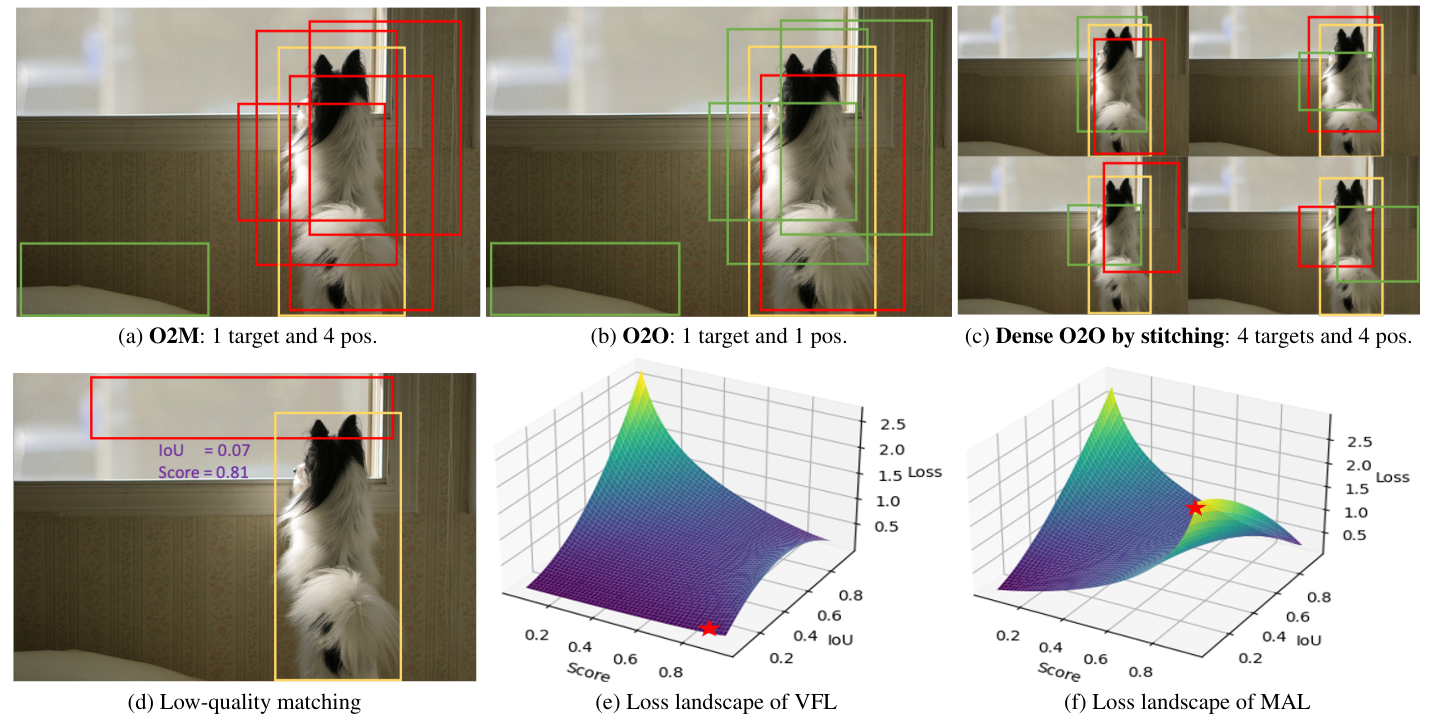
Figure source: [24], arXiv:2412.04234v3, PDF page 3. Original PDF.
Dense O2O through augmentation. Mosaic combines images spatially; Mixup overlays image content. Their transformed annotations create more target instances in the resulting training example. Matching remains one-to-one for those instances. Four targets may produce four positive matches, rather than four predictions being assigned to a single target. This distinction is why denser supervision does not by itself reintroduce the need for NMS.
All geometric transformations must also transform boxes and remove invalid or excessively cropped annotations consistently. More targets are not useful if their coordinates are wrong. The augmentation probability and when augmentation is disabled are part of the method, not incidental loader details.
Matchability-Aware Loss. MAL aims to provide better learning signals for low-quality matched boxes. For a class probability , matched-box IoU and a positive-match indicator , its form is
controls the target transformation and negative modulation. A positive prediction receives the soft target ; an unmatched negative receives a focal-style penalty. Compared with the Varifocal Loss used in its baseline [73], MAL changes both the positive target and the weighting. It should not be described as ordinary binary cross-entropy with every positive target set to one.
The intended effect is better supervision for imperfect matches. IoU is used during training, when a target box is available; the detector does not need ground truth to score its deployment predictions. As with other quality-aware losses, the score’s interpretation depends on training and is not guaranteed calibration.
Schedule and implementation. The paper combines its loss with an augmentation schedule and a flat-cosine learning-rate schedule. Efficient cached Mosaic and within-batch Mixup limit the overhead of constructing denser images. Strong augmentation is disabled partway through training to return the model toward the evaluation distribution. The final inference graph remains that of the underlying detector.
Results
The paper evaluates DEIM on both RT-DETRv2 and D-FINE rather than introducing one fixed architecture. In Table 6, the RT-DETRv2-R50 baseline reaches 53.4 AP in 72 epochs, while the combined DEIM recipe reaches 53.9 in 36 epochs. For D-FINE-L, the corresponding values are 54.0 in 72 epochs and 54.6 in 36 epochs [24]. The comparison is deliberately about faster convergence as well as accuracy.
Table 7 also gives training time: one epoch is approximately 1.181 GPU-hours for the baseline and 1.183 with DEIM on the stated single-4090 setup. A separate comparison reaches 54.3 AP in about 71 hours over 60 epochs, versus the baseline’s 53.4 AP in about 85 hours over 72 epochs [24]. Epoch count alone would miss this distinction, although these particular per-epoch costs are nearly equal.
Ablations
Table 4 varies Mosaic and Mixup. At 12 epochs, the no-augmentation row gives 49.6 AP; Mosaic alone gives 50.4, Mixup alone 50.1, and both 50.4. At 24 epochs the corresponding results are 51.7, 51.9, 51.5 and 52.5 [24]. Mixup alone can hurt the later result, so the evidence does not support “every way of adding targets always helps.”
Table 6 isolates the loss contribution on top of Dense O2O. At 36 epochs, the R50 model with Dense O2O gives 53.6 AP, and adding MAL gives 53.9. D-FINE-L changes from 54.2 to 54.6 in the analogous rows. These support complementary benefits in the tested settings, not a universal gain on every dataset or model.
Conclusion
DEIM improves the supervision reaching an existing set predictor. It shows that image construction and loss design can accelerate learning without adding inference modules. That makes it a direct modern counterpart to YOLOv4’s training-only recipe improvements.
Problems
Artificially dense images can differ from the deployment distribution. Cropping and blending may create unrealistic occlusion, tiny instances or annotation conflicts. Query capacity remains finite: adding targets beyond that capacity cannot create unlimited useful positive matches.
A fair reproduction must report the full augmentation schedule, training cost and underlying architecture. “DEIM” denotes a training method applied to a detector; it is not enough information to determine parameter count, latency or pretrained data.
References
- C.-Y. Wang, A. Bochkovskiy and H.-Y. M. Liao, “YOLOv7: Trainable bag-of-freebies sets new state-of-the-art for real-time object detectors,” in Proc. IEEE/CVF CVPR, pp. 7464–7475, 2023. doi
- C.-Y. Wang, I-H. Yeh and H.-Y. M. Liao, “YOLOv9: Learning what you want to learn using programmable gradient information,” in Proc. ECCV, 2024. doi
- G. Jocher, “Ultralytics YOLOv5,” software (first released 2020; v7.0 released 22 November 2022). release · documentation
- G. Jocher, A. Chaurasia and J. Qiu, “Ultralytics YOLOv8,” software, version 8.0.0, 2023 (no paper). docs · code
- G. Jocher and J. Qiu, “Ultralytics YOLO11,” software, version 11.0.0, 2024 (no paper). docs · code
- J. Lu, J. Jia, J. Yawl and C. Zhang, “YOLOv14: Adaptive real-time object detection for diverse imaging conditions,” arXiv:2608.04720, 2026 (withdrawn by the authors, 20 August 2026). arXiv
- J. Redmon, S. Divvala, R. Girshick and A. Farhadi, “You only look once: Unified, real-time object detection,” in Proc. IEEE CVPR, pp. 779–788, 2016. doi · arXiv
- J. Redmon and A. Farhadi, “YOLO9000: Better, faster, stronger,” in Proc. IEEE CVPR, pp. 6517–6525, 2017. doi · arXiv
- J. Redmon and A. Farhadi, “YOLOv3: An incremental improvement,” tech. report, arXiv:1804.02767, 2018. arXiv
- W. Liu, D. Anguelov, D. Erhan, C. Szegedy, S. Reed, C. Fu, A. C. Berg, “SSD: Single Shot MultiBox Detector,” Lecture Notes in Computer Science / Computer Vision – ECCV 2016, 2016. doi · manuscript
- T.-Y. Lin, P. Goyal, R. Girshick, K. He and P. Dollár, “Focal loss for dense object detection,” in Proc. IEEE ICCV, pp. 2999–3007, 2017. doi
- Z. Tian, C. Shen, H. Chen, T. He, “FCOS: Fully Convolutional One-Stage Object Detection,” 2019 IEEE/CVF International Conference on Computer Vision (ICCV), 2019. doi · manuscript
- X. Zhou, D. Wang, P. Krähenbühl, “Objects as Points,” arXiv preprint, 2019. source
- C. Wang, I. Yeh, H. M. Liao, “You Only Learn One Representation: Unified Network for Multiple Tasks,” arXiv preprint, 2021. source
- Z. Ge, S. Liu, F. Wang, Z. Li and J. Sun, “YOLOX: Exceeding YOLO series in 2021,” arXiv:2107.08430, 2021. arXiv
- C. Li, L. Li, H. Jiang, K. Weng, Y. Geng et al., “YOLOv6: A single-stage object detection framework for industrial applications,” tech. report, arXiv:2209.02976, 2022. arXiv
- A. Wang, H. Chen, L. Liu, K. Chen, Z. Lin, J. Han and G. Ding, “YOLOv10: Real-time end-to-end object detection,” in Proc. NeurIPS, 2024. arXiv
- Y. Tian, Q. Ye and D. Doermann, “YOLOv12: Attention-centric real-time object detectors,” in Advances in Neural Information Processing Systems 38 (NeurIPS), 2025. proceedings · arXiv
- M. Lei, S. Li, Y. Wu, H. Hu, Y. Zhou et al., “YOLOv13: Real-time object detection with hypergraph-enhanced adaptive visual perception,” arXiv:2506.17733, 2025. arXiv
- G. Jocher, J. Qiu, M. Liu, S. Lyu, F. C. Akyon and M. E. Kalfaoglu, “Ultralytics YOLO26: Unified real-time end-to-end vision models,” arXiv:2606.03748, 2026 (software released January 2026). arXiv · docs
- Y. Zhao, W. Lv, S. Xu, J. Wei, G. Wang, Q. Dang, Y. Liu, J. Chen, “DETRs Beat YOLOs on Real-time Object Detection,” Proceedings of the IEEE/CVF Conference on Computer Vision and Pattern Recognition, 2024. source
- W. Lv, Y. Zhao, Q. Chang, K. Huang, G. Wang and Y. Liu, “RT-DETRv2: Improved baseline with bag-of-freebies for real-time detection transformer,” arXiv:2407.17140, 2024. arXiv
- Y. Peng, H. Li, P. Wu, Y. Zhang, X. Sun and F. Wu, “D-FINE: Redefine regression task in DETRs as fine-grained distribution refinement,” in Proc. ICLR, 2025. arXiv · code
- S. Huang, Z. Lu, X. Cun, Y. Yu, X. Zhou, X. Shen, “DEIM: DETR with Improved Matching for Fast Convergence,” Proceedings of the IEEE/CVF Conference on Computer Vision and Pattern Recognition, 2025. source
- I. Robinson, P. Robicheaux, M. Popov, D. Ramanan and N. Peri, “RF-DETR: Neural architecture search for real-time detection transformers,” in Proc. ICLR, 2026. arXiv
- S. Huang, Y. Hou, L. Liu, X. Yu and X. Shen, “Real-time object detection meets DINOv3,” arXiv:2509.20787, 2025 (revised 2026). arXiv
- A. Bochkovskiy, C.-Y. Wang and H.-Y. M. Liao, “YOLOv4: Optimal speed and accuracy of object detection,” arXiv:2004.10934, 2020. arXiv
- M. Tan, R. Pang, Q. V. Le, “EfficientDet: Scalable and Efficient Object Detection,” 2020 IEEE/CVF Conference on Computer Vision and Pattern Recognition (CVPR), 2020. doi · manuscript
- NVIDIA, “TensorRT documentation,” official documentation. link
- J. Deng, W. Dong, R. Socher, L. Li, Kai Li, Li Fei-Fei, “ImageNet: A large-scale hierarchical image database,” 2009 IEEE Conference on Computer Vision and Pattern Recognition, 2009. source
- K. Simonyan, A. Zisserman, “Very Deep Convolutional Networks for Large-Scale Image Recognition,” arXiv preprint, 2014. source
- K. He, X. Zhang, S. Ren, J. Sun, “Deep Residual Learning for Image Recognition,” arXiv preprint, 2015. source
- T.-Y. Lin, P. Dollár, R. Girshick, K. He, B. Hariharan and S. Belongie, “Feature pyramid networks for object detection,” in Proc. IEEE CVPR, 2017. doi
- S. Liu, L. Qi, H. Qin, J. Shi and J. Jia, “Path aggregation network for instance segmentation,” in Proc. IEEE/CVF CVPR, pp. 8759–8768, 2018. doi
- K. He, X. Zhang, S. Ren, J. Sun, “Spatial Pyramid Pooling in Deep Convolutional Networks for Visual Recognition,” Lecture Notes in Computer Science / Computer Vision – ECCV 2014, 2014. doi · manuscript
- C.-Y. Wang, H.-Y. M. Liao, I-H. Yeh, Y.-H. Wu, P.-Y. Chen and J.-W. Hsieh, “CSPNet: A new backbone that can enhance learning capability of CNN,” CVPR Workshops, 2020. arXiv · doi
- A. Bochkovskiy and contributors, “Darknet: YOLOv4 configuration and detection layer,” official implementation, accessed 2 November 2026. configuration · assignment and decoding
- M. Tan, Q. V. Le, “EfficientNet: Rethinking Model Scaling for Convolutional Neural Networks,” ICML, 2019. source · proceedings
- G. Huang, Z. Liu, L. Van Der Maaten, K. Q. Weinberger, “Densely Connected Convolutional Networks,” 2017 IEEE Conference on Computer Vision and Pattern Recognition (CVPR), 2017. doi · manuscript
- S. Xie, R. Girshick, P. Dollar, Z. Tu, K. He, “Aggregated Residual Transformations for Deep Neural Networks,” 2017 IEEE Conference on Computer Vision and Pattern Recognition (CVPR), 2017. doi · manuscript
- D. Misra, “Mish: A Self Regularized Non-Monotonic Activation Function,” BMVC, 2020. source
- P. Ramachandran, B. Zoph, Q. V. Le, “Searching for Activation Functions,” arXiv preprint, 2017. source
- J. Yu, Y. Jiang, Z. Wang, Z. Cao, T. Huang, “UnitBox: An Advanced Object Detection Network,” ACM Multimedia, 2016. source
- H. Rezatofighi, N. Tsoi, J. Gwak, A. Sadeghian, I. Reid, S. Savarese, “Generalized Intersection over Union: A Metric and A Loss for Bounding Box Regression,” arXiv preprint, 2019. source
- Z. Zheng, P. Wang, W. Liu, J. Li, R. Ye and D. Ren, “Distance-IoU loss: Faster and better learning for bounding box regression,” in Proc. AAAI, pp. 12993–13000, 2020. doi
- H. Zhang, M. Cisse, Y. N. Dauphin and D. Lopez-Paz, “mixup: Beyond empirical risk minimization,” in Proc. ICLR, 2018. arXiv
- S. Yun, D. Han, S. Chun, S. J. Oh, Y. Yoo, J. Choe, “CutMix: Regularization Strategy to Train Strong Classifiers With Localizable Features,” 2019 IEEE/CVF International Conference on Computer Vision (ICCV), 2019. doi · manuscript
- Nitish Srivastava, Geoffrey Hinton, Alex Krizhevsky, Ilya Sutskever, Ruslan Salakhutdinov, “Dropout: A Simple Way to Prevent Neural Networks from Overfitting,” Journal of Machine Learning Research, 2014. source
- G. Ghiasi, T. Lin, Q. V. Le, “DropBlock: A regularization method for convolutional networks,” NeurIPS, 2018. source · proceedings
- C. Szegedy, V. Vanhoucke, S. Ioffe, J. Shlens, Z. Wojna, “Rethinking the Inception Architecture for Computer Vision,” 2016 IEEE Conference on Computer Vision and Pattern Recognition (CVPR), 2016. doi · manuscript
- S. Ioffe and C. Szegedy, “Batch normalization: Accelerating deep network training by reducing internal covariate shift,” in Proc. ICML, PMLR vol. 37, pp. 448–456, 2015. link
- Z. Yao, Y. Cao, S. Zheng, G. Huang, S. Lin, “Cross-Iteration Batch Normalization,” 2021 IEEE/CVF Conference on Computer Vision and Pattern Recognition (CVPR), 2021. doi · manuscript
- S. Woo, J. Park, J. Lee, I. S. Kweon, “CBAM: Convolutional Block Attention Module,” Lecture Notes in Computer Science / Computer Vision – ECCV 2018, 2018. doi · manuscript
- I. Loshchilov, F. Hutter, “SGDR: Stochastic Gradient Descent with Warm Restarts,” ICLR, 2017. source
- T.-Y. Lin, M. Maire, S. Belongie, J. Hays, P. Perona, D. Ramanan, P. Dollár and C. L. Zitnick, “Microsoft COCO: Common objects in context,” in Proc. ECCV, pp. 740–755, 2014. doi
- COCO Consortium, “COCO detection evaluation,” official evaluation description. link
- ONNX, “Open Neural Network Exchange,” official project page. link
- B. Jacob, S. Kligys, B. Chen, M. Zhu, M. Tang, A. Howard, H. Adam and D. Kalenichenko, “Quantization and training of neural networks for efficient integer-arithmetic-only inference,” in Proc. IEEE/CVF CVPR, pp. 2704–2713, 2018. doi
- N. Carion, F. Massa, G. Synnaeve, N. Usunier, A. Kirillov and S. Zagoruyko, “End-to-end object detection with transformers,” in Proc. ECCV, 2020. doi
- H. W. Kuhn, “The Hungarian method for the assignment problem,” Naval Research Logistics Quarterly, vol. 2, pp. 83–97, 1955. doi
- J. Terven, D.-M. Córdova-Esparza and J.-A. Romero-González, “A comprehensive review of YOLO architectures in computer vision: From YOLOv1 to YOLOv8 and YOLO-NAS,” Machine Learning and Knowledge Extraction, vol. 5, no. 4, pp. 1680–1716, 2023. doi · arXiv
- N. Jegham, C. Y. Koh, M. Abdelatti and A. Hendawi, “YOLO evolution: A comprehensive benchmark and architectural review of YOLOv12, YOLO11, and their previous versions,” arXiv:2411.00201, 2024 (revised 2025). arXiv
- R. Sapkota and M. Karkee, “Ultralytics YOLO evolution: An overview of YOLO27, YOLO26, YOLO11, YOLOv8, and YOLOv5 object detectors for computer vision and pattern recognition,” arXiv:2510.09653, 2025 (revised 2026). arXiv
- T. Shehzadi, K. A. Hashmi, M. Liwicki, D. Stricker and M. Z. Afzal, “Object detection with transformers: A review,” Sensors, vol. 25, no. 19, 2025. doi
- Ultralytics, “YOLO27 (coming soon),” official documentation page, accessed 2 November 2026. docs
- M. Oquab, T. Darcet, T. Moutakanni, H. Vo, M. Szafraniec et al., “DINOv2: Learning robust visual features without supervision,” arXiv:2304.07193, 2023. arXiv
- O. Siméoni, H. V. Vo, M. Seitzer, F. Baldassarre, M. Oquab et al., “DINOv3,” arXiv:2508.10104, 2025. arXiv
- X. Ding, X. Zhang, N. Ma, J. Han, G. Ding and J. Sun, “RepVGG: Making VGG-style ConvNets great again,” in Proc. IEEE/CVF CVPR, pp. 13728–13737, 2021. doi
- R. Girshick, “Fast R-CNN,” 2015 IEEE International Conference on Computer Vision (ICCV), 2015. doi · manuscript
- S. Ren, K. He, R. Girshick, J. Sun, “Faster R-CNN: Towards Real-Time Object Detection with Region Proposal Networks,” arXiv preprint, 2015. source
- M. Everingham, L. Van Gool, C. K. I. Williams, J. Winn, A. Zisserman, “The Pascal Visual Object Classes (VOC) Challenge,” International Journal of Computer Vision, 2009. source
- A. Shrivastava, A. Gupta, R. Girshick, “Training Region-Based Object Detectors with Online Hard Example Mining,” 2016 IEEE Conference on Computer Vision and Pattern Recognition (CVPR), 2016. doi · manuscript
- H. Zhang, Y. Wang, F. Dayoub and N. Sünderhauf, “VarifocalNet: An IoU-aware dense object detector,” in Proc. IEEE/CVF CVPR, pp. 8510–8519, 2021. doi
- YOLOX contributors, “YOLOX detection head,” official implementation, accessed 2 November 2026. code
- K. Duan, S. Bai, L. Xie, H. Qi, Q. Huang, Q. Tian, “CenterNet: Keypoint Triplets for Object Detection,” arXiv preprint, 2019. source
- Z. Ge, S. Liu, Z. Li, O. Yoshie and J. Sun, “OTA: Optimal transport assignment for object detection,” in Proc. IEEE/CVF CVPR, pp. 303–312, 2021. doi
- C. Li, L. Li, Y. Geng, et al., “YOLOv6 v3.0: A Full-Scale Reloading,” arXiv preprint, 2023. source
- C. Feng, Y. Zhong, Y. Gao, M. R. Scott, W. Huang, “TOOD: Task-Aligned One-Stage Object Detection,” Proceedings of the IEEE/CVF International Conference on Computer Vision, 2021. source
- Z. Gevorgyan, “SIoU Loss: More Powerful Learning for Bounding Box Regression,” arXiv preprint, 2022. source
- X. Li, W. Wang, L. Wu, S. Chen, X. Hu, J. Li, J. Tang and J. Yang, “Generalized focal loss: Learning qualified and distributed bounding boxes for dense object detection,” in Advances in Neural Information Processing Systems 33 (NeurIPS), 2020. proceedings
- X. Ding, H. Chen, X. Zhang, K. Huang, J. Han, G. Ding, “Re-parameterizing Your Optimizers rather than Architectures,” ICLR, 2023. source
- S. Zhang, C. Chi, Y. Yao, Z. Lei, S. Z. Li, “Bridging the Gap Between Anchor-Based and Anchor-Free Detection via Adaptive Training Sample Selection,” 2020 IEEE/CVF Conference on Computer Vision and Pattern Recognition (CVPR), 2020. doi · manuscript
- C. Wang, H. M. Liao, I. Yeh, “Designing Network Design Strategies Through Gradient Path Analysis,” arXiv preprint, 2022. source
- T. Dao, D. Fu, S. Ermon, A. Rudra, C. Ré, “FlashAttention: Fast and Memory-Efficient Exact Attention with IO-Awareness,” Advances in Neural Information Processing Systems 35, 2022. doi · manuscript
- D. P. Kingma, J. Ba, “Adam: A Method for Stochastic Optimization,” ICLR, 2015. source
- K. Jordan, “Muon: An optimizer for hidden layers in neural networks,” technical blog, 2024. source
- S. Shao, Z. Li, T. Zhang, C. Peng, G. Yu, X. Zhang, J. Li, J. Sun, “Objects365: A Large-Scale, High-Quality Dataset for Object Detection,” Proceedings of the IEEE/CVF International Conference on Computer Vision, 2019. source