SinSR: distilling a deterministic image-conditioned map (CVPR 2024)
Optional · paper guide 2 of 8 for DLCV 09A.2 · One-Step Diffusion Super-Resolution. Citation numbers refer to the reference list at the bottom of this page.
Navigate: this page and this track: Navigate: this page and this track
On this page
- ResShift: a short restoration-conditioned chain (NeurIPS 2023)
- SinSR: distilling a deterministic image-conditioned map (CVPR 2024)
- OSEDiff: LR-latent start and variational score regularization (NeurIPS 2024)
- S3Diff: degradation-guided low-rank adaptation
- TSD-SR: target-aware score regularization (CVPR 2025)
- InvSR: a learned image-conditioned start (CVPR 2025)
- PiSA-SR: separate pixel and semantic adaptation (CVPR 2025)
- AddSR: prediction-refined adversarial restoration distillation
Deep Learning for Computer Vision
Challenge
ResShift’s short chain still requires several model evaluations. SinSR aims to learn its complete LR-conditioned mapping in a single prediction [3]. A difficulty is that the original reverse process is stochastic: the same starting state can lead to different endpoints if fresh noise is injected along the way. A squared-error student trained against varying endpoints can average them.
SinSR therefore derives a deterministic sampling map and then adds a learned inverse/ground-truth cycle to go beyond endpoint imitation. These steps have distinct roles: determinism makes a seed-to-endpoint target specific; paired HR reconstruction supplies information not limited to the teacher’s chosen sample.
Method
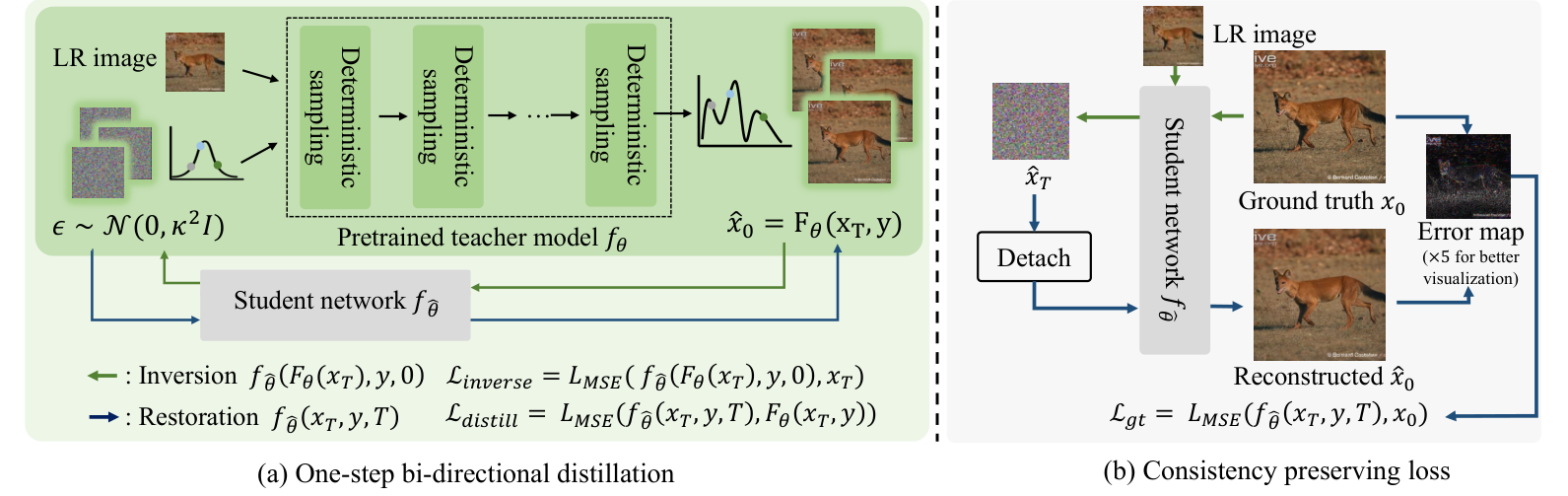
Figure source: [3], arXiv:2311.14760v1, PDF page 4. Original PDF.
Deterministic teacher. Begin with the ResShift marginal . A non-Markovian deterministic update can retain the intended forward marginals in the ideal derivation. The reverse update is affine in the predicted HR image:
Here is the frozen pretrained restorer, and are coefficients derived from the shift schedule. In particular, , and . The update removes newly sampled reverse noise, while the initial LR-centered state remains random.
Teacher endpoint. With for standard Gaussian , run that deterministic teacher to obtain . This map is fixed for a given start and observation. Constructing it requires multiple teacher evaluations during training, but those evaluations are not part of the student’s one-step deployment.
Direct distillation. Initialize the student from the teacher. Its restoration query uses time , and minimizes . Time here also distinguishes restoration from the inverse query; it is not an invitation to use an arbitrary untrained intermediate-step sampler.
Learned inverse. The same network queried at time 0 predicts a starting state from a teacher-generated HR endpoint. The inverse loss compares with . This encourages a bidirectional relation between generated images and starting states without adding a separate inverse network at deployment.
Ground-truth cycle. Encode a real paired HR target with the learned inverse, then restore it:
The stop-gradient operation is essential. Without it, the inverse can hide extra HR residual information in a starting state whose distribution differs from the LR-plus-noise states used at inference. The decoder/restoration branch could then solve an easier training task that is unavailable during deployment.
Complete loss and use. The paper combines endpoint, inverse and ground-truth terms with equal default weights. It trains on paired synthetic degradations using the teacher’s representation. Deployment forms one LR-conditioned starting state and makes the restoration query, then decodes. The generated sample can still change with its initial random draw. Holding that draw fixed is useful for comparing settings, but makes only the sampling procedure repeatable; it does not validate the image details. Input resizing and latent decoding also remain part of the complete runtime. It does not run the inverse cycle or teacher online.
Results
On the paper’s ImageNet-Test comparison, SinSR’s one-step LPIPS is 0.221 and CLIPIQA 0.611, compared with 0.228 and 0.603 for 15-step ResShift in the same table. A one-step call to the unchanged ResShift model has LPIPS 0.383 and CLIPIQA 0.340. Learning the endpoint therefore differs substantially from simply truncating the teacher.
For ×4 restoration from 64 × 64 to 256 × 256 on an A100, batch-one runtime is 0.058 seconds for SinSR and 0.633 for 15-step ResShift. At batch size 64, per-image times change to 0.012 and 0.047 seconds. The measured ratio depends on batching; neither row predicts an invariant speedup on every deployment device or larger image size.
Ablations
The supplementary loss study reports ImageNet-Test PSNR/LPIPS/CLIPIQA of 24.69/0.222/0.607 for endpoint distillation alone and 24.56/0.221/0.611 for the complete default. Removing endpoint distillation while retaining the inverse/GT terms gives 23.49/0.226/0.671. The last variant improves a no-reference score but reduces pixel fidelity, illustrating why the three terms are balanced.
The stop-gradient study on RealSet65 gives CLIPIQA 0.6536 for distillation only, 0.6994 for the cycle without detaching, and 0.7150 for the selected detached cycle. The corresponding MUSIQ values are 61.330, 61.342 and 62.169. Visualizations of the inferred starting noise also show the distribution mismatch without detaching. This evidence supports the gradient boundary, rather than treating it as an implementation detail with no learning consequence.
Conclusion
A deterministic image-conditioned teacher map can be distilled directly. A learned inverse lets paired HR data add supervision, and stopping gradients through that inverse prevents an unavailable information shortcut.
Problems
The student inherits its restoration-specific teacher and synthetic degradation assumptions. One-step output can still have invented or missing detail. The inverse cycle is not proof that every generated sample is invertible or that starting noise remains perfectly Gaussian. Larger pretrained-prior methods use different objectives and capacities; their scores should not be interpreted as an isolated comparison of one-step distillation losses.
References
- R. Wu, L. Sun, Z. Ma, L. Zhang, “One-Step Effective Diffusion Network for Real-World Image Super-Resolution,” NeurIPS, 2024. source
- Z. Yue, J. Wang, C. C. Loy, “ResShift: Efficient Diffusion Model for Image Super-resolution by Residual Shifting,” NeurIPS, 2023. source
- Y. Wang, W. Yang, X. Chen, et al., “SinSR: Diffusion-Based Image Super-Resolution in a Single Step,” CVPR, 2024. source · supplementary ablations
- A. Zhang, Z. Yue, R. Pei, W. Ren, X. Cao, “Degradation-Guided One-Step Image Super-Resolution with Diffusion Priors,” arXiv preprint, 2024. paper
- Y. Tai, R. Xie, C. Zhao, K. Zhang, Z. Zhang, J. Zhou, J. Yang, “AddSR: Accelerating diffusion-based blind super-resolution with adversarial diffusion distillation,” Pattern Recognition, 2026. published version · manuscript supplying the discussed tables
- L. Dong, Q. Fan, Y. Guo, Z. Wang, Q. Zhang, J. Chen, Y. Luo, C. Zou, “TSD-SR: One-Step Diffusion with Target Score Distillation for Real-World Image Super-Resolution,” CVPR, 2025. paper
- Z. Yue, K. Liao, C. C. Loy, “Arbitrary-steps Image Super-resolution via Diffusion Inversion,” CVPR, 2025. paper
- L. Sun, R. Wu, Z. Ma, S. Liu, Q. Yi, L. Zhang, “Pixel-level and Semantic-level Adjustable Super-resolution: A Dual-LoRA Approach,” CVPR, 2025. paper
- A. Liu, Y. Liu, J. Gu, Y. Qiao, C. Dong, “Blind Image Super-Resolution: A Survey and Beyond,” IEEE TPAMI (early access), 2022. source
- B. B. Moser, A. S. Shanbhag, F. Raue, S. Frolov, S. Palacio and A. Dengel, “Diffusion Models, Image Super-Resolution, and Everything: A Survey,” IEEE Transactions on Neural Networks and Learning Systems, vol. 36, no. 7, pp. 11793–11813, 2025. doi · arXiv
- E. J. Hu, Y. Shen, P. Wallis, Z. Allen-Zhu, Y. Li, S. Wang, L. Wang, W. Chen, “LoRA: Low-Rank Adaptation of Large Language Models,” ICLR, 2022. source
- R. Zhang, P. Isola, A. A. Efros, E. Shechtman and O. Wang, “The Unreasonable Effectiveness of Deep Features as a Perceptual Metric,” in Proc. IEEE/CVF CVPR, 2018, pp. 586–595. doi · arXiv
- Z. Wang, C. Lu, Y. Wang, F. Bao, C. Li, H. Su, J. Zhu, “ProlificDreamer: High-Fidelity and Diverse Text-to-3D Generation with Variational Score Distillation,” NeurIPS, 2023. paper
- A. Sauer, D. Lorenz, A. Blattmann, R. Rombach, “Adversarial Diffusion Distillation,” ECCV, 2024. paper
- J. Cai, H. Zeng, H. Yong, Z. Cao, L. Zhang, “Toward Real-World Single Image Super-Resolution: A New Benchmark and a New Model,” Proceedings of the IEEE/CVF International Conference on Computer Vision, 2019. source
- P. Wei, Z. Xie, H. Lu, Z. Zhan, Q. Ye, W. Zuo, L. Lin, “Component Divide-and-Conquer for Real-World Image Super-Resolution,” ECCV, 2020. source
- E. Agustsson and R. Timofte, “NTIRE 2017 Challenge on Single Image Super-Resolution: Dataset and Study,” in Proc. IEEE CVPR Workshops, 2017, pp. 1122–1131. doi · CVF
- Z. Wang, A. C. Bovik, H. R. Sheikh and E. P. Simoncelli, “Image Quality Assessment: From Error Visibility to Structural Similarity,” IEEE Transactions on Image Processing, vol. 13, no. 4, pp. 600–612, 2004. doi
- K. Ding, K. Ma, S. Wang, E. P. Simoncelli, “Image Quality Assessment: Unifying Structure and Texture Similarity,” IEEE TPAMI, 2022. source
- A. Mittal, R. Soundararajan and A. C. Bovik, “Making a “Completely Blind” Image Quality Analyzer,” IEEE Signal Processing Letters, vol. 20, no. 3, pp. 209–212, 2013. doi
- J. Ke, Q. Wang, Y. Wang, P. Milanfar, F. Yang, “MUSIQ: Multi-scale Image Quality Transformer,” ICCV, 2021. source
- S. Yang, T. Wu, S. Shi, S. Lao, Y. Gong, M. Cao, J. Wang, Y. Yang, “MANIQA: Multi-dimension Attention Network for No-Reference Image Quality Assessment,” CVPR Workshops, 2022. source
- J. Wang, K. C. K. Chan, C. C. Loy, “Exploring CLIP for Assessing the Look and Feel of Images,” AAAI, 2023. source
- X. Fan, Z. Wu, H. Wu, L. Cao, “A Survey on Pre-Trained Diffusion Model Distillations,” arXiv preprint, version 2, 2025. paper
- Z. Wu, Y. Dong, X. Wei, “TUDSR: Twice Upsampling-Diffusion for Higher Super-Resolution,” CVPR, 2026. paper
- P. Esser, R. Rombach, B. Ommer, “Taming Transformers for High-Resolution Image Synthesis,” CVPR, 2021. paper
- X. Wang, L. Xie, C. Dong, Y. Shan, “Real-ESRGAN: Training Real-World Blind Super-Resolution With Pure Synthetic Data,” Proceedings of the IEEE/CVF International Conference on Computer Vision, 2021. source
- J. Deng, W. Dong, R. Socher, L. Li, Kai Li, Li Fei-Fei, “ImageNet: A large-scale hierarchical image database,” CVPR, 2009. doi
- R. Rombach, A. Blattmann, D. Lorenz, P. Esser, B. Ommer, “High-Resolution Image Synthesis with Latent Diffusion Models,” CVPR, 2022. source
- R. Wu, T. Yang, L. Sun, Z. Zhang, S. Li, L. Zhang, “SeeSR: Towards Semantics-Aware Real-World Image Super-Resolution,” Proceedings of the IEEE/CVF Conference on Computer Vision and Pattern Recognition, 2024. source · supplementary experiments
- H. Liu, C. Li, Q. Wu, Y. J. Lee, “Visual Instruction Tuning,” NeurIPS, 2023. source
- Y. Li, K. Zhang, J. Liang, et al., “LSDIR: A Large Scale Dataset for Image Restoration,” CVPR Workshops, 2023. paper
- T. Karras, S. Laine, T. Aila, “A Style-Based Generator Architecture for Generative Adversarial Networks,” CVPR, 2019. paper
- I. Loshchilov, F. Hutter, “Decoupled Weight Decay Regularization,” ICLR, 2019. paper
- P. Esser, S. Kulal, A. Blattmann, et al., “Scaling Rectified Flow Transformers for High-Resolution Image Synthesis,” ICML, 2024. paper
- J. Ho, T. Salimans, “Classifier-Free Diffusion Guidance,” arXiv preprint, 2022. paper
- R. Timofte, E. Agustsson, L. Van Gool, M.-H. Yang, L. Zhang et al., “NTIRE 2017 Challenge on Single Image Super-Resolution: Methods and Results,” in Proc. IEEE CVPR Workshops, 2017, pp. 1110–1121. doi · CVF