TSD-SR: target-aware score regularization (CVPR 2025)
Optional · paper guide 5 of 8 for DLCV 09A.2 · One-Step Diffusion Super-Resolution. Citation numbers refer to the reference list at the bottom of this page.
Navigate: this page and this track: Navigate: this page and this track
On this page
- ResShift: a short restoration-conditioned chain (NeurIPS 2023)
- SinSR: distilling a deterministic image-conditioned map (CVPR 2024)
- OSEDiff: LR-latent start and variational score regularization (NeurIPS 2024)
- S3Diff: degradation-guided low-rank adaptation
- TSD-SR: target-aware score regularization (CVPR 2025)
- InvSR: a learned image-conditioned start (CVPR 2025)
- PiSA-SR: separate pixel and semantic adaptation (CVPR 2025)
- AddSR: prediction-refined adversarial restoration distillation
Deep Learning for Computer Vision
Challenge
A pretrained diffusion teacher can give an unreliable optimization direction when the current student output is poor. TSD-SR investigates this problem in real-world SR, where low-frequency structure is supplied by an LR input but high-frequency content is missing [6]. It uses the paired HR target during training to improve the score-based signal, rather than relying only on a teacher prediction evaluated at a generated sample.
The method also changes which noisy states are used for regularization. Uniformly sampling a time and independently adding noise may under-emphasize difficult detail-forming regions of the adapted trajectory. TSD-SR combines a target-aware score term with distribution-aware sampling. These are training changes; the HR target and additional sampled trajectory are unavailable during deployment.
Method
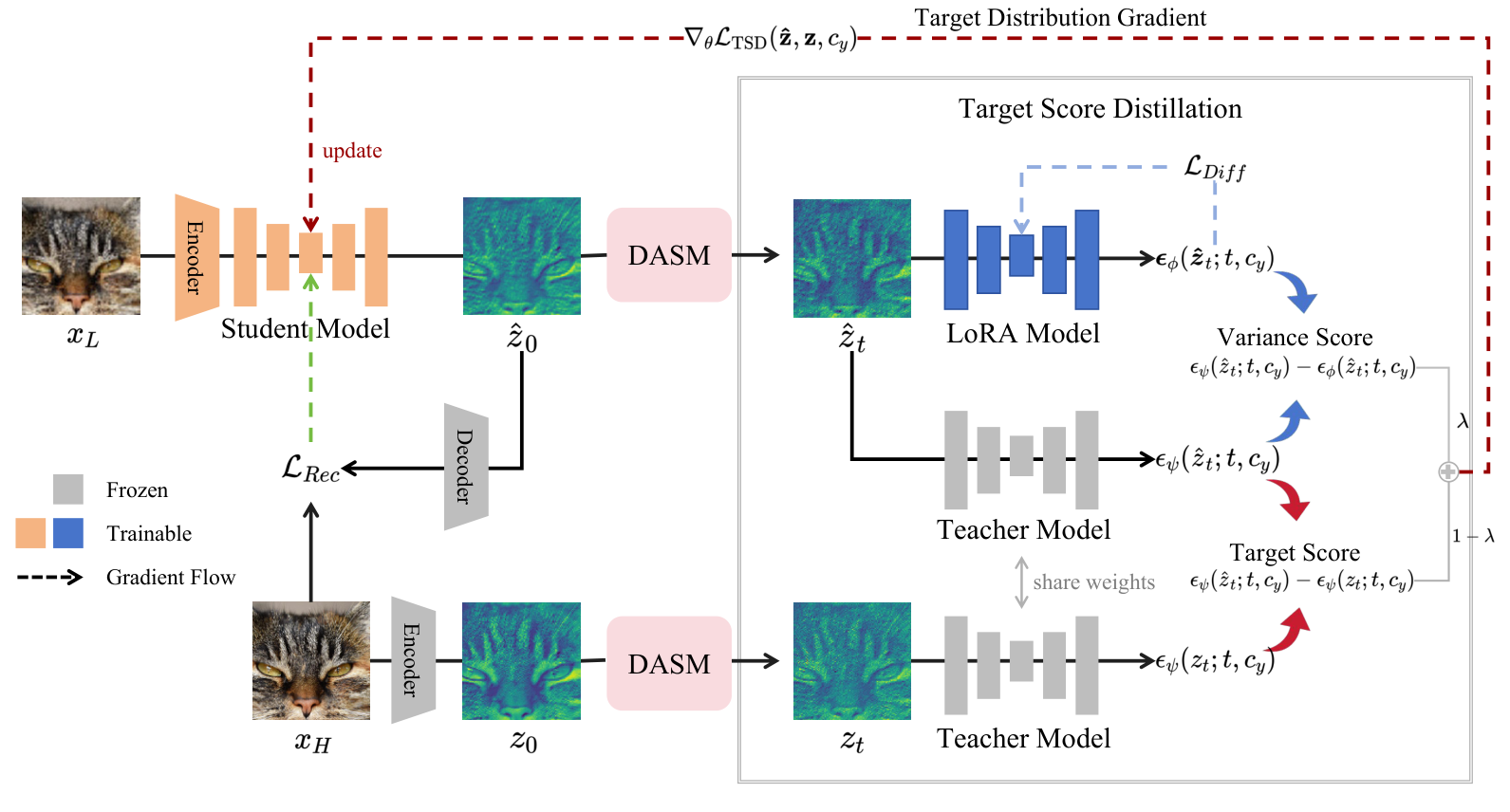
Figure source: [6], arXiv:2411.18263v4, PDF page 3. Original PDF.
Student and score models. A one-step image-conditioned student predicts an HR latent . A frozen pretrained teacher predicts a target-prior direction, while an adapted low-rank model estimates the student distribution. The main experiments use a pretrained flow-matching image-generation backbone [35], with additional smaller-backbone comparisons. The student encoder and denoising network are adapted while the image decoder remains fixed.
Ordinary variational score signal. For a noised generated latent , the difference between the fixed teacher prediction and adapted generated-distribution prediction supplies a prior gradient. This is the same general role as the two regularizers in OSEDiff. Its reliability depends on the predictions being meaningful at the actual generated states; a powerful teacher is not automatically calibrated on every poor early-training sample.
Target-score comparison. Encode the paired HR target as and construct a corresponding noised target state . Compare the teacher’s predictions on and . The gradient direction contains a term proportional to , where denotes fixed teacher parameters and training text conditioning. This is a paired target-aware signal, not a theorem that scores at arbitrary points from one distribution should be equal.
Combined direction. The paper combines target-score matching with variational score distillation. One expression is
Here is the adapted generated-distribution model and balances the terms. A time weight and the student latent’s parameter Jacobian turn this vector into a generator update. At a special endpoint of the weighting this reduces algebraically to the ordinary score-difference direction; intermediate weighting introduces paired HR-target information. Predictions are used as gradient targets, not as an explicitly evaluated clean-image density.
Distribution-aware sampling. Start from noised generated and HR latents, then use short adapted-model denoising transitions to produce multiple regularization states. Accumulating gradients over these states emphasizes regions of the trajectory that a single uniformly sampled comparison may miss. The module’s parameters include the number of sampled states and their spacing. More states increase training work and do not necessarily improve the result.
Other supervision. The student combines pixel-space LPIPS with latent-space MSE and the target-score regularizer. The adapted score model has its own diffusion training loss. The implementation first stabilizes training without the full distribution-aware module, then introduces it. Training prompts for the teacher/score models can come from HR images; the deployed student uses a default prompt. Consequently, the complete training diagram should not be interpreted as requiring an HR-caption extractor at inference.
Results
The main one-step comparison reports, on RealSR, PSNR 24.81, LPIPS 0.2743, DISTS 0.2104, FID 114.45 and MUSIQ 71.19. On synthetic DIV2K validation crops, it reports 23.02/0.2673/0.1821/29.16/71.69 for those measures. These rows show improved selected perceptual measures with lower pixel fidelity than some restoration baselines. The main backbone differs from OSEDiff’s, so the cross-method table is not an objective-only experiment.
The paper therefore also plugs the training idea into smaller pretrained backbones. Those comparisons help assess whether the target-aware changes matter apart from the larger prior. No-reference scores and preference studies remain measurements of the tested images, not proof that the method recovers every missing scene feature.
Ablations
On DRealSR, removing target-score matching gives LPIPS 0.3176, DISTS 0.2327 and MUSIQ 63.90. Removing distribution-aware sampling gives 0.3097, 0.2311 and 63.56. The complete setting gives 0.2967, 0.2136 and 66.62. On RealSR, the corresponding LPIPS values are 0.2934, 0.2873 and 0.2743. These controlled comparisons support both components under the tested setup.
For distribution-aware sampling at the selected spacing, two, four and eight sampled states give LPIPS 0.3104, 0.2967 and 0.3421 on DRealSR. More states are not automatically better. The paper also compares spacing choices. These are regularizer-training settings, not additional deployed SR steps.
Conclusion
Paired HR targets can improve how a pretrained prior guides a one-step restorer, while trajectory-aware training states change where that guidance is applied. The method addresses score-target and training-distribution errors rather than merely using a larger inference budget.
Problems
The procedure needs paired data, auxiliary models and extra training transitions. Teacher-score predictions remain approximations, and target-aware training does not create HR evidence for a new input. Larger-backbone comparisons mix capacity and objectives unless controlled. Pixel fidelity, predicted appearance and semantics can still disagree, so one-step output needs the same detailed inspection as slower generative restoration.
References
- R. Wu, L. Sun, Z. Ma, L. Zhang, “One-Step Effective Diffusion Network for Real-World Image Super-Resolution,” NeurIPS, 2024. source
- Z. Yue, J. Wang, C. C. Loy, “ResShift: Efficient Diffusion Model for Image Super-resolution by Residual Shifting,” NeurIPS, 2023. source
- Y. Wang, W. Yang, X. Chen, et al., “SinSR: Diffusion-Based Image Super-Resolution in a Single Step,” CVPR, 2024. source · supplementary ablations
- A. Zhang, Z. Yue, R. Pei, W. Ren, X. Cao, “Degradation-Guided One-Step Image Super-Resolution with Diffusion Priors,” arXiv preprint, 2024. paper
- Y. Tai, R. Xie, C. Zhao, K. Zhang, Z. Zhang, J. Zhou, J. Yang, “AddSR: Accelerating diffusion-based blind super-resolution with adversarial diffusion distillation,” Pattern Recognition, 2026. published version · manuscript supplying the discussed tables
- L. Dong, Q. Fan, Y. Guo, Z. Wang, Q. Zhang, J. Chen, Y. Luo, C. Zou, “TSD-SR: One-Step Diffusion with Target Score Distillation for Real-World Image Super-Resolution,” CVPR, 2025. paper
- Z. Yue, K. Liao, C. C. Loy, “Arbitrary-steps Image Super-resolution via Diffusion Inversion,” CVPR, 2025. paper
- L. Sun, R. Wu, Z. Ma, S. Liu, Q. Yi, L. Zhang, “Pixel-level and Semantic-level Adjustable Super-resolution: A Dual-LoRA Approach,” CVPR, 2025. paper
- A. Liu, Y. Liu, J. Gu, Y. Qiao, C. Dong, “Blind Image Super-Resolution: A Survey and Beyond,” IEEE TPAMI (early access), 2022. source
- B. B. Moser, A. S. Shanbhag, F. Raue, S. Frolov, S. Palacio and A. Dengel, “Diffusion Models, Image Super-Resolution, and Everything: A Survey,” IEEE Transactions on Neural Networks and Learning Systems, vol. 36, no. 7, pp. 11793–11813, 2025. doi · arXiv
- E. J. Hu, Y. Shen, P. Wallis, Z. Allen-Zhu, Y. Li, S. Wang, L. Wang, W. Chen, “LoRA: Low-Rank Adaptation of Large Language Models,” ICLR, 2022. source
- R. Zhang, P. Isola, A. A. Efros, E. Shechtman and O. Wang, “The Unreasonable Effectiveness of Deep Features as a Perceptual Metric,” in Proc. IEEE/CVF CVPR, 2018, pp. 586–595. doi · arXiv
- Z. Wang, C. Lu, Y. Wang, F. Bao, C. Li, H. Su, J. Zhu, “ProlificDreamer: High-Fidelity and Diverse Text-to-3D Generation with Variational Score Distillation,” NeurIPS, 2023. paper
- A. Sauer, D. Lorenz, A. Blattmann, R. Rombach, “Adversarial Diffusion Distillation,” ECCV, 2024. paper
- J. Cai, H. Zeng, H. Yong, Z. Cao, L. Zhang, “Toward Real-World Single Image Super-Resolution: A New Benchmark and a New Model,” Proceedings of the IEEE/CVF International Conference on Computer Vision, 2019. source
- P. Wei, Z. Xie, H. Lu, Z. Zhan, Q. Ye, W. Zuo, L. Lin, “Component Divide-and-Conquer for Real-World Image Super-Resolution,” ECCV, 2020. source
- E. Agustsson and R. Timofte, “NTIRE 2017 Challenge on Single Image Super-Resolution: Dataset and Study,” in Proc. IEEE CVPR Workshops, 2017, pp. 1122–1131. doi · CVF
- Z. Wang, A. C. Bovik, H. R. Sheikh and E. P. Simoncelli, “Image Quality Assessment: From Error Visibility to Structural Similarity,” IEEE Transactions on Image Processing, vol. 13, no. 4, pp. 600–612, 2004. doi
- K. Ding, K. Ma, S. Wang, E. P. Simoncelli, “Image Quality Assessment: Unifying Structure and Texture Similarity,” IEEE TPAMI, 2022. source
- A. Mittal, R. Soundararajan and A. C. Bovik, “Making a “Completely Blind” Image Quality Analyzer,” IEEE Signal Processing Letters, vol. 20, no. 3, pp. 209–212, 2013. doi
- J. Ke, Q. Wang, Y. Wang, P. Milanfar, F. Yang, “MUSIQ: Multi-scale Image Quality Transformer,” ICCV, 2021. source
- S. Yang, T. Wu, S. Shi, S. Lao, Y. Gong, M. Cao, J. Wang, Y. Yang, “MANIQA: Multi-dimension Attention Network for No-Reference Image Quality Assessment,” CVPR Workshops, 2022. source
- J. Wang, K. C. K. Chan, C. C. Loy, “Exploring CLIP for Assessing the Look and Feel of Images,” AAAI, 2023. source
- X. Fan, Z. Wu, H. Wu, L. Cao, “A Survey on Pre-Trained Diffusion Model Distillations,” arXiv preprint, version 2, 2025. paper
- Z. Wu, Y. Dong, X. Wei, “TUDSR: Twice Upsampling-Diffusion for Higher Super-Resolution,” CVPR, 2026. paper
- P. Esser, R. Rombach, B. Ommer, “Taming Transformers for High-Resolution Image Synthesis,” CVPR, 2021. paper
- X. Wang, L. Xie, C. Dong, Y. Shan, “Real-ESRGAN: Training Real-World Blind Super-Resolution With Pure Synthetic Data,” Proceedings of the IEEE/CVF International Conference on Computer Vision, 2021. source
- J. Deng, W. Dong, R. Socher, L. Li, Kai Li, Li Fei-Fei, “ImageNet: A large-scale hierarchical image database,” CVPR, 2009. doi
- R. Rombach, A. Blattmann, D. Lorenz, P. Esser, B. Ommer, “High-Resolution Image Synthesis with Latent Diffusion Models,” CVPR, 2022. source
- R. Wu, T. Yang, L. Sun, Z. Zhang, S. Li, L. Zhang, “SeeSR: Towards Semantics-Aware Real-World Image Super-Resolution,” Proceedings of the IEEE/CVF Conference on Computer Vision and Pattern Recognition, 2024. source · supplementary experiments
- H. Liu, C. Li, Q. Wu, Y. J. Lee, “Visual Instruction Tuning,” NeurIPS, 2023. source
- Y. Li, K. Zhang, J. Liang, et al., “LSDIR: A Large Scale Dataset for Image Restoration,” CVPR Workshops, 2023. paper
- T. Karras, S. Laine, T. Aila, “A Style-Based Generator Architecture for Generative Adversarial Networks,” CVPR, 2019. paper
- I. Loshchilov, F. Hutter, “Decoupled Weight Decay Regularization,” ICLR, 2019. paper
- P. Esser, S. Kulal, A. Blattmann, et al., “Scaling Rectified Flow Transformers for High-Resolution Image Synthesis,” ICML, 2024. paper
- J. Ho, T. Salimans, “Classifier-Free Diffusion Guidance,” arXiv preprint, 2022. paper
- R. Timofte, E. Agustsson, L. Van Gool, M.-H. Yang, L. Zhang et al., “NTIRE 2017 Challenge on Single Image Super-Resolution: Methods and Results,” in Proc. IEEE CVPR Workshops, 2017, pp. 1110–1121. doi · CVF