AddSR: prediction-refined adversarial restoration distillation
Optional · paper guide 8 of 8 for DLCV 09A.2 · One-Step Diffusion Super-Resolution. Citation numbers refer to the reference list at the bottom of this page.
Navigate: this page and this track: Navigate: this page and this track
On this page
- ResShift: a short restoration-conditioned chain (NeurIPS 2023)
- SinSR: distilling a deterministic image-conditioned map (CVPR 2024)
- OSEDiff: LR-latent start and variational score regularization (NeurIPS 2024)
- S3Diff: degradation-guided low-rank adaptation
- TSD-SR: target-aware score regularization (CVPR 2025)
- InvSR: a learned image-conditioned start (CVPR 2025)
- PiSA-SR: separate pixel and semantic adaptation (CVPR 2025)
- AddSR: prediction-refined adversarial restoration distillation
Deep Learning for Computer Vision
Challenge
An adversarially distilled text-to-image generator is not automatically a good blind restorer. It can generate attractive details that drift from the observation, and the balance between realism and fidelity can change across a few refinement steps. AddSR combines an image-conditioned teacher, adversarial distillation and prediction-based condition refinement [5].
The paper supports one- and four-step settings. Its strongest perceptual setting is not interchangeable with a one-step result. That budget distinction is central to understanding the method: a progressively refined condition supplies information that is absent from the first call.
Method
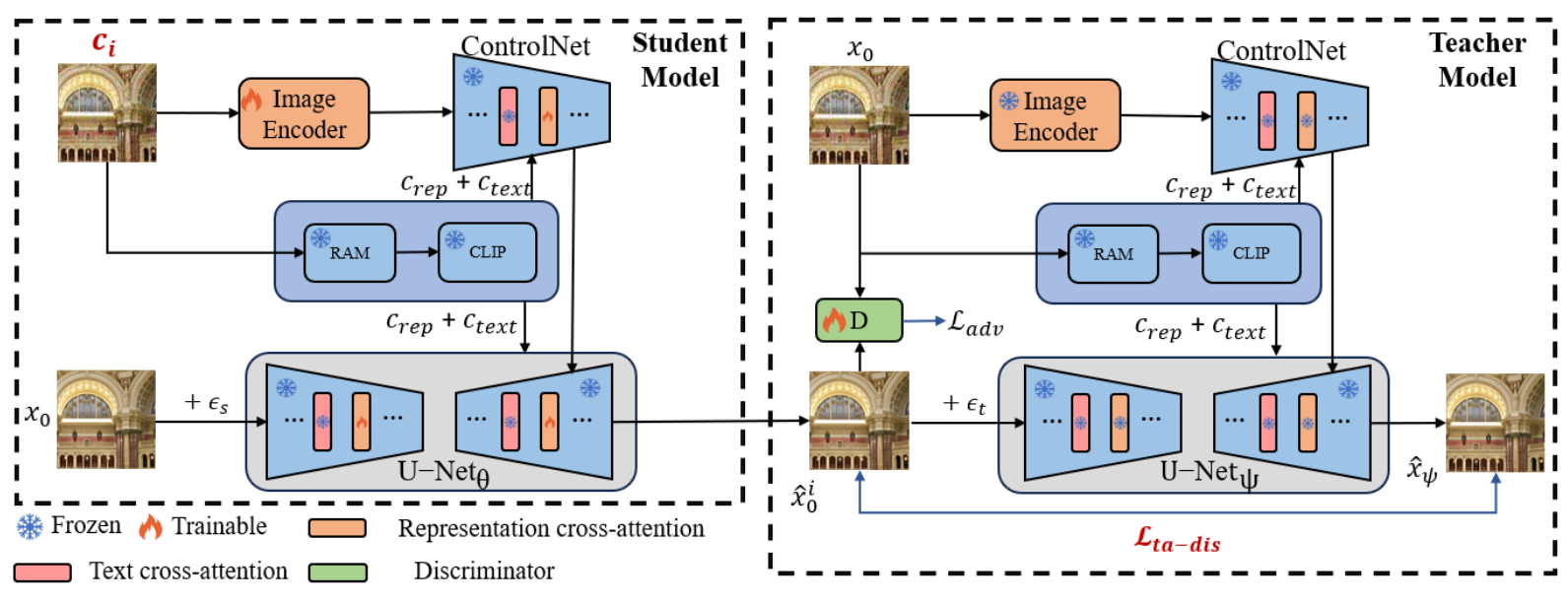
Figure source: [5], arXiv:2404.01717v4, PDF page 4. Original PDF.
Teacher and student. The linked manuscript uses a SeeSR-based restoration teacher [30]. The student is initialized from that teacher, retaining an image-conditioned diffusion architecture with semantic/image control. A discriminator supplies additional appearance supervision. The three networks have different roles: teacher knowledge is fixed during distillation, the student learns the fast restoration map, and the discriminator learns a real-versus-generated distinction.
Training states. Sample a student timestep from a small predefined set and noise an HR training image at that level. The student receives the noisy state, a condition image and semantic conditions. A teacher path supplies a denoising target under its training condition. The manuscript refines teacher conditioning using HR data available at training time, reducing degradation in that supervision. HR conditioning is a training advantage, not an available deployment observation.
Prediction-based self-refinement. At the first inference step, the condition is the LR image. Later steps use the previous predicted clean HR image as the next condition. Given a noisy state and noise prediction , a clean estimate is formed by the standard schedule conversion. This estimate can contain more recovered structure than the original LR condition, but it can also contain mistakes. Feeding it back can reinforce either.
Adaptive distillation weighting. The relative strength of the adversarial and teacher losses changes with both teacher and student timesteps. The paper motivates stronger appearance supervision at very short budgets and increased distillation influence during refinement, when uncontrolled adversarial detail could drift further. It uses a two-time weighting rather than assuming one fixed weight is suitable for all student queries.
Discriminator. A pretrained image-feature backbone with trainable heads judges real and generated results, with image conditioning. This supplies a local/global appearance signal beyond endpoint regression. The discriminator does not know the original HR scene for every real deployment image; its learned realness score cannot certify missing-detail accuracy.
Data and representation. The manuscript trains on restoration photo collections, including DIV2K, Flickr2K, LSDIR and a face subset [17], [37], [32], [33], with Real-ESRGAN-style damage [27]. A latent image model reduces repeated spatial computation, while encoding/decoding and semantic extraction remain part of the complete system. The final journal publication has verified bibliographic metadata; the numerical examples here refer to the linked manuscript’s tables.
Results
For the manuscript’s synthetic ×4 single-degradation comparison, one-step AddSR gives PSNR 22.70, LPIPS 0.2872, MUSIQ 63.05 and CLIPIQA 0.5572. Four-step AddSR gives 21.83, 0.2812, 71.43 and 0.7794. The longer setting substantially increases those NR scores while lowering PSNR. It is therefore misleading to describe the four-step appearance result as one-step fidelity preservation.
The paper evaluates several degradation settings and real-image collections, emphasizing human preference and predicted quality. Those tests demonstrate selected appearance advantages but do not settle factual reconstruction. A model may look more detailed while changing a discrete object feature, and an averaged metric can hide that failure.
Ablations
The refined-training study separately changes the teacher’s condition image and semantic condition extraction. On RealLR200, the row using neither refinement has MUSIQ 70.75 and CLIPIQA 0.7431; the complete refined configuration has 72.62 and 0.7724. On DRealSR, the same rows have PSNR 26.96 and 26.09. The improvement in predicted appearance is accompanied by lower reference fidelity, so the refinement should not be summarized as uniformly better reconstruction.
Additional experiments compare timestep-weighting forms and their hyperparameters. The paper selects an exponential form, while changing its balance yields different perceptual/fidelity operating points. These are controlled training and sampling comparisons, not a proof that a particular weight eliminates hallucination. Visual examples illustrate that adaptive weighting can reduce some semantic drift in a refined output.
Conclusion
A few-step restoration student benefits from image-conditioned teacher knowledge, a realistic-appearance objective and conditions updated from its own predictions. The objective balance must account for the student’s selected budget.
Problems
Refinement can amplify an earlier mistake. Adversarial sharpness and preferred appearance do not guarantee correct missing detail. Training uses paired HR information unavailable during real inference, and synthetic processing still limits generalization. One- and four-step costs and scores must remain separate. The system includes conditioning networks and a pretrained latent model, so a count of diffusion updates alone is an incomplete deployment description.
References
- R. Wu, L. Sun, Z. Ma, L. Zhang, “One-Step Effective Diffusion Network for Real-World Image Super-Resolution,” NeurIPS, 2024. source
- Z. Yue, J. Wang, C. C. Loy, “ResShift: Efficient Diffusion Model for Image Super-resolution by Residual Shifting,” NeurIPS, 2023. source
- Y. Wang, W. Yang, X. Chen, et al., “SinSR: Diffusion-Based Image Super-Resolution in a Single Step,” CVPR, 2024. source · supplementary ablations
- A. Zhang, Z. Yue, R. Pei, W. Ren, X. Cao, “Degradation-Guided One-Step Image Super-Resolution with Diffusion Priors,” arXiv preprint, 2024. paper
- Y. Tai, R. Xie, C. Zhao, K. Zhang, Z. Zhang, J. Zhou, J. Yang, “AddSR: Accelerating diffusion-based blind super-resolution with adversarial diffusion distillation,” Pattern Recognition, 2026. published version · manuscript supplying the discussed tables
- L. Dong, Q. Fan, Y. Guo, Z. Wang, Q. Zhang, J. Chen, Y. Luo, C. Zou, “TSD-SR: One-Step Diffusion with Target Score Distillation for Real-World Image Super-Resolution,” CVPR, 2025. paper
- Z. Yue, K. Liao, C. C. Loy, “Arbitrary-steps Image Super-resolution via Diffusion Inversion,” CVPR, 2025. paper
- L. Sun, R. Wu, Z. Ma, S. Liu, Q. Yi, L. Zhang, “Pixel-level and Semantic-level Adjustable Super-resolution: A Dual-LoRA Approach,” CVPR, 2025. paper
- A. Liu, Y. Liu, J. Gu, Y. Qiao, C. Dong, “Blind Image Super-Resolution: A Survey and Beyond,” IEEE TPAMI (early access), 2022. source
- B. B. Moser, A. S. Shanbhag, F. Raue, S. Frolov, S. Palacio and A. Dengel, “Diffusion Models, Image Super-Resolution, and Everything: A Survey,” IEEE Transactions on Neural Networks and Learning Systems, vol. 36, no. 7, pp. 11793–11813, 2025. doi · arXiv
- E. J. Hu, Y. Shen, P. Wallis, Z. Allen-Zhu, Y. Li, S. Wang, L. Wang, W. Chen, “LoRA: Low-Rank Adaptation of Large Language Models,” ICLR, 2022. source
- R. Zhang, P. Isola, A. A. Efros, E. Shechtman and O. Wang, “The Unreasonable Effectiveness of Deep Features as a Perceptual Metric,” in Proc. IEEE/CVF CVPR, 2018, pp. 586–595. doi · arXiv
- Z. Wang, C. Lu, Y. Wang, F. Bao, C. Li, H. Su, J. Zhu, “ProlificDreamer: High-Fidelity and Diverse Text-to-3D Generation with Variational Score Distillation,” NeurIPS, 2023. paper
- A. Sauer, D. Lorenz, A. Blattmann, R. Rombach, “Adversarial Diffusion Distillation,” ECCV, 2024. paper
- J. Cai, H. Zeng, H. Yong, Z. Cao, L. Zhang, “Toward Real-World Single Image Super-Resolution: A New Benchmark and a New Model,” Proceedings of the IEEE/CVF International Conference on Computer Vision, 2019. source
- P. Wei, Z. Xie, H. Lu, Z. Zhan, Q. Ye, W. Zuo, L. Lin, “Component Divide-and-Conquer for Real-World Image Super-Resolution,” ECCV, 2020. source
- E. Agustsson and R. Timofte, “NTIRE 2017 Challenge on Single Image Super-Resolution: Dataset and Study,” in Proc. IEEE CVPR Workshops, 2017, pp. 1122–1131. doi · CVF
- Z. Wang, A. C. Bovik, H. R. Sheikh and E. P. Simoncelli, “Image Quality Assessment: From Error Visibility to Structural Similarity,” IEEE Transactions on Image Processing, vol. 13, no. 4, pp. 600–612, 2004. doi
- K. Ding, K. Ma, S. Wang, E. P. Simoncelli, “Image Quality Assessment: Unifying Structure and Texture Similarity,” IEEE TPAMI, 2022. source
- A. Mittal, R. Soundararajan and A. C. Bovik, “Making a “Completely Blind” Image Quality Analyzer,” IEEE Signal Processing Letters, vol. 20, no. 3, pp. 209–212, 2013. doi
- J. Ke, Q. Wang, Y. Wang, P. Milanfar, F. Yang, “MUSIQ: Multi-scale Image Quality Transformer,” ICCV, 2021. source
- S. Yang, T. Wu, S. Shi, S. Lao, Y. Gong, M. Cao, J. Wang, Y. Yang, “MANIQA: Multi-dimension Attention Network for No-Reference Image Quality Assessment,” CVPR Workshops, 2022. source
- J. Wang, K. C. K. Chan, C. C. Loy, “Exploring CLIP for Assessing the Look and Feel of Images,” AAAI, 2023. source
- X. Fan, Z. Wu, H. Wu, L. Cao, “A Survey on Pre-Trained Diffusion Model Distillations,” arXiv preprint, version 2, 2025. paper
- Z. Wu, Y. Dong, X. Wei, “TUDSR: Twice Upsampling-Diffusion for Higher Super-Resolution,” CVPR, 2026. paper
- P. Esser, R. Rombach, B. Ommer, “Taming Transformers for High-Resolution Image Synthesis,” CVPR, 2021. paper
- X. Wang, L. Xie, C. Dong, Y. Shan, “Real-ESRGAN: Training Real-World Blind Super-Resolution With Pure Synthetic Data,” Proceedings of the IEEE/CVF International Conference on Computer Vision, 2021. source
- J. Deng, W. Dong, R. Socher, L. Li, Kai Li, Li Fei-Fei, “ImageNet: A large-scale hierarchical image database,” CVPR, 2009. doi
- R. Rombach, A. Blattmann, D. Lorenz, P. Esser, B. Ommer, “High-Resolution Image Synthesis with Latent Diffusion Models,” CVPR, 2022. source
- R. Wu, T. Yang, L. Sun, Z. Zhang, S. Li, L. Zhang, “SeeSR: Towards Semantics-Aware Real-World Image Super-Resolution,” Proceedings of the IEEE/CVF Conference on Computer Vision and Pattern Recognition, 2024. source · supplementary experiments
- H. Liu, C. Li, Q. Wu, Y. J. Lee, “Visual Instruction Tuning,” NeurIPS, 2023. source
- Y. Li, K. Zhang, J. Liang, et al., “LSDIR: A Large Scale Dataset for Image Restoration,” CVPR Workshops, 2023. paper
- T. Karras, S. Laine, T. Aila, “A Style-Based Generator Architecture for Generative Adversarial Networks,” CVPR, 2019. paper
- I. Loshchilov, F. Hutter, “Decoupled Weight Decay Regularization,” ICLR, 2019. paper
- P. Esser, S. Kulal, A. Blattmann, et al., “Scaling Rectified Flow Transformers for High-Resolution Image Synthesis,” ICML, 2024. paper
- J. Ho, T. Salimans, “Classifier-Free Diffusion Guidance,” arXiv preprint, 2022. paper
- R. Timofte, E. Agustsson, L. Van Gool, M.-H. Yang, L. Zhang et al., “NTIRE 2017 Challenge on Single Image Super-Resolution: Methods and Results,” in Proc. IEEE CVPR Workshops, 2017, pp. 1110–1121. doi · CVF