S3Diff: degradation-guided low-rank adaptation
Optional · paper guide 4 of 8 for DLCV 09A.2 · One-Step Diffusion Super-Resolution. Citation numbers refer to the reference list at the bottom of this page.
Navigate: this page and this track: Navigate: this page and this track
On this page
- ResShift: a short restoration-conditioned chain (NeurIPS 2023)
- SinSR: distilling a deterministic image-conditioned map (CVPR 2024)
- OSEDiff: LR-latent start and variational score regularization (NeurIPS 2024)
- S3Diff: degradation-guided low-rank adaptation
- TSD-SR: target-aware score regularization (CVPR 2025)
- InvSR: a learned image-conditioned start (CVPR 2025)
- PiSA-SR: separate pixel and semantic adaptation (CVPR 2025)
- AddSR: prediction-refined adversarial restoration distillation
Deep Learning for Computer Vision
Challenge
A pretrained one-step image generator is not automatically a reliable SR model. Blur and noise vary between photographs, and a fixed adaptation may under-correct one input while over-correcting another. S3Diff adapts the generator according to estimated damage, while avoiding an expensive semantic captioner for each input [4].
The design asks two separate questions: how should the network’s effective weights depend on degradation, and how should it learn positive/negative quality prompting? The first changes image-conditioned adaptation; the second teaches quality steering. Neither guarantees that an estimated blur/noise vector fully represents a real camera pipeline.
Method
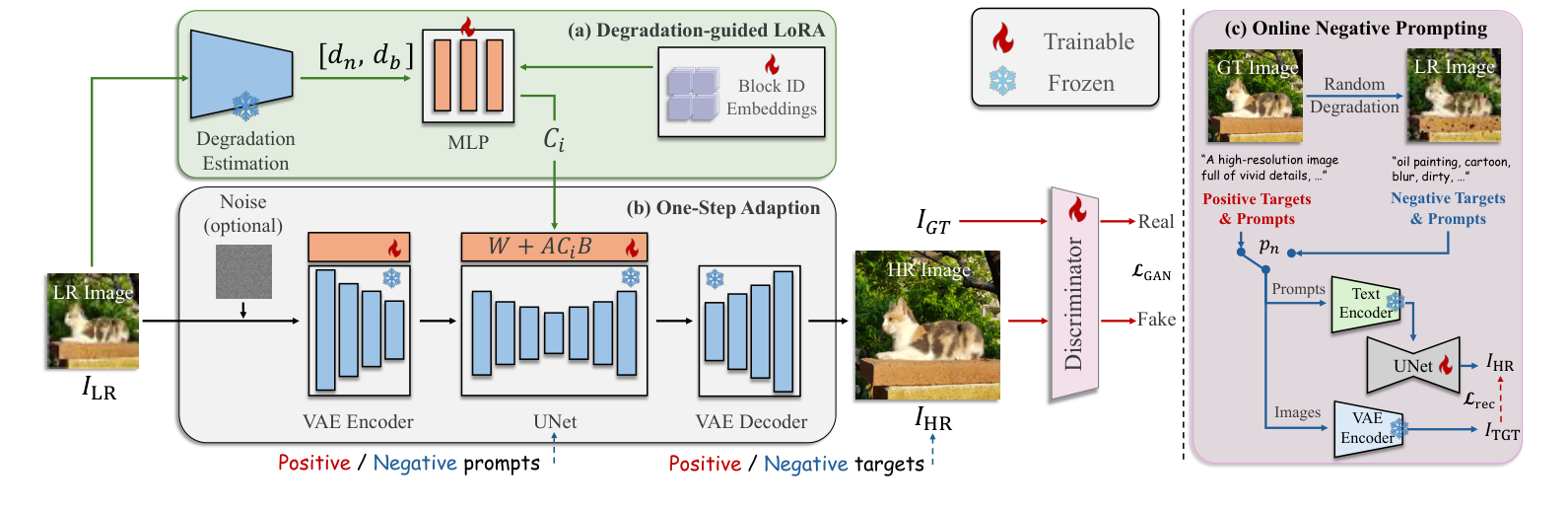
Figure source: [4], arXiv:2409.17058v1, PDF page 5. Original PDF.
Starting prior and image path. The method uses an ADD-derived one-step latent image prior [14]. It feeds the LR-derived image representation with little or no added noise, adapts the VAE encoder and denoiser, and keeps the decoder fixed. The encoder can suppress input defects before the latent transformation. Freezing the decoder preserves the pretrained output representation, with the same general motivation tested by other latent-prior restorers.
Low-rank correction. For , write an adapted weight as , where , and is the rank. S3Diff inserts a learned correction between them: . This changes the effective low-rank directions according to the current degradation descriptor .
Degradation and block identity. A pretrained estimator supplies two normalized values representing blur and noise. A sinusoidal/Fourier embedding and learned mapping process that descriptor. Block-ID embeddings let the shared mapping generate different for different network blocks. A single shared matrix can be too restrictive, while an entirely separate large predictor for every block increases adaptation cost. The block embedding provides an intermediate design.
Dynamic computation. Unlike one globally merged static adapter, the effective correction can vary per input. The matrix factors still restrict its structure and parameter count, but estimation and modulation remain part of the executed system. If a deployment exposes manual degradation values, those are user-supplied estimates, not verified physical measurements.
Online negative targets. During training, a small fraction of targets is replaced by their degraded counterparts and associated with a negative-quality prompt. Positive targets use a generic positive-quality prompt. This teaches the model what negative appearance means using the same damage distribution, instead of relying only on offline generative negative examples. The reported negative-target probability is 0.05. Reconstruction/perceptual supervision applies to the selected target, while adversarial supervision applies to positive HR targets.
Losses and guidance. The generator combines L2, LPIPS and GAN terms, with reported weights 2, 5 and 0.5. The discriminator uses pretrained image features and trainable heads. At inference, positive/negative guidance can combine two conditioned predictions. This is still one state-update step, but the guided configuration must count both denoiser predictions. The source uses a small guidance strength because excessive guidance harms fidelity.
Training setup. The linked manuscript trains on LSDIR and a 10,000-image face subset from FFHQ [32], [33], with Real-ESRGAN-style synthetic damage [27]. Its selected adapter ranks are 16 for the encoder and 32 for the denoiser. Those ranks and the guidance setting belong to the reported version; they are not universal requirements for every low-rank SR model.
Results
In the opened manuscript’s synthetic DIV2K validation comparison, S3Diff gives PSNR 23.40, LPIPS 0.2571, DISTS 0.1730, FID 19.35 and MUSIQ 68.21. On RealSR it gives PSNR 25.03, LPIPS 0.2699 and FID 108.88. These figures describe that paper’s rerun of the compared checkpoints and processing protocol. Its OSEDiff rows differ from OSEDiff’s original tables; use a controlled rerun or keep the source table attached instead of merging them into one canonical score.
The reported improvement concerns the collection of measures and images, not every metric on every dataset. Some stronger-reference baselines have higher PSNR, while different no-reference metrics favor different appearance choices.
Ablations
For degradation-guided LoRA, using a shared correction matrix gives DIV2K LPIPS 0.2613 and MUSIQ 65.52; block-ID-conditioned unshared corrections give 0.2563 and 66.55. On RealSR, the same comparison changes LPIPS from 0.2626 to 0.2573 and MUSIQ from 64.23 to 65.78.
The negative-prompting study on RealSR gives PSNR 25.76 and MUSIQ 66.42 with online negative targets but no guidance; with guidance these become 25.03 and 67.88. Increasing preferred appearance therefore costs reference fidelity in that setting. Encoder/decoder adaptation and rank sweeps provide additional evidence that more trainable capacity or stronger guidance is not automatically better. The dynamic architecture and the guidance must be evaluated together with their cost.
Conclusion
Estimated degradation can modulate a low-rank generative restorer, and online negative targets can teach quality steering without a semantic captioner. These are distinct controls over adaptation and appearance.
Problems
The estimator can misread damage, and blur/noise descriptors omit many processing effects. Dynamic corrections and guided predictions add deployment work. Generic prompts avoid some semantic-extractor cost but do not solve missing-detail ambiguity. The pretrained prior can still invent texture, and parameter-efficient adaptation does not remove the large backbone. Compare the exact checkpoint, guidance and evaluation protocol, since experimental settings can differ between versions.
References
- R. Wu, L. Sun, Z. Ma, L. Zhang, “One-Step Effective Diffusion Network for Real-World Image Super-Resolution,” NeurIPS, 2024. source
- Z. Yue, J. Wang, C. C. Loy, “ResShift: Efficient Diffusion Model for Image Super-resolution by Residual Shifting,” NeurIPS, 2023. source
- Y. Wang, W. Yang, X. Chen, et al., “SinSR: Diffusion-Based Image Super-Resolution in a Single Step,” CVPR, 2024. source · supplementary ablations
- A. Zhang, Z. Yue, R. Pei, W. Ren, X. Cao, “Degradation-Guided One-Step Image Super-Resolution with Diffusion Priors,” arXiv preprint, 2024. paper
- Y. Tai, R. Xie, C. Zhao, K. Zhang, Z. Zhang, J. Zhou, J. Yang, “AddSR: Accelerating diffusion-based blind super-resolution with adversarial diffusion distillation,” Pattern Recognition, 2026. published version · manuscript supplying the discussed tables
- L. Dong, Q. Fan, Y. Guo, Z. Wang, Q. Zhang, J. Chen, Y. Luo, C. Zou, “TSD-SR: One-Step Diffusion with Target Score Distillation for Real-World Image Super-Resolution,” CVPR, 2025. paper
- Z. Yue, K. Liao, C. C. Loy, “Arbitrary-steps Image Super-resolution via Diffusion Inversion,” CVPR, 2025. paper
- L. Sun, R. Wu, Z. Ma, S. Liu, Q. Yi, L. Zhang, “Pixel-level and Semantic-level Adjustable Super-resolution: A Dual-LoRA Approach,” CVPR, 2025. paper
- A. Liu, Y. Liu, J. Gu, Y. Qiao, C. Dong, “Blind Image Super-Resolution: A Survey and Beyond,” IEEE TPAMI (early access), 2022. source
- B. B. Moser, A. S. Shanbhag, F. Raue, S. Frolov, S. Palacio and A. Dengel, “Diffusion Models, Image Super-Resolution, and Everything: A Survey,” IEEE Transactions on Neural Networks and Learning Systems, vol. 36, no. 7, pp. 11793–11813, 2025. doi · arXiv
- E. J. Hu, Y. Shen, P. Wallis, Z. Allen-Zhu, Y. Li, S. Wang, L. Wang, W. Chen, “LoRA: Low-Rank Adaptation of Large Language Models,” ICLR, 2022. source
- R. Zhang, P. Isola, A. A. Efros, E. Shechtman and O. Wang, “The Unreasonable Effectiveness of Deep Features as a Perceptual Metric,” in Proc. IEEE/CVF CVPR, 2018, pp. 586–595. doi · arXiv
- Z. Wang, C. Lu, Y. Wang, F. Bao, C. Li, H. Su, J. Zhu, “ProlificDreamer: High-Fidelity and Diverse Text-to-3D Generation with Variational Score Distillation,” NeurIPS, 2023. paper
- A. Sauer, D. Lorenz, A. Blattmann, R. Rombach, “Adversarial Diffusion Distillation,” ECCV, 2024. paper
- J. Cai, H. Zeng, H. Yong, Z. Cao, L. Zhang, “Toward Real-World Single Image Super-Resolution: A New Benchmark and a New Model,” Proceedings of the IEEE/CVF International Conference on Computer Vision, 2019. source
- P. Wei, Z. Xie, H. Lu, Z. Zhan, Q. Ye, W. Zuo, L. Lin, “Component Divide-and-Conquer for Real-World Image Super-Resolution,” ECCV, 2020. source
- E. Agustsson and R. Timofte, “NTIRE 2017 Challenge on Single Image Super-Resolution: Dataset and Study,” in Proc. IEEE CVPR Workshops, 2017, pp. 1122–1131. doi · CVF
- Z. Wang, A. C. Bovik, H. R. Sheikh and E. P. Simoncelli, “Image Quality Assessment: From Error Visibility to Structural Similarity,” IEEE Transactions on Image Processing, vol. 13, no. 4, pp. 600–612, 2004. doi
- K. Ding, K. Ma, S. Wang, E. P. Simoncelli, “Image Quality Assessment: Unifying Structure and Texture Similarity,” IEEE TPAMI, 2022. source
- A. Mittal, R. Soundararajan and A. C. Bovik, “Making a “Completely Blind” Image Quality Analyzer,” IEEE Signal Processing Letters, vol. 20, no. 3, pp. 209–212, 2013. doi
- J. Ke, Q. Wang, Y. Wang, P. Milanfar, F. Yang, “MUSIQ: Multi-scale Image Quality Transformer,” ICCV, 2021. source
- S. Yang, T. Wu, S. Shi, S. Lao, Y. Gong, M. Cao, J. Wang, Y. Yang, “MANIQA: Multi-dimension Attention Network for No-Reference Image Quality Assessment,” CVPR Workshops, 2022. source
- J. Wang, K. C. K. Chan, C. C. Loy, “Exploring CLIP for Assessing the Look and Feel of Images,” AAAI, 2023. source
- X. Fan, Z. Wu, H. Wu, L. Cao, “A Survey on Pre-Trained Diffusion Model Distillations,” arXiv preprint, version 2, 2025. paper
- Z. Wu, Y. Dong, X. Wei, “TUDSR: Twice Upsampling-Diffusion for Higher Super-Resolution,” CVPR, 2026. paper
- P. Esser, R. Rombach, B. Ommer, “Taming Transformers for High-Resolution Image Synthesis,” CVPR, 2021. paper
- X. Wang, L. Xie, C. Dong, Y. Shan, “Real-ESRGAN: Training Real-World Blind Super-Resolution With Pure Synthetic Data,” Proceedings of the IEEE/CVF International Conference on Computer Vision, 2021. source
- J. Deng, W. Dong, R. Socher, L. Li, Kai Li, Li Fei-Fei, “ImageNet: A large-scale hierarchical image database,” CVPR, 2009. doi
- R. Rombach, A. Blattmann, D. Lorenz, P. Esser, B. Ommer, “High-Resolution Image Synthesis with Latent Diffusion Models,” CVPR, 2022. source
- R. Wu, T. Yang, L. Sun, Z. Zhang, S. Li, L. Zhang, “SeeSR: Towards Semantics-Aware Real-World Image Super-Resolution,” Proceedings of the IEEE/CVF Conference on Computer Vision and Pattern Recognition, 2024. source · supplementary experiments
- H. Liu, C. Li, Q. Wu, Y. J. Lee, “Visual Instruction Tuning,” NeurIPS, 2023. source
- Y. Li, K. Zhang, J. Liang, et al., “LSDIR: A Large Scale Dataset for Image Restoration,” CVPR Workshops, 2023. paper
- T. Karras, S. Laine, T. Aila, “A Style-Based Generator Architecture for Generative Adversarial Networks,” CVPR, 2019. paper
- I. Loshchilov, F. Hutter, “Decoupled Weight Decay Regularization,” ICLR, 2019. paper
- P. Esser, S. Kulal, A. Blattmann, et al., “Scaling Rectified Flow Transformers for High-Resolution Image Synthesis,” ICML, 2024. paper
- J. Ho, T. Salimans, “Classifier-Free Diffusion Guidance,” arXiv preprint, 2022. paper
- R. Timofte, E. Agustsson, L. Van Gool, M.-H. Yang, L. Zhang et al., “NTIRE 2017 Challenge on Single Image Super-Resolution: Methods and Results,” in Proc. IEEE CVPR Workshops, 2017, pp. 1110–1121. doi · CVF