Madry et al., “Towards Deep Learning Models Resistant to Adversarial Attacks” (ICLR 2018)
Optional · paper guide 1 of 3 for DLCV 14 · Robustness: Distribution Shift, Adversarial Examples and Anomalies. Citation numbers refer to the reference list at the bottom of this page.
Navigate: this page and this track: Navigate: this page and this track
Challenge
By 2017 many defenses against adversarial examples had been proposed and quickly broken, and there was no agreed definition of what a defense should achieve [23].
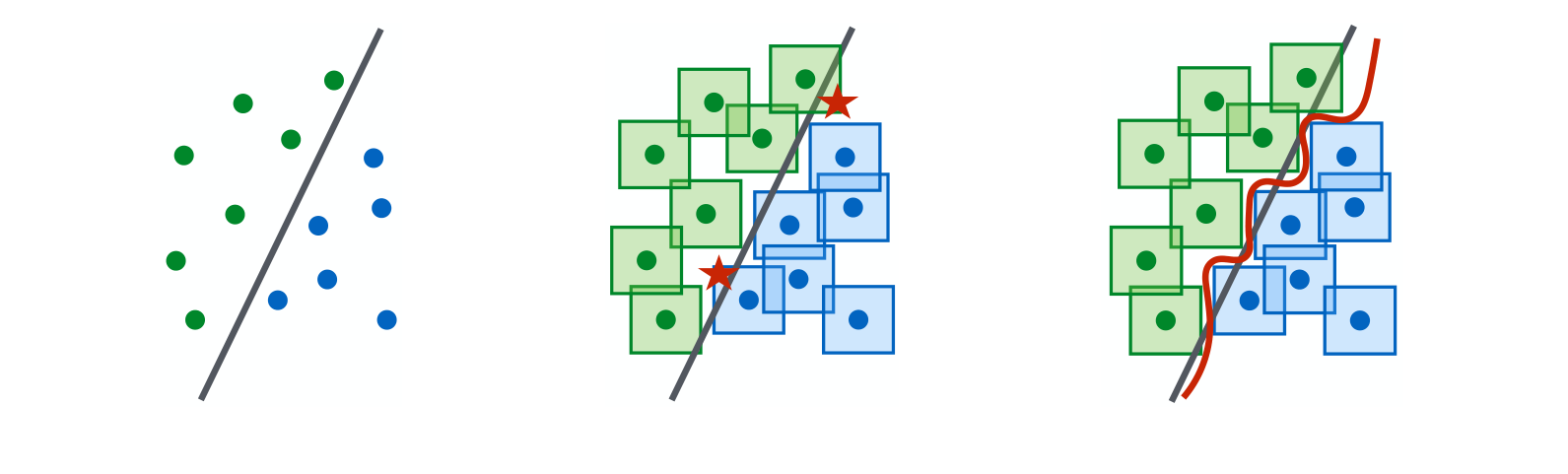
Figure source: [23], arXiv:1706.06083v4, PDF page 9. Original PDF.
Method
State robustness as an optimization problem. The adversarial (robust) risk is the expected loss when an adversary may perturb each input within a set , and training minimizes it: the min-max problem in the main text. This one formula defines the attack (the inner maximization), the defense (the outer minimization) and the guarantee (a small value of the objective means low loss against every perturbation in ). The authors argue that PGD with random starts is a strong, in some sense “universal”, first-order adversary, and train against it.
Results
(1) The inner problem is tractable in practice: PGD from many random starts reaches loss values that are well concentrated, with no extreme outliers, suggesting that PGD finds near-maximal values within the reach of first-order methods. (2) Training against PGD reliably reduced the adversarial loss during training. (3) Capacity matters: larger networks were more robust, small networks trained against PGD could collapse, and FGSM-based training overfitted to its own narrow perturbations (“label leaking”) without robustness to PGD at large . (4) The resulting MNIST () and CIFAR-10 ( on the 0–255 scale) models resisted a range of white-box and transfer attacks, and the authors published them as open challenges.
Reading the evidence
Read Section 2 (the saddle-point formulation) and Section 3 (the loss-landscape experiments) first. In the result tables, each row is an attack: its source (white-box on the same model, or black-box from an independently trained copy, a naturally trained copy, or a different architecture), its method (FGSM, PGD with given steps and restarts, or PGD with the Carlini–Wagner loss), and the resulting accuracy. Check: (a) the threat model, with the stated only; (b) that the strongest attack per column is the number to quote; (c) the additional experiments at other values and with -bounded attacks, which show how far robustness extends beyond the training threat model.
Problems
Robustness is shown only against the attacks tried and only for one norm and radius; it is empirical, not certified. Training cost grows with the number of PGD steps, and clean accuracy drops. Later work (TRADES, generated-data training, AutoAttack evaluations) refined both training and evaluation, but the formulation remained the reference point.
Conclusion
The chapter’s adversarial-training code is exactly this recipe on a small scale, and the min-max formula is the common language of almost every later robustness paper.
References
- D. Hendrycks, K. Zhao, S. Basart, J. Steinhardt and D. Song, “Natural Adversarial Examples,” CVPR, 2021. CVF
- P. W. Koh, S. Sagawa, H. Marklund, S. M. Xie, M. Zhang, A. Balsubramani et al., “WILDS: A Benchmark of in-the-Wild Distribution Shifts,” ICML, PMLR 139, 2021. PMLR
- J. Yang, K. Zhou, Y. Li and Z. Liu, “Generalized Out-of-Distribution Detection: A Survey,” International Journal of Computer Vision, vol. 132, no. 12, pp. 5635–5662, 2024. doi · arXiv
- D. Hendrycks and T. Dietterich, “Benchmarking Neural Network Robustness to Common Corruptions and Perturbations,” ICLR, 2019. arXiv
- D. Hendrycks, S. Basart, N. Mu, S. Kadavath, F. Wang, E. Dorundo et al., “The Many Faces of Robustness: A Critical Analysis of Out-of-Distribution Generalization,” ICCV, 2021. CVF
- A. Barbu, D. Mayo, J. Alverio, W. Luo, C. Wang, D. Gutfreund, J. Tenenbaum and B. Katz, “ObjectNet: A large-scale bias-controlled dataset for pushing the limits of object recognition models,” NeurIPS, 2019. proceedings
- B. Recht, R. Roelofs, L. Schmidt and V. Shankar, “Do ImageNet Classifiers Generalize to ImageNet?,” ICML, PMLR 97, 2019. PMLR
- R. Taori, A. Dave, V. Shankar, N. Carlini, B. Recht and L. Schmidt, “Measuring Robustness to Natural Distribution Shifts in Image Classification,” NeurIPS, 2020. proceedings
- J. Miller, R. Taori, A. Raghunathan, S. Sagawa, P. W. Koh, V. Shankar, P. Liang, Y. Carmon and L. Schmidt, “Accuracy on the Line: on the Strong Correlation Between Out-of-Distribution and In-Distribution Generalization,” ICML, PMLR 139, 2021. PMLR
- D. Hendrycks, N. Mu, E. D. Cubuk, B. Zoph, J. Gilmer and B. Lakshminarayanan, “AugMix: A Simple Data Processing Method to Improve Robustness and Uncertainty,” ICLR, 2020. arXiv
- R. Geirhos, P. Rubisch, C. Michaelis, M. Bethge, F. A. Wichmann and W. Brendel, “ImageNet-trained CNNs are biased towards texture; increasing shape bias improves accuracy and robustness,” ICLR, 2019. arXiv
- A. Radford, J. W. Kim, C. Hallacy, A. Ramesh, G. Goh, S. Agarwal et al., “Learning Transferable Visual Models From Natural Language Supervision,” ICML, PMLR 139, 2021. PMLR
- A. Fang, G. Ilharco, M. Wortsman, Y. Wan, V. Shankar, A. Dave and L. Schmidt, “Data Determines Distributional Robustness in Contrastive Language Image Pre-training (CLIP),” ICML, PMLR 162, 2022. PMLR
- M. Wortsman, G. Ilharco, J. W. Kim, M. Li, S. Kornblith, R. Roelofs et al., “Robust Fine-Tuning of Zero-Shot Models,” CVPR, 2022. CVF
- S. Schneider, E. Rusak, L. Eck, O. Bringmann, W. Brendel and M. Bethge, “Improving robustness against common corruptions by covariate shift adaptation,” NeurIPS, 2020. proceedings
- D. Wang, E. Shelhamer, S. Liu, B. Olshausen and T. Darrell, “Tent: Fully Test-Time Adaptation by Entropy Minimization,” ICLR, 2021. arXiv
- Y. Ganin, E. Ustinova, H. Ajakan, P. Germain, H. Larochelle, F. Laviolette, M. Marchand and V. Lempitsky, “Domain-Adversarial Training of Neural Networks,” Journal of Machine Learning Research, vol. 17, no. 59, pp. 1–35, 2016. JMLR
- K. Zhou, Z. Liu, Y. Qiao, T. Xiang and C. C. Loy, “Domain Generalization: A Survey,” IEEE Transactions on Pattern Analysis and Machine Intelligence, 2022. doi · arXiv
- I. Gulrajani and D. Lopez-Paz, “In Search of Lost Domain Generalization,” ICLR, 2021. arXiv
- Y. Ovadia, E. Fertig, J. Ren, Z. Nado, D. Sculley, S. Nowozin, J. V. Dillon, B. Lakshminarayanan and J. Snoek, “Can you trust your model’s uncertainty? Evaluating predictive uncertainty under dataset shift,” NeurIPS, 2019. proceedings
- C. Szegedy, W. Zaremba, I. Sutskever, J. Bruna, D. Erhan, I. Goodfellow and R. Fergus, “Intriguing properties of neural networks,” ICLR, 2014. arXiv
- I. J. Goodfellow, J. Shlens and C. Szegedy, “Explaining and Harnessing Adversarial Examples,” ICLR, 2015. arXiv
- A. Madry, A. Makelov, L. Schmidt, D. Tsipras and A. Vladu, “Towards Deep Learning Models Resistant to Adversarial Attacks,” ICLR, 2018. arXiv
- F. Croce, M. Andriushchenko, V. Sehwag, E. Debenedetti, N. Flammarion, M. Chiang, P. Mittal and M. Hein, “RobustBench: a standardized adversarial robustness benchmark,” NeurIPS Datasets and Benchmarks Track, 2021. proceedings · leaderboard
- N. Papernot, P. McDaniel, I. Goodfellow, S. Jha, Z. B. Celik and A. Swami, “Practical Black-Box Attacks against Machine Learning,” ACM Asia Conference on Computer and Communications Security (AsiaCCS), pp. 506–519, 2017. doi
- N. Carlini and D. Wagner, “Towards Evaluating the Robustness of Neural Networks,” IEEE Symposium on Security and Privacy (SP), pp. 39–57, 2017. doi
- D. Tsipras, S. Santurkar, L. Engstrom, A. Turner and A. Madry, “Robustness May Be at Odds with Accuracy,” ICLR, 2019. arXiv
- H. Zhang, Y. Yu, J. Jiao, E. P. Xing, L. El Ghaoui and M. I. Jordan, “Theoretically Principled Trade-off between Robustness and Accuracy,” ICML, PMLR 97, 2019. PMLR
- A. Athalye, N. Carlini and D. Wagner, “Obfuscated Gradients Give a False Sense of Security: Circumventing Defenses to Adversarial Examples,” ICML, PMLR 80, 2018. PMLR
- F. Croce and M. Hein, “Reliable evaluation of adversarial robustness with an ensemble of diverse parameter-free attacks,” ICML, PMLR 119, 2020. PMLR
- J. Cohen, E. Rosenfeld and J. Z. Kolter, “Certified Adversarial Robustness via Randomized Smoothing,” ICML, PMLR 97, 2019. PMLR
- K. Eykholt, I. Evtimov, E. Fernandes, B. Li, A. Rahmati, C. Xiao, A. Prakash, T. Kohno and D. Song, “Robust Physical-World Attacks on Deep Learning Visual Classification,” CVPR, 2018. CVF
- T. B. Brown, D. Mané, A. Roy, M. Abadi and J. Gilmer, “Adversarial Patch,” arXiv:1712.09665, 2017. arXiv
- D. Hendrycks and K. Gimpel, “A Baseline for Detecting Misclassified and Out-of-Distribution Examples in Neural Networks,” ICLR, 2017. arXiv
- W. Liu, X. Wang, J. D. Owens and Y. Li, “Energy-based Out-of-distribution Detection,” NeurIPS, 2020. proceedings
- K. Lee, K. Lee, H. Lee and J. Shin, “A Simple Unified Framework for Detecting Out-of-Distribution Samples and Adversarial Attacks,” NeurIPS, 2018. proceedings
- Y. Sun, Y. Ming, X. Zhu and Y. Li, “Out-of-Distribution Detection with Deep Nearest Neighbors,” ICML, PMLR 162, 2022. PMLR
- D. Hendrycks, M. Mazeika and T. Dietterich, “Deep Anomaly Detection with Outlier Exposure,” ICLR, 2019. arXiv
- J. Zhang, J. Yang, P. Wang, H. Wang, Y. Lin, H. Zhang et al., “OpenOOD v1.5: Enhanced Benchmark for Out-of-Distribution Detection,” arXiv:2306.09301, 2023. arXiv
- P. Bergmann, M. Fauser, D. Sattlegger and C. Steger, “MVTec AD — A Comprehensive Real-World Dataset for Unsupervised Anomaly Detection,” CVPR, 2019. CVF
- L. Heckler-Kram, J.-H. Neudeck, U. Scheler, R. König and C. Steger, “The MVTec AD 2 Dataset: Advanced Scenarios for Unsupervised Anomaly Detection,” International Journal of Computer Vision, vol. 134, no. 4, 2026. doi · arXiv
- K. Roth, L. Pemula, J. Zepeda, B. Schölkopf, T. Brox and P. Gehler, “Towards Total Recall in Industrial Anomaly Detection,” CVPR, 2022. CVF
- J. Bitterwolf, M. Müller and M. Hein, “In or Out? Fixing ImageNet Out-of-Distribution Detection Evaluation,” ICML, PMLR 202, 2023. PMLR
- J. Liang, R. He and T. Tan, “A Comprehensive Survey on Test-Time Adaptation Under Distribution Shifts,” International Journal of Computer Vision, vol. 133, no. 1, pp. 31–64, 2025. doi · arXiv
- N. Akhtar, A. Mian, N. Kardan and M. Shah, “Advances in Adversarial Attacks and Defenses in Computer Vision: A Survey,” IEEE Access, vol. 9, pp. 155161–155196, 2021. doi · arXiv
- G. Pang, C. Shen, L. Cao and A. van den Hengel, “Deep Learning for Anomaly Detection: A Review,” ACM Computing Surveys, vol. 54, no. 2, pp. 1–38, 2021. doi · arXiv
- J. Liu, G. Xie, J. Wang, S. Li, C. Wang, F. Zheng and Y. Jin, “Deep Industrial Image Anomaly Detection: A Survey,” Machine Intelligence Research, vol. 21, no. 1, pp. 104–135, 2024. doi · arXiv
- Z. Wang, T. Pang, C. Du, M. Lin, W. Liu and S. Yan, “Better Diffusion Models Further Improve Adversarial Training,” ICML, PMLR 202, 2023. PMLR
- J. Yang, P. Wang, D. Zou, Z. Zhou, K. Ding, W. Peng et al., “OpenOOD: Benchmarking Generalized Out-of-Distribution Detection,” NeurIPS Datasets and Benchmarks Track, 2022. proceedings
- J. Jeong, Y. Zou, T. Kim, D. Zhang, A. Ravichandran and O. Dabeer, “WinCLIP: Zero-/Few-Shot Anomaly Classification and Segmentation,” CVPR, 2023. CVF