Gulrajani and Lopez-Paz, “In Search of Lost Domain Generalization” (ICLR 2021)
Optional · paper guide 3 of 3 for DLCV 14 · Robustness: Distribution Shift, Adversarial Examples and Anomalies. Citation numbers refer to the reference list at the bottom of this page.
Navigate: this page and this track: Navigate: this page and this track
Challenge
Many domain generalization algorithms reported gains over plain training, but under different datasets, architectures and, above all, different (often unstated) rules for choosing hyperparameters, sometimes using the test domain [19].
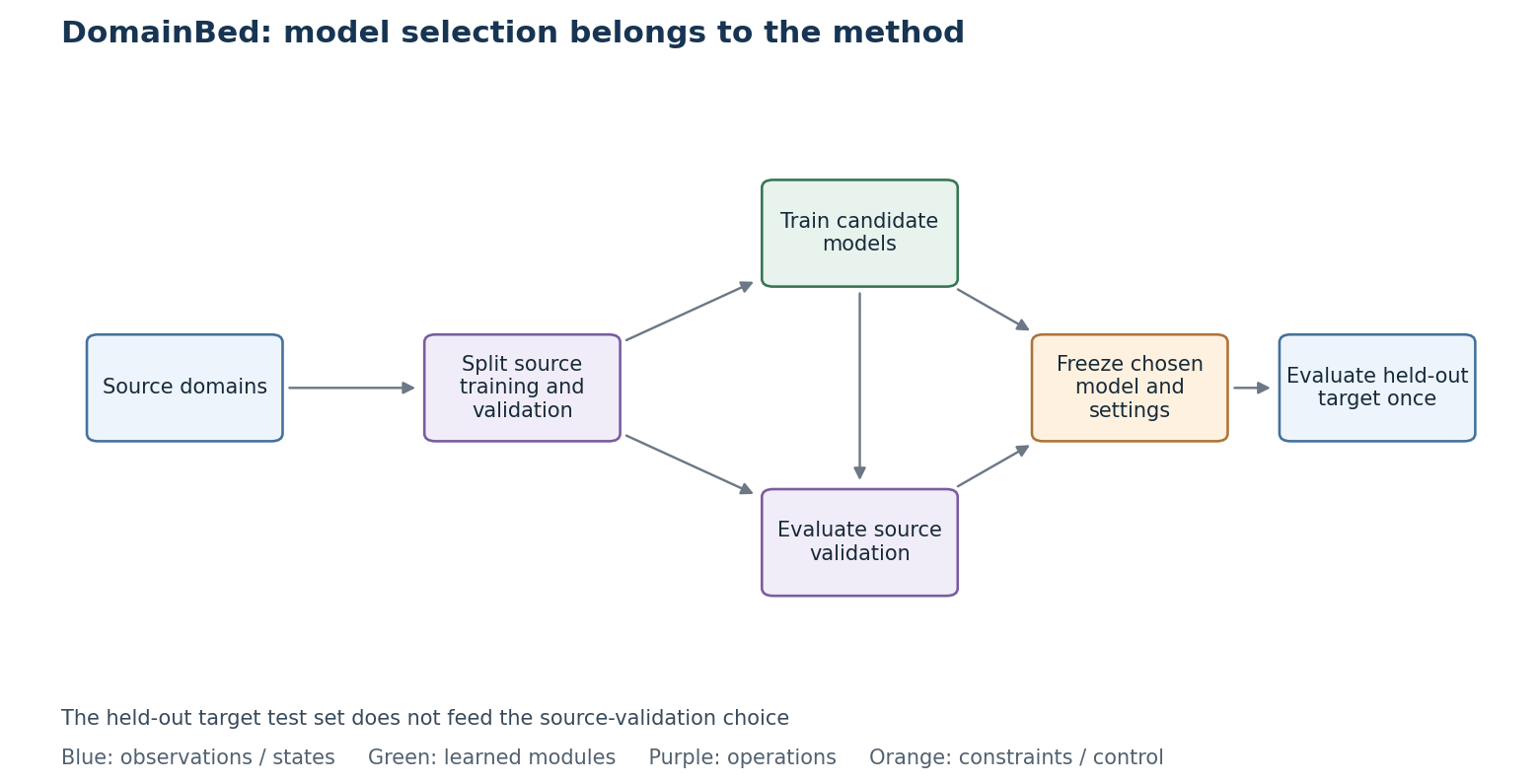
Method
Treat model selection as part of the problem. A DG algorithm must come with a rule for choosing hyperparameters and checkpoints that uses only training domains. The paper defines three rules: a training-domain validation set (hold out part of each training domain), leave-one-domain-out cross-validation (train with one training domain held out, in turn, and average), and test-domain validation, an oracle that peeks at labelled test-domain data and must be disclosed as such. It then implements DomainBed, a testbed with seven multi-domain datasets (including Colored MNIST, Rotated MNIST, VLCS, PACS, Office-Home, TerraIncognita and DomainNet), nine algorithms and the three selection rules, with a random hyperparameter search of 20 trials per algorithm and test domain, and repeats the whole study three times.
Results
With a ResNet-50, strong data augmentation and careful tuning, ERM matched or beat all previously published results under training-domain validation, and no algorithm beat ERM by more than about a point on average under any selection rule. Training-domain validation worked better than leave-one-domain-out. The oracle rule gave higher numbers, which shows both possible headroom and how optimistic oracle-selected results are.
Reading the evidence
The main table reports, for each selection rule, the average accuracy over test domains per dataset, with standard errors over the three repetitions. Read across a row to compare an algorithm with ERM on the same footing, and compare the same algorithm between tables to see the effect of the selection rule. Check: (a) the standard errors before believing any difference; (b) the appendix, which collects results reported in the literature for more than thirty algorithms, to see how far published numbers depart from the controlled ones.
Problems
The conclusion is about these datasets, these algorithms and this tuning budget; a method may still help elsewhere. The datasets are small-to-medium image benchmarks; foundation-model backbones, which changed the field later, are not part of the study.
Conclusion
It is the clearest example of the chapter’s recurring lesson: robustness gains disappear when baselines are tuned well and when test data stay out of model selection.
References
- D. Hendrycks, K. Zhao, S. Basart, J. Steinhardt and D. Song, “Natural Adversarial Examples,” CVPR, 2021. CVF
- P. W. Koh, S. Sagawa, H. Marklund, S. M. Xie, M. Zhang, A. Balsubramani et al., “WILDS: A Benchmark of in-the-Wild Distribution Shifts,” ICML, PMLR 139, 2021. PMLR
- J. Yang, K. Zhou, Y. Li and Z. Liu, “Generalized Out-of-Distribution Detection: A Survey,” International Journal of Computer Vision, vol. 132, no. 12, pp. 5635–5662, 2024. doi · arXiv
- D. Hendrycks and T. Dietterich, “Benchmarking Neural Network Robustness to Common Corruptions and Perturbations,” ICLR, 2019. arXiv
- D. Hendrycks, S. Basart, N. Mu, S. Kadavath, F. Wang, E. Dorundo et al., “The Many Faces of Robustness: A Critical Analysis of Out-of-Distribution Generalization,” ICCV, 2021. CVF
- A. Barbu, D. Mayo, J. Alverio, W. Luo, C. Wang, D. Gutfreund, J. Tenenbaum and B. Katz, “ObjectNet: A large-scale bias-controlled dataset for pushing the limits of object recognition models,” NeurIPS, 2019. proceedings
- B. Recht, R. Roelofs, L. Schmidt and V. Shankar, “Do ImageNet Classifiers Generalize to ImageNet?,” ICML, PMLR 97, 2019. PMLR
- R. Taori, A. Dave, V. Shankar, N. Carlini, B. Recht and L. Schmidt, “Measuring Robustness to Natural Distribution Shifts in Image Classification,” NeurIPS, 2020. proceedings
- J. Miller, R. Taori, A. Raghunathan, S. Sagawa, P. W. Koh, V. Shankar, P. Liang, Y. Carmon and L. Schmidt, “Accuracy on the Line: on the Strong Correlation Between Out-of-Distribution and In-Distribution Generalization,” ICML, PMLR 139, 2021. PMLR
- D. Hendrycks, N. Mu, E. D. Cubuk, B. Zoph, J. Gilmer and B. Lakshminarayanan, “AugMix: A Simple Data Processing Method to Improve Robustness and Uncertainty,” ICLR, 2020. arXiv
- R. Geirhos, P. Rubisch, C. Michaelis, M. Bethge, F. A. Wichmann and W. Brendel, “ImageNet-trained CNNs are biased towards texture; increasing shape bias improves accuracy and robustness,” ICLR, 2019. arXiv
- A. Radford, J. W. Kim, C. Hallacy, A. Ramesh, G. Goh, S. Agarwal et al., “Learning Transferable Visual Models From Natural Language Supervision,” ICML, PMLR 139, 2021. PMLR
- A. Fang, G. Ilharco, M. Wortsman, Y. Wan, V. Shankar, A. Dave and L. Schmidt, “Data Determines Distributional Robustness in Contrastive Language Image Pre-training (CLIP),” ICML, PMLR 162, 2022. PMLR
- M. Wortsman, G. Ilharco, J. W. Kim, M. Li, S. Kornblith, R. Roelofs et al., “Robust Fine-Tuning of Zero-Shot Models,” CVPR, 2022. CVF
- S. Schneider, E. Rusak, L. Eck, O. Bringmann, W. Brendel and M. Bethge, “Improving robustness against common corruptions by covariate shift adaptation,” NeurIPS, 2020. proceedings
- D. Wang, E. Shelhamer, S. Liu, B. Olshausen and T. Darrell, “Tent: Fully Test-Time Adaptation by Entropy Minimization,” ICLR, 2021. arXiv
- Y. Ganin, E. Ustinova, H. Ajakan, P. Germain, H. Larochelle, F. Laviolette, M. Marchand and V. Lempitsky, “Domain-Adversarial Training of Neural Networks,” Journal of Machine Learning Research, vol. 17, no. 59, pp. 1–35, 2016. JMLR
- K. Zhou, Z. Liu, Y. Qiao, T. Xiang and C. C. Loy, “Domain Generalization: A Survey,” IEEE Transactions on Pattern Analysis and Machine Intelligence, 2022. doi · arXiv
- I. Gulrajani and D. Lopez-Paz, “In Search of Lost Domain Generalization,” ICLR, 2021. arXiv
- Y. Ovadia, E. Fertig, J. Ren, Z. Nado, D. Sculley, S. Nowozin, J. V. Dillon, B. Lakshminarayanan and J. Snoek, “Can you trust your model’s uncertainty? Evaluating predictive uncertainty under dataset shift,” NeurIPS, 2019. proceedings
- C. Szegedy, W. Zaremba, I. Sutskever, J. Bruna, D. Erhan, I. Goodfellow and R. Fergus, “Intriguing properties of neural networks,” ICLR, 2014. arXiv
- I. J. Goodfellow, J. Shlens and C. Szegedy, “Explaining and Harnessing Adversarial Examples,” ICLR, 2015. arXiv
- A. Madry, A. Makelov, L. Schmidt, D. Tsipras and A. Vladu, “Towards Deep Learning Models Resistant to Adversarial Attacks,” ICLR, 2018. arXiv
- F. Croce, M. Andriushchenko, V. Sehwag, E. Debenedetti, N. Flammarion, M. Chiang, P. Mittal and M. Hein, “RobustBench: a standardized adversarial robustness benchmark,” NeurIPS Datasets and Benchmarks Track, 2021. proceedings · leaderboard
- N. Papernot, P. McDaniel, I. Goodfellow, S. Jha, Z. B. Celik and A. Swami, “Practical Black-Box Attacks against Machine Learning,” ACM Asia Conference on Computer and Communications Security (AsiaCCS), pp. 506–519, 2017. doi
- N. Carlini and D. Wagner, “Towards Evaluating the Robustness of Neural Networks,” IEEE Symposium on Security and Privacy (SP), pp. 39–57, 2017. doi
- D. Tsipras, S. Santurkar, L. Engstrom, A. Turner and A. Madry, “Robustness May Be at Odds with Accuracy,” ICLR, 2019. arXiv
- H. Zhang, Y. Yu, J. Jiao, E. P. Xing, L. El Ghaoui and M. I. Jordan, “Theoretically Principled Trade-off between Robustness and Accuracy,” ICML, PMLR 97, 2019. PMLR
- A. Athalye, N. Carlini and D. Wagner, “Obfuscated Gradients Give a False Sense of Security: Circumventing Defenses to Adversarial Examples,” ICML, PMLR 80, 2018. PMLR
- F. Croce and M. Hein, “Reliable evaluation of adversarial robustness with an ensemble of diverse parameter-free attacks,” ICML, PMLR 119, 2020. PMLR
- J. Cohen, E. Rosenfeld and J. Z. Kolter, “Certified Adversarial Robustness via Randomized Smoothing,” ICML, PMLR 97, 2019. PMLR
- K. Eykholt, I. Evtimov, E. Fernandes, B. Li, A. Rahmati, C. Xiao, A. Prakash, T. Kohno and D. Song, “Robust Physical-World Attacks on Deep Learning Visual Classification,” CVPR, 2018. CVF
- T. B. Brown, D. Mané, A. Roy, M. Abadi and J. Gilmer, “Adversarial Patch,” arXiv:1712.09665, 2017. arXiv
- D. Hendrycks and K. Gimpel, “A Baseline for Detecting Misclassified and Out-of-Distribution Examples in Neural Networks,” ICLR, 2017. arXiv
- W. Liu, X. Wang, J. D. Owens and Y. Li, “Energy-based Out-of-distribution Detection,” NeurIPS, 2020. proceedings
- K. Lee, K. Lee, H. Lee and J. Shin, “A Simple Unified Framework for Detecting Out-of-Distribution Samples and Adversarial Attacks,” NeurIPS, 2018. proceedings
- Y. Sun, Y. Ming, X. Zhu and Y. Li, “Out-of-Distribution Detection with Deep Nearest Neighbors,” ICML, PMLR 162, 2022. PMLR
- D. Hendrycks, M. Mazeika and T. Dietterich, “Deep Anomaly Detection with Outlier Exposure,” ICLR, 2019. arXiv
- J. Zhang, J. Yang, P. Wang, H. Wang, Y. Lin, H. Zhang et al., “OpenOOD v1.5: Enhanced Benchmark for Out-of-Distribution Detection,” arXiv:2306.09301, 2023. arXiv
- P. Bergmann, M. Fauser, D. Sattlegger and C. Steger, “MVTec AD — A Comprehensive Real-World Dataset for Unsupervised Anomaly Detection,” CVPR, 2019. CVF
- L. Heckler-Kram, J.-H. Neudeck, U. Scheler, R. König and C. Steger, “The MVTec AD 2 Dataset: Advanced Scenarios for Unsupervised Anomaly Detection,” International Journal of Computer Vision, vol. 134, no. 4, 2026. doi · arXiv
- K. Roth, L. Pemula, J. Zepeda, B. Schölkopf, T. Brox and P. Gehler, “Towards Total Recall in Industrial Anomaly Detection,” CVPR, 2022. CVF
- J. Bitterwolf, M. Müller and M. Hein, “In or Out? Fixing ImageNet Out-of-Distribution Detection Evaluation,” ICML, PMLR 202, 2023. PMLR
- J. Liang, R. He and T. Tan, “A Comprehensive Survey on Test-Time Adaptation Under Distribution Shifts,” International Journal of Computer Vision, vol. 133, no. 1, pp. 31–64, 2025. doi · arXiv
- N. Akhtar, A. Mian, N. Kardan and M. Shah, “Advances in Adversarial Attacks and Defenses in Computer Vision: A Survey,” IEEE Access, vol. 9, pp. 155161–155196, 2021. doi · arXiv
- G. Pang, C. Shen, L. Cao and A. van den Hengel, “Deep Learning for Anomaly Detection: A Review,” ACM Computing Surveys, vol. 54, no. 2, pp. 1–38, 2021. doi · arXiv
- J. Liu, G. Xie, J. Wang, S. Li, C. Wang, F. Zheng and Y. Jin, “Deep Industrial Image Anomaly Detection: A Survey,” Machine Intelligence Research, vol. 21, no. 1, pp. 104–135, 2024. doi · arXiv
- Z. Wang, T. Pang, C. Du, M. Lin, W. Liu and S. Yan, “Better Diffusion Models Further Improve Adversarial Training,” ICML, PMLR 202, 2023. PMLR
- J. Yang, P. Wang, D. Zou, Z. Zhou, K. Ding, W. Peng et al., “OpenOOD: Benchmarking Generalized Out-of-Distribution Detection,” NeurIPS Datasets and Benchmarks Track, 2022. proceedings
- J. Jeong, Y. Zou, T. Kim, D. Zhang, A. Ravichandran and O. Dabeer, “WinCLIP: Zero-/Few-Shot Anomaly Classification and Segmentation,” CVPR, 2023. CVF