Li et al., “Diffusion Models for Image Restoration and Enhancement: A Comprehensive Survey” (IJCV 2025)
Optional · paper guide 5 of 5 for DLCV 09B · Generative Image Restoration: Sampling a Plausible Answer. Citation numbers refer to the reference list at the bottom of this page.
Navigate: this page and this track: Navigate: this page and this track
On this page
- Blau and Michaeli, “The Perception-Distortion Tradeoff” (CVPR 2018)
- Chung et al., “Diffusion Posterior Sampling for General Noisy Inverse Problems” (ICLR 2023)
- DDNM: preserve measured components and generate the null space
- BlindDPS: infer an image and its degradation together
- Li et al., “Diffusion Models for Image Restoration and Enhancement: A Comprehensive Survey” (IJCV 2025)
Deep Learning for Computer Vision
Challenge
Diffusion-based restoration grew quickly, with very different conditioning schemes, training regimes and benchmarks, which made methods hard to compare and follow [44].
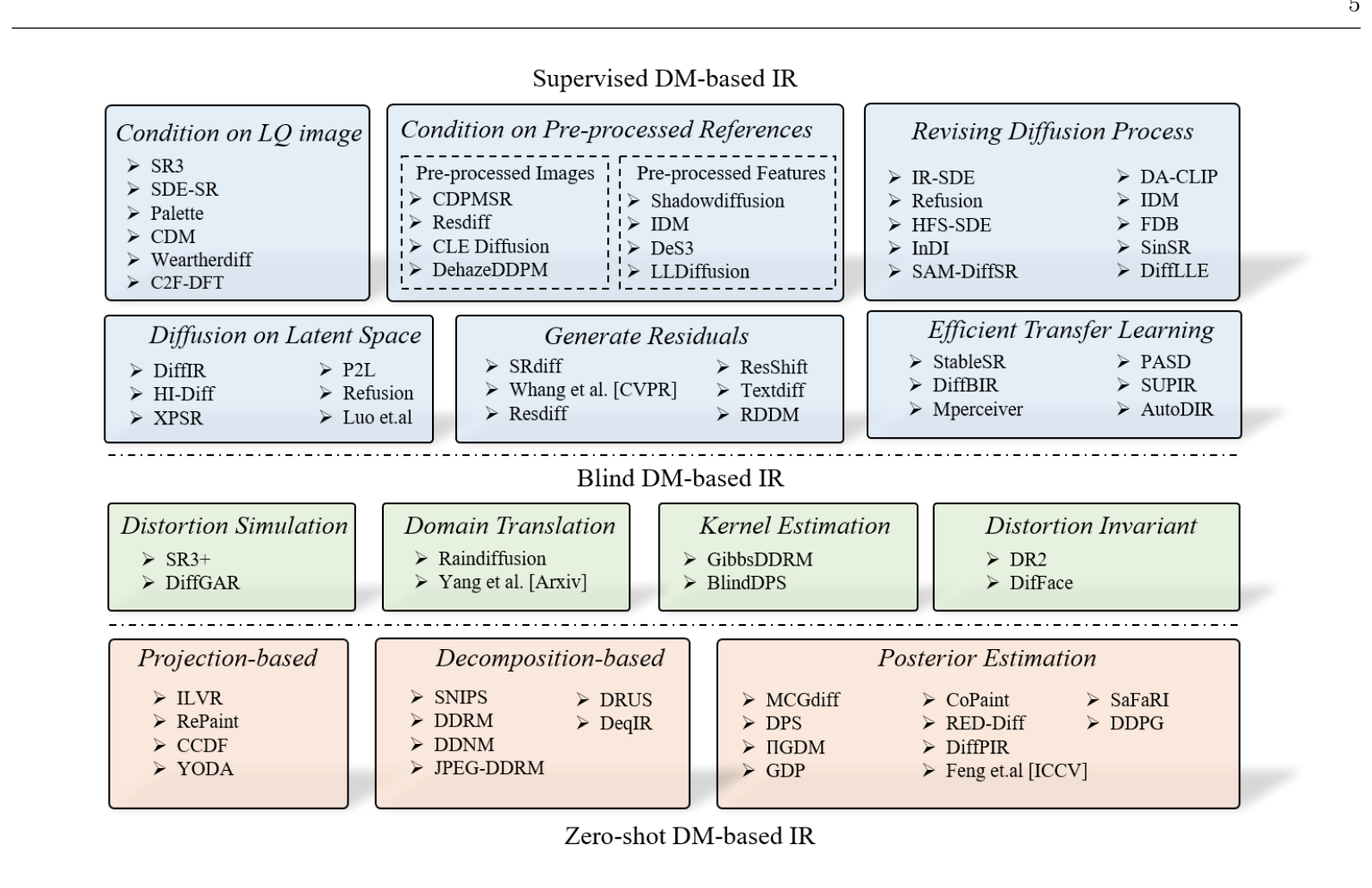
Figure source: [44], arXiv:2308.09388v3, PDF page 5. Original PDF.
Method
Organize the field by learning paradigm (supervised versus zero-shot), then by how each method conditions or constrains the sampler, then by how it addresses blind and real-world degradations, and close with experimental comparisons and open directions.
Results
Its sections give a usable map: supervised methods are grouped by the form of conditioning and modeling (low-quality image as condition, pre-processed references, revised diffusion processes, residual generation, latent diffusion, efficient transfer learning); zero-shot methods by projection, decomposition and posterior estimation; real-world methods by degradation simulation, kernel estimation, domain translation and degradation-invariant learning. Its experiments section collects results on super-resolution, inpainting, deblurring and real-world restoration with PSNR, SSIM, LPIPS and FID. Its discussion highlights sampling efficiency, model size and compression, degradation estimation, all-in-one restoration and language-guided restoration.
Reading the evidence
Use Sections 3 and 4 as a catalogue: find the group your problem belongs to, then read the two or three papers it cites there. In the comparison tables, check which numbers were rerun by the authors and which were copied from papers, the resolution and number of steps, and whether a method’s training data overlaps the test sets. Read Section 6 for open problems.
Problems
Like any survey of a fast field, it lags the newest methods (for example the 2025 one-step distillation methods), and its categories overlap: one method can fit several groups. Its numbers are not a benchmark in their own right.
Conclusion
It places every method in this chapter’s families into a larger map, and its supervised/zero-shot split is the same as this chapter’s Route A and Route B.
References
- Y. Blau and T. Michaeli, “The Perception-Distortion Tradeoff,” in Proc. IEEE/CVF CVPR, 2018, pp. 6228–6237 (extended version on arXiv). doi · arXiv
- C. Ledig, L. Theis, F. Huszár, J. Caballero, A. Cunningham, A. Acosta, A. Aitken, A. Tejani, J. Totz, Z. Wang and W. Shi, “Photo-Realistic Single Image Super-Resolution Using a Generative Adversarial Network,” in Proc. IEEE CVPR, 2017, pp. 105–114. doi · arXiv
- J. Johnson, A. Alahi and L. Fei-Fei, “Perceptual Losses for Real-Time Style Transfer and Super-Resolution,” in Proc. ECCV, 2016, pp. 694–711. doi · arXiv
- X. Wang, K. Yu, S. Wu, J. Gu, Y. Liu, C. Dong, Y. Qiao and C. C. Loy, “ESRGAN: Enhanced Super-Resolution Generative Adversarial Networks,” in Proc. ECCV Workshops, 2018 (LNCS, 2019), pp. 63–79. doi · arXiv
- X. Wang, L. Xie, C. Dong and Y. Shan, “Real-ESRGAN: Training Real-World Blind Super-Resolution with Pure Synthetic Data,” in Proc. IEEE/CVF ICCV Workshops, 2021, pp. 1905–1914. doi · arXiv
- T. Karras, S. Laine and T. Aila, “A Style-Based Generator Architecture for Generative Adversarial Networks,” in Proc. IEEE/CVF CVPR, 2019, pp. 4396–4405. doi · arXiv
- S. Menon, A. Damian, S. Hu, N. Ravi and C. Rudin, “PULSE: Self-Supervised Photo Upsampling via Latent Space Exploration of Generative Models,” in Proc. IEEE/CVF CVPR, 2020, pp. 2434–2442. doi · arXiv
- K. C. K. Chan, X. Wang, X. Xu, J. Gu and C. C. Loy, “GLEAN: Generative Latent Bank for Large-Factor Image Super-Resolution,” in Proc. IEEE/CVF CVPR, 2021, pp. 14240–14249. doi · arXiv
- X. Wang, Y. Li, H. Zhang and Y. Shan, “Towards Real-World Blind Face Restoration with Generative Facial Prior,” in Proc. IEEE/CVF CVPR, 2021, pp. 9164–9174. doi · arXiv
- S. Zhou, K. C. K. Chan, C. Li and C. C. Loy, “Towards Robust Blind Face Restoration with Codebook Lookup Transformer,” in Proc. NeurIPS, vol. 35, 2022, pp. 30599–30611. doi · arXiv
- J. Ho, A. Jain and P. Abbeel, “Denoising Diffusion Probabilistic Models,” in Proc. NeurIPS, 2020. proceedings · arXiv
- Y. Song, J. Sohl-Dickstein, D. P. Kingma, A. Kumar, S. Ermon and B. Poole, “Score-Based Generative Modeling through Stochastic Differential Equations,” in Proc. ICLR, 2021. arXiv
- B. Efron, “Tweedie’s Formula and Selection Bias,” Journal of the American Statistical Association, vol. 106, no. 496, pp. 1602–1614, 2011. doi
- C. Saharia, J. Ho, W. Chan, T. Salimans, D. J. Fleet and M. Norouzi, “Image Super-Resolution via Iterative Refinement,” IEEE TPAMI, 2022 (early access). doi · arXiv
- C. Saharia, W. Chan, H. Chang, C. Lee, J. Ho, T. Salimans, D. Fleet and M. Norouzi, “Palette: Image-to-Image Diffusion Models,” in Proc. ACM SIGGRAPH Conference, 2022, pp. 1–10. doi · arXiv
- Z. Yue, J. Wang and C. C. Loy, “ResShift: Efficient Diffusion Model for Image Super-resolution by Residual Shifting,” in Proc. NeurIPS, vol. 36, 2023, pp. 13294–13307. doi · arXiv
- H. Chung, J. Kim, M. T. McCann, M. L. Klasky and J. C. Ye, “Diffusion Posterior Sampling for General Noisy Inverse Problems,” in Proc. ICLR, 2023. arXiv
- B. Kawar, M. Elad, S. Ermon and J. Song, “Denoising Diffusion Restoration Models,” in Proc. NeurIPS, vol. 35, 2022, pp. 23593–23606. doi · arXiv
- Y. Wang, J. Yu and J. Zhang, “Zero-Shot Image Restoration Using Denoising Diffusion Null-Space Model,” in Proc. ICLR, 2023. arXiv
- J. Song, A. Vahdat, M. Mardani and J. Kautz, “Pseudoinverse-Guided Diffusion Models for Inverse Problems,” in Proc. ICLR, 2023. ICLR page
- Y. Zhu, K. Zhang, J. Liang, J. Cao, B. Wen, R. Timofte and L. Van Gool, “Denoising Diffusion Models for Plug-and-Play Image Restoration,” in Proc. IEEE/CVF CVPR Workshops, 2023, pp. 1219–1229. doi · arXiv
- R. Rombach, A. Blattmann, D. Lorenz, P. Esser and B. Ommer, “High-Resolution Image Synthesis with Latent Diffusion Models,” in Proc. IEEE/CVF CVPR, 2022, pp. 10674–10685. doi · arXiv
- L. Zhang, A. Rao and M. Agrawala, “Adding Conditional Control to Text-to-Image Diffusion Models,” in Proc. IEEE/CVF ICCV, 2023, pp. 3813–3824. doi · arXiv
- J. Wang, Z. Yue, S. Zhou, K. C. K. Chan and C. C. Loy, “Exploiting Diffusion Prior for Real-World Image Super-Resolution,” International Journal of Computer Vision, vol. 132, no. 12, pp. 5929–5949, 2024. doi · arXiv
- X. Lin, J. He, Z. Chen, Z. Lyu, B. Dai, F. Yu, Y. Qiao, W. Ouyang and C. Dong, “DiffBIR: Toward Blind Image Restoration with Generative Diffusion Prior,” in Proc. ECCV, 2024 (LNCS), pp. 430–448. doi · arXiv
- F. Yu, J. Gu, Z. Li, J. Hu, X. Kong, X. Wang, J. He, Y. Qiao and C. Dong, “Scaling Up to Excellence: Practicing Model Scaling for Photo-Realistic Image Restoration In the Wild,” in Proc. IEEE/CVF CVPR, 2024, pp. 25669–25680. doi · arXiv
- Y. Wang, W. Yang, X. Chen, Y. Wang, L. Guo, L.-P. Chau, Z. Liu, Y. Qiao, A. C. Kot and B. Wen, “SinSR: Diffusion-Based Image Super-Resolution in a Single Step,” in Proc. IEEE/CVF CVPR, 2024, pp. 25796–25805. doi · arXiv
- R. Wu, L. Sun, Z. Ma and L. Zhang, “One-Step Effective Diffusion Network for Real-World Image Super-Resolution,” in Proc. NeurIPS, vol. 37, 2024, pp. 92529–92553. doi · arXiv
- Z. Yue, K. Liao and C. C. Loy, “Arbitrary-steps Image Super-resolution via Diffusion Inversion,” in Proc. IEEE/CVF CVPR, 2025, pp. 23153–23163. doi · arXiv
- L. Dong, Q. Fan, Y. Guo, Z. Wang, Q. Zhang, J. Chen, Y. Luo and C. Zou, “TSD-SR: One-Step Diffusion with Target Score Distillation for Real-World Image Super-Resolution,” in Proc. IEEE/CVF CVPR, 2025, pp. 23174–23184. doi · arXiv
- Y. Lipman, R. T. Q. Chen, H. Ben-Hamu, M. Nickel and M. Le, “Flow Matching for Generative Modeling,” in Proc. ICLR, 2023. arXiv
- X. Liu, C. Gong and Q. Liu, “Flow Straight and Fast: Learning to Generate and Transfer Data with Rectified Flow,” in Proc. ICLR, 2023. arXiv
- G. Ohayon, T. Michaeli and M. Elad, “Posterior-Mean Rectified Flow: Towards Minimum MSE Photo-Realistic Image Restoration,” in Proc. ICLR, 2025. arXiv
- S. Martin, A. Gagneux, P. Hagemann and G. Steidl, “PnP-Flow: Plug-and-Play Image Restoration with Flow Matching,” in Proc. ICLR, 2025. arXiv
- S. Bhadra, V. A. Kelkar, F. J. Brooks and M. A. Anastasio, “On Hallucinations in Tomographic Image Reconstruction,” IEEE Transactions on Medical Imaging, vol. 40, no. 11, pp. 3249–3260, 2021. doi · arXiv
- W. Ren, R. Goyal, Z. Hu, T. T. Aumentado-Armstrong, I. Mohomed and A. Levinshtein, “Hallucination Score: Towards Mitigating Hallucinations in Generative Image Super-Resolution,” arXiv:2507.14367, 2025. arXiv
- A. N. Angelopoulos, A. P. Kohli, S. Bates, M. I. Jordan, J. Malik, T. Alshaabi, S. Upadhyayula and Y. Romano, “Image-to-Image Regression with Distribution-Free Uncertainty Quantification and Applications in Imaging,” in Proc. ICML, PMLR 162, 2022. proceedings · arXiv
- R. Zhang, P. Isola, A. A. Efros, E. Shechtman and O. Wang, “The Unreasonable Effectiveness of Deep Features as a Perceptual Metric,” in Proc. IEEE/CVF CVPR, 2018, pp. 586–595. doi · arXiv
- Z. Wang, A. C. Bovik, H. R. Sheikh and E. P. Simoncelli, “Image Quality Assessment: From Error Visibility to Structural Similarity,” IEEE Transactions on Image Processing, vol. 13, no. 4, pp. 600–612, 2004. doi
- M. Heusel, H. Ramsauer, T. Unterthiner, B. Nessler and S. Hochreiter, “GANs Trained by a Two Time-Scale Update Rule Converge to a Local Nash Equilibrium,” in Proc. NeurIPS (NIPS), 2017. arXiv
- A. Mittal, R. Soundararajan and A. C. Bovik, “Making a ‘Completely Blind’ Image Quality Analyzer,” IEEE Signal Processing Letters, vol. 20, no. 3, pp. 209–212, 2013. doi
- J. Ke, Q. Wang, Y. Wang, P. Milanfar and F. Yang, “MUSIQ: Multi-scale Image Quality Transformer,” in Proc. IEEE/CVF ICCV, 2021, pp. 5128–5137. doi · arXiv
- J. Wang, K. C. K. Chan and C. C. Loy, “Exploring CLIP for Assessing the Look and Feel of Images,” in Proc. AAAI, vol. 37, no. 2, 2023, pp. 2555–2563. doi · arXiv
- X. Li, Y. Ren, X. Jin, C. Lan, X. Wang, W. Zeng, X. Wang and Z. Chen, “Diffusion Models for Image Restoration and Enhancement: A Comprehensive Survey,” International Journal of Computer Vision, vol. 133, no. 11, pp. 8078–8108, 2025. doi · arXiv
- G. Daras, H. Chung, C.-H. Lai, Y. Mitsufuji, J. C. Ye, P. Milanfar, A. G. Dimakis and M. Delbracio, “A Survey on Diffusion Models for Inverse Problems,” arXiv:2410.00083, 2024. arXiv
- B. B. Moser, A. S. Shanbhag, F. Raue, S. Frolov, S. Palacio and A. Dengel, “Diffusion Models, Image Super-Resolution, and Everything: A Survey,” IEEE Transactions on Neural Networks and Learning Systems, vol. 36, no. 7, pp. 11793–11813, 2025. doi · arXiv
- W. Xia, Y. Zhang, Y. Yang, J.-H. Xue, B. Zhou and M.-H. Yang, “GAN Inversion: A Survey,” IEEE TPAMI, vol. 45, no. 3, pp. 3121–3138, 2023. doi · arXiv
- Y. Song and S. Ermon, “Generative Modeling by Estimating Gradients of the Data Distribution,” in Proc. NeurIPS, 2019. arXiv
- H. Chung, J. Kim, S. Kim and J. C. Ye, “Parallel Diffusion Models of Operator and Image for Blind Inverse Problems,” in Proc. IEEE/CVF CVPR, 2023, pp. 6059–6069. paper