BlindDPS: infer an image and its degradation together
Optional · paper guide 4 of 5 for DLCV 09B · Generative Image Restoration: Sampling a Plausible Answer. Citation numbers refer to the reference list at the bottom of this page.
Navigate: this page and this track: Navigate: this page and this track
On this page
- Blau and Michaeli, “The Perception-Distortion Tradeoff” (CVPR 2018)
- Chung et al., “Diffusion Posterior Sampling for General Noisy Inverse Problems” (ICLR 2023)
- DDNM: preserve measured components and generate the null space
- BlindDPS: infer an image and its degradation together
- Li et al., “Diffusion Models for Image Restoration and Enhancement: A Comprehensive Survey” (IJCV 2025)
Deep Learning for Computer Vision
Challenge
Non-blind DPS assumes that the forward operator is known. BlindDPS—“Parallel Diffusion Models of Operator and Image for Blind Inverse Problems,” CVPR 2023 [49]—also estimates operator parameters. For motion deblurring, both the sharp image and blur kernel are unknown; reducing their shared residual is not enough to identify them without suitable priors.
Method
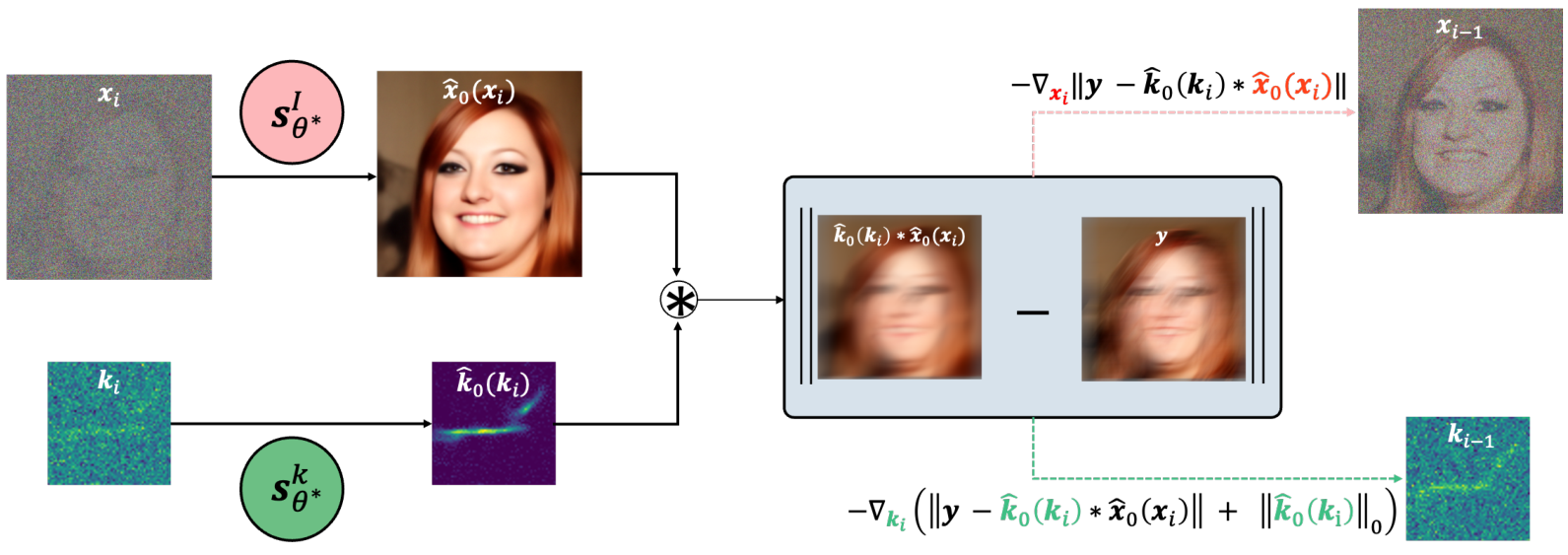
Figure source: [49], PDF page 3. Original PDF.
Define the unknowns explicitly. For image , kernel , convolution and measurement noise , the basic forward model is
is the observed blurry image; and are separately trained image and kernel priors. Their independence is a modeling assumption before observing . The likelihood couples them in the posterior. The paper also models turbulence as a tilt/warp followed by blur, with an additional prior for the operator field.
Run parallel prior processes with coupled corrections. At time , image and kernel score networks produce clean estimates and . A common data term uses
are their noisy diffusion states and is the measurement residual. Image guidance differentiates through the image estimate while treating the kernel state as the other variable; kernel guidance differentiates through the kernel estimate. Both gradients depend on the current estimates of both unknowns.
The implementation makes separate reverse-diffusion proposals and applies likelihood corrections. The paper uses the residual norm with a static coefficient in its practical algorithm, rather than requiring the exact Gaussian squared-residual coefficient at every step. This numerical choice is distinct from the probabilistic motivation.
Constrain the kernel and add useful regularity. Clean kernel estimates are projected to nonnegative, unit-sum kernels. This fixes a common scale ambiguity and excludes negative point-spread functions, but does not prove a unique image/kernel solution. A sparsity term further favors suitable motion kernels. Its weight is an extra assumption, not a property shared by every real optical blur.
Training operator priors is part of the method. BlindDPS is not an unchanged unconditional image model that somehow learns any unknown physical degradation during one inference run.
Read the figure and choose a baseline. Follow both clean estimates into the same predicted measurement. Updating the image while ignoring the current kernel, or updating the kernel as if the image were known, would remove the coupling that defines the method. A small residual alone cannot identify the correct pair. Inspect the estimated kernel as well as the restored image, and distinguish training an operator prior from fitting an operator at test time. Compared with known-operator restoration, this method adds uncertainty and computation; the extra prior is useful only insofar as it represents the degradation actually encountered.
Results
Original Table 1 reports FFHQ blind motion deblurring at FID 29.49 / LPIPS 0.281 / PSNR 22.24 dB. Table 2 also evaluates estimated kernels, rather than judging images alone; its FFHQ motion-kernel normalized-convolution score is 0.955.
Table 3 demonstrates a perceptual/distortion trade-off for turbulence: on FFHQ, BlindDPS has FID 27.35 / PSNR 24.49 dB, while the supervised TSR-WGAN comparison has FID 58.30 / PSNR 26.29 dB. Improved perceptual distribution scores do not mean a higher PSNR or guaranteed recovery of the true scene.
Ablations
Figure 7 replaces the diffusion kernel prior with a uniform prior, leaving kernel estimation to likelihood guidance. Its degraded kernel/image results support learning an operator prior; they do not isolate every possible alternative regularizer.
Section 4.3 and the supplementary sparsity study vary kernel regularization. Omitting the term is worse, particularly for motion blur, while a range of nonzero strengths works in the tested setting. The findings justify the paper’s combination of learned and hand-designed priors, not a universal sparsity weight for unknown cameras.
Conclusion
BlindDPS extends likelihood-guided diffusion to several unknown variables, each with its own prior, and couples their sampling through the measurement model. Jointly inspecting reconstruction and operator estimates is essential.
Problems
Different image/kernel pairs can explain the same observation. A kernel or image outside the trained prior distribution can be forced toward a plausible but wrong solution. Spatially varying blur, saturation and unmodeled sensor effects may violate the assumed forward model. Each additional variable requires modeling and computation, so the ability to add another diffusion process does not make its cost or identifiability free.
References
- Y. Blau and T. Michaeli, “The Perception-Distortion Tradeoff,” in Proc. IEEE/CVF CVPR, 2018, pp. 6228–6237 (extended version on arXiv). doi · arXiv
- C. Ledig, L. Theis, F. Huszár, J. Caballero, A. Cunningham, A. Acosta, A. Aitken, A. Tejani, J. Totz, Z. Wang and W. Shi, “Photo-Realistic Single Image Super-Resolution Using a Generative Adversarial Network,” in Proc. IEEE CVPR, 2017, pp. 105–114. doi · arXiv
- J. Johnson, A. Alahi and L. Fei-Fei, “Perceptual Losses for Real-Time Style Transfer and Super-Resolution,” in Proc. ECCV, 2016, pp. 694–711. doi · arXiv
- X. Wang, K. Yu, S. Wu, J. Gu, Y. Liu, C. Dong, Y. Qiao and C. C. Loy, “ESRGAN: Enhanced Super-Resolution Generative Adversarial Networks,” in Proc. ECCV Workshops, 2018 (LNCS, 2019), pp. 63–79. doi · arXiv
- X. Wang, L. Xie, C. Dong and Y. Shan, “Real-ESRGAN: Training Real-World Blind Super-Resolution with Pure Synthetic Data,” in Proc. IEEE/CVF ICCV Workshops, 2021, pp. 1905–1914. doi · arXiv
- T. Karras, S. Laine and T. Aila, “A Style-Based Generator Architecture for Generative Adversarial Networks,” in Proc. IEEE/CVF CVPR, 2019, pp. 4396–4405. doi · arXiv
- S. Menon, A. Damian, S. Hu, N. Ravi and C. Rudin, “PULSE: Self-Supervised Photo Upsampling via Latent Space Exploration of Generative Models,” in Proc. IEEE/CVF CVPR, 2020, pp. 2434–2442. doi · arXiv
- K. C. K. Chan, X. Wang, X. Xu, J. Gu and C. C. Loy, “GLEAN: Generative Latent Bank for Large-Factor Image Super-Resolution,” in Proc. IEEE/CVF CVPR, 2021, pp. 14240–14249. doi · arXiv
- X. Wang, Y. Li, H. Zhang and Y. Shan, “Towards Real-World Blind Face Restoration with Generative Facial Prior,” in Proc. IEEE/CVF CVPR, 2021, pp. 9164–9174. doi · arXiv
- S. Zhou, K. C. K. Chan, C. Li and C. C. Loy, “Towards Robust Blind Face Restoration with Codebook Lookup Transformer,” in Proc. NeurIPS, vol. 35, 2022, pp. 30599–30611. doi · arXiv
- J. Ho, A. Jain and P. Abbeel, “Denoising Diffusion Probabilistic Models,” in Proc. NeurIPS, 2020. proceedings · arXiv
- Y. Song, J. Sohl-Dickstein, D. P. Kingma, A. Kumar, S. Ermon and B. Poole, “Score-Based Generative Modeling through Stochastic Differential Equations,” in Proc. ICLR, 2021. arXiv
- B. Efron, “Tweedie’s Formula and Selection Bias,” Journal of the American Statistical Association, vol. 106, no. 496, pp. 1602–1614, 2011. doi
- C. Saharia, J. Ho, W. Chan, T. Salimans, D. J. Fleet and M. Norouzi, “Image Super-Resolution via Iterative Refinement,” IEEE TPAMI, 2022 (early access). doi · arXiv
- C. Saharia, W. Chan, H. Chang, C. Lee, J. Ho, T. Salimans, D. Fleet and M. Norouzi, “Palette: Image-to-Image Diffusion Models,” in Proc. ACM SIGGRAPH Conference, 2022, pp. 1–10. doi · arXiv
- Z. Yue, J. Wang and C. C. Loy, “ResShift: Efficient Diffusion Model for Image Super-resolution by Residual Shifting,” in Proc. NeurIPS, vol. 36, 2023, pp. 13294–13307. doi · arXiv
- H. Chung, J. Kim, M. T. McCann, M. L. Klasky and J. C. Ye, “Diffusion Posterior Sampling for General Noisy Inverse Problems,” in Proc. ICLR, 2023. arXiv
- B. Kawar, M. Elad, S. Ermon and J. Song, “Denoising Diffusion Restoration Models,” in Proc. NeurIPS, vol. 35, 2022, pp. 23593–23606. doi · arXiv
- Y. Wang, J. Yu and J. Zhang, “Zero-Shot Image Restoration Using Denoising Diffusion Null-Space Model,” in Proc. ICLR, 2023. arXiv
- J. Song, A. Vahdat, M. Mardani and J. Kautz, “Pseudoinverse-Guided Diffusion Models for Inverse Problems,” in Proc. ICLR, 2023. ICLR page
- Y. Zhu, K. Zhang, J. Liang, J. Cao, B. Wen, R. Timofte and L. Van Gool, “Denoising Diffusion Models for Plug-and-Play Image Restoration,” in Proc. IEEE/CVF CVPR Workshops, 2023, pp. 1219–1229. doi · arXiv
- R. Rombach, A. Blattmann, D. Lorenz, P. Esser and B. Ommer, “High-Resolution Image Synthesis with Latent Diffusion Models,” in Proc. IEEE/CVF CVPR, 2022, pp. 10674–10685. doi · arXiv
- L. Zhang, A. Rao and M. Agrawala, “Adding Conditional Control to Text-to-Image Diffusion Models,” in Proc. IEEE/CVF ICCV, 2023, pp. 3813–3824. doi · arXiv
- J. Wang, Z. Yue, S. Zhou, K. C. K. Chan and C. C. Loy, “Exploiting Diffusion Prior for Real-World Image Super-Resolution,” International Journal of Computer Vision, vol. 132, no. 12, pp. 5929–5949, 2024. doi · arXiv
- X. Lin, J. He, Z. Chen, Z. Lyu, B. Dai, F. Yu, Y. Qiao, W. Ouyang and C. Dong, “DiffBIR: Toward Blind Image Restoration with Generative Diffusion Prior,” in Proc. ECCV, 2024 (LNCS), pp. 430–448. doi · arXiv
- F. Yu, J. Gu, Z. Li, J. Hu, X. Kong, X. Wang, J. He, Y. Qiao and C. Dong, “Scaling Up to Excellence: Practicing Model Scaling for Photo-Realistic Image Restoration In the Wild,” in Proc. IEEE/CVF CVPR, 2024, pp. 25669–25680. doi · arXiv
- Y. Wang, W. Yang, X. Chen, Y. Wang, L. Guo, L.-P. Chau, Z. Liu, Y. Qiao, A. C. Kot and B. Wen, “SinSR: Diffusion-Based Image Super-Resolution in a Single Step,” in Proc. IEEE/CVF CVPR, 2024, pp. 25796–25805. doi · arXiv
- R. Wu, L. Sun, Z. Ma and L. Zhang, “One-Step Effective Diffusion Network for Real-World Image Super-Resolution,” in Proc. NeurIPS, vol. 37, 2024, pp. 92529–92553. doi · arXiv
- Z. Yue, K. Liao and C. C. Loy, “Arbitrary-steps Image Super-resolution via Diffusion Inversion,” in Proc. IEEE/CVF CVPR, 2025, pp. 23153–23163. doi · arXiv
- L. Dong, Q. Fan, Y. Guo, Z. Wang, Q. Zhang, J. Chen, Y. Luo and C. Zou, “TSD-SR: One-Step Diffusion with Target Score Distillation for Real-World Image Super-Resolution,” in Proc. IEEE/CVF CVPR, 2025, pp. 23174–23184. doi · arXiv
- Y. Lipman, R. T. Q. Chen, H. Ben-Hamu, M. Nickel and M. Le, “Flow Matching for Generative Modeling,” in Proc. ICLR, 2023. arXiv
- X. Liu, C. Gong and Q. Liu, “Flow Straight and Fast: Learning to Generate and Transfer Data with Rectified Flow,” in Proc. ICLR, 2023. arXiv
- G. Ohayon, T. Michaeli and M. Elad, “Posterior-Mean Rectified Flow: Towards Minimum MSE Photo-Realistic Image Restoration,” in Proc. ICLR, 2025. arXiv
- S. Martin, A. Gagneux, P. Hagemann and G. Steidl, “PnP-Flow: Plug-and-Play Image Restoration with Flow Matching,” in Proc. ICLR, 2025. arXiv
- S. Bhadra, V. A. Kelkar, F. J. Brooks and M. A. Anastasio, “On Hallucinations in Tomographic Image Reconstruction,” IEEE Transactions on Medical Imaging, vol. 40, no. 11, pp. 3249–3260, 2021. doi · arXiv
- W. Ren, R. Goyal, Z. Hu, T. T. Aumentado-Armstrong, I. Mohomed and A. Levinshtein, “Hallucination Score: Towards Mitigating Hallucinations in Generative Image Super-Resolution,” arXiv:2507.14367, 2025. arXiv
- A. N. Angelopoulos, A. P. Kohli, S. Bates, M. I. Jordan, J. Malik, T. Alshaabi, S. Upadhyayula and Y. Romano, “Image-to-Image Regression with Distribution-Free Uncertainty Quantification and Applications in Imaging,” in Proc. ICML, PMLR 162, 2022. proceedings · arXiv
- R. Zhang, P. Isola, A. A. Efros, E. Shechtman and O. Wang, “The Unreasonable Effectiveness of Deep Features as a Perceptual Metric,” in Proc. IEEE/CVF CVPR, 2018, pp. 586–595. doi · arXiv
- Z. Wang, A. C. Bovik, H. R. Sheikh and E. P. Simoncelli, “Image Quality Assessment: From Error Visibility to Structural Similarity,” IEEE Transactions on Image Processing, vol. 13, no. 4, pp. 600–612, 2004. doi
- M. Heusel, H. Ramsauer, T. Unterthiner, B. Nessler and S. Hochreiter, “GANs Trained by a Two Time-Scale Update Rule Converge to a Local Nash Equilibrium,” in Proc. NeurIPS (NIPS), 2017. arXiv
- A. Mittal, R. Soundararajan and A. C. Bovik, “Making a ‘Completely Blind’ Image Quality Analyzer,” IEEE Signal Processing Letters, vol. 20, no. 3, pp. 209–212, 2013. doi
- J. Ke, Q. Wang, Y. Wang, P. Milanfar and F. Yang, “MUSIQ: Multi-scale Image Quality Transformer,” in Proc. IEEE/CVF ICCV, 2021, pp. 5128–5137. doi · arXiv
- J. Wang, K. C. K. Chan and C. C. Loy, “Exploring CLIP for Assessing the Look and Feel of Images,” in Proc. AAAI, vol. 37, no. 2, 2023, pp. 2555–2563. doi · arXiv
- X. Li, Y. Ren, X. Jin, C. Lan, X. Wang, W. Zeng, X. Wang and Z. Chen, “Diffusion Models for Image Restoration and Enhancement: A Comprehensive Survey,” International Journal of Computer Vision, vol. 133, no. 11, pp. 8078–8108, 2025. doi · arXiv
- G. Daras, H. Chung, C.-H. Lai, Y. Mitsufuji, J. C. Ye, P. Milanfar, A. G. Dimakis and M. Delbracio, “A Survey on Diffusion Models for Inverse Problems,” arXiv:2410.00083, 2024. arXiv
- B. B. Moser, A. S. Shanbhag, F. Raue, S. Frolov, S. Palacio and A. Dengel, “Diffusion Models, Image Super-Resolution, and Everything: A Survey,” IEEE Transactions on Neural Networks and Learning Systems, vol. 36, no. 7, pp. 11793–11813, 2025. doi · arXiv
- W. Xia, Y. Zhang, Y. Yang, J.-H. Xue, B. Zhou and M.-H. Yang, “GAN Inversion: A Survey,” IEEE TPAMI, vol. 45, no. 3, pp. 3121–3138, 2023. doi · arXiv
- Y. Song and S. Ermon, “Generative Modeling by Estimating Gradients of the Data Distribution,” in Proc. NeurIPS, 2019. arXiv
- H. Chung, J. Kim, S. Kim and J. C. Ye, “Parallel Diffusion Models of Operator and Image for Blind Inverse Problems,” in Proc. IEEE/CVF CVPR, 2023, pp. 6059–6069. paper