Chung et al., “Diffusion Posterior Sampling for General Noisy Inverse Problems” (ICLR 2023)
Optional · paper guide 2 of 5 for DLCV 09B · Generative Image Restoration: Sampling a Plausible Answer. Citation numbers refer to the reference list at the bottom of this page.
Navigate: this page and this track: Navigate: this page and this track
On this page
- Blau and Michaeli, “The Perception-Distortion Tradeoff” (CVPR 2018)
- Chung et al., “Diffusion Posterior Sampling for General Noisy Inverse Problems” (ICLR 2023)
- DDNM: preserve measured components and generate the null space
- BlindDPS: infer an image and its degradation together
- Li et al., “Diffusion Models for Image Restoration and Enhancement: A Comprehensive Survey” (IJCV 2025)
Deep Learning for Computer Vision
Challenge
An unconditional diffusion model can generate convincing images without matching a particular measurement. DPS [17] uses a known measurement operator and a noise model to steer that prior during sampling. Its target is a conditional distribution, not merely the photograph with the smallest measurement residual.
Method
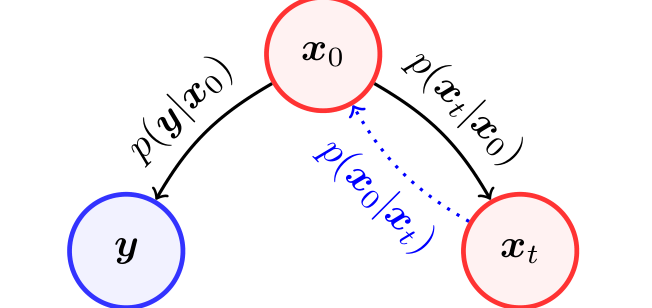
Figure source: [17], PDF page 4. Original PDF.
Separate the image prior from the measurement likelihood. For clean image , measurement and known possibly nonlinear operator , assume . With Gaussian noise , is measurement-noise standard deviation and is the identity. The unconditional score network estimates the noisy-image score .
A clean-image estimate is
is the noisy sampling state and is its retained signal-power fraction. This is the variance-preserving score parameterization; a noise-predicting implementation must convert its output consistently.
The difficult likelihood integrates over possible clean images. DPS approximates it by evaluating the clean-image likelihood at . Define
is a Gaussian negative-log-likelihood up to constants, and is the approximate conditional score. The gradient passes through both the forward operator and the denoiser’s clean-image estimate. Detaching that estimate changes the algorithm.
Alternate a prior move and a likelihood correction. The practical discrete algorithm first makes the reverse-diffusion proposal, then corrects it using the measurement residual differentiated at the current state. Its residual-normalized step schedule is a practical stabilization rule; the implemented coefficient should not be confused with an untouched analytic .
For Poisson observations, the paper uses a measurement-dependent weighted residual approximation. It is not the same Gaussian likelihood with a new dataset name, and its low-count behavior needs care. A differentiable nonlinear operator can also be used, such as the paper’s phase-retrieval setting, without computing an SVD.
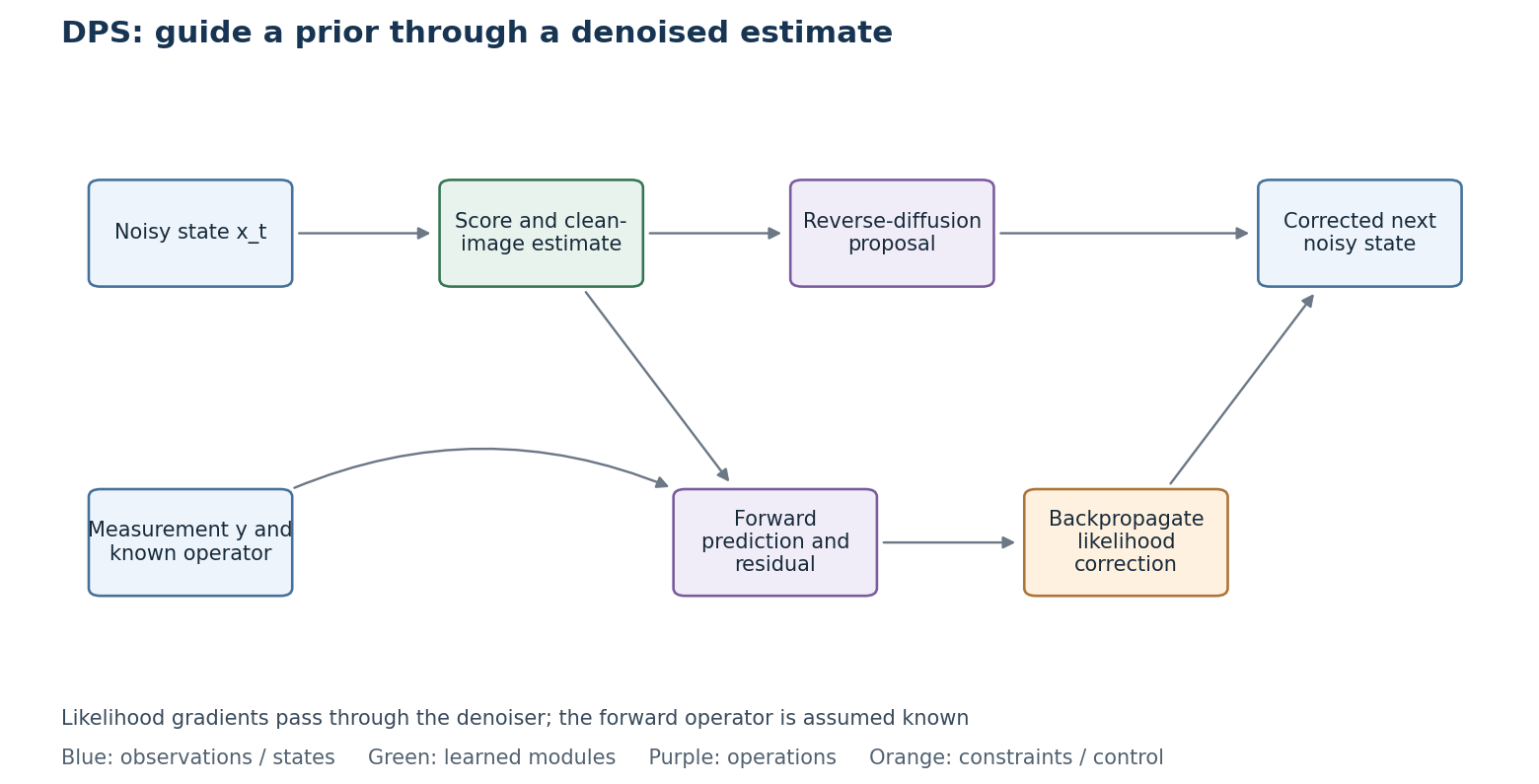
Read the figure and choose a baseline. Trace the noisy state to its clean estimate, apply the known forward operator to that estimate, compare with the measurement, and backpropagate the discrepancy to the noisy state. The residual is computed in measurement space; it is not a clean-image error available at inference. A differentiable operator makes this correction possible but does not make the approximate posterior exact. Inspect both measurement fit and reconstruction plausibility, especially with noisy data: forcing the residual to zero can fit noise. Step strength and the likelihood model therefore belong in any reproducible comparison.
Results
Table 1 evaluates noisy FFHQ restoration at with Gaussian standard deviation 0.05. For SR, DPS reports FID 39.35 / LPIPS 0.214, compared with DDRM’s 62.15 / 0.294 in that experiment. Those numbers must not be compared directly with noiseless DDNM tables as if the measurement model were unchanged.
The paper also evaluates ImageNet, inpainting, Gaussian/motion deblurring and nonlinear problems. Its appendix reports approximately 95 seconds per FFHQ image and 600 seconds per ImageNet image for 1,000 network evaluations on an RTX 2080 Ti. That historical timing is a complete-experiment setting, not a current-device guarantee.
Ablations
Appendix C varies likelihood-step strength: too little guidance leaves measurement disagreement; too much produces saturation and noise amplification. Its tested useful range for the normalized strength is roughly 0.1–1.0, rather than a universal value for every operator.
Table 5’s 100-image FFHQ Gaussian-deblurring study reports LPIPS 0.247 ± 0.045 for the proposed residual-normalized schedule versus 0.727 ± 0.038 for the tested inverse-noise-variance setting. Linear and exponential schedules also differ. Figure 11 compares function-evaluation counts and runtime, demonstrating that quality claims must include a sampling budget.
Conclusion
DPS turns a reusable image prior into a flexible noisy inverse-problem solver by differentiating a likelihood through a denoised estimate. Its flexibility comes with repeated network evaluations, backpropagation and an approximation to the true conditional score.
Problems
The plug-in likelihood is not generally the exact marginal likelihood, so exact posterior sampling is not guaranteed. Results depend on score quality, the operator/noise model and guidance strength. Small residuals do not establish correct invisible detail, and phase-retrieval comparisons using best-of-multiple samples answer a different question from a single-run result. Unknown operator parameters require an additional estimation/prior mechanism, as in BlindDPS.
References
- Y. Blau and T. Michaeli, “The Perception-Distortion Tradeoff,” in Proc. IEEE/CVF CVPR, 2018, pp. 6228–6237 (extended version on arXiv). doi · arXiv
- C. Ledig, L. Theis, F. Huszár, J. Caballero, A. Cunningham, A. Acosta, A. Aitken, A. Tejani, J. Totz, Z. Wang and W. Shi, “Photo-Realistic Single Image Super-Resolution Using a Generative Adversarial Network,” in Proc. IEEE CVPR, 2017, pp. 105–114. doi · arXiv
- J. Johnson, A. Alahi and L. Fei-Fei, “Perceptual Losses for Real-Time Style Transfer and Super-Resolution,” in Proc. ECCV, 2016, pp. 694–711. doi · arXiv
- X. Wang, K. Yu, S. Wu, J. Gu, Y. Liu, C. Dong, Y. Qiao and C. C. Loy, “ESRGAN: Enhanced Super-Resolution Generative Adversarial Networks,” in Proc. ECCV Workshops, 2018 (LNCS, 2019), pp. 63–79. doi · arXiv
- X. Wang, L. Xie, C. Dong and Y. Shan, “Real-ESRGAN: Training Real-World Blind Super-Resolution with Pure Synthetic Data,” in Proc. IEEE/CVF ICCV Workshops, 2021, pp. 1905–1914. doi · arXiv
- T. Karras, S. Laine and T. Aila, “A Style-Based Generator Architecture for Generative Adversarial Networks,” in Proc. IEEE/CVF CVPR, 2019, pp. 4396–4405. doi · arXiv
- S. Menon, A. Damian, S. Hu, N. Ravi and C. Rudin, “PULSE: Self-Supervised Photo Upsampling via Latent Space Exploration of Generative Models,” in Proc. IEEE/CVF CVPR, 2020, pp. 2434–2442. doi · arXiv
- K. C. K. Chan, X. Wang, X. Xu, J. Gu and C. C. Loy, “GLEAN: Generative Latent Bank for Large-Factor Image Super-Resolution,” in Proc. IEEE/CVF CVPR, 2021, pp. 14240–14249. doi · arXiv
- X. Wang, Y. Li, H. Zhang and Y. Shan, “Towards Real-World Blind Face Restoration with Generative Facial Prior,” in Proc. IEEE/CVF CVPR, 2021, pp. 9164–9174. doi · arXiv
- S. Zhou, K. C. K. Chan, C. Li and C. C. Loy, “Towards Robust Blind Face Restoration with Codebook Lookup Transformer,” in Proc. NeurIPS, vol. 35, 2022, pp. 30599–30611. doi · arXiv
- J. Ho, A. Jain and P. Abbeel, “Denoising Diffusion Probabilistic Models,” in Proc. NeurIPS, 2020. proceedings · arXiv
- Y. Song, J. Sohl-Dickstein, D. P. Kingma, A. Kumar, S. Ermon and B. Poole, “Score-Based Generative Modeling through Stochastic Differential Equations,” in Proc. ICLR, 2021. arXiv
- B. Efron, “Tweedie’s Formula and Selection Bias,” Journal of the American Statistical Association, vol. 106, no. 496, pp. 1602–1614, 2011. doi
- C. Saharia, J. Ho, W. Chan, T. Salimans, D. J. Fleet and M. Norouzi, “Image Super-Resolution via Iterative Refinement,” IEEE TPAMI, 2022 (early access). doi · arXiv
- C. Saharia, W. Chan, H. Chang, C. Lee, J. Ho, T. Salimans, D. Fleet and M. Norouzi, “Palette: Image-to-Image Diffusion Models,” in Proc. ACM SIGGRAPH Conference, 2022, pp. 1–10. doi · arXiv
- Z. Yue, J. Wang and C. C. Loy, “ResShift: Efficient Diffusion Model for Image Super-resolution by Residual Shifting,” in Proc. NeurIPS, vol. 36, 2023, pp. 13294–13307. doi · arXiv
- H. Chung, J. Kim, M. T. McCann, M. L. Klasky and J. C. Ye, “Diffusion Posterior Sampling for General Noisy Inverse Problems,” in Proc. ICLR, 2023. arXiv
- B. Kawar, M. Elad, S. Ermon and J. Song, “Denoising Diffusion Restoration Models,” in Proc. NeurIPS, vol. 35, 2022, pp. 23593–23606. doi · arXiv
- Y. Wang, J. Yu and J. Zhang, “Zero-Shot Image Restoration Using Denoising Diffusion Null-Space Model,” in Proc. ICLR, 2023. arXiv
- J. Song, A. Vahdat, M. Mardani and J. Kautz, “Pseudoinverse-Guided Diffusion Models for Inverse Problems,” in Proc. ICLR, 2023. ICLR page
- Y. Zhu, K. Zhang, J. Liang, J. Cao, B. Wen, R. Timofte and L. Van Gool, “Denoising Diffusion Models for Plug-and-Play Image Restoration,” in Proc. IEEE/CVF CVPR Workshops, 2023, pp. 1219–1229. doi · arXiv
- R. Rombach, A. Blattmann, D. Lorenz, P. Esser and B. Ommer, “High-Resolution Image Synthesis with Latent Diffusion Models,” in Proc. IEEE/CVF CVPR, 2022, pp. 10674–10685. doi · arXiv
- L. Zhang, A. Rao and M. Agrawala, “Adding Conditional Control to Text-to-Image Diffusion Models,” in Proc. IEEE/CVF ICCV, 2023, pp. 3813–3824. doi · arXiv
- J. Wang, Z. Yue, S. Zhou, K. C. K. Chan and C. C. Loy, “Exploiting Diffusion Prior for Real-World Image Super-Resolution,” International Journal of Computer Vision, vol. 132, no. 12, pp. 5929–5949, 2024. doi · arXiv
- X. Lin, J. He, Z. Chen, Z. Lyu, B. Dai, F. Yu, Y. Qiao, W. Ouyang and C. Dong, “DiffBIR: Toward Blind Image Restoration with Generative Diffusion Prior,” in Proc. ECCV, 2024 (LNCS), pp. 430–448. doi · arXiv
- F. Yu, J. Gu, Z. Li, J. Hu, X. Kong, X. Wang, J. He, Y. Qiao and C. Dong, “Scaling Up to Excellence: Practicing Model Scaling for Photo-Realistic Image Restoration In the Wild,” in Proc. IEEE/CVF CVPR, 2024, pp. 25669–25680. doi · arXiv
- Y. Wang, W. Yang, X. Chen, Y. Wang, L. Guo, L.-P. Chau, Z. Liu, Y. Qiao, A. C. Kot and B. Wen, “SinSR: Diffusion-Based Image Super-Resolution in a Single Step,” in Proc. IEEE/CVF CVPR, 2024, pp. 25796–25805. doi · arXiv
- R. Wu, L. Sun, Z. Ma and L. Zhang, “One-Step Effective Diffusion Network for Real-World Image Super-Resolution,” in Proc. NeurIPS, vol. 37, 2024, pp. 92529–92553. doi · arXiv
- Z. Yue, K. Liao and C. C. Loy, “Arbitrary-steps Image Super-resolution via Diffusion Inversion,” in Proc. IEEE/CVF CVPR, 2025, pp. 23153–23163. doi · arXiv
- L. Dong, Q. Fan, Y. Guo, Z. Wang, Q. Zhang, J. Chen, Y. Luo and C. Zou, “TSD-SR: One-Step Diffusion with Target Score Distillation for Real-World Image Super-Resolution,” in Proc. IEEE/CVF CVPR, 2025, pp. 23174–23184. doi · arXiv
- Y. Lipman, R. T. Q. Chen, H. Ben-Hamu, M. Nickel and M. Le, “Flow Matching for Generative Modeling,” in Proc. ICLR, 2023. arXiv
- X. Liu, C. Gong and Q. Liu, “Flow Straight and Fast: Learning to Generate and Transfer Data with Rectified Flow,” in Proc. ICLR, 2023. arXiv
- G. Ohayon, T. Michaeli and M. Elad, “Posterior-Mean Rectified Flow: Towards Minimum MSE Photo-Realistic Image Restoration,” in Proc. ICLR, 2025. arXiv
- S. Martin, A. Gagneux, P. Hagemann and G. Steidl, “PnP-Flow: Plug-and-Play Image Restoration with Flow Matching,” in Proc. ICLR, 2025. arXiv
- S. Bhadra, V. A. Kelkar, F. J. Brooks and M. A. Anastasio, “On Hallucinations in Tomographic Image Reconstruction,” IEEE Transactions on Medical Imaging, vol. 40, no. 11, pp. 3249–3260, 2021. doi · arXiv
- W. Ren, R. Goyal, Z. Hu, T. T. Aumentado-Armstrong, I. Mohomed and A. Levinshtein, “Hallucination Score: Towards Mitigating Hallucinations in Generative Image Super-Resolution,” arXiv:2507.14367, 2025. arXiv
- A. N. Angelopoulos, A. P. Kohli, S. Bates, M. I. Jordan, J. Malik, T. Alshaabi, S. Upadhyayula and Y. Romano, “Image-to-Image Regression with Distribution-Free Uncertainty Quantification and Applications in Imaging,” in Proc. ICML, PMLR 162, 2022. proceedings · arXiv
- R. Zhang, P. Isola, A. A. Efros, E. Shechtman and O. Wang, “The Unreasonable Effectiveness of Deep Features as a Perceptual Metric,” in Proc. IEEE/CVF CVPR, 2018, pp. 586–595. doi · arXiv
- Z. Wang, A. C. Bovik, H. R. Sheikh and E. P. Simoncelli, “Image Quality Assessment: From Error Visibility to Structural Similarity,” IEEE Transactions on Image Processing, vol. 13, no. 4, pp. 600–612, 2004. doi
- M. Heusel, H. Ramsauer, T. Unterthiner, B. Nessler and S. Hochreiter, “GANs Trained by a Two Time-Scale Update Rule Converge to a Local Nash Equilibrium,” in Proc. NeurIPS (NIPS), 2017. arXiv
- A. Mittal, R. Soundararajan and A. C. Bovik, “Making a ‘Completely Blind’ Image Quality Analyzer,” IEEE Signal Processing Letters, vol. 20, no. 3, pp. 209–212, 2013. doi
- J. Ke, Q. Wang, Y. Wang, P. Milanfar and F. Yang, “MUSIQ: Multi-scale Image Quality Transformer,” in Proc. IEEE/CVF ICCV, 2021, pp. 5128–5137. doi · arXiv
- J. Wang, K. C. K. Chan and C. C. Loy, “Exploring CLIP for Assessing the Look and Feel of Images,” in Proc. AAAI, vol. 37, no. 2, 2023, pp. 2555–2563. doi · arXiv
- X. Li, Y. Ren, X. Jin, C. Lan, X. Wang, W. Zeng, X. Wang and Z. Chen, “Diffusion Models for Image Restoration and Enhancement: A Comprehensive Survey,” International Journal of Computer Vision, vol. 133, no. 11, pp. 8078–8108, 2025. doi · arXiv
- G. Daras, H. Chung, C.-H. Lai, Y. Mitsufuji, J. C. Ye, P. Milanfar, A. G. Dimakis and M. Delbracio, “A Survey on Diffusion Models for Inverse Problems,” arXiv:2410.00083, 2024. arXiv
- B. B. Moser, A. S. Shanbhag, F. Raue, S. Frolov, S. Palacio and A. Dengel, “Diffusion Models, Image Super-Resolution, and Everything: A Survey,” IEEE Transactions on Neural Networks and Learning Systems, vol. 36, no. 7, pp. 11793–11813, 2025. doi · arXiv
- W. Xia, Y. Zhang, Y. Yang, J.-H. Xue, B. Zhou and M.-H. Yang, “GAN Inversion: A Survey,” IEEE TPAMI, vol. 45, no. 3, pp. 3121–3138, 2023. doi · arXiv
- Y. Song and S. Ermon, “Generative Modeling by Estimating Gradients of the Data Distribution,” in Proc. NeurIPS, 2019. arXiv
- H. Chung, J. Kim, S. Kim and J. C. Ye, “Parallel Diffusion Models of Operator and Image for Blind Inverse Problems,” in Proc. IEEE/CVF CVPR, 2023, pp. 6059–6069. paper