Guide to the Modern view surveys
Optional · paper guide 3 of 3 for DLCV 08 · Video Understanding and Action Recognition. Citation numbers refer to the reference list at the bottom of this page.
Navigate: this page and this track: Navigate: this page and this track
Choose a reading by topic: Shape, Local keypoints, Texture, Matching.
A Comprehensive Study of Deep Video Action Recognition
(Zhu et al., 2020) [1] is the best entry point for the CNN era. It introduces 17 datasets that influenced model design, then follows the models chronologically: early deep models, two-stream networks, 3D CNNs and compute-efficient models. Its distinctive part is a benchmark of popular methods under a common setting with released code, which addresses the problem it names at the start: results that cannot be compared because of different datasets and protocols. Read its dataset section and its benchmark tables first.
Human Action Recognition and Prediction: A Survey
(Kong and Fu, IJCV, 2022) [2] places recognition next to prediction, inferring an action from its incomplete beginning, which matters for driving and surveillance. It covers models, algorithms, technical difficulties, datasets and evaluation protocols for both, and discusses future directions.
Video Transformers: A Survey
(Selva et al., IEEE TPAMI, 2023) [3] analyzes video transformers by design question: how video is handled at the input (tokenization and embedding), architectural changes to reduce redundancy, reintroduce inductive biases and capture long-term dynamics, and training regimes including self-supervision. Its performance comparison on action classification finds transformers ahead of 3D CNNs even at lower computational cost. Read it to understand why the attention variants in the main text exist.
Foundation Models for Video Understanding: A Survey
(Madan et al., 2024) [4] analyzes over 200 video foundation models and benchmarks across 14 video tasks in three categories. Its taxonomy (image-based models adapted to video, video-based models with video-specific encoding, and universal models across modalities) is a useful map, and its main finding is the one to remember: adapted image models outperformed video-based models on most tasks, while universal multimodal models were strongest.
Video Understanding with Large Language Models: A Survey
(Tang et al., 2023, accepted to IEEE TCSVT according to its arXiv record) [5] organizes video LLMs in two ways: by how video information reaches the language model (a video analyzer that produces text, a video embedder that produces tokens, or both) and by the role the language model plays (summarizer, manager, text decoder, regressor, hidden layer). It also surveys tasks, datasets, benchmarks and evaluation methods for these models. Read it after ML 10.
Reading these papers critically
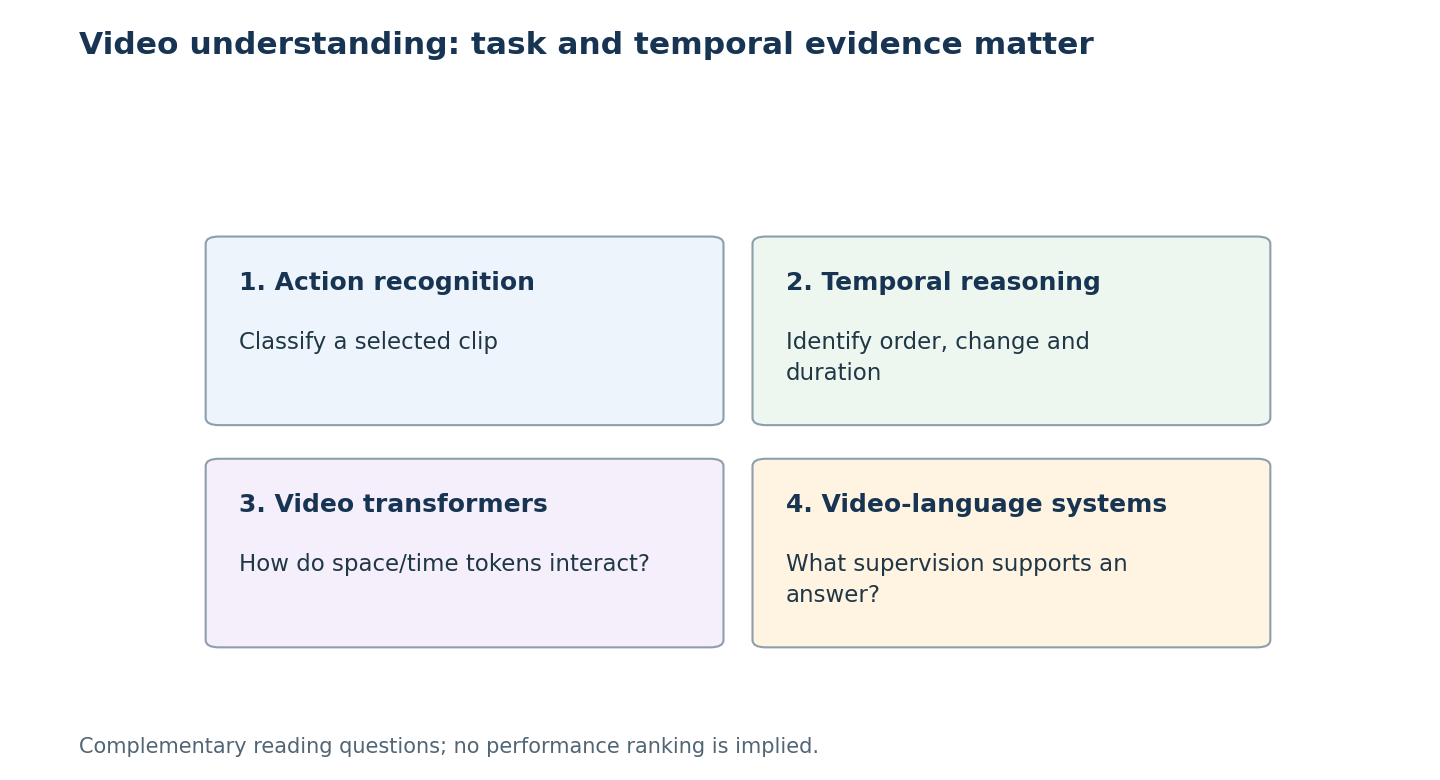
A video classifier, a temporal localization model and a video-language system are evaluated on different outputs. Strong frame appearance can solve some action benchmarks while leaving temporal reasoning weak. A model answering questions about video may rely on sparse selected frames, external text supervision or a language prior. The surveys connect these families but do not make their scores directly interchangeable.
Read each experiment with the frame count, sampling interval, clip duration, spatial resolution and test-time views stated. More clips or crops change computation as well as accuracy. For video-language comparisons, also check the available subtitles, audio, pretraining data and answer-matching procedure. To test a claim about temporal understanding, look for controls that change frame order or motion while preserving much of the appearance; a general recognition score alone does not isolate time. Use the survey taxonomy to find the relevant task, then inspect the original model’s actual visual evidence and the evaluation controls before concluding that it understands an event.
References
- Y. Zhu, X. Li, C. Liu, M. Zolfaghari, Y. Xiong, C. Wu, Z. Zhang, J. Tighe et al., “A comprehensive study of deep video action recognition,” technical report, arXiv:2012.06567, 2020. arXiv
- Y. Kong and Y. Fu, “Human action recognition and prediction: A survey,” International Journal of Computer Vision, vol. 130, no. 5, pp. 1366–1401, 2022. doi
- J. Selva, A. S. Johansen, S. Escalera, K. Nasrollahi, T. B. Moeslund and A. Clapés, “Video transformers: A survey,” IEEE Transactions on Pattern Analysis and Machine Intelligence, vol. 45, no. 11, pp. 12922–12943, 2023. doi
- N. Madan, A. Moegelmose, R. Modi, Y. S. Rawat and T. B. Moeslund, “Foundation models for video understanding: A survey,” arXiv:2405.03770, 2024. arXiv
- Y. Tang, J. Bi, S. Xu, L. Song, S. Liang, T. Wang, D. Zhang, J. An et al., “Video understanding with large language models: A survey,” arXiv:2312.17432, 2023 (accepted to IEEE Transactions on Circuits and Systems for Video Technology according to the arXiv record). arXiv
- A. Karpathy, G. Toderici, S. Shetty, T. Leung, R. Sukthankar and L. Fei-Fei, “Large-scale video classification with convolutional neural networks,” in Proc. IEEE CVPR, pp. 1725–1732, 2014. CVF
- Y. Li, Y. Li and N. Vasconcelos, “RESOUND: Towards action recognition without representation bias,” in Proc. ECCV, 2018. CVF
- L. Sevilla-Lara, S. Zha, Z. Yan, V. Goswami, M. Feiszli and L. Torresani, “Only time can tell: Discovering temporal data for temporal modeling,” in Proc. IEEE WACV, 2021. doi
- R. Goyal, S. Ebrahimi Kahou, V. Michalski, J. Materzyńska, S. Westphal, H. Kim, V. Haenel, I. Fruend et al., “The ‘something something’ video database for learning and evaluating visual common sense,” in Proc. IEEE ICCV, 2017. CVF
- Z. Tong, Y. Song, J. Wang and L. Wang, “VideoMAE: Masked autoencoders are data-efficient learners for self-supervised video pre-training,” in Advances in Neural Information Processing Systems (NeurIPS), 2022. NeurIPS · arXiv
- S. Hochreiter and J. Schmidhuber, “Long short-term memory,” Neural Computation, vol. 9, no. 8, pp. 1735–1780, 1997. doi
- K. Simonyan and A. Zisserman, “Two-stream convolutional networks for action recognition in videos,” in Advances in Neural Information Processing Systems (NeurIPS), 2014. NeurIPS · arXiv
- L. Wang, Y. Xiong, Z. Wang, Y. Qiao, D. Lin, X. Tang and L. Van Gool, “Temporal segment networks: Towards good practices for deep action recognition,” in Proc. ECCV, pp. 20–36, 2016. doi · arXiv
- J. Carreira and A. Zisserman, “Quo vadis, action recognition? A new model and the Kinetics dataset,” in Proc. IEEE CVPR, 2017. CVF · arXiv
- C. Feichtenhofer, H. Fan, J. Malik and K. He, “SlowFast networks for video recognition,” in Proc. IEEE/CVF ICCV, 2019. CVF · arXiv
- D. Tran, L. Bourdev, R. Fergus, L. Torresani and M. Paluri, “Learning spatiotemporal features with 3D convolutional networks,” in Proc. IEEE ICCV, pp. 4489–4497, 2015. CVF
- W. Kay, J. Carreira, K. Simonyan, B. Zhang, C. Hillier, S. Vijayanarasimhan, F. Viola, T. Green et al., “The Kinetics human action video dataset,” arXiv:1705.06950, 2017. arXiv
- J. Deng, W. Dong, R. Socher, L.-J. Li, K. Li and L. Fei-Fei, “ImageNet: A large-scale hierarchical image database,” in Proc. IEEE CVPR, 2009. doi
- T. Unterthiner, S. van Steenkiste, K. Kurach, R. Marinier, M. Michalski and S. Gelly, “Towards accurate generative models of video: A new metric & challenges,” arXiv:1812.01717, 2018. arXiv
- D. Tran, H. Wang, L. Torresani, J. Ray, Y. LeCun and M. Paluri, “A closer look at spatiotemporal convolutions for action recognition,” in Proc. IEEE/CVF CVPR, 2018. CVF · arXiv
- J. Lin, C. Gan and S. Han, “TSM: Temporal shift module for efficient video understanding,” in Proc. IEEE/CVF ICCV, 2019. CVF · arXiv
- X. Wang, R. Girshick, A. Gupta and K. He, “Non-local neural networks,” in Proc. IEEE/CVF CVPR, 2018. CVF
- C. Feichtenhofer, “X3D: Expanding architectures for efficient video recognition,” in Proc. IEEE/CVF CVPR, 2020. CVF
- A. Dosovitskiy, L. Beyer, A. Kolesnikov, D. Weissenborn, X. Zhai, T. Unterthiner, M. Dehghani, M. Minderer et al., “An image is worth 16x16 words: Transformers for image recognition at scale,” in Proc. ICLR, 2021. arXiv
- A. Arnab, M. Dehghani, G. Heigold, C. Sun, M. Lučić and C. Schmid, “ViViT: A video vision transformer,” in Proc. IEEE/CVF ICCV, 2021. CVF · arXiv
- G. Bertasius, H. Wang and L. Torresani, “Is space-time attention all you need for video understanding?,” in Proc. ICML, PMLR 139, 2021. PMLR · arXiv
- H. Fan, B. Xiong, K. Mangalam, Y. Li, Z. Yan, J. Malik and C. Feichtenhofer, “Multiscale vision transformers,” in Proc. IEEE/CVF ICCV, 2021. CVF · arXiv
- Z. Liu, J. Ning, Y. Cao, Y. Wei, Z. Zhang, S. Lin and H. Hu, “Video Swin Transformer,” in Proc. IEEE/CVF CVPR, 2022. CVF · arXiv
- Z. Liu, Y. Lin, Y. Cao, H. Hu, Y. Wei, Z. Zhang, S. Lin and B. Guo, “Swin Transformer: Hierarchical vision transformer using shifted windows,” in Proc. IEEE/CVF ICCV, 2021. doi
- K. Li, X. Li, Y. Wang, Y. He, Y. Wang, L. Wang and Y. Qiao, “VideoMamba: State space model for efficient video understanding,” in Proc. ECCV, pp. 237–255, 2024. doi · arXiv
- A. Gu and T. Dao, “Mamba: Linear-time sequence modeling with selective state spaces,” in Proc. Conference on Language Modeling (COLM), 2024. arXiv
- K. He, X. Chen, S. Xie, Y. Li, P. Dollár and R. Girshick, “Masked autoencoders are scalable vision learners,” in Proc. IEEE/CVF CVPR, 2022. doi
- L. Wang, B. Huang, Z. Zhao, Z. Tong, Y. He, Y. Wang, Y. Wang and Y. Qiao, “VideoMAE V2: Scaling video masked autoencoders with dual masking,” in Proc. IEEE/CVF CVPR, 2023. CVF · arXiv
- A. Bardes, Q. Garrido, J. Ponce, X. Chen, M. Rabbat, Y. LeCun, M. Assran and N. Ballas, “Revisiting feature prediction for learning visual representations from video,” Transactions on Machine Learning Research (TMLR), 2024. OpenReview · arXiv
- M. Assran, A. Bardes, D. Fan, Q. Garrido, R. Howes et al., “V-JEPA 2: Self-supervised video models enable understanding, prediction and planning,” arXiv:2506.09985, 2025. arXiv
- A. Radford, J. W. Kim, C. Hallacy, A. Ramesh, G. Goh, S. Agarwal et al., “Learning transferable visual models from natural language supervision,” in Proc. ICML, PMLR 139, 2021. PMLR
- H. Luo, L. Ji, M. Zhong, Y. Chen, W. Lei, N. Duan and T. Li, “CLIP4Clip: An empirical study of CLIP for end to end video clip retrieval and captioning,” Neurocomputing, vol. 508, pp. 293–304, 2022. doi · arXiv
- J. Xu, T. Mei, T. Yao and Y. Rui, “MSR-VTT: A large video description dataset for bridging video and language,” in Proc. IEEE CVPR, 2016. CVF
- Y. Wang, K. Li, X. Li, J. Yu, Y. He, G. Chen, B. Pei, R. Zheng et al., “InternVideo2: Scaling foundation models for multimodal video understanding,” in Proc. ECCV, pp. 396–416, 2024. doi · arXiv
- C. Fu, Y. Dai, Y. Luo, L. Li, S. Ren, R. Zhang, Z. Wang, C. Zhou et al., “Video-MME: The first-ever comprehensive evaluation benchmark of multi-modal LLMs in video analysis,” in Proc. IEEE/CVF CVPR, 2025. CVF · arXiv
- T. Lin, X. Liu, X. Li, E. Ding and S. Wen, “BMN: Boundary-matching network for temporal action proposal generation,” in Proc. IEEE/CVF ICCV, 2019. CVF
- C.-L. Zhang, J. Wu and Y. Li, “ActionFormer: Localizing moments of actions with transformers,” in Proc. ECCV, pp. 492–510, 2022. doi · arXiv
- C. Gu, C. Sun, D. A. Ross, C. Vondrick, C. Pantofaru, Y. Li, S. Vijayanarasimhan, G. Toderici et al., “AVA: A video dataset of spatio-temporally localized atomic visual actions,” in Proc. IEEE/CVF CVPR, 2018. CVF · arXiv
- A. Shahroudy, J. Liu, T.-T. Ng and G. Wang, “NTU RGB+D: A large scale dataset for 3D human activity analysis,” in Proc. IEEE CVPR, 2016. doi · arXiv
- S. Yan, Y. Xiong and D. Lin, “Spatial temporal graph convolutional networks for skeleton-based action recognition,” in Proc. AAAI, vol. 32, no. 1, 2018. doi · arXiv
- P. Weinzaepfel and G. Rogez, “Mimetics: Towards understanding human actions out of context,” International Journal of Computer Vision, vol. 129, no. 5, pp. 1675–1690, 2021. doi · arXiv
- K. Soomro, A. R. Zamir and M. Shah, “UCF101: A dataset of 101 human actions classes from videos in the wild,” technical report CRCV-TR-12-01, arXiv:1212.0402, 2012. arXiv
- H. Kuehne, H. Jhuang, E. Garrote, T. Poggio and T. Serre, “HMDB: A large video database for human motion recognition,” in Proc. IEEE ICCV, pp. 2556–2563, 2011. doi
- G. A. Sigurdsson, G. Varol, X. Wang, A. Farhadi, I. Laptev and A. Gupta, “Hollywood in homes: Crowdsourcing data collection for activity understanding,” in Proc. ECCV, pp. 510–526, 2016. doi · arXiv
- H. Idrees, A. R. Zamir, Y.-G. Jiang, A. Gorban, I. Laptev, R. Sukthankar and M. Shah, “The THUMOS challenge on action recognition for videos ‘in the wild’,” Computer Vision and Image Understanding, vol. 155, pp. 1–23, 2017. doi
- F. Caba Heilbron, V. Escorcia, B. Ghanem and J. C. Niebles, “ActivityNet: A large-scale video benchmark for human activity understanding,” in Proc. IEEE CVPR, pp. 961–970, 2015. CVF
- D. Damen, H. Doughty, G. M. Farinella, S. Fidler, A. Furnari, E. Kazakos, D. Moltisanti, J. Munro et al., “Scaling egocentric vision: The EPIC-KITCHENS dataset,” in Proc. ECCV, 2018. CVF
- D. Damen, H. Doughty, G. M. Farinella, A. Furnari, E. Kazakos, J. Ma, D. Moltisanti, J. Munro et al., “Rescaling egocentric vision: Collection, pipeline and challenges for EPIC-KITCHENS-100,” International Journal of Computer Vision, vol. 130, no. 1, 2022. doi · arXiv
- J. Choi, C. Gao, J. C. E. Messou and J.-B. Huang, “Why can’t I dance in the mall? Learning to mitigate scene bias in action recognition,” in Advances in Neural Information Processing Systems (NeurIPS), 2019. NeurIPS · arXiv
- C. Szegedy, W. Liu, Y. Jia, P. Sermanet, S. Reed, D. Anguelov, D. Erhan, V. Vanhoucke and A. Rabinovich, “Going deeper with convolutions,” in Proc. IEEE CVPR, 2015. doi