Quo Vadis: I3D and the Kinetics dataset (Carreira and Zisserman, 2017)
Optional · paper guide 1 of 3 for DLCV 08 · Video Understanding and Action Recognition. Citation numbers refer to the reference list at the bottom of this page.
Navigate: this page and this track: Navigate: this page and this track
Challenge
In 2017, video architectures were compared on UCF101 and HMDB51, which are small enough that most methods performed similarly, so it was hard to tell which designs were actually better [14].
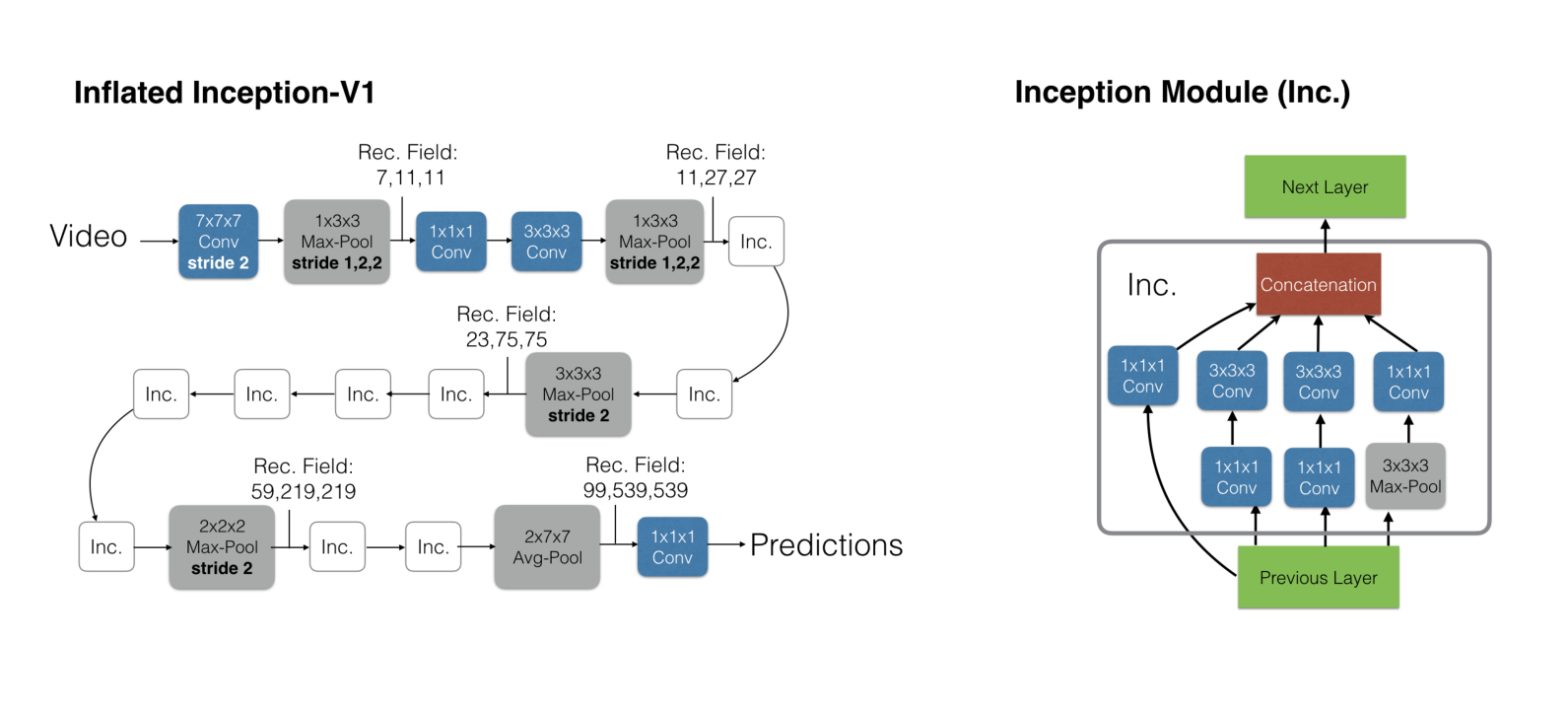
Figure source: [14], Published paper PDF, PDF page 5. Original PDF.
Method
Two contributions. First, re-evaluate the main architecture families on the much larger Kinetics dataset [17]: a CNN with an LSTM on top, a C3D-like 3D CNN trained from scratch [16], a two-stream network, a “3D-fused” two-stream network, and the new two-stream I3D. Second, build I3D by inflating an ImageNet-pretrained Inception-V1 [55], bootstrapping its 3D filters from the 2D ones with the boring-video rule described in the main text [14].
Results
I3D did best on all three datasets with RGB, flow or both; two-stream versions were better than single-stream ones everywhere; and pretraining on Kinetics followed by fine-tuning gave large gains on UCF101 and HMDB51 [14]. Interestingly, flow alone was stronger than RGB on HMDB51 but weaker on Kinetics, which the authors linked to the larger camera motion in Kinetics [14], an early sign that what a benchmark rewards shapes the conclusions.
Reading the evidence
Start with the architecture comparison table, which trains and tests each model on each dataset separately, then the transfer table, which compares training from scratch, frozen Kinetics features and fine-tuning. Check what each model was pretrained on (all but the 3D CNN start from ImageNet), how many frames each sees at training and test time, and whether flow was used: these differences explain much of the ranking.
Problems
The flow stream still needs precomputed optical flow; Kinetics clips are short, and the authors themselves found the RGB stream more discriminative than flow there [14]; and inflation inherits the image network’s design rather than asking what a video network should look like, a question later answered by R(2+1)D, SlowFast and X3D [20], [15], [23].
Conclusion
I3D made “inflate a pretrained image model and pretrain on Kinetics” the standard recipe, and its features became a common video representation, including the feature network of the Fréchet Video Distance discussed in DLCV 12A.
References
- Y. Zhu, X. Li, C. Liu, M. Zolfaghari, Y. Xiong, C. Wu, Z. Zhang, J. Tighe et al., “A comprehensive study of deep video action recognition,” technical report, arXiv:2012.06567, 2020. arXiv
- Y. Kong and Y. Fu, “Human action recognition and prediction: A survey,” International Journal of Computer Vision, vol. 130, no. 5, pp. 1366–1401, 2022. doi
- J. Selva, A. S. Johansen, S. Escalera, K. Nasrollahi, T. B. Moeslund and A. Clapés, “Video transformers: A survey,” IEEE Transactions on Pattern Analysis and Machine Intelligence, vol. 45, no. 11, pp. 12922–12943, 2023. doi
- N. Madan, A. Moegelmose, R. Modi, Y. S. Rawat and T. B. Moeslund, “Foundation models for video understanding: A survey,” arXiv:2405.03770, 2024. arXiv
- Y. Tang, J. Bi, S. Xu, L. Song, S. Liang, T. Wang, D. Zhang, J. An et al., “Video understanding with large language models: A survey,” arXiv:2312.17432, 2023 (accepted to IEEE Transactions on Circuits and Systems for Video Technology according to the arXiv record). arXiv
- A. Karpathy, G. Toderici, S. Shetty, T. Leung, R. Sukthankar and L. Fei-Fei, “Large-scale video classification with convolutional neural networks,” in Proc. IEEE CVPR, pp. 1725–1732, 2014. CVF
- Y. Li, Y. Li and N. Vasconcelos, “RESOUND: Towards action recognition without representation bias,” in Proc. ECCV, 2018. CVF
- L. Sevilla-Lara, S. Zha, Z. Yan, V. Goswami, M. Feiszli and L. Torresani, “Only time can tell: Discovering temporal data for temporal modeling,” in Proc. IEEE WACV, 2021. doi
- R. Goyal, S. Ebrahimi Kahou, V. Michalski, J. Materzyńska, S. Westphal, H. Kim, V. Haenel, I. Fruend et al., “The ‘something something’ video database for learning and evaluating visual common sense,” in Proc. IEEE ICCV, 2017. CVF
- Z. Tong, Y. Song, J. Wang and L. Wang, “VideoMAE: Masked autoencoders are data-efficient learners for self-supervised video pre-training,” in Advances in Neural Information Processing Systems (NeurIPS), 2022. NeurIPS · arXiv
- S. Hochreiter and J. Schmidhuber, “Long short-term memory,” Neural Computation, vol. 9, no. 8, pp. 1735–1780, 1997. doi
- K. Simonyan and A. Zisserman, “Two-stream convolutional networks for action recognition in videos,” in Advances in Neural Information Processing Systems (NeurIPS), 2014. NeurIPS · arXiv
- L. Wang, Y. Xiong, Z. Wang, Y. Qiao, D. Lin, X. Tang and L. Van Gool, “Temporal segment networks: Towards good practices for deep action recognition,” in Proc. ECCV, pp. 20–36, 2016. doi · arXiv
- J. Carreira and A. Zisserman, “Quo vadis, action recognition? A new model and the Kinetics dataset,” in Proc. IEEE CVPR, 2017. CVF · arXiv
- C. Feichtenhofer, H. Fan, J. Malik and K. He, “SlowFast networks for video recognition,” in Proc. IEEE/CVF ICCV, 2019. CVF · arXiv
- D. Tran, L. Bourdev, R. Fergus, L. Torresani and M. Paluri, “Learning spatiotemporal features with 3D convolutional networks,” in Proc. IEEE ICCV, pp. 4489–4497, 2015. CVF
- W. Kay, J. Carreira, K. Simonyan, B. Zhang, C. Hillier, S. Vijayanarasimhan, F. Viola, T. Green et al., “The Kinetics human action video dataset,” arXiv:1705.06950, 2017. arXiv
- J. Deng, W. Dong, R. Socher, L.-J. Li, K. Li and L. Fei-Fei, “ImageNet: A large-scale hierarchical image database,” in Proc. IEEE CVPR, 2009. doi
- T. Unterthiner, S. van Steenkiste, K. Kurach, R. Marinier, M. Michalski and S. Gelly, “Towards accurate generative models of video: A new metric & challenges,” arXiv:1812.01717, 2018. arXiv
- D. Tran, H. Wang, L. Torresani, J. Ray, Y. LeCun and M. Paluri, “A closer look at spatiotemporal convolutions for action recognition,” in Proc. IEEE/CVF CVPR, 2018. CVF · arXiv
- J. Lin, C. Gan and S. Han, “TSM: Temporal shift module for efficient video understanding,” in Proc. IEEE/CVF ICCV, 2019. CVF · arXiv
- X. Wang, R. Girshick, A. Gupta and K. He, “Non-local neural networks,” in Proc. IEEE/CVF CVPR, 2018. CVF
- C. Feichtenhofer, “X3D: Expanding architectures for efficient video recognition,” in Proc. IEEE/CVF CVPR, 2020. CVF
- A. Dosovitskiy, L. Beyer, A. Kolesnikov, D. Weissenborn, X. Zhai, T. Unterthiner, M. Dehghani, M. Minderer et al., “An image is worth 16x16 words: Transformers for image recognition at scale,” in Proc. ICLR, 2021. arXiv
- A. Arnab, M. Dehghani, G. Heigold, C. Sun, M. Lučić and C. Schmid, “ViViT: A video vision transformer,” in Proc. IEEE/CVF ICCV, 2021. CVF · arXiv
- G. Bertasius, H. Wang and L. Torresani, “Is space-time attention all you need for video understanding?,” in Proc. ICML, PMLR 139, 2021. PMLR · arXiv
- H. Fan, B. Xiong, K. Mangalam, Y. Li, Z. Yan, J. Malik and C. Feichtenhofer, “Multiscale vision transformers,” in Proc. IEEE/CVF ICCV, 2021. CVF · arXiv
- Z. Liu, J. Ning, Y. Cao, Y. Wei, Z. Zhang, S. Lin and H. Hu, “Video Swin Transformer,” in Proc. IEEE/CVF CVPR, 2022. CVF · arXiv
- Z. Liu, Y. Lin, Y. Cao, H. Hu, Y. Wei, Z. Zhang, S. Lin and B. Guo, “Swin Transformer: Hierarchical vision transformer using shifted windows,” in Proc. IEEE/CVF ICCV, 2021. doi
- K. Li, X. Li, Y. Wang, Y. He, Y. Wang, L. Wang and Y. Qiao, “VideoMamba: State space model for efficient video understanding,” in Proc. ECCV, pp. 237–255, 2024. doi · arXiv
- A. Gu and T. Dao, “Mamba: Linear-time sequence modeling with selective state spaces,” in Proc. Conference on Language Modeling (COLM), 2024. arXiv
- K. He, X. Chen, S. Xie, Y. Li, P. Dollár and R. Girshick, “Masked autoencoders are scalable vision learners,” in Proc. IEEE/CVF CVPR, 2022. doi
- L. Wang, B. Huang, Z. Zhao, Z. Tong, Y. He, Y. Wang, Y. Wang and Y. Qiao, “VideoMAE V2: Scaling video masked autoencoders with dual masking,” in Proc. IEEE/CVF CVPR, 2023. CVF · arXiv
- A. Bardes, Q. Garrido, J. Ponce, X. Chen, M. Rabbat, Y. LeCun, M. Assran and N. Ballas, “Revisiting feature prediction for learning visual representations from video,” Transactions on Machine Learning Research (TMLR), 2024. OpenReview · arXiv
- M. Assran, A. Bardes, D. Fan, Q. Garrido, R. Howes et al., “V-JEPA 2: Self-supervised video models enable understanding, prediction and planning,” arXiv:2506.09985, 2025. arXiv
- A. Radford, J. W. Kim, C. Hallacy, A. Ramesh, G. Goh, S. Agarwal et al., “Learning transferable visual models from natural language supervision,” in Proc. ICML, PMLR 139, 2021. PMLR
- H. Luo, L. Ji, M. Zhong, Y. Chen, W. Lei, N. Duan and T. Li, “CLIP4Clip: An empirical study of CLIP for end to end video clip retrieval and captioning,” Neurocomputing, vol. 508, pp. 293–304, 2022. doi · arXiv
- J. Xu, T. Mei, T. Yao and Y. Rui, “MSR-VTT: A large video description dataset for bridging video and language,” in Proc. IEEE CVPR, 2016. CVF
- Y. Wang, K. Li, X. Li, J. Yu, Y. He, G. Chen, B. Pei, R. Zheng et al., “InternVideo2: Scaling foundation models for multimodal video understanding,” in Proc. ECCV, pp. 396–416, 2024. doi · arXiv
- C. Fu, Y. Dai, Y. Luo, L. Li, S. Ren, R. Zhang, Z. Wang, C. Zhou et al., “Video-MME: The first-ever comprehensive evaluation benchmark of multi-modal LLMs in video analysis,” in Proc. IEEE/CVF CVPR, 2025. CVF · arXiv
- T. Lin, X. Liu, X. Li, E. Ding and S. Wen, “BMN: Boundary-matching network for temporal action proposal generation,” in Proc. IEEE/CVF ICCV, 2019. CVF
- C.-L. Zhang, J. Wu and Y. Li, “ActionFormer: Localizing moments of actions with transformers,” in Proc. ECCV, pp. 492–510, 2022. doi · arXiv
- C. Gu, C. Sun, D. A. Ross, C. Vondrick, C. Pantofaru, Y. Li, S. Vijayanarasimhan, G. Toderici et al., “AVA: A video dataset of spatio-temporally localized atomic visual actions,” in Proc. IEEE/CVF CVPR, 2018. CVF · arXiv
- A. Shahroudy, J. Liu, T.-T. Ng and G. Wang, “NTU RGB+D: A large scale dataset for 3D human activity analysis,” in Proc. IEEE CVPR, 2016. doi · arXiv
- S. Yan, Y. Xiong and D. Lin, “Spatial temporal graph convolutional networks for skeleton-based action recognition,” in Proc. AAAI, vol. 32, no. 1, 2018. doi · arXiv
- P. Weinzaepfel and G. Rogez, “Mimetics: Towards understanding human actions out of context,” International Journal of Computer Vision, vol. 129, no. 5, pp. 1675–1690, 2021. doi · arXiv
- K. Soomro, A. R. Zamir and M. Shah, “UCF101: A dataset of 101 human actions classes from videos in the wild,” technical report CRCV-TR-12-01, arXiv:1212.0402, 2012. arXiv
- H. Kuehne, H. Jhuang, E. Garrote, T. Poggio and T. Serre, “HMDB: A large video database for human motion recognition,” in Proc. IEEE ICCV, pp. 2556–2563, 2011. doi
- G. A. Sigurdsson, G. Varol, X. Wang, A. Farhadi, I. Laptev and A. Gupta, “Hollywood in homes: Crowdsourcing data collection for activity understanding,” in Proc. ECCV, pp. 510–526, 2016. doi · arXiv
- H. Idrees, A. R. Zamir, Y.-G. Jiang, A. Gorban, I. Laptev, R. Sukthankar and M. Shah, “The THUMOS challenge on action recognition for videos ‘in the wild’,” Computer Vision and Image Understanding, vol. 155, pp. 1–23, 2017. doi
- F. Caba Heilbron, V. Escorcia, B. Ghanem and J. C. Niebles, “ActivityNet: A large-scale video benchmark for human activity understanding,” in Proc. IEEE CVPR, pp. 961–970, 2015. CVF
- D. Damen, H. Doughty, G. M. Farinella, S. Fidler, A. Furnari, E. Kazakos, D. Moltisanti, J. Munro et al., “Scaling egocentric vision: The EPIC-KITCHENS dataset,” in Proc. ECCV, 2018. CVF
- D. Damen, H. Doughty, G. M. Farinella, A. Furnari, E. Kazakos, J. Ma, D. Moltisanti, J. Munro et al., “Rescaling egocentric vision: Collection, pipeline and challenges for EPIC-KITCHENS-100,” International Journal of Computer Vision, vol. 130, no. 1, 2022. doi · arXiv
- J. Choi, C. Gao, J. C. E. Messou and J.-B. Huang, “Why can’t I dance in the mall? Learning to mitigate scene bias in action recognition,” in Advances in Neural Information Processing Systems (NeurIPS), 2019. NeurIPS · arXiv
- C. Szegedy, W. Liu, Y. Jia, P. Sermanet, S. Reed, D. Anguelov, D. Erhan, V. Vanhoucke and A. Rabinovich, “Going deeper with convolutions,” in Proc. IEEE CVPR, 2015. doi