Simple Baselines (Xiao et al., 2018)
Optional · paper guide 1 of 3 for DLCV 05 · Human Pose and Keypoint Estimation. Citation numbers refer to the reference list at the bottom of this page.
Navigate: this page and this track: Navigate: this page and this track
Challenge
By 2018, top pose estimators had become complicated: multi-stage hourglasses, cascaded pyramid networks, refinement modules. It was hard to tell which parts mattered. Xiao, Wu and Wei [9] asked how far the simplest reasonable design would go, and offered it as a baseline for evaluating new ideas, for both single-frame pose and pose tracking in video.
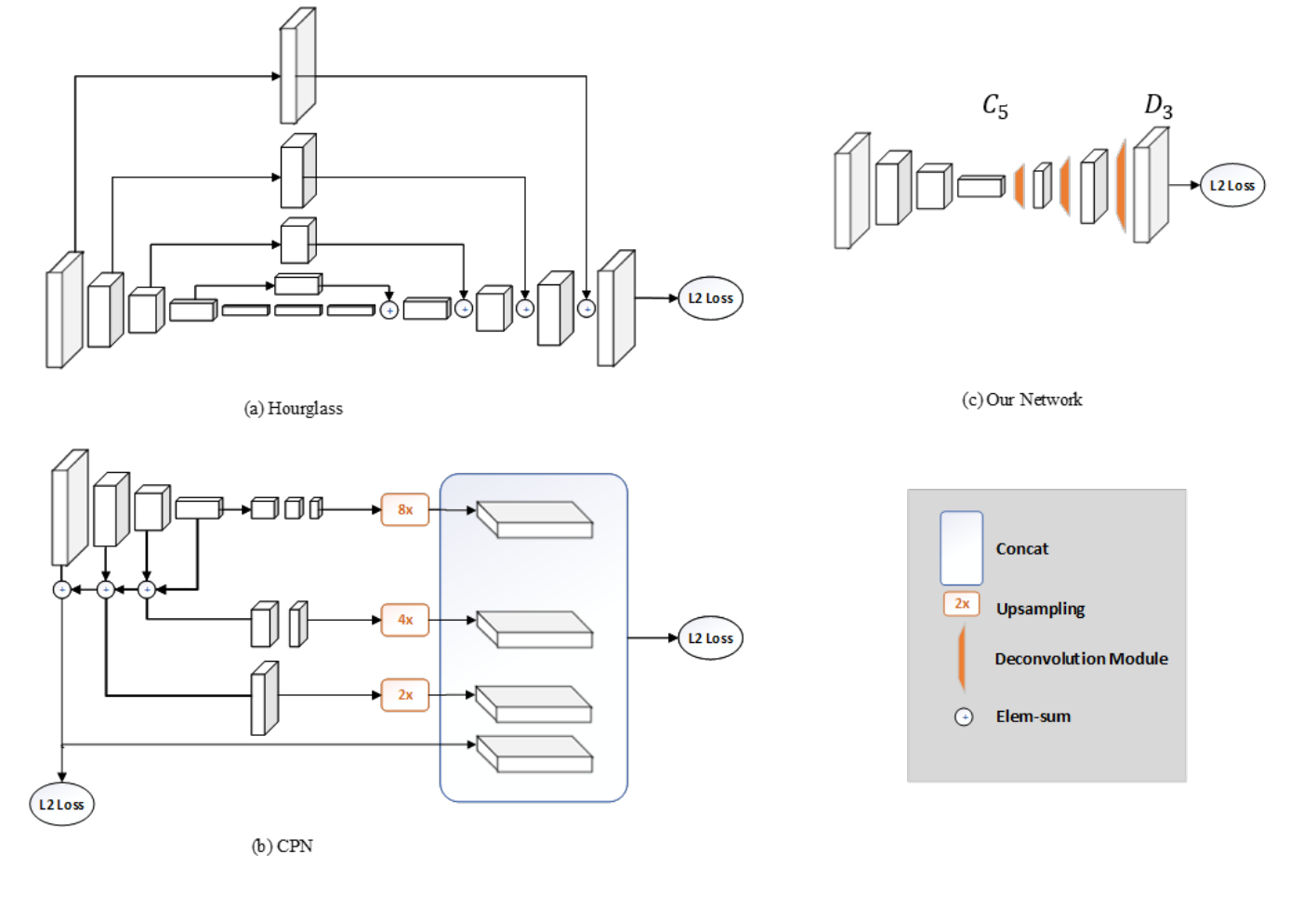
Figure source: [9], arXiv:1804.06208v2, PDF page 3. Original PDF.
Method
Take an ImageNet-pretrained ResNet, remove nothing, and add three deconvolution layers (with batch normalization and ReLU) on top of the last stage; predict heatmaps with a convolution; train with MSE against Gaussian targets. Use a standard top-down pipeline with a Faster R-CNN person detector, flip testing and the quarter-offset decoder. For tracking, propagate each person’s keypoints to the next frame with optical flow to create extra boxes, and link people across frames with a greedy matching based on a flow-based OKS similarity.
Results
The simple network matched or beat the more complex models of the time on COCO; the paper’s best single model reached 73.7 AP on COCO test-dev, and its tracking system was the state of the art on the PoseTrack benchmark at publication.
Reading the evidence
The ablation (Table 2) changes one factor at a time on COCO val2017: heatmap resolution (three deconvolution layers giving maps beat two giving by 2.5 AP), deconvolution kernel size (a small effect, 0.3 AP between kernel sizes 4 and 2), backbone depth (deeper ResNets help steadily) and input size. The comparison with Hourglass and CPN (Table 3) uses numbers cited from the CPN paper, not re-implemented; the authors say so and note that differences could come from implementation details. Two other settings must match before you compare any top-down numbers: the person detector (the paper’s detector has a person AP of 56.4 on COCO val2017, against 55.3 for the detector used by Hourglass and CPN) and the input size ( versus ).
Problems
It is a top-down method, so it inherits every detector failure and its cost grows with the number of people. Its heatmaps are still at stride 4, so decoding precision depends on the post-processing described in this chapter. HRNet, by some of the same authors, later showed that keeping high resolution throughout the network does better than recovering it at the end [15].
Conclusion
It is the template of a modern top-down pose estimator, and later systems such as ViTPose explicitly keep its simple deconvolution decoder [16].
References
- A. Mathis, P. Mamidanna, K. M. Cury, T. Abe, V. N. Murthy, M. W. Mathis and M. Bethge, “DeepLabCut: Markerless pose estimation of user-defined body parts with deep learning,” Nature Neuroscience, vol. 21, no. 9, 2018. doi · arXiv
- C. Zheng, W. Wu, C. Chen, T. Yang, S. Zhu, J. Shen, N. Kehtarnavaz and M. Shah, “Deep learning-based human pose estimation: A survey,” ACM Computing Surveys, vol. 56, no. 1, 2024. doi · arXiv
- Y. Chen, Y. Tian and M. He, “Monocular human pose estimation: A survey of deep learning-based methods,” Computer Vision and Image Understanding, vol. 192, 102897, 2020. doi · arXiv
- COCO Consortium, “Keypoint evaluation,” COCO dataset official documentation (accessed 2026-11-01). cocodataset.org
- Y. Tian, H. Zhang, Y. Liu and L. Wang, “Recovering 3D human mesh from monocular images: A survey,” IEEE Transactions on Pattern Analysis and Machine Intelligence, vol. 45, no. 12, 2023. doi · arXiv
- A. Toshev and C. Szegedy, “DeepPose: Human pose estimation via deep neural networks,” in Proc. IEEE Conference on Computer Vision and Pattern Recognition (CVPR), 2014. doi · arXiv
- J. Tompson, A. Jain, Y. LeCun and C. Bregler, “Joint training of a convolutional network and a graphical model for human pose estimation,” in Advances in Neural Information Processing Systems (NeurIPS), 2014. NeurIPS · arXiv
- A. Newell, K. Yang and J. Deng, “Stacked hourglass networks for human pose estimation,” in Proc. European Conference on Computer Vision (ECCV), LNCS, 2016. doi · arXiv
- B. Xiao, H. Wu and Y. Wei, “Simple baselines for human pose estimation and tracking,” in Proc. European Conference on Computer Vision (ECCV), LNCS, 2018. doi · arXiv
- F. Zhang, X. Zhu, H. Dai, M. Ye and C. Zhu, “Distribution-aware coordinate representation for human pose estimation,” in Proc. IEEE/CVF Conference on Computer Vision and Pattern Recognition (CVPR), 2020. doi · arXiv
- X. Sun, B. Xiao, F. Wei, S. Liang and Y. Wei, “Integral human pose regression,” in Proc. European Conference on Computer Vision (ECCV), LNCS, 2018. doi · arXiv
- Y. Li, S. Yang, P. Liu, S. Zhang, Y. Wang, Z. Wang, W. Yang and S.-T. Xia, “SimCC: A simple coordinate classification perspective for human pose estimation,” in Proc. European Conference on Computer Vision (ECCV), LNCS, 2022. doi · arXiv
- J. Li, S. Bian, A. Zeng, C. Wang, B. Pang, W. Liu and C. Lu, “Human pose regression with residual log-likelihood estimation,” in Proc. IEEE/CVF International Conference on Computer Vision (ICCV), 2021. doi · arXiv
- S.-E. Wei, V. Ramakrishna, T. Kanade and Y. Sheikh, “Convolutional pose machines,” in Proc. IEEE Conference on Computer Vision and Pattern Recognition (CVPR), 2016. doi · arXiv
- K. Sun, B. Xiao, D. Liu and J. Wang, “Deep high-resolution representation learning for human pose estimation,” in Proc. IEEE/CVF Conference on Computer Vision and Pattern Recognition (CVPR), 2019. doi · arXiv
- Y. Xu, J. Zhang, Q. Zhang and D. Tao, “ViTPose: Simple vision transformer baselines for human pose estimation,” in Advances in Neural Information Processing Systems (NeurIPS), 2022. NeurIPS · arXiv
- K. He, G. Gkioxari, P. Dollár and R. Girshick, “Mask R-CNN,” in Proc. IEEE International Conference on Computer Vision (ICCV), 2017. doi · arXiv
- Z. Cao, T. Simon, S.-E. Wei and Y. Sheikh, “Realtime multi-person 2D pose estimation using part affinity fields,” in Proc. IEEE Conference on Computer Vision and Pattern Recognition (CVPR), 2017. doi · arXiv
- A. Newell, Z. Huang and J. Deng, “Associative embedding: End-to-end learning for joint detection and grouping,” in Advances in Neural Information Processing Systems (NeurIPS), 2017. NeurIPS · arXiv
- B. Cheng, B. Xiao, J. Wang, H. Shi, T. S. Huang and L. Zhang, “HigherHRNet: Scale-aware representation learning for bottom-up human pose estimation,” in Proc. IEEE/CVF Conference on Computer Vision and Pattern Recognition (CVPR), 2020. doi · arXiv
- Z. Geng, K. Sun, B. Xiao, Z. Zhang and J. Wang, “Bottom-up human pose estimation via disentangled keypoint regression,” in Proc. IEEE/CVF Conference on Computer Vision and Pattern Recognition (CVPR), 2021. doi · arXiv
- X. Zhou, D. Wang and P. Krähenbühl, “Objects as points,” arXiv:1904.07850, 2019. arXiv
- P. Lu, T. Jiang, Y. Li, X. Li, K. Chen and W. Yang, “RTMO: Towards high-performance one-stage real-time multi-person pose estimation,” in Proc. IEEE/CVF Conference on Computer Vision and Pattern Recognition (CVPR), 2024. doi · arXiv
- J. Yang, A. Zeng, S. Liu, F. Li, R. Zhang and L. Zhang, “Explicit box detection unifies end-to-end multi-person pose estimation,” in Proc. International Conference on Learning Representations (ICLR), 2023. OpenReview · arXiv
- Y. Yang and D. Ramanan, “Articulated human detection with flexible mixtures of parts,” IEEE Transactions on Pattern Analysis and Machine Intelligence, vol. 35, no. 12, 2013. doi
- M. Andriluka, L. Pishchulin, P. Gehler and B. Schiele, “2D human pose estimation: New benchmark and state of the art analysis,” in Proc. IEEE Conference on Computer Vision and Pattern Recognition (CVPR), 2014. doi · CVF
- COCO Consortium,
cocoeval.py(keypoint OKS computation and the per-keypoint sigmas), official COCO API source code (accessed 2026-11-01). GitHub - J. Martinez, R. Hossain, J. Romero and J. J. Little, “A simple yet effective baseline for 3d human pose estimation,” in Proc. IEEE International Conference on Computer Vision (ICCV), 2017. doi · arXiv
- M. R. Ronchi and P. Perona, “Benchmarking and error diagnosis in multi-instance pose estimation,” in Proc. IEEE International Conference on Computer Vision (ICCV), 2017. doi · arXiv
- T.-Y. Lin, M. Maire, S. Belongie, J. Hays, P. Perona, D. Ramanan, P. Dollár and C. L. Zitnick, “Microsoft COCO: Common objects in context,” in Proc. European Conference on Computer Vision (ECCV), LNCS, 2014. doi · arXiv
- J. Li, C. Wang, H. Zhu, Y. Mao, H.-S. Fang and C. Lu, “CrowdPose: Efficient crowded scenes pose estimation and a new benchmark,” in Proc. IEEE/CVF Conference on Computer Vision and Pattern Recognition (CVPR), 2019. doi · arXiv
- S. Jin, L. Xu, J. Xu, C. Wang, W. Liu, C. Qian, W. Ouyang and P. Luo, “Whole-body human pose estimation in the wild,” in Proc. European Conference on Computer Vision (ECCV), LNCS, 2020. doi · arXiv
- M. Andriluka, U. Iqbal, E. Insafutdinov, L. Pishchulin, A. Milan, J. Gall and B. Schiele, “PoseTrack: A benchmark for human pose estimation and tracking,” in Proc. IEEE/CVF Conference on Computer Vision and Pattern Recognition (CVPR), 2018. doi · arXiv
- C. Ionescu, D. Papava, V. Olaru and C. Sminchisescu, “Human3.6M: Large scale datasets and predictive methods for 3D human sensing in natural environments,” IEEE Transactions on Pattern Analysis and Machine Intelligence, vol. 36, no. 7, 2014. doi · project page
- H. Yu, Y. Xu, J. Zhang, W. Zhao, Z. Guan and D. Tao, “AP-10K: A benchmark for animal pose estimation in the wild,” in Advances in Neural Information Processing Systems (NeurIPS) Datasets and Benchmarks Track, 2021. NeurIPS · arXiv
- Z. Cao, G. Hidalgo, T. Simon, S.-E. Wei and Y. Sheikh, “OpenPose: Realtime multi-person 2D pose estimation using part affinity fields,” IEEE Transactions on Pattern Analysis and Machine Intelligence, vol. 43, no. 1, 2021. doi · arXiv
- D. Pavllo, C. Feichtenhofer, D. Grangier and M. Auli, “3D human pose estimation in video with temporal convolutions and semi-supervised training,” in Proc. IEEE/CVF Conference on Computer Vision and Pattern Recognition (CVPR), 2019. doi · arXiv
- K. Iskakov, E. Burkov, V. Lempitsky and Y. Malkov, “Learnable triangulation of human pose,” in Proc. IEEE/CVF International Conference on Computer Vision (ICCV), 2019. doi · arXiv
- M. Loper, N. Mahmood, J. Romero, G. Pons-Moll and M. J. Black, “SMPL: A skinned multi-person linear model,” ACM Transactions on Graphics (Proc. SIGGRAPH Asia), vol. 34, no. 6, 2015. doi
- A. Kanazawa, M. J. Black, D. W. Jacobs and J. Malik, “End-to-end recovery of human shape and pose,” in Proc. IEEE/CVF Conference on Computer Vision and Pattern Recognition (CVPR), 2018. doi · arXiv
- S. Goel, G. Pavlakos, J. Rajasegaran, A. Kanazawa and J. Malik, “Humans in 4D: Reconstructing and tracking humans with transformers,” in Proc. IEEE/CVF International Conference on Computer Vision (ICCV), 2023. doi · arXiv
- R. Khirodkar, T. Bagautdinov, J. Martinez, S. Zhaoen, A. James, P. Selednik, S. Anderson and S. Saito, “Sapiens: Foundation for human vision models,” in Proc. European Conference on Computer Vision (ECCV), LNCS, 2024. doi · arXiv
- T. Jiang, P. Lu, L. Zhang, N. Ma, R. Han, C. Lyu, Y. Li and K. Chen, “RTMPose: Real-time multi-person pose estimation based on MMPose,” arXiv:2303.07399, 2023. arXiv