OpenPose: part affinity fields (Cao et al., 2017)
Optional · paper guide 2 of 3 for DLCV 05 · Human Pose and Keypoint Estimation. Citation numbers refer to the reference list at the bottom of this page.
Navigate: this page and this track: Navigate: this page and this track
Challenge
Top-down methods run one network per person, so their runtime grows with the crowd, and they cannot recover from a missed detection. Earlier bottom-up methods grouped keypoints by solving large graph problems that took minutes per image. Cao, Simon, Wei and Sheikh [18] wanted bottom-up grouping that was accurate and real-time.
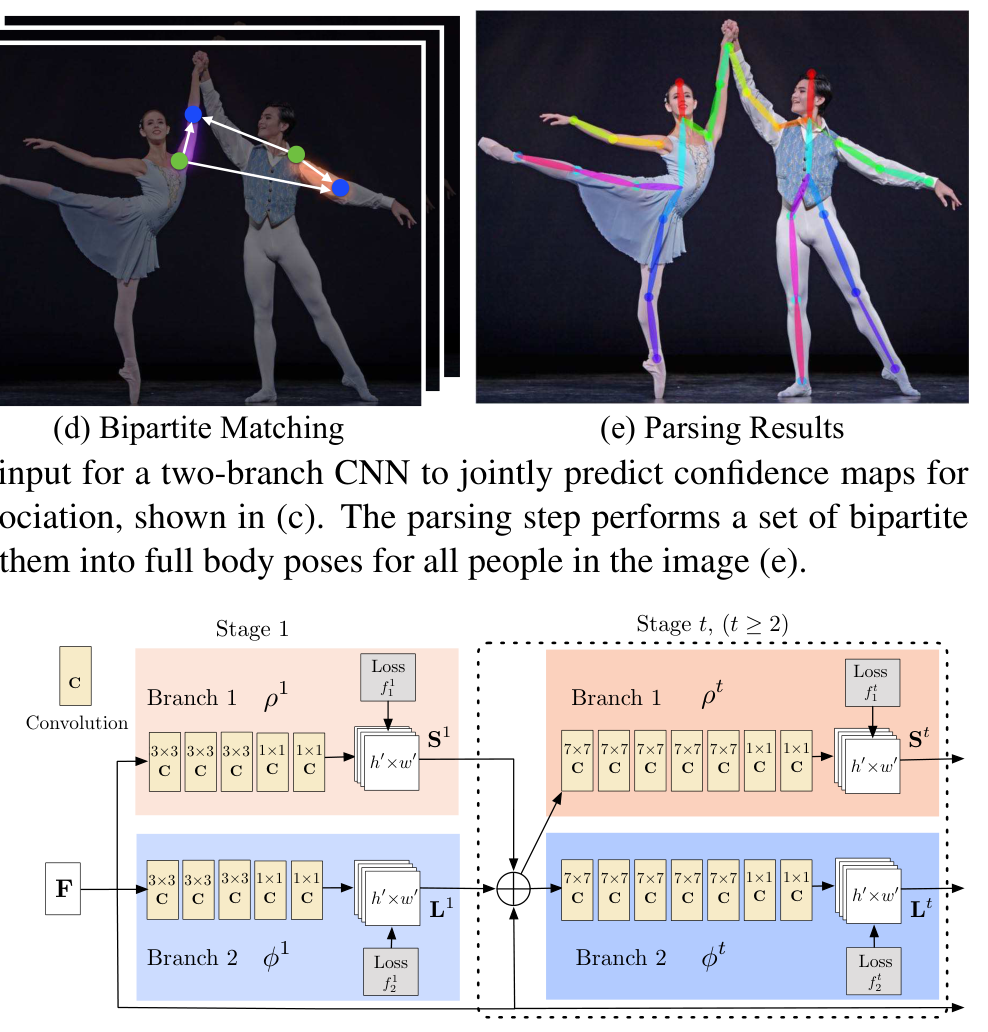
Figure source: [18], Published paper PDF, PDF page 2. Original PDF.
Method
One network with two branches predicts, in several refining stages, confidence maps for the keypoints and part affinity fields for the limbs: 2D vector fields that point along each limb. Each stage receives the image features plus both predictions of the previous stage, and every stage is supervised. At test time, candidate limbs are scored by the line integral of the field along them, and a greedy parse solves one bipartite matching per limb of a tree skeleton instead of the full NP-hard problem. The paper argues that the greedy parse works because the fields, computed with a large receptive field, already encode global context.
Results
The method won the first COCO keypoint challenge in 2016 and clearly improved the state of the art on the MPII multi-person benchmark, with a parsing step whose cost barely depends on the number of people.
Reading the evidence
The self-comparison on a COCO validation subset (Table 4) is the most instructive: a top-down baseline that uses CPM as the single-person model scores 62.7 AP with ground-truth boxes but 52.7 AP with boxes from an SSD detector, which quantifies how much top-down accuracy depends on the detector; the PAF method alone scores 58.4 AP, and 61.0 AP when each person is refined by CPM. In the challenge table, note the medium-size column: the method is weaker than top-down entries on medium-sized people, which the authors attribute to seeing all people at a single image scale. The runtime figure compares parsing and network time as the number of people grows; the network cost is constant, the parsing cost small.
Problems
Accuracy on small and medium people, the greedy parse (limbs are matched locally, so an early mistake propagates), and ambiguous fields where limbs of different people overlap along the same line (Exercise 4). The journal version [36] refines the architecture and adds foot keypoints.
Conclusion
PAFs are the clearest example of learning an explicit association signal next to the detections, the same idea that associative embedding implements with tags.
References
- A. Mathis, P. Mamidanna, K. M. Cury, T. Abe, V. N. Murthy, M. W. Mathis and M. Bethge, “DeepLabCut: Markerless pose estimation of user-defined body parts with deep learning,” Nature Neuroscience, vol. 21, no. 9, 2018. doi · arXiv
- C. Zheng, W. Wu, C. Chen, T. Yang, S. Zhu, J. Shen, N. Kehtarnavaz and M. Shah, “Deep learning-based human pose estimation: A survey,” ACM Computing Surveys, vol. 56, no. 1, 2024. doi · arXiv
- Y. Chen, Y. Tian and M. He, “Monocular human pose estimation: A survey of deep learning-based methods,” Computer Vision and Image Understanding, vol. 192, 102897, 2020. doi · arXiv
- COCO Consortium, “Keypoint evaluation,” COCO dataset official documentation (accessed 2026-11-01). cocodataset.org
- Y. Tian, H. Zhang, Y. Liu and L. Wang, “Recovering 3D human mesh from monocular images: A survey,” IEEE Transactions on Pattern Analysis and Machine Intelligence, vol. 45, no. 12, 2023. doi · arXiv
- A. Toshev and C. Szegedy, “DeepPose: Human pose estimation via deep neural networks,” in Proc. IEEE Conference on Computer Vision and Pattern Recognition (CVPR), 2014. doi · arXiv
- J. Tompson, A. Jain, Y. LeCun and C. Bregler, “Joint training of a convolutional network and a graphical model for human pose estimation,” in Advances in Neural Information Processing Systems (NeurIPS), 2014. NeurIPS · arXiv
- A. Newell, K. Yang and J. Deng, “Stacked hourglass networks for human pose estimation,” in Proc. European Conference on Computer Vision (ECCV), LNCS, 2016. doi · arXiv
- B. Xiao, H. Wu and Y. Wei, “Simple baselines for human pose estimation and tracking,” in Proc. European Conference on Computer Vision (ECCV), LNCS, 2018. doi · arXiv
- F. Zhang, X. Zhu, H. Dai, M. Ye and C. Zhu, “Distribution-aware coordinate representation for human pose estimation,” in Proc. IEEE/CVF Conference on Computer Vision and Pattern Recognition (CVPR), 2020. doi · arXiv
- X. Sun, B. Xiao, F. Wei, S. Liang and Y. Wei, “Integral human pose regression,” in Proc. European Conference on Computer Vision (ECCV), LNCS, 2018. doi · arXiv
- Y. Li, S. Yang, P. Liu, S. Zhang, Y. Wang, Z. Wang, W. Yang and S.-T. Xia, “SimCC: A simple coordinate classification perspective for human pose estimation,” in Proc. European Conference on Computer Vision (ECCV), LNCS, 2022. doi · arXiv
- J. Li, S. Bian, A. Zeng, C. Wang, B. Pang, W. Liu and C. Lu, “Human pose regression with residual log-likelihood estimation,” in Proc. IEEE/CVF International Conference on Computer Vision (ICCV), 2021. doi · arXiv
- S.-E. Wei, V. Ramakrishna, T. Kanade and Y. Sheikh, “Convolutional pose machines,” in Proc. IEEE Conference on Computer Vision and Pattern Recognition (CVPR), 2016. doi · arXiv
- K. Sun, B. Xiao, D. Liu and J. Wang, “Deep high-resolution representation learning for human pose estimation,” in Proc. IEEE/CVF Conference on Computer Vision and Pattern Recognition (CVPR), 2019. doi · arXiv
- Y. Xu, J. Zhang, Q. Zhang and D. Tao, “ViTPose: Simple vision transformer baselines for human pose estimation,” in Advances in Neural Information Processing Systems (NeurIPS), 2022. NeurIPS · arXiv
- K. He, G. Gkioxari, P. Dollár and R. Girshick, “Mask R-CNN,” in Proc. IEEE International Conference on Computer Vision (ICCV), 2017. doi · arXiv
- Z. Cao, T. Simon, S.-E. Wei and Y. Sheikh, “Realtime multi-person 2D pose estimation using part affinity fields,” in Proc. IEEE Conference on Computer Vision and Pattern Recognition (CVPR), 2017. doi · arXiv
- A. Newell, Z. Huang and J. Deng, “Associative embedding: End-to-end learning for joint detection and grouping,” in Advances in Neural Information Processing Systems (NeurIPS), 2017. NeurIPS · arXiv
- B. Cheng, B. Xiao, J. Wang, H. Shi, T. S. Huang and L. Zhang, “HigherHRNet: Scale-aware representation learning for bottom-up human pose estimation,” in Proc. IEEE/CVF Conference on Computer Vision and Pattern Recognition (CVPR), 2020. doi · arXiv
- Z. Geng, K. Sun, B. Xiao, Z. Zhang and J. Wang, “Bottom-up human pose estimation via disentangled keypoint regression,” in Proc. IEEE/CVF Conference on Computer Vision and Pattern Recognition (CVPR), 2021. doi · arXiv
- X. Zhou, D. Wang and P. Krähenbühl, “Objects as points,” arXiv:1904.07850, 2019. arXiv
- P. Lu, T. Jiang, Y. Li, X. Li, K. Chen and W. Yang, “RTMO: Towards high-performance one-stage real-time multi-person pose estimation,” in Proc. IEEE/CVF Conference on Computer Vision and Pattern Recognition (CVPR), 2024. doi · arXiv
- J. Yang, A. Zeng, S. Liu, F. Li, R. Zhang and L. Zhang, “Explicit box detection unifies end-to-end multi-person pose estimation,” in Proc. International Conference on Learning Representations (ICLR), 2023. OpenReview · arXiv
- Y. Yang and D. Ramanan, “Articulated human detection with flexible mixtures of parts,” IEEE Transactions on Pattern Analysis and Machine Intelligence, vol. 35, no. 12, 2013. doi
- M. Andriluka, L. Pishchulin, P. Gehler and B. Schiele, “2D human pose estimation: New benchmark and state of the art analysis,” in Proc. IEEE Conference on Computer Vision and Pattern Recognition (CVPR), 2014. doi · CVF
- COCO Consortium,
cocoeval.py(keypoint OKS computation and the per-keypoint sigmas), official COCO API source code (accessed 2026-11-01). GitHub - J. Martinez, R. Hossain, J. Romero and J. J. Little, “A simple yet effective baseline for 3d human pose estimation,” in Proc. IEEE International Conference on Computer Vision (ICCV), 2017. doi · arXiv
- M. R. Ronchi and P. Perona, “Benchmarking and error diagnosis in multi-instance pose estimation,” in Proc. IEEE International Conference on Computer Vision (ICCV), 2017. doi · arXiv
- T.-Y. Lin, M. Maire, S. Belongie, J. Hays, P. Perona, D. Ramanan, P. Dollár and C. L. Zitnick, “Microsoft COCO: Common objects in context,” in Proc. European Conference on Computer Vision (ECCV), LNCS, 2014. doi · arXiv
- J. Li, C. Wang, H. Zhu, Y. Mao, H.-S. Fang and C. Lu, “CrowdPose: Efficient crowded scenes pose estimation and a new benchmark,” in Proc. IEEE/CVF Conference on Computer Vision and Pattern Recognition (CVPR), 2019. doi · arXiv
- S. Jin, L. Xu, J. Xu, C. Wang, W. Liu, C. Qian, W. Ouyang and P. Luo, “Whole-body human pose estimation in the wild,” in Proc. European Conference on Computer Vision (ECCV), LNCS, 2020. doi · arXiv
- M. Andriluka, U. Iqbal, E. Insafutdinov, L. Pishchulin, A. Milan, J. Gall and B. Schiele, “PoseTrack: A benchmark for human pose estimation and tracking,” in Proc. IEEE/CVF Conference on Computer Vision and Pattern Recognition (CVPR), 2018. doi · arXiv
- C. Ionescu, D. Papava, V. Olaru and C. Sminchisescu, “Human3.6M: Large scale datasets and predictive methods for 3D human sensing in natural environments,” IEEE Transactions on Pattern Analysis and Machine Intelligence, vol. 36, no. 7, 2014. doi · project page
- H. Yu, Y. Xu, J. Zhang, W. Zhao, Z. Guan and D. Tao, “AP-10K: A benchmark for animal pose estimation in the wild,” in Advances in Neural Information Processing Systems (NeurIPS) Datasets and Benchmarks Track, 2021. NeurIPS · arXiv
- Z. Cao, G. Hidalgo, T. Simon, S.-E. Wei and Y. Sheikh, “OpenPose: Realtime multi-person 2D pose estimation using part affinity fields,” IEEE Transactions on Pattern Analysis and Machine Intelligence, vol. 43, no. 1, 2021. doi · arXiv
- D. Pavllo, C. Feichtenhofer, D. Grangier and M. Auli, “3D human pose estimation in video with temporal convolutions and semi-supervised training,” in Proc. IEEE/CVF Conference on Computer Vision and Pattern Recognition (CVPR), 2019. doi · arXiv
- K. Iskakov, E. Burkov, V. Lempitsky and Y. Malkov, “Learnable triangulation of human pose,” in Proc. IEEE/CVF International Conference on Computer Vision (ICCV), 2019. doi · arXiv
- M. Loper, N. Mahmood, J. Romero, G. Pons-Moll and M. J. Black, “SMPL: A skinned multi-person linear model,” ACM Transactions on Graphics (Proc. SIGGRAPH Asia), vol. 34, no. 6, 2015. doi
- A. Kanazawa, M. J. Black, D. W. Jacobs and J. Malik, “End-to-end recovery of human shape and pose,” in Proc. IEEE/CVF Conference on Computer Vision and Pattern Recognition (CVPR), 2018. doi · arXiv
- S. Goel, G. Pavlakos, J. Rajasegaran, A. Kanazawa and J. Malik, “Humans in 4D: Reconstructing and tracking humans with transformers,” in Proc. IEEE/CVF International Conference on Computer Vision (ICCV), 2023. doi · arXiv
- R. Khirodkar, T. Bagautdinov, J. Martinez, S. Zhaoen, A. James, P. Selednik, S. Anderson and S. Saito, “Sapiens: Foundation for human vision models,” in Proc. European Conference on Computer Vision (ECCV), LNCS, 2024. doi · arXiv
- T. Jiang, P. Lu, L. Zhang, N. Ma, R. Han, C. Lyu, Y. Li and K. Chen, “RTMPose: Real-time multi-person pose estimation based on MMPose,” arXiv:2303.07399, 2023. arXiv