Guide to the Modern view surveys
Optional · paper guide 3 of 3 for DLCV 05 · Human Pose and Keypoint Estimation. Citation numbers refer to the reference list at the bottom of this page.
Navigate: this page and this track: Navigate: this page and this track
Choose a reading by topic: Shape, Local keypoints, Texture, Matching.
Deep Learning-Based Human Pose Estimation: A Survey
(Zheng et al., ACM Computing Surveys, 2024) [2] is the broadest of the three. It covers more than 250 papers since 2014, for images and video, 2D and 3D. Its taxonomy follows the input and the inference procedure: 2D single-person (regression versus heatmaps), 2D multi-person (top-down versus bottom-up), and 3D split into single-view single-person (skeleton-only methods, either direct or lifting, versus human mesh recovery), single-view multi-person and multi-view. It also lists datasets and metrics and tabulates reported results. Use it as a map of the literature: find the branch your problem belongs to, then follow its references. Its future directions (domain adaptation, lighter body models, human–scene constraints, temporal metrics) are a good list of open questions.
Monocular Human Pose Estimation: A Survey of Deep Learning-based Methods
(Chen et al., Computer Vision and Image Understanding, 2020) [3] is shorter and earlier. It sorts methods into four tasks (2D and 3D, single- and multi-person) and introduces the three kinds of body model used in the field: skeleton-based, contour-based and volume-based. Its value for a newcomer is its summary of design tricks that proved effective and of the gap between benchmarks and applications (occlusion, crowds, efficiency, data diversity).
Recovering 3D Human Mesh from Monocular Images: A Survey
(Tian et al., IEEE TPAMI, 2023) [5] focuses on mesh recovery with body models such as SMPL. It contrasts optimization-based fitting (data terms plus priors, solved per image) with regression-based networks (trained end to end), reviews training objectives, datasets and metrics, and discusses the remaining difficulties: flexible motion, diverse appearance, complex environments and the shortage of in-the-wild 3D labels. Read it after the 3D section of this chapter if you want to go from skeletons to full bodies.
Reading these papers critically
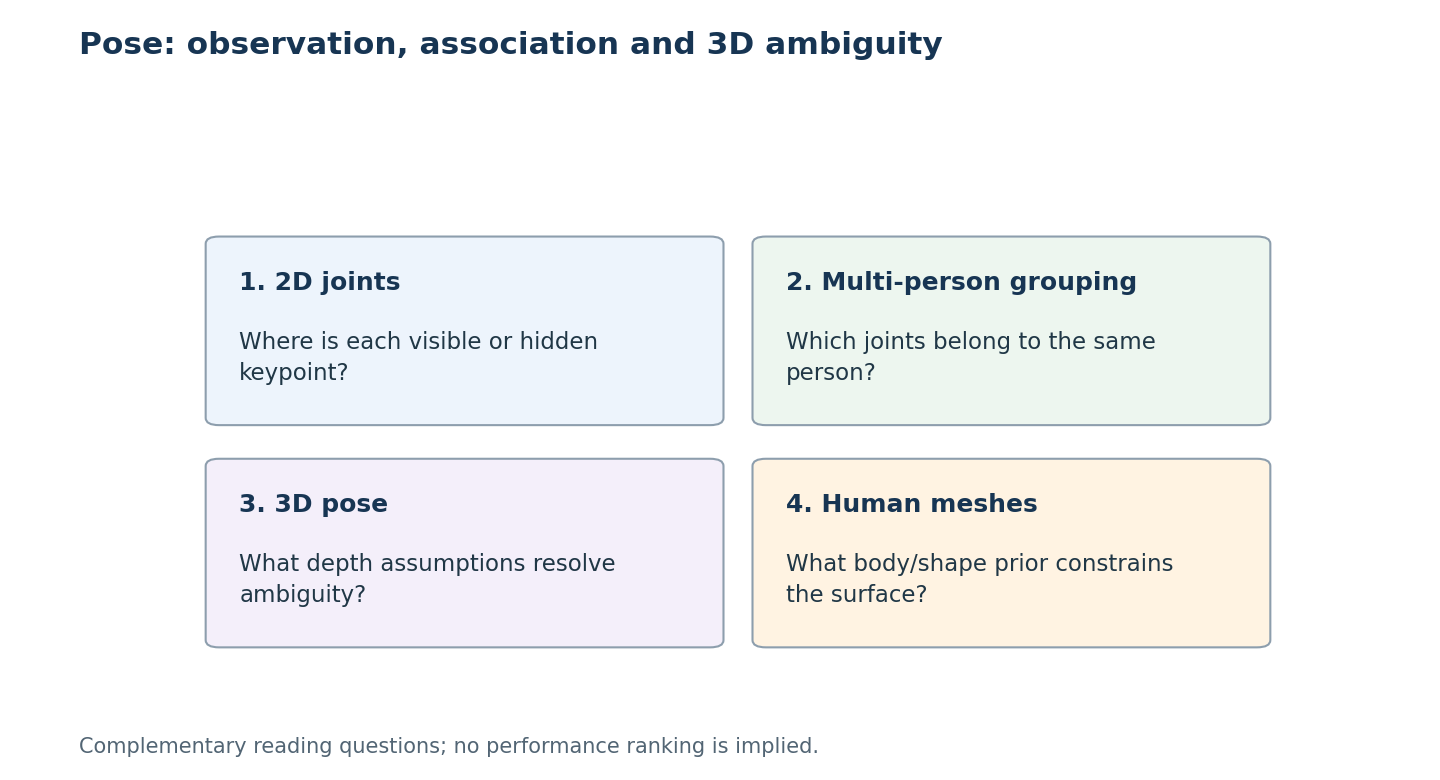
Read the pose surveys as increasingly different inference problems, not merely increasingly detailed output formats. Locating joints, assigning them to people, inferring 3D position and fitting a body surface require different supervision and priors. A top-down system also depends on person detection/cropping; a bottom-up system depends on grouping. Failure in those upstream steps can dominate a joint estimator’s apparent performance.
For 3D results, check camera information, coordinate frame, root alignment and whether a rigid or similarity alignment is applied before measuring error. A low aligned error does not establish calibrated world position. Mesh methods additionally constrain pose and shape through a body representation, which can fail outside its training population or under heavy occlusion. The surveys expose these assumptions and task families, but their scores should be traced to original evaluation protocols. Choose the next paper according to whether the unresolved problem is localization, association, depth or surface structure, and evaluate that stage rather than attributing every gain to a backbone.
References
- A. Mathis, P. Mamidanna, K. M. Cury, T. Abe, V. N. Murthy, M. W. Mathis and M. Bethge, “DeepLabCut: Markerless pose estimation of user-defined body parts with deep learning,” Nature Neuroscience, vol. 21, no. 9, 2018. doi · arXiv
- C. Zheng, W. Wu, C. Chen, T. Yang, S. Zhu, J. Shen, N. Kehtarnavaz and M. Shah, “Deep learning-based human pose estimation: A survey,” ACM Computing Surveys, vol. 56, no. 1, 2024. doi · arXiv
- Y. Chen, Y. Tian and M. He, “Monocular human pose estimation: A survey of deep learning-based methods,” Computer Vision and Image Understanding, vol. 192, 102897, 2020. doi · arXiv
- COCO Consortium, “Keypoint evaluation,” COCO dataset official documentation (accessed 2026-11-01). cocodataset.org
- Y. Tian, H. Zhang, Y. Liu and L. Wang, “Recovering 3D human mesh from monocular images: A survey,” IEEE Transactions on Pattern Analysis and Machine Intelligence, vol. 45, no. 12, 2023. doi · arXiv
- A. Toshev and C. Szegedy, “DeepPose: Human pose estimation via deep neural networks,” in Proc. IEEE Conference on Computer Vision and Pattern Recognition (CVPR), 2014. doi · arXiv
- J. Tompson, A. Jain, Y. LeCun and C. Bregler, “Joint training of a convolutional network and a graphical model for human pose estimation,” in Advances in Neural Information Processing Systems (NeurIPS), 2014. NeurIPS · arXiv
- A. Newell, K. Yang and J. Deng, “Stacked hourglass networks for human pose estimation,” in Proc. European Conference on Computer Vision (ECCV), LNCS, 2016. doi · arXiv
- B. Xiao, H. Wu and Y. Wei, “Simple baselines for human pose estimation and tracking,” in Proc. European Conference on Computer Vision (ECCV), LNCS, 2018. doi · arXiv
- F. Zhang, X. Zhu, H. Dai, M. Ye and C. Zhu, “Distribution-aware coordinate representation for human pose estimation,” in Proc. IEEE/CVF Conference on Computer Vision and Pattern Recognition (CVPR), 2020. doi · arXiv
- X. Sun, B. Xiao, F. Wei, S. Liang and Y. Wei, “Integral human pose regression,” in Proc. European Conference on Computer Vision (ECCV), LNCS, 2018. doi · arXiv
- Y. Li, S. Yang, P. Liu, S. Zhang, Y. Wang, Z. Wang, W. Yang and S.-T. Xia, “SimCC: A simple coordinate classification perspective for human pose estimation,” in Proc. European Conference on Computer Vision (ECCV), LNCS, 2022. doi · arXiv
- J. Li, S. Bian, A. Zeng, C. Wang, B. Pang, W. Liu and C. Lu, “Human pose regression with residual log-likelihood estimation,” in Proc. IEEE/CVF International Conference on Computer Vision (ICCV), 2021. doi · arXiv
- S.-E. Wei, V. Ramakrishna, T. Kanade and Y. Sheikh, “Convolutional pose machines,” in Proc. IEEE Conference on Computer Vision and Pattern Recognition (CVPR), 2016. doi · arXiv
- K. Sun, B. Xiao, D. Liu and J. Wang, “Deep high-resolution representation learning for human pose estimation,” in Proc. IEEE/CVF Conference on Computer Vision and Pattern Recognition (CVPR), 2019. doi · arXiv
- Y. Xu, J. Zhang, Q. Zhang and D. Tao, “ViTPose: Simple vision transformer baselines for human pose estimation,” in Advances in Neural Information Processing Systems (NeurIPS), 2022. NeurIPS · arXiv
- K. He, G. Gkioxari, P. Dollár and R. Girshick, “Mask R-CNN,” in Proc. IEEE International Conference on Computer Vision (ICCV), 2017. doi · arXiv
- Z. Cao, T. Simon, S.-E. Wei and Y. Sheikh, “Realtime multi-person 2D pose estimation using part affinity fields,” in Proc. IEEE Conference on Computer Vision and Pattern Recognition (CVPR), 2017. doi · arXiv
- A. Newell, Z. Huang and J. Deng, “Associative embedding: End-to-end learning for joint detection and grouping,” in Advances in Neural Information Processing Systems (NeurIPS), 2017. NeurIPS · arXiv
- B. Cheng, B. Xiao, J. Wang, H. Shi, T. S. Huang and L. Zhang, “HigherHRNet: Scale-aware representation learning for bottom-up human pose estimation,” in Proc. IEEE/CVF Conference on Computer Vision and Pattern Recognition (CVPR), 2020. doi · arXiv
- Z. Geng, K. Sun, B. Xiao, Z. Zhang and J. Wang, “Bottom-up human pose estimation via disentangled keypoint regression,” in Proc. IEEE/CVF Conference on Computer Vision and Pattern Recognition (CVPR), 2021. doi · arXiv
- X. Zhou, D. Wang and P. Krähenbühl, “Objects as points,” arXiv:1904.07850, 2019. arXiv
- P. Lu, T. Jiang, Y. Li, X. Li, K. Chen and W. Yang, “RTMO: Towards high-performance one-stage real-time multi-person pose estimation,” in Proc. IEEE/CVF Conference on Computer Vision and Pattern Recognition (CVPR), 2024. doi · arXiv
- J. Yang, A. Zeng, S. Liu, F. Li, R. Zhang and L. Zhang, “Explicit box detection unifies end-to-end multi-person pose estimation,” in Proc. International Conference on Learning Representations (ICLR), 2023. OpenReview · arXiv
- Y. Yang and D. Ramanan, “Articulated human detection with flexible mixtures of parts,” IEEE Transactions on Pattern Analysis and Machine Intelligence, vol. 35, no. 12, 2013. doi
- M. Andriluka, L. Pishchulin, P. Gehler and B. Schiele, “2D human pose estimation: New benchmark and state of the art analysis,” in Proc. IEEE Conference on Computer Vision and Pattern Recognition (CVPR), 2014. doi · CVF
- COCO Consortium,
cocoeval.py(keypoint OKS computation and the per-keypoint sigmas), official COCO API source code (accessed 2026-11-01). GitHub - J. Martinez, R. Hossain, J. Romero and J. J. Little, “A simple yet effective baseline for 3d human pose estimation,” in Proc. IEEE International Conference on Computer Vision (ICCV), 2017. doi · arXiv
- M. R. Ronchi and P. Perona, “Benchmarking and error diagnosis in multi-instance pose estimation,” in Proc. IEEE International Conference on Computer Vision (ICCV), 2017. doi · arXiv
- T.-Y. Lin, M. Maire, S. Belongie, J. Hays, P. Perona, D. Ramanan, P. Dollár and C. L. Zitnick, “Microsoft COCO: Common objects in context,” in Proc. European Conference on Computer Vision (ECCV), LNCS, 2014. doi · arXiv
- J. Li, C. Wang, H. Zhu, Y. Mao, H.-S. Fang and C. Lu, “CrowdPose: Efficient crowded scenes pose estimation and a new benchmark,” in Proc. IEEE/CVF Conference on Computer Vision and Pattern Recognition (CVPR), 2019. doi · arXiv
- S. Jin, L. Xu, J. Xu, C. Wang, W. Liu, C. Qian, W. Ouyang and P. Luo, “Whole-body human pose estimation in the wild,” in Proc. European Conference on Computer Vision (ECCV), LNCS, 2020. doi · arXiv
- M. Andriluka, U. Iqbal, E. Insafutdinov, L. Pishchulin, A. Milan, J. Gall and B. Schiele, “PoseTrack: A benchmark for human pose estimation and tracking,” in Proc. IEEE/CVF Conference on Computer Vision and Pattern Recognition (CVPR), 2018. doi · arXiv
- C. Ionescu, D. Papava, V. Olaru and C. Sminchisescu, “Human3.6M: Large scale datasets and predictive methods for 3D human sensing in natural environments,” IEEE Transactions on Pattern Analysis and Machine Intelligence, vol. 36, no. 7, 2014. doi · project page
- H. Yu, Y. Xu, J. Zhang, W. Zhao, Z. Guan and D. Tao, “AP-10K: A benchmark for animal pose estimation in the wild,” in Advances in Neural Information Processing Systems (NeurIPS) Datasets and Benchmarks Track, 2021. NeurIPS · arXiv
- Z. Cao, G. Hidalgo, T. Simon, S.-E. Wei and Y. Sheikh, “OpenPose: Realtime multi-person 2D pose estimation using part affinity fields,” IEEE Transactions on Pattern Analysis and Machine Intelligence, vol. 43, no. 1, 2021. doi · arXiv
- D. Pavllo, C. Feichtenhofer, D. Grangier and M. Auli, “3D human pose estimation in video with temporal convolutions and semi-supervised training,” in Proc. IEEE/CVF Conference on Computer Vision and Pattern Recognition (CVPR), 2019. doi · arXiv
- K. Iskakov, E. Burkov, V. Lempitsky and Y. Malkov, “Learnable triangulation of human pose,” in Proc. IEEE/CVF International Conference on Computer Vision (ICCV), 2019. doi · arXiv
- M. Loper, N. Mahmood, J. Romero, G. Pons-Moll and M. J. Black, “SMPL: A skinned multi-person linear model,” ACM Transactions on Graphics (Proc. SIGGRAPH Asia), vol. 34, no. 6, 2015. doi
- A. Kanazawa, M. J. Black, D. W. Jacobs and J. Malik, “End-to-end recovery of human shape and pose,” in Proc. IEEE/CVF Conference on Computer Vision and Pattern Recognition (CVPR), 2018. doi · arXiv
- S. Goel, G. Pavlakos, J. Rajasegaran, A. Kanazawa and J. Malik, “Humans in 4D: Reconstructing and tracking humans with transformers,” in Proc. IEEE/CVF International Conference on Computer Vision (ICCV), 2023. doi · arXiv
- R. Khirodkar, T. Bagautdinov, J. Martinez, S. Zhaoen, A. James, P. Selednik, S. Anderson and S. Saito, “Sapiens: Foundation for human vision models,” in Proc. European Conference on Computer Vision (ECCV), LNCS, 2024. doi · arXiv
- T. Jiang, P. Lu, L. Zhang, N. Ma, R. Han, C. Lyu, Y. Li and K. Chen, “RTMPose: Real-time multi-person pose estimation based on MMPose,” arXiv:2303.07399, 2023. arXiv