Mask2Former: a reading guide
Optional · paper guide 2 of 2 for DLCV 04 · Image Segmentation: Semantic, Instance and Panoptic. Citation numbers refer to the reference list at the bottom of this page.
Navigate: this page and this track: Navigate: this page and this track
Cheng, Misra, Schwing, Kirillov and Girdhar, Masked-attention Mask Transformer for Universal Image Segmentation, CVPR 2022 [26]. This guide explains what the paper claims and what to look for in its tables.
Challenge
“Universal” mask-classification models such as MaskFormer could address every segmentation task with the same architecture, but they lagged behind the best specialized model on instance segmentation and were expensive to train: the paper notes that MaskFormer needed 300 epochs on COCO and fit only one image on a 32 GB GPU. Researchers therefore kept building specialized architectures per task.
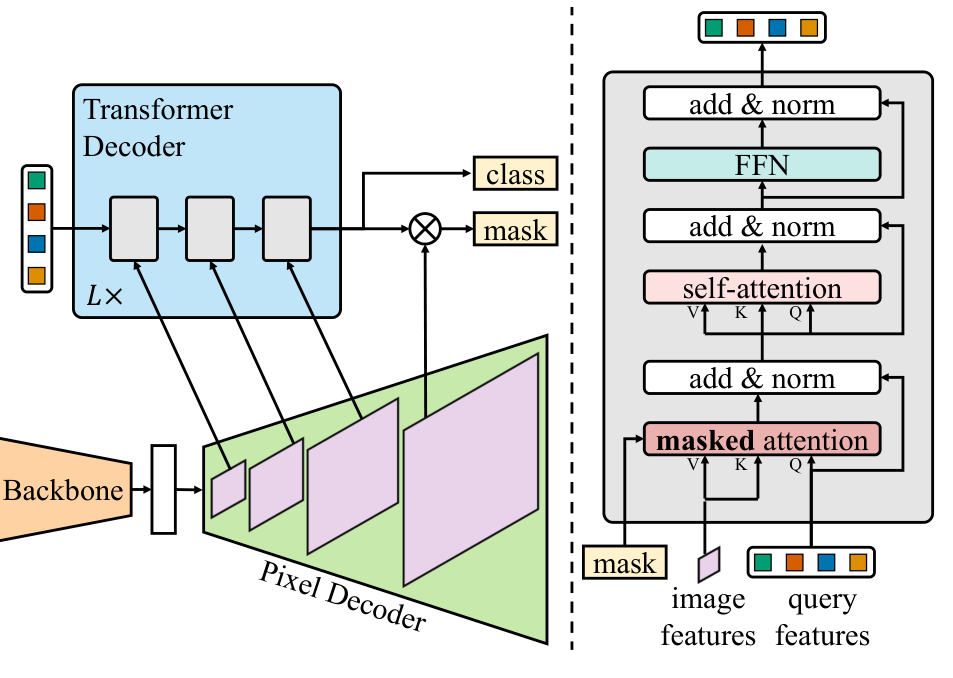
Figure source: [26], Published paper PDF, PDF page 3. Original PDF.
Method
Keep MaskFormer’s meta-architecture and fix the transformer decoder:
- masked attention, which restricts each query’s cross-attention to the foreground of its own previous mask prediction (the equation in the main text);
- multi-scale features in round robin, feeding the pixel decoder’s 1/32, 1/16 and 1/8 maps to successive decoder layers, repeated times;
- optimization changes: cross-attention before self-attention, learnable query features that are supervised directly (the authors say they behave like a region proposal network), and no dropout;
- point-sampled mask loss: the loss is computed on () sampled points, with uniform sampling for the matching cost and importance sampling for the final loss, following PointRend; the paper reports training memory falling from 18 GB to 6 GB per image.
Results
The same architecture, trained separately per task and dataset, reaches or exceeds the specialized state of the art of the time on COCO, ADE20K, Cityscapes and Mapillary Vistas, for panoptic, instance and semantic segmentation (the abstract quotes 57.8 PQ on COCO panoptic, 50.1 AP on COCO instance and 57.7 mIoU on ADE20K). In the ablations (its Table 4), masked attention gives the largest improvement, more for instance and panoptic than for semantic segmentation, and the high-resolution multi-scale strategy matters too.
Reading the evidence
- Check the training schedule column. In the COCO panoptic table (its Table 1), DETR is trained for 500+25 epochs, MaskFormer for 300 and Mask2Former for 50; part of the paper’s message is convergence speed, so compare at equal epochs where the paper provides them.
- Check backbone and pretraining. Rows marked with a dagger use backbones pretrained on a larger classification dataset than the others, and the strongest rows use 200 queries instead of 100. Compare rows with the same backbone before crediting the decoder.
- Separate task-specific and panoptic-trained numbers. The table also reports and , which come from the same model trained only with panoptic annotations; they are not the same as the numbers of models trained for instance or semantic segmentation.
- Look at cost columns. Parameters, FLOPs and frames per second are reported next to accuracy; the largest models are much slower.
Problems
A universal architecture is not yet a universal model: trained only on panoptic labels, Mask2Former is slightly worse on instance and semantic metrics than the same model trained with task-specific annotations (their Table 7), so it still needs per-task training. It also still struggles with small objects and does not fully exploit multi-scale features.
Conclusion
Mask2Former is the reference design behind the “mask classification” section and the baseline in most later tables, including OneFormer’s single-model training and EoMT’s encoder-only simplification.
References
- S. Minaee, Y. Boykov, F. Porikli, A. Plaza, N. Kehtarnavaz and D. Terzopoulos, “Image segmentation using deep learning: A survey,” IEEE Transactions on Pattern Analysis and Machine Intelligence, vol. 44, no. 7, 2022. doi · arXiv
- X. Li, H. Ding, H. Yuan, W. Zhang, J. Pang, G. Cheng, K. Chen, Z. Liu and C. C. Loy, “Transformer-based visual segmentation: A survey,” IEEE Transactions on Pattern Analysis and Machine Intelligence, vol. 46, no. 12, 2024. doi · arXiv
- T. Zhou, W. Xia, F. Zhang, B. Chang, W. Wang, Y. Yuan, E. Konukoglu and D. Cremers, “Image segmentation in foundation model era: A survey,” arXiv:2408.12957, 2024. arXiv
- A. Kirillov, K. He, R. Girshick, C. Rother and P. Dollár, “Panoptic segmentation,” in Proc. IEEE/CVF Conference on Computer Vision and Pattern Recognition (CVPR), 2019. doi · arXiv
- J. Long, E. Shelhamer and T. Darrell, “Fully convolutional networks for semantic segmentation,” in Proc. IEEE Conference on Computer Vision and Pattern Recognition (CVPR), 2015. doi · arXiv
- O. Ronneberger, P. Fischer and T. Brox, “U-Net: Convolutional networks for biomedical image segmentation,” in Medical Image Computing and Computer-Assisted Intervention (MICCAI), LNCS vol. 9351, 2015. doi
- L.-C. Chen, Y. Zhu, G. Papandreou, F. Schroff and H. Adam, “Encoder-decoder with atrous separable convolution for semantic image segmentation,” in Proc. European Conference on Computer Vision (ECCV), 2018. doi · arXiv
- L.-C. Chen, G. Papandreou, I. Kokkinos, K. Murphy and A. L. Yuille, “DeepLab: Semantic image segmentation with deep convolutional nets, atrous convolution, and fully connected CRFs,” IEEE Transactions on Pattern Analysis and Machine Intelligence, vol. 40, no. 4, 2018. doi · arXiv
- F. Yu and V. Koltun, “Multi-scale context aggregation by dilated convolutions,” in Proc. International Conference on Learning Representations (ICLR), 2016. arXiv
- L.-C. Chen, G. Papandreou, F. Schroff and H. Adam, “Rethinking atrous convolution for semantic image segmentation,” arXiv:1706.05587, 2017. arXiv
- P. Wang, P. Chen, Y. Yuan, D. Liu, Z. Huang, X. Hou and G. Cottrell, “Understanding convolution for semantic segmentation,” in Proc. IEEE Winter Conference on Applications of Computer Vision (WACV), 2018. doi · arXiv
- H. Zhao, J. Shi, X. Qi, X. Wang and J. Jia, “Pyramid scene parsing network,” in Proc. IEEE Conference on Computer Vision and Pattern Recognition (CVPR), 2017. doi · arXiv
- A. Dosovitskiy, L. Beyer, A. Kolesnikov, D. Weissenborn, X. Zhai, T. Unterthiner et al., “An image is worth 16x16 words: Transformers for image recognition at scale,” in Proc. International Conference on Learning Representations (ICLR), 2021. arXiv
- E. Xie, W. Wang, Z. Yu, A. Anandkumar, J. M. Alvarez and P. Luo, “SegFormer: Simple and efficient design for semantic segmentation with transformers,” in Advances in Neural Information Processing Systems (NeurIPS), 2021. NeurIPS · arXiv
- F. Milletari, N. Navab and S.-A. Ahmadi, “V-Net: Fully convolutional neural networks for volumetric medical image segmentation,” in Proc. Fourth International Conference on 3D Vision (3DV), 2016. doi · arXiv
- T.-Y. Lin, P. Goyal, R. Girshick, K. He and P. Dollár, “Focal loss for dense object detection,” in Proc. IEEE International Conference on Computer Vision (ICCV), 2017. doi
- B. Cheng, A. G. Schwing and A. Kirillov, “Per-pixel classification is not all you need for semantic segmentation,” in Advances in Neural Information Processing Systems (NeurIPS), 2021. NeurIPS · arXiv
- M. Cordts, M. Omran, S. Ramos, T. Rehfeld, M. Enzweiler, R. Benenson, U. Franke, S. Roth and B. Schiele, “The Cityscapes dataset for semantic urban scene understanding,” in Proc. IEEE Conference on Computer Vision and Pattern Recognition (CVPR), 2016. doi · arXiv
- B. Cheng, R. Girshick, P. Dollár, A. C. Berg and A. Kirillov, “Boundary IoU: Improving object-centric image segmentation evaluation,” in Proc. IEEE/CVF Conference on Computer Vision and Pattern Recognition (CVPR), 2021. doi · arXiv
- K. He, G. Gkioxari, P. Dollár and R. Girshick, “Mask R-CNN,” in Proc. IEEE International Conference on Computer Vision (ICCV), 2017. doi · arXiv
- S. Ren, K. He, R. Girshick and J. Sun, “Faster R-CNN: Towards real-time object detection with region proposal networks,” IEEE Transactions on Pattern Analysis and Machine Intelligence, vol. 39, no. 6, 2017. doi
- T.-Y. Lin, P. Dollár, R. Girshick, K. He, B. Hariharan and S. Belongie, “Feature pyramid networks for object detection,” in Proc. IEEE Conference on Computer Vision and Pattern Recognition (CVPR), 2017. doi
- A. Kirillov, Y. Wu, K. He and R. Girshick, “PointRend: Image segmentation as rendering,” in Proc. IEEE/CVF Conference on Computer Vision and Pattern Recognition (CVPR), 2020. doi · arXiv
- A. Kirillov, R. Girshick, K. He and P. Dollár, “Panoptic feature pyramid networks,” in Proc. IEEE/CVF Conference on Computer Vision and Pattern Recognition (CVPR), 2019. doi · arXiv
- N. Carion, F. Massa, G. Synnaeve, N. Usunier, A. Kirillov and S. Zagoruyko, “End-to-end object detection with transformers,” in Proc. European Conference on Computer Vision (ECCV), 2020. doi · arXiv
- B. Cheng, I. Misra, A. G. Schwing, A. Kirillov and R. Girdhar, “Masked-attention mask transformer for universal image segmentation,” in Proc. IEEE/CVF Conference on Computer Vision and Pattern Recognition (CVPR), 2022. doi · arXiv
- J. Jain, J. Li, M. Chiu, A. Hassani, N. Orlov and H. Shi, “OneFormer: One transformer to rule universal image segmentation,” in Proc. IEEE/CVF Conference on Computer Vision and Pattern Recognition (CVPR), 2023. doi · arXiv
- T. Kerssies, N. Cavagnero, A. Hermans, N. Norouzi, G. Averta, B. Leibe, G. Dubbelman and D. de Geus, “Your ViT is secretly an image segmentation model,” in Proc. IEEE/CVF Conference on Computer Vision and Pattern Recognition (CVPR), 2025. CVF · arXiv
- A. Kirillov, E. Mintun, N. Ravi, H. Mao, C. Rolland, L. Gustafson et al., “Segment anything,” in Proc. IEEE/CVF International Conference on Computer Vision (ICCV), 2023. doi · arXiv
- N. Ravi, V. Gabeur, Y.-T. Hu, R. Hu, C. Ryali, T. Ma et al., “SAM 2: Segment anything in images and videos,” in Proc. International Conference on Learning Representations (ICLR), 2025. OpenReview · arXiv
- N. Carion, L. Gustafson, Y.-T. Hu, S. Debnath, R. Hu, D. Suris et al., “SAM 3: Segment anything with concepts,” in Proc. International Conference on Learning Representations (ICLR), 2026. OpenReview · arXiv
- A. Radford, J. W. Kim, C. Hallacy, A. Ramesh, G. Goh, S. Agarwal et al., “Learning transferable visual models from natural language supervision,” in Proc. International Conference on Machine Learning (ICML), PMLR 139, 2021. PMLR
- B. Li, K. Q. Weinberger, S. Belongie, V. Koltun and R. Ranftl, “Language-driven semantic segmentation,” in Proc. International Conference on Learning Representations (ICLR), 2022. OpenReview · arXiv
- S. Cho, H. Shin, S. Hong, A. Arnab, P. H. Seo and S. Kim, “CAT-Seg: Cost aggregation for open-vocabulary semantic segmentation,” in Proc. IEEE/CVF Conference on Computer Vision and Pattern Recognition (CVPR), 2024. doi · arXiv
- C. Zhu and L. Chen, “A survey on open-vocabulary detection and segmentation: Past, present, and future,” IEEE Transactions on Pattern Analysis and Machine Intelligence, vol. 46, no. 12, 2024. doi
- M. Everingham, L. Van Gool, C. K. I. Williams, J. Winn and A. Zisserman, “The PASCAL Visual Object Classes (VOC) challenge,” International Journal of Computer Vision, vol. 88, no. 2, 2010. doi
- B. Zhou, H. Zhao, X. Puig, S. Fidler, A. Barriuso and A. Torralba, “Scene parsing through ADE20K dataset,” in Proc. IEEE Conference on Computer Vision and Pattern Recognition (CVPR), 2017. doi · CVF
- T.-Y. Lin, M. Maire, S. Belongie, J. Hays, P. Perona, D. Ramanan et al., “Microsoft COCO: Common objects in context,” in Proc. European Conference on Computer Vision (ECCV), 2014. doi · arXiv
- H. Caesar, J. Uijlings and V. Ferrari, “COCO-Stuff: Thing and stuff classes in context,” in Proc. IEEE/CVF Conference on Computer Vision and Pattern Recognition (CVPR), 2018. doi · arXiv
- G. Neuhold, T. Ollmann, S. Rota Bulò and P. Kontschieder, “The Mapillary Vistas dataset for semantic understanding of street scenes,” in Proc. IEEE International Conference on Computer Vision (ICCV), 2017. doi
- P. Krähenbühl and V. Koltun, “Efficient inference in fully connected CRFs with Gaussian edge potentials,” in Advances in Neural Information Processing Systems (NeurIPS), 2011. NeurIPS · arXiv