Panoptic Segmentation: a reading guide
Optional · paper guide 1 of 2 for DLCV 04 · Image Segmentation: Semantic, Instance and Panoptic. Citation numbers refer to the reference list at the bottom of this page.
Navigate: this page and this track: Navigate: this page and this track
Kirillov, He, Girshick, Rother and Dollár, Panoptic Segmentation, CVPR 2019 [4]. This guide summarizes what the paper proposes and how to read its results.
Challenge
Semantic segmentation (stuff, per-pixel labels, mIoU) and instance segmentation (things, scored masks, AP) had grown into separate tasks with separate datasets, methods and metrics. The authors argue that the split may hide something important, and that earlier joint “scene parsing” work faded partly for lack of an agreed task definition and metric.
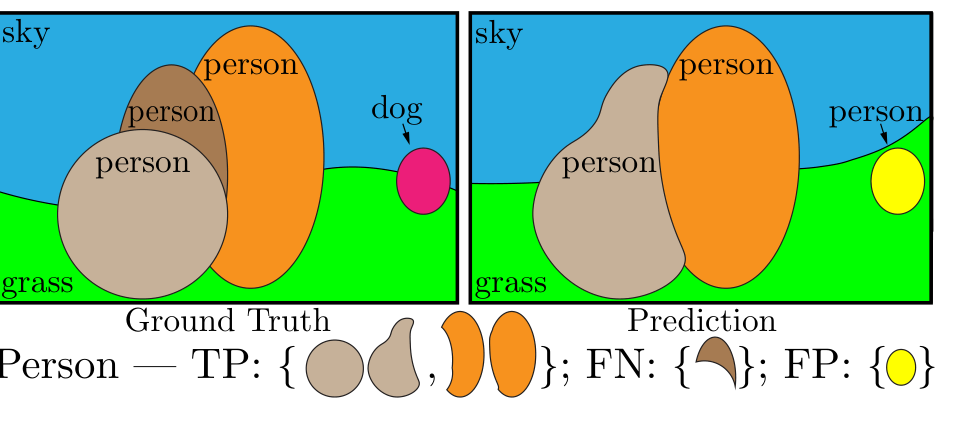
Figure source: [4], arXiv:1801.00868v3, PDF page 4. Original PDF.
Method
The paper contributes a task and a metric, not a network. The task: every pixel gets a (class, instance id) pair, stuff ids are ignored, segments cannot overlap, and no confidence scores are needed. The metric: PQ, with a matching step whose IoU threshold of 0.5 makes the match unique (Theorem 1 in the paper, proved in a few lines) and a scoring step that factors into SQ and RQ. The desiderata are stated explicitly: completeness (stuff and things treated alike), interpretability and simplicity.
Results
- Human consistency (its Tables 1 and 2). Doubly annotated images (30 from Cityscapes, 64 from ADE20K, 46 from Vistas) are scored against each other. Human PQ is far from perfect, stuff and things are similarly hard for humans, and for small objects RQ drops sharply while SQ stays reasonable: annotators miss small objects more than they mis-draw them.
- The threshold (Figures 6 and 7). With an optimal bipartite matching and no threshold, fewer than 16% of matched pairs have IoU below 0.5, and lowering the threshold to 0.25 changes PQ much less than raising it to 0.75, which supports 0.5 as the default.
- Machine baselines (Tables 3–6). Outputs of leading semantic and instance systems, obtained from the challenge organizers, are merged with the heuristic described in the main text. AP and PQ track each other for instance methods, and mIoU and PQ for semantic methods, with one telling exception: on ADE20K a semantic method that produces many small spurious patches loses much more PQ than mIoU, because PQ counts segments and mIoU counts pixels.
- Humans versus machines (Table 6). Machines are close to humans in SQ but far behind in RQ: at the time, the main gap was recognition, not segmentation.
Reading the evidence
The human study uses small image sets, so the authors report bootstrapped error ranges; check them before reading small differences. The human-versus-machine comparison uses different test images and averages over slightly different class sets, which the paper itself flags as approximate. The paper also warns that human PQ values are not comparable across datasets, because class counts, coverage and scene complexity differ. The machine results are merges of competition entries, not a single trained model, so they describe the state of separate systems rather than a method.
Problems
PQ gives every segment equal weight regardless of area, so a tiny missed object costs as much as a missed building; this is by design, but it changes which errors dominate. The 0.5 threshold ignores how good a match is beyond “more than half”, which SQ only partly recovers. Boundary quality is not measured separately, a gap Boundary PQ [19] later addressed.
Conclusion
PQ is the metric of the panoptic section and the motivation for the universal models that follow; the paper’s observation that recognition, not segmentation, was the bottleneck is a useful lens for reading later results.
References
- S. Minaee, Y. Boykov, F. Porikli, A. Plaza, N. Kehtarnavaz and D. Terzopoulos, “Image segmentation using deep learning: A survey,” IEEE Transactions on Pattern Analysis and Machine Intelligence, vol. 44, no. 7, 2022. doi · arXiv
- X. Li, H. Ding, H. Yuan, W. Zhang, J. Pang, G. Cheng, K. Chen, Z. Liu and C. C. Loy, “Transformer-based visual segmentation: A survey,” IEEE Transactions on Pattern Analysis and Machine Intelligence, vol. 46, no. 12, 2024. doi · arXiv
- T. Zhou, W. Xia, F. Zhang, B. Chang, W. Wang, Y. Yuan, E. Konukoglu and D. Cremers, “Image segmentation in foundation model era: A survey,” arXiv:2408.12957, 2024. arXiv
- A. Kirillov, K. He, R. Girshick, C. Rother and P. Dollár, “Panoptic segmentation,” in Proc. IEEE/CVF Conference on Computer Vision and Pattern Recognition (CVPR), 2019. doi · arXiv
- J. Long, E. Shelhamer and T. Darrell, “Fully convolutional networks for semantic segmentation,” in Proc. IEEE Conference on Computer Vision and Pattern Recognition (CVPR), 2015. doi · arXiv
- O. Ronneberger, P. Fischer and T. Brox, “U-Net: Convolutional networks for biomedical image segmentation,” in Medical Image Computing and Computer-Assisted Intervention (MICCAI), LNCS vol. 9351, 2015. doi
- L.-C. Chen, Y. Zhu, G. Papandreou, F. Schroff and H. Adam, “Encoder-decoder with atrous separable convolution for semantic image segmentation,” in Proc. European Conference on Computer Vision (ECCV), 2018. doi · arXiv
- L.-C. Chen, G. Papandreou, I. Kokkinos, K. Murphy and A. L. Yuille, “DeepLab: Semantic image segmentation with deep convolutional nets, atrous convolution, and fully connected CRFs,” IEEE Transactions on Pattern Analysis and Machine Intelligence, vol. 40, no. 4, 2018. doi · arXiv
- F. Yu and V. Koltun, “Multi-scale context aggregation by dilated convolutions,” in Proc. International Conference on Learning Representations (ICLR), 2016. arXiv
- L.-C. Chen, G. Papandreou, F. Schroff and H. Adam, “Rethinking atrous convolution for semantic image segmentation,” arXiv:1706.05587, 2017. arXiv
- P. Wang, P. Chen, Y. Yuan, D. Liu, Z. Huang, X. Hou and G. Cottrell, “Understanding convolution for semantic segmentation,” in Proc. IEEE Winter Conference on Applications of Computer Vision (WACV), 2018. doi · arXiv
- H. Zhao, J. Shi, X. Qi, X. Wang and J. Jia, “Pyramid scene parsing network,” in Proc. IEEE Conference on Computer Vision and Pattern Recognition (CVPR), 2017. doi · arXiv
- A. Dosovitskiy, L. Beyer, A. Kolesnikov, D. Weissenborn, X. Zhai, T. Unterthiner et al., “An image is worth 16x16 words: Transformers for image recognition at scale,” in Proc. International Conference on Learning Representations (ICLR), 2021. arXiv
- E. Xie, W. Wang, Z. Yu, A. Anandkumar, J. M. Alvarez and P. Luo, “SegFormer: Simple and efficient design for semantic segmentation with transformers,” in Advances in Neural Information Processing Systems (NeurIPS), 2021. NeurIPS · arXiv
- F. Milletari, N. Navab and S.-A. Ahmadi, “V-Net: Fully convolutional neural networks for volumetric medical image segmentation,” in Proc. Fourth International Conference on 3D Vision (3DV), 2016. doi · arXiv
- T.-Y. Lin, P. Goyal, R. Girshick, K. He and P. Dollár, “Focal loss for dense object detection,” in Proc. IEEE International Conference on Computer Vision (ICCV), 2017. doi
- B. Cheng, A. G. Schwing and A. Kirillov, “Per-pixel classification is not all you need for semantic segmentation,” in Advances in Neural Information Processing Systems (NeurIPS), 2021. NeurIPS · arXiv
- M. Cordts, M. Omran, S. Ramos, T. Rehfeld, M. Enzweiler, R. Benenson, U. Franke, S. Roth and B. Schiele, “The Cityscapes dataset for semantic urban scene understanding,” in Proc. IEEE Conference on Computer Vision and Pattern Recognition (CVPR), 2016. doi · arXiv
- B. Cheng, R. Girshick, P. Dollár, A. C. Berg and A. Kirillov, “Boundary IoU: Improving object-centric image segmentation evaluation,” in Proc. IEEE/CVF Conference on Computer Vision and Pattern Recognition (CVPR), 2021. doi · arXiv
- K. He, G. Gkioxari, P. Dollár and R. Girshick, “Mask R-CNN,” in Proc. IEEE International Conference on Computer Vision (ICCV), 2017. doi · arXiv
- S. Ren, K. He, R. Girshick and J. Sun, “Faster R-CNN: Towards real-time object detection with region proposal networks,” IEEE Transactions on Pattern Analysis and Machine Intelligence, vol. 39, no. 6, 2017. doi
- T.-Y. Lin, P. Dollár, R. Girshick, K. He, B. Hariharan and S. Belongie, “Feature pyramid networks for object detection,” in Proc. IEEE Conference on Computer Vision and Pattern Recognition (CVPR), 2017. doi
- A. Kirillov, Y. Wu, K. He and R. Girshick, “PointRend: Image segmentation as rendering,” in Proc. IEEE/CVF Conference on Computer Vision and Pattern Recognition (CVPR), 2020. doi · arXiv
- A. Kirillov, R. Girshick, K. He and P. Dollár, “Panoptic feature pyramid networks,” in Proc. IEEE/CVF Conference on Computer Vision and Pattern Recognition (CVPR), 2019. doi · arXiv
- N. Carion, F. Massa, G. Synnaeve, N. Usunier, A. Kirillov and S. Zagoruyko, “End-to-end object detection with transformers,” in Proc. European Conference on Computer Vision (ECCV), 2020. doi · arXiv
- B. Cheng, I. Misra, A. G. Schwing, A. Kirillov and R. Girdhar, “Masked-attention mask transformer for universal image segmentation,” in Proc. IEEE/CVF Conference on Computer Vision and Pattern Recognition (CVPR), 2022. doi · arXiv
- J. Jain, J. Li, M. Chiu, A. Hassani, N. Orlov and H. Shi, “OneFormer: One transformer to rule universal image segmentation,” in Proc. IEEE/CVF Conference on Computer Vision and Pattern Recognition (CVPR), 2023. doi · arXiv
- T. Kerssies, N. Cavagnero, A. Hermans, N. Norouzi, G. Averta, B. Leibe, G. Dubbelman and D. de Geus, “Your ViT is secretly an image segmentation model,” in Proc. IEEE/CVF Conference on Computer Vision and Pattern Recognition (CVPR), 2025. CVF · arXiv
- A. Kirillov, E. Mintun, N. Ravi, H. Mao, C. Rolland, L. Gustafson et al., “Segment anything,” in Proc. IEEE/CVF International Conference on Computer Vision (ICCV), 2023. doi · arXiv
- N. Ravi, V. Gabeur, Y.-T. Hu, R. Hu, C. Ryali, T. Ma et al., “SAM 2: Segment anything in images and videos,” in Proc. International Conference on Learning Representations (ICLR), 2025. OpenReview · arXiv
- N. Carion, L. Gustafson, Y.-T. Hu, S. Debnath, R. Hu, D. Suris et al., “SAM 3: Segment anything with concepts,” in Proc. International Conference on Learning Representations (ICLR), 2026. OpenReview · arXiv
- A. Radford, J. W. Kim, C. Hallacy, A. Ramesh, G. Goh, S. Agarwal et al., “Learning transferable visual models from natural language supervision,” in Proc. International Conference on Machine Learning (ICML), PMLR 139, 2021. PMLR
- B. Li, K. Q. Weinberger, S. Belongie, V. Koltun and R. Ranftl, “Language-driven semantic segmentation,” in Proc. International Conference on Learning Representations (ICLR), 2022. OpenReview · arXiv
- S. Cho, H. Shin, S. Hong, A. Arnab, P. H. Seo and S. Kim, “CAT-Seg: Cost aggregation for open-vocabulary semantic segmentation,” in Proc. IEEE/CVF Conference on Computer Vision and Pattern Recognition (CVPR), 2024. doi · arXiv
- C. Zhu and L. Chen, “A survey on open-vocabulary detection and segmentation: Past, present, and future,” IEEE Transactions on Pattern Analysis and Machine Intelligence, vol. 46, no. 12, 2024. doi
- M. Everingham, L. Van Gool, C. K. I. Williams, J. Winn and A. Zisserman, “The PASCAL Visual Object Classes (VOC) challenge,” International Journal of Computer Vision, vol. 88, no. 2, 2010. doi
- B. Zhou, H. Zhao, X. Puig, S. Fidler, A. Barriuso and A. Torralba, “Scene parsing through ADE20K dataset,” in Proc. IEEE Conference on Computer Vision and Pattern Recognition (CVPR), 2017. doi · CVF
- T.-Y. Lin, M. Maire, S. Belongie, J. Hays, P. Perona, D. Ramanan et al., “Microsoft COCO: Common objects in context,” in Proc. European Conference on Computer Vision (ECCV), 2014. doi · arXiv
- H. Caesar, J. Uijlings and V. Ferrari, “COCO-Stuff: Thing and stuff classes in context,” in Proc. IEEE/CVF Conference on Computer Vision and Pattern Recognition (CVPR), 2018. doi · arXiv
- G. Neuhold, T. Ollmann, S. Rota Bulò and P. Kontschieder, “The Mapillary Vistas dataset for semantic understanding of street scenes,” in Proc. IEEE International Conference on Computer Vision (ICCV), 2017. doi
- P. Krähenbühl and V. Koltun, “Efficient inference in fully connected CRFs with Gaussian edge potentials,” in Advances in Neural Information Processing Systems (NeurIPS), 2011. NeurIPS · arXiv