NIST FRVT Part 3: Demographic Effects (Grother, Ngan and Hanaoka, 2019)
Optional · paper guide 2 of 3 for DLCV 02A · Face Recognition and Metric Learning. Citation numbers refer to the reference list at the bottom of this page.
Navigate: this page and this track: Navigate: this page and this track
On this page
- Aligning a face: the least-squares similarity transform
- How large must the scale s be?
- Margin losses side by side: one formula and its edge cases
- Beyond one center per class: sub-centers, quality-aware margins and Partial FC
- Measuring very small error rates
- Before deep learning: eigenfaces and Fisherfaces
Deep Learning for Computer Vision
Challenge
Public claims about bias in face recognition were often based on small studies, on different tasks (such as gender classification), or on a single error type. NIST set out to quantify demographic differentials of contemporary algorithms on large operational datasets [2].
Method
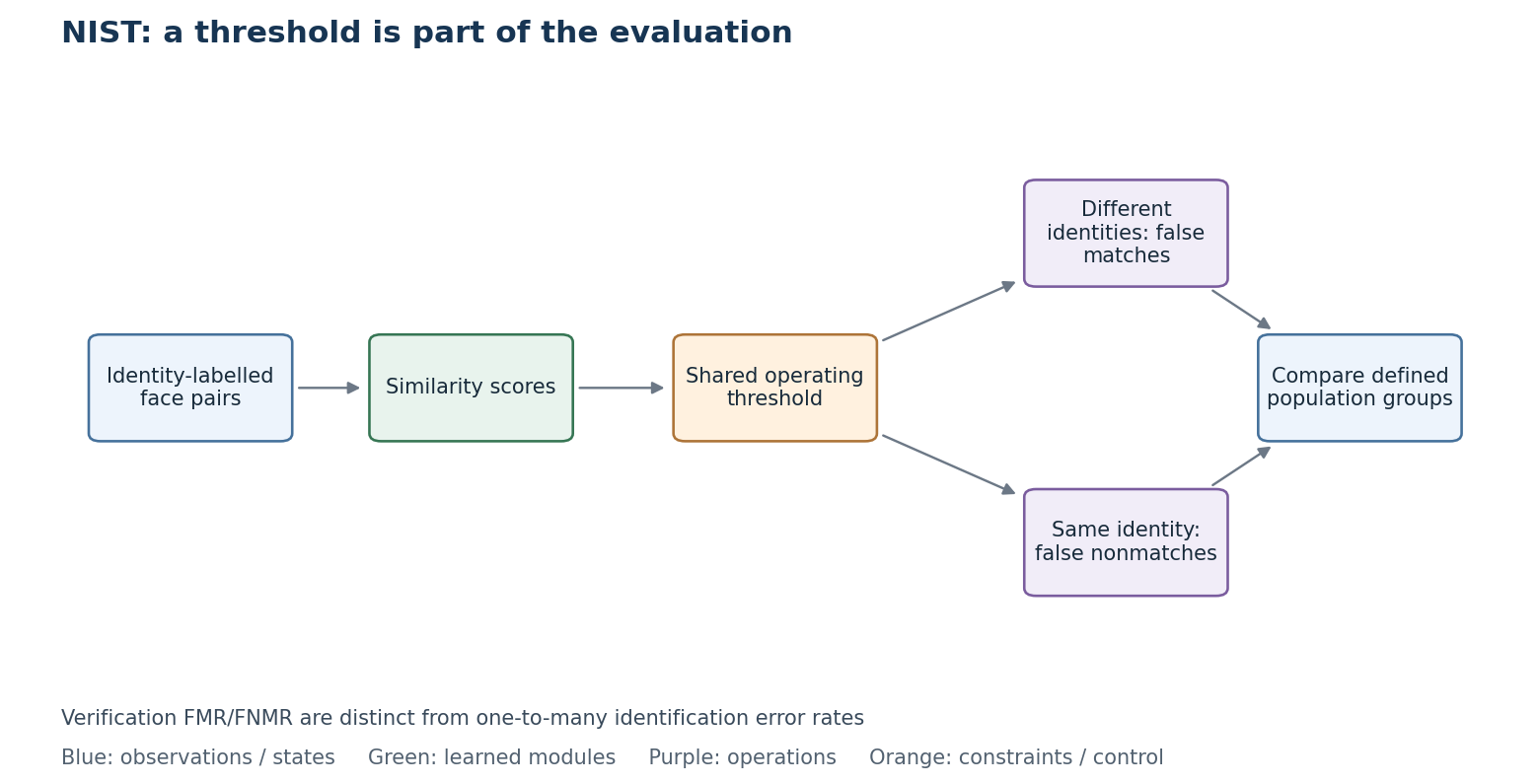
Run many submitted one-to-one and one-to-many algorithms on four large U.S. government image collections with sex, age and race or country-of-birth metadata, and report false positive and false negative rates per group at fixed thresholds [2].
Results
The executive summary’s main result is that false positive differentials were much larger than false negative ones, often by factors of 10 to beyond 100 across groups, and that the size and even the direction of effects depended on the algorithm and the dataset; image quality explained several false negative differences; and some accurate one-to-many algorithms showed undetectable false positive differentials [2].
Reading the evidence
Always check three things for any number you quote: which error (FMR or FNMR, FPIR or FNIR), at which threshold, and on which dataset. The report gives results per algorithm in extensive annexes, so “face recognition is biased by X” is not a statement the report supports; “algorithm A on dataset D at threshold t has false match rates that differ by X between groups” is. The datasets are not public, so results cannot be reproduced outside NIST, and the algorithms were prototypes submitted at the time, not necessarily deployed products [2].
Problems
Country of birth is used as a proxy for race in three of the four datasets [2]; the report measures differentials but does not decide which differences are acceptable; and algorithms have changed since 2019, so current per-algorithm results should be taken from NIST’s ongoing evaluations [3].
Conclusion
It is the basis for the fairness section’s main claims and for the advice to report both error types per group at the operating threshold.
Keep the operating point explicit
For one-to-one verification, suppose larger similarity score means a stronger match and acceptance occurs when . For the report’s defined comparison stratum ,
is the threshold; must specify how the pair/population is grouped. A cross-group pair and a same-group pair need not be the same stratum. Both errors depend on the threshold and the image population. Changing to a separate threshold for every group answers a different operating-policy question from comparing groups at one common threshold. Neither rate is itself a complete definition of fairness [2].
One-to-many search additionally depends on the gallery and search decision, so its FPIR/FNIR cannot simply be substituted for the two verification rates. Read uncertainty and small comparison counts alongside an observed differential; an undetected difference is not proof that all populations and capture conditions behave identically [2], [3].
References
- M. Wang and W. Deng, “Deep face recognition: A survey,” Neurocomputing, vol. 429, pp. 215–244, 2021. doi
- P. Grother, M. Ngan and K. Hanaoka, “Face Recognition Vendor Test (FRVT) Part 3: Demographic Effects,” NIST Interagency Report 8280, National Institute of Standards and Technology, 2019. doi
- National Institute of Standards and Technology, “Face Recognition Technology Evaluation (FRTE) 1:1 Verification,” evaluation web page, accessed 2026. NIST
- K. Zhang, Z. Zhang, Z. Li and Y. Qiao, “Joint face detection and alignment using multitask cascaded convolutional networks,” IEEE Signal Processing Letters, vol. 23, no. 10, pp. 1499–1503, 2016. doi
- J. Deng, J. Guo, E. Ververas, I. Kotsia and S. Zafeiriou, “RetinaFace: Single-shot multi-level face localisation in the wild,” in Proc. IEEE/CVF CVPR, 2020. CVF
- Y. Taigman, M. Yang, M. Ranzato and L. Wolf, “DeepFace: Closing the gap to human-level performance in face verification,” in Proc. IEEE CVPR, 2014. CVF
- F. Schroff, D. Kalenichenko and J. Philbin, “FaceNet: A unified embedding for face recognition and clustering,” in Proc. IEEE CVPR, 2015. CVF
- S. Chopra, R. Hadsell and Y. LeCun, “Learning a similarity metric discriminatively, with application to face verification,” in Proc. IEEE CVPR, vol. 1, pp. 539–546, 2005. doi
- R. Hadsell, S. Chopra and Y. LeCun, “Dimensionality reduction by learning an invariant mapping,” in Proc. IEEE CVPR, vol. 2, pp. 1735–1742, 2006. doi
- A. Hermans, L. Beyer and B. Leibe, “In defense of the triplet loss for person re-identification,” arXiv:1703.07737, 2017. arXiv
- F. Wang, X. Xiang, J. Cheng and A. L. Yuille, “NormFace: L2 hypersphere embedding for face verification,” in Proc. ACM International Conference on Multimedia, pp. 1041–1049, 2017. doi
- W. Liu, Y. Wen, Z. Yu, M. Li, B. Raj and L. Song, “SphereFace: Deep hypersphere embedding for face recognition,” in Proc. IEEE CVPR, 2017. CVF
- H. Wang, Y. Wang, Z. Zhou, X. Ji, D. Gong, J. Zhou, Z. Li and W. Liu, “CosFace: Large margin cosine loss for deep face recognition,” in Proc. IEEE/CVF CVPR, 2018. CVF
- F. Wang, J. Cheng, W. Liu and H. Liu, “Additive margin softmax for face verification,” IEEE Signal Processing Letters, vol. 25, no. 7, pp. 926–930, 2018. doi
- J. Deng, J. Guo, N. Xue and S. Zafeiriou, “ArcFace: Additive angular margin loss for deep face recognition,” in Proc. IEEE/CVF CVPR, 2019. CVF
- J. Deng, J. Guo, J. Yang, N. Xue, I. Kotsia and S. Zafeiriou, “ArcFace: Additive angular margin loss for deep face recognition,” IEEE Transactions on Pattern Analysis and Machine Intelligence, vol. 44, no. 10, pp. 5962–5979, 2022. doi
- Y. Wen, K. Zhang, Z. Li and Y. Qiao, “A discriminative feature learning approach for deep face recognition,” in Proc. ECCV, pp. 499–515, 2016. doi
- J. Deng, J. Guo, T. Liu, M. Gong and S. Zafeiriou, “Sub-center ArcFace: Boosting face recognition by large-scale noisy web faces,” in Proc. ECCV, pp. 741–757, 2020. doi
- Q. Meng, S. Zhao, Z. Huang and F. Zhou, “MagFace: A universal representation for face recognition and quality assessment,” in Proc. IEEE/CVF CVPR, 2021. CVF
- M. Kim, A. K. Jain and X. Liu, “AdaFace: Quality adaptive margin for face recognition,” in Proc. IEEE/CVF CVPR, 2022. CVF
- X. An, J. Deng, J. Guo, Z. Feng, X. Zhu, J. Yang and T. Liu, “Killing two birds with one stone: Efficient and robust training of face recognition CNNs by Partial FC,” in Proc. IEEE/CVF CVPR, 2022. CVF
- A. Martin, G. Doddington, T. Kamm, M. Ordowski and M. Przybocki, “The DET curve in assessment of detection task performance,” in Proc. Eurospeech, pp. 1895–1898, 1997. ISCA
- G. B. Huang, M. Mattar, T. Berg and E. Learned-Miller, “Labeled Faces in the Wild: A database for studying face recognition in unconstrained environments,” in Workshop on Faces in ‘Real-Life’ Images: Detection, Alignment, and Recognition, Marseille, 2008. HAL
- I. Kemelmacher-Shlizerman, S. M. Seitz, D. Miller and E. Brossard, “The MegaFace benchmark: 1 million faces for recognition at scale,” in Proc. IEEE CVPR, 2016. CVF
- University of Washington, “MegaFace and MF2: Million-scale face recognition,” project web page, accessed 2026. project page
- Y. Guo, L. Zhang, Y. Hu, X. He and J. Gao, “MS-Celeb-1M: A dataset and benchmark for large-scale face recognition,” in Proc. ECCV, pp. 87–102, 2016. doi
- C. Whitelam, E. Taborsky, A. Blanton, B. Maze, J. Adams, T. Miller, N. Kalka, A. K. Jain, J. A. Duncan, K. Allen, J. Cheney and P. Grother, “IARPA Janus Benchmark-B face dataset,” in Proc. IEEE CVPR Workshops, 2017. CVF
- B. Maze, J. Adams, J. A. Duncan, N. Kalka, T. Miller, C. Otto, A. K. Jain, W. T. Niggel, J. Anderson, J. Cheney and P. Grother, “IARPA Janus Benchmark – C: Face dataset and protocol,” in Proc. International Conference on Biometrics (ICB), pp. 158–165, 2018. doi
- Z. Zhu, G. Huang, J. Deng, Y. Ye, J. Huang, X. Chen, J. Zhu, T. Yang, J. Lu, D. Du and J. Zhou, “WebFace260M: A benchmark unveiling the power of million-scale deep face recognition,” in Proc. IEEE/CVF CVPR, 2021. CVF
- K. Peng, A. Mathur and A. Narayanan, “Mitigating dataset harms requires stewardship: Lessons from 1000 papers,” in Proc. NeurIPS Datasets and Benchmarks Track, 2021. proceedings
- G. Bae, M. de La Gorce, T. Baltrušaitis, C. Hewitt, D. Chen, J. Valentin, R. Cipolla and J. Shen, “DigiFace-1M: 1 million digital face images for face recognition,” in Proc. IEEE/CVF WACV, 2023. CVF
- M. Kim, F. Liu, A. Jain and X. Liu, “DCFace: Synthetic face generation with dual condition diffusion model,” in Proc. IEEE/CVF CVPR, 2023. CVF
- F. Boutros, V. Struc, J. Fierrez and N. Damer, “Synthetic data for face recognition: Current state and future prospects,” Image and Vision Computing, vol. 135, art. 104688, 2023. doi
- M. Wang, W. Deng, J. Hu, X. Tao and Y. Huang, “Racial Faces in the Wild: Reducing racial bias by information maximization adaptation network,” in Proc. IEEE/CVF ICCV, pp. 692–702, 2019. doi
- J. Buolamwini and T. Gebru, “Gender Shades: Intersectional accuracy disparities in commercial gender classification,” in Proc. Conference on Fairness, Accountability and Transparency, PMLR 81, pp. 77–91, 2018. PMLR
- P. Drozdowski, C. Rathgeb, A. Dantcheva, N. Damer and C. Busch, “Demographic bias in biometrics: A survey on an emerging challenge,” IEEE Transactions on Technology and Society, vol. 1, no. 2, pp. 89–103, 2020. doi
- Z. Yu, Y. Qin, X. Li, C. Zhao, Z. Lei and G. Zhao, “Deep learning for face anti-spoofing: A survey,” IEEE Transactions on Pattern Analysis and Machine Intelligence, vol. 45, pp. 5609–5631, 2023. doi
- European Commission, “What personal data is considered sensitive?,” data protection guidance referring to Article 9 of the GDPR, accessed 2026. European Commission
- European Commission, “AI Act” (Regulation (EU) 2024/1689), policy page, accessed 2026. European Commission
- M. Turk and A. Pentland, “Eigenfaces for recognition,” Journal of Cognitive Neuroscience, vol. 3, no. 1, pp. 71–86, 1991. doi
- P. N. Belhumeur, J. P. Hespanha and D. J. Kriegman, “Eigenfaces vs. Fisherfaces: Recognition using class specific linear projection,” IEEE Transactions on Pattern Analysis and Machine Intelligence, vol. 19, no. 7, pp. 711–720, 1997. doi