ArcFace (Deng et al., CVPR 2019; TPAMI 2022)
Optional · paper guide 1 of 3 for DLCV 02A · Face Recognition and Metric Learning. Citation numbers refer to the reference list at the bottom of this page.
Navigate: this page and this track: Navigate: this page and this track
On this page
- Aligning a face: the least-squares similarity transform
- How large must the scale s be?
- Margin losses side by side: one formula and its edge cases
- Beyond one center per class: sub-centers, quality-aware margins and Partial FC
- Measuring very small error rates
- Before deep learning: eigenfaces and Fisherfaces
Deep Learning for Computer Vision
Challenge
By 2018 several losses added margins to the softmax (SphereFace, CosFace), with different geometric meanings and training difficulties. The authors wanted a margin with a clear geometric interpretation that is also easy to train at scale [15].
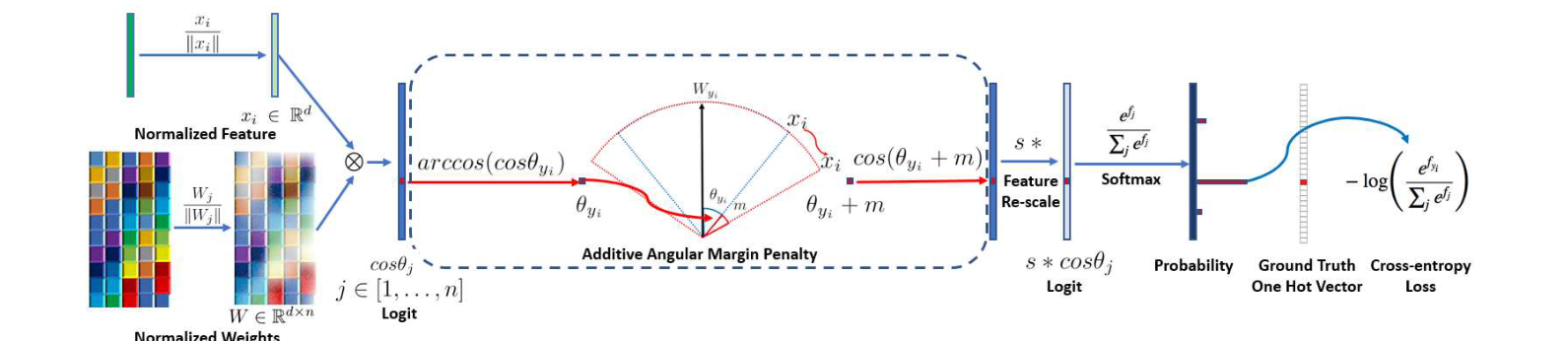
Figure source: [15], Published paper PDF, PDF page 3. Original PDF.
Method
Normalize features and class weights, rescale by , and add an angular margin to the angle between a feature and its own class center: the target logit becomes . Because the margin is added to the angle, it equals a geodesic distance on the hypersphere [15]. The journal version [16] extends the work with sub-center ArcFace for noisy web data, a combined-margin analysis that places SphereFace, CosFace and ArcFace in one formula, and further experiments (including inverting the model to synthesize faces).
Results
The experiments compare losses with the backbone and training data held fixed, written as [training set, network, loss] [16]. Read the tables in that spirit: compare rows that differ only in the loss; a change of training set (for example a cleaned versus a raw web set) moves results by more than many loss changes. The main test sets are LFW and similar pair-based sets, MegaFace, and IJB-B/IJB-C; for IJB the reported number is TAR at FAR = on template pairs, where a template’s embedding is the mean of its images’ embeddings [16]. The experimental setup (five RetinaFace landmarks, crops, 512-D embeddings, , ) is documented in the paper [16] and has become a common default.
Problems
The gains on LFW are tiny because LFW is saturated; the informative comparisons are at low FAR on IJB-B/C and on large galleries. Several training sets used in this line of work have since been withdrawn or changed [30], which makes exact reproduction difficult. The margin assumes labels are correct; with heavy label noise the plain loss suffers, which is what sub-centers address.
Conclusion
ArcFace is the reference form of the margin-based softmax in this chapter, and its geometric argument (constant geodesic margin) is the one Figure 2 illustrates.
References
- M. Wang and W. Deng, “Deep face recognition: A survey,” Neurocomputing, vol. 429, pp. 215–244, 2021. doi
- P. Grother, M. Ngan and K. Hanaoka, “Face Recognition Vendor Test (FRVT) Part 3: Demographic Effects,” NIST Interagency Report 8280, National Institute of Standards and Technology, 2019. doi
- National Institute of Standards and Technology, “Face Recognition Technology Evaluation (FRTE) 1:1 Verification,” evaluation web page, accessed 2026. NIST
- K. Zhang, Z. Zhang, Z. Li and Y. Qiao, “Joint face detection and alignment using multitask cascaded convolutional networks,” IEEE Signal Processing Letters, vol. 23, no. 10, pp. 1499–1503, 2016. doi
- J. Deng, J. Guo, E. Ververas, I. Kotsia and S. Zafeiriou, “RetinaFace: Single-shot multi-level face localisation in the wild,” in Proc. IEEE/CVF CVPR, 2020. CVF
- Y. Taigman, M. Yang, M. Ranzato and L. Wolf, “DeepFace: Closing the gap to human-level performance in face verification,” in Proc. IEEE CVPR, 2014. CVF
- F. Schroff, D. Kalenichenko and J. Philbin, “FaceNet: A unified embedding for face recognition and clustering,” in Proc. IEEE CVPR, 2015. CVF
- S. Chopra, R. Hadsell and Y. LeCun, “Learning a similarity metric discriminatively, with application to face verification,” in Proc. IEEE CVPR, vol. 1, pp. 539–546, 2005. doi
- R. Hadsell, S. Chopra and Y. LeCun, “Dimensionality reduction by learning an invariant mapping,” in Proc. IEEE CVPR, vol. 2, pp. 1735–1742, 2006. doi
- A. Hermans, L. Beyer and B. Leibe, “In defense of the triplet loss for person re-identification,” arXiv:1703.07737, 2017. arXiv
- F. Wang, X. Xiang, J. Cheng and A. L. Yuille, “NormFace: L2 hypersphere embedding for face verification,” in Proc. ACM International Conference on Multimedia, pp. 1041–1049, 2017. doi
- W. Liu, Y. Wen, Z. Yu, M. Li, B. Raj and L. Song, “SphereFace: Deep hypersphere embedding for face recognition,” in Proc. IEEE CVPR, 2017. CVF
- H. Wang, Y. Wang, Z. Zhou, X. Ji, D. Gong, J. Zhou, Z. Li and W. Liu, “CosFace: Large margin cosine loss for deep face recognition,” in Proc. IEEE/CVF CVPR, 2018. CVF
- F. Wang, J. Cheng, W. Liu and H. Liu, “Additive margin softmax for face verification,” IEEE Signal Processing Letters, vol. 25, no. 7, pp. 926–930, 2018. doi
- J. Deng, J. Guo, N. Xue and S. Zafeiriou, “ArcFace: Additive angular margin loss for deep face recognition,” in Proc. IEEE/CVF CVPR, 2019. CVF
- J. Deng, J. Guo, J. Yang, N. Xue, I. Kotsia and S. Zafeiriou, “ArcFace: Additive angular margin loss for deep face recognition,” IEEE Transactions on Pattern Analysis and Machine Intelligence, vol. 44, no. 10, pp. 5962–5979, 2022. doi
- Y. Wen, K. Zhang, Z. Li and Y. Qiao, “A discriminative feature learning approach for deep face recognition,” in Proc. ECCV, pp. 499–515, 2016. doi
- J. Deng, J. Guo, T. Liu, M. Gong and S. Zafeiriou, “Sub-center ArcFace: Boosting face recognition by large-scale noisy web faces,” in Proc. ECCV, pp. 741–757, 2020. doi
- Q. Meng, S. Zhao, Z. Huang and F. Zhou, “MagFace: A universal representation for face recognition and quality assessment,” in Proc. IEEE/CVF CVPR, 2021. CVF
- M. Kim, A. K. Jain and X. Liu, “AdaFace: Quality adaptive margin for face recognition,” in Proc. IEEE/CVF CVPR, 2022. CVF
- X. An, J. Deng, J. Guo, Z. Feng, X. Zhu, J. Yang and T. Liu, “Killing two birds with one stone: Efficient and robust training of face recognition CNNs by Partial FC,” in Proc. IEEE/CVF CVPR, 2022. CVF
- A. Martin, G. Doddington, T. Kamm, M. Ordowski and M. Przybocki, “The DET curve in assessment of detection task performance,” in Proc. Eurospeech, pp. 1895–1898, 1997. ISCA
- G. B. Huang, M. Mattar, T. Berg and E. Learned-Miller, “Labeled Faces in the Wild: A database for studying face recognition in unconstrained environments,” in Workshop on Faces in ‘Real-Life’ Images: Detection, Alignment, and Recognition, Marseille, 2008. HAL
- I. Kemelmacher-Shlizerman, S. M. Seitz, D. Miller and E. Brossard, “The MegaFace benchmark: 1 million faces for recognition at scale,” in Proc. IEEE CVPR, 2016. CVF
- University of Washington, “MegaFace and MF2: Million-scale face recognition,” project web page, accessed 2026. project page
- Y. Guo, L. Zhang, Y. Hu, X. He and J. Gao, “MS-Celeb-1M: A dataset and benchmark for large-scale face recognition,” in Proc. ECCV, pp. 87–102, 2016. doi
- C. Whitelam, E. Taborsky, A. Blanton, B. Maze, J. Adams, T. Miller, N. Kalka, A. K. Jain, J. A. Duncan, K. Allen, J. Cheney and P. Grother, “IARPA Janus Benchmark-B face dataset,” in Proc. IEEE CVPR Workshops, 2017. CVF
- B. Maze, J. Adams, J. A. Duncan, N. Kalka, T. Miller, C. Otto, A. K. Jain, W. T. Niggel, J. Anderson, J. Cheney and P. Grother, “IARPA Janus Benchmark – C: Face dataset and protocol,” in Proc. International Conference on Biometrics (ICB), pp. 158–165, 2018. doi
- Z. Zhu, G. Huang, J. Deng, Y. Ye, J. Huang, X. Chen, J. Zhu, T. Yang, J. Lu, D. Du and J. Zhou, “WebFace260M: A benchmark unveiling the power of million-scale deep face recognition,” in Proc. IEEE/CVF CVPR, 2021. CVF
- K. Peng, A. Mathur and A. Narayanan, “Mitigating dataset harms requires stewardship: Lessons from 1000 papers,” in Proc. NeurIPS Datasets and Benchmarks Track, 2021. proceedings
- G. Bae, M. de La Gorce, T. Baltrušaitis, C. Hewitt, D. Chen, J. Valentin, R. Cipolla and J. Shen, “DigiFace-1M: 1 million digital face images for face recognition,” in Proc. IEEE/CVF WACV, 2023. CVF
- M. Kim, F. Liu, A. Jain and X. Liu, “DCFace: Synthetic face generation with dual condition diffusion model,” in Proc. IEEE/CVF CVPR, 2023. CVF
- F. Boutros, V. Struc, J. Fierrez and N. Damer, “Synthetic data for face recognition: Current state and future prospects,” Image and Vision Computing, vol. 135, art. 104688, 2023. doi
- M. Wang, W. Deng, J. Hu, X. Tao and Y. Huang, “Racial Faces in the Wild: Reducing racial bias by information maximization adaptation network,” in Proc. IEEE/CVF ICCV, pp. 692–702, 2019. doi
- J. Buolamwini and T. Gebru, “Gender Shades: Intersectional accuracy disparities in commercial gender classification,” in Proc. Conference on Fairness, Accountability and Transparency, PMLR 81, pp. 77–91, 2018. PMLR
- P. Drozdowski, C. Rathgeb, A. Dantcheva, N. Damer and C. Busch, “Demographic bias in biometrics: A survey on an emerging challenge,” IEEE Transactions on Technology and Society, vol. 1, no. 2, pp. 89–103, 2020. doi
- Z. Yu, Y. Qin, X. Li, C. Zhao, Z. Lei and G. Zhao, “Deep learning for face anti-spoofing: A survey,” IEEE Transactions on Pattern Analysis and Machine Intelligence, vol. 45, pp. 5609–5631, 2023. doi
- European Commission, “What personal data is considered sensitive?,” data protection guidance referring to Article 9 of the GDPR, accessed 2026. European Commission
- European Commission, “AI Act” (Regulation (EU) 2024/1689), policy page, accessed 2026. European Commission
- M. Turk and A. Pentland, “Eigenfaces for recognition,” Journal of Cognitive Neuroscience, vol. 3, no. 1, pp. 71–86, 1991. doi
- P. N. Belhumeur, J. P. Hespanha and D. J. Kriegman, “Eigenfaces vs. Fisherfaces: Recognition using class specific linear projection,” IEEE Transactions on Pattern Analysis and Machine Intelligence, vol. 19, no. 7, pp. 711–720, 1997. doi