Guide to the Modern view surveys
Optional · paper guide 3 of 3 for DLCV 02A · Face Recognition and Metric Learning. Citation numbers refer to the reference list at the bottom of this page.
Navigate: this page and this track: Navigate: this page and this track
On this page
- Aligning a face: the least-squares similarity transform
- How large must the scale s be?
- Margin losses side by side: one formula and its edge cases
- Beyond one center per class: sub-centers, quality-aware margins and Partial FC
- Measuring very small error rates
- Before deep learning: eigenfaces and Fisherfaces
Deep Learning for Computer Vision
Choose a reading by topic: Shape, Local keypoints, Texture, Matching.
Deep face recognition: A survey
(Wang and Deng, Neurocomputing, 2021) [1]. Coverage: architectures, loss functions, face processing, datasets and protocols, and application scenes. Organization: losses in three families (Euclidean-distance-based, angular/cosine-margin-based, softmax variations); face processing in two (“one-to-many augmentation”, which generates many images with pose variation from one image, and “many-to-one normalization”, which recovers a canonical frontal view); scenes such as cross-factor, heterogeneous, multiple-media and industrial recognition. Use it as a map when you meet an unfamiliar loss or benchmark: find its family, then read the original paper.
Demographic bias in biometrics: A survey on an emerging challenge
(Drozdowski et al., IEEE Transactions on Technology and Society, 2020) [36]. Coverage: algorithmic bias in biometrics generally, the literature on estimating and mitigating it, and the related technical and social issues. Use it to see how fairness is measured in different studies, which makes it easier to compare their claims.
Deep learning for face anti-spoofing: A survey
(Yu et al., IEEE TPAMI, 2023) [37]. Coverage: deep PAD with binary and pixel-wise supervision, domain generalization and open-set protocols, and multi-modal or specialized sensors. Use it to understand what the PAD benchmarks test and which protocols are hardest.
Synthetic data for face recognition: Current state and future prospects
(Boutros et al., Image and Vision Computing, 2023) [33]. Coverage: a taxonomy of use cases of synthetic face data, recent recognition models trained on it, and the remaining challenges. Use it to place DigiFace-1M, DCFace and later synthetic datasets.
Reading these papers critically
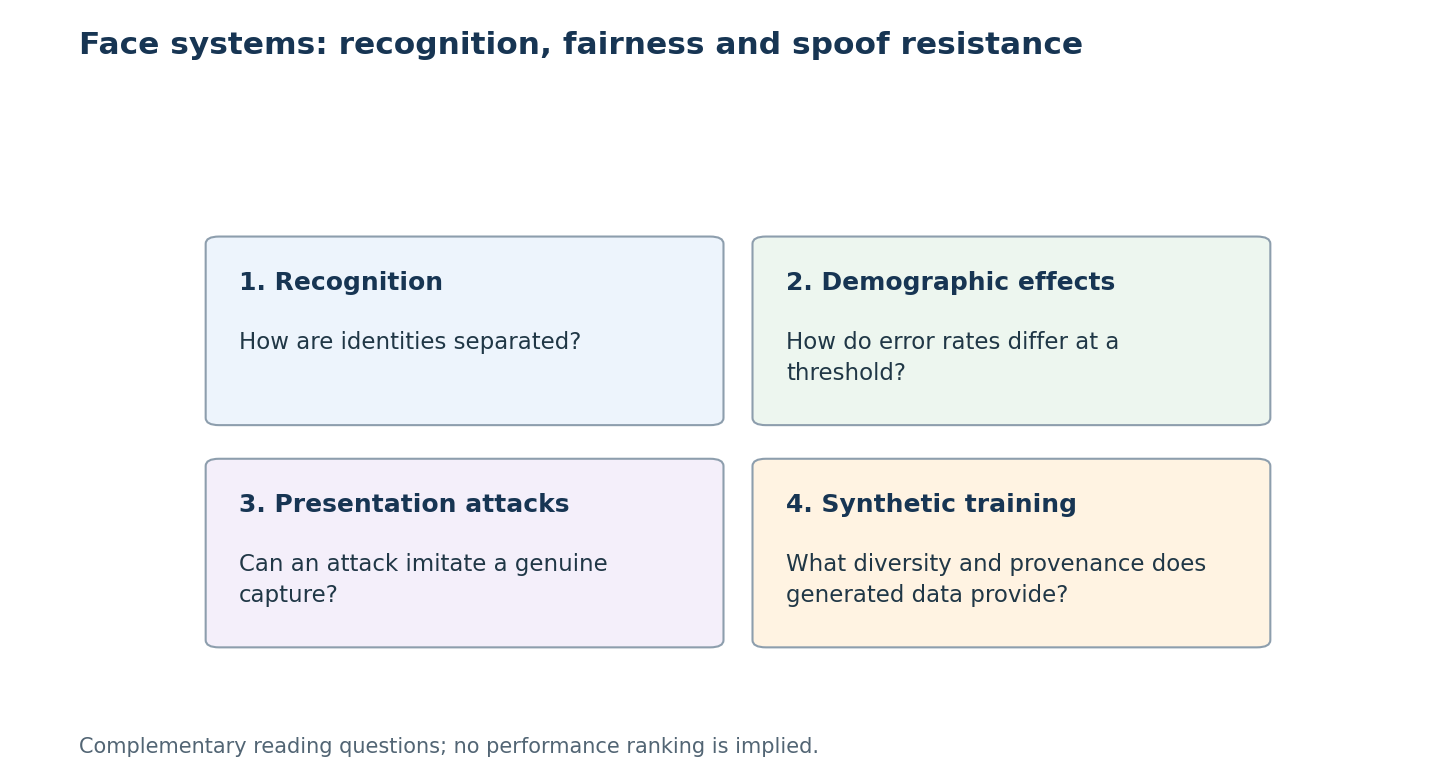
Treat these as separate claims about a face system. Identity discrimination does not establish resistance to presentation attacks, and high average recognition accuracy does not establish equal error rates across groups. Synthetic training data can reduce dependence on particular collections without automatically removing demographic bias, privacy concerns or evaluation leakage. The surveys are useful precisely because they expose these different questions.
Read each result with its protocol: verification versus identification, the operating threshold, false-match versus false-nonmatch errors, attack types and whether the test domains were seen during training. A change in population composition can change an average without improving every group. Anti-spoofing evaluated on known attack media does not establish open-set resistance. For synthetic-data studies, inspect the identity source, generator training provenance and independence of the recognition test set. Use the recognition survey for losses and pipelines, the bias survey for measurement choices, the PAD survey for attack protocols and the synthetic-data survey for data construction; one benchmark cannot replace all four.
References
- M. Wang and W. Deng, “Deep face recognition: A survey,” Neurocomputing, vol. 429, pp. 215–244, 2021. doi
- P. Grother, M. Ngan and K. Hanaoka, “Face Recognition Vendor Test (FRVT) Part 3: Demographic Effects,” NIST Interagency Report 8280, National Institute of Standards and Technology, 2019. doi
- National Institute of Standards and Technology, “Face Recognition Technology Evaluation (FRTE) 1:1 Verification,” evaluation web page, accessed 2026. NIST
- K. Zhang, Z. Zhang, Z. Li and Y. Qiao, “Joint face detection and alignment using multitask cascaded convolutional networks,” IEEE Signal Processing Letters, vol. 23, no. 10, pp. 1499–1503, 2016. doi
- J. Deng, J. Guo, E. Ververas, I. Kotsia and S. Zafeiriou, “RetinaFace: Single-shot multi-level face localisation in the wild,” in Proc. IEEE/CVF CVPR, 2020. CVF
- Y. Taigman, M. Yang, M. Ranzato and L. Wolf, “DeepFace: Closing the gap to human-level performance in face verification,” in Proc. IEEE CVPR, 2014. CVF
- F. Schroff, D. Kalenichenko and J. Philbin, “FaceNet: A unified embedding for face recognition and clustering,” in Proc. IEEE CVPR, 2015. CVF
- S. Chopra, R. Hadsell and Y. LeCun, “Learning a similarity metric discriminatively, with application to face verification,” in Proc. IEEE CVPR, vol. 1, pp. 539–546, 2005. doi
- R. Hadsell, S. Chopra and Y. LeCun, “Dimensionality reduction by learning an invariant mapping,” in Proc. IEEE CVPR, vol. 2, pp. 1735–1742, 2006. doi
- A. Hermans, L. Beyer and B. Leibe, “In defense of the triplet loss for person re-identification,” arXiv:1703.07737, 2017. arXiv
- F. Wang, X. Xiang, J. Cheng and A. L. Yuille, “NormFace: L2 hypersphere embedding for face verification,” in Proc. ACM International Conference on Multimedia, pp. 1041–1049, 2017. doi
- W. Liu, Y. Wen, Z. Yu, M. Li, B. Raj and L. Song, “SphereFace: Deep hypersphere embedding for face recognition,” in Proc. IEEE CVPR, 2017. CVF
- H. Wang, Y. Wang, Z. Zhou, X. Ji, D. Gong, J. Zhou, Z. Li and W. Liu, “CosFace: Large margin cosine loss for deep face recognition,” in Proc. IEEE/CVF CVPR, 2018. CVF
- F. Wang, J. Cheng, W. Liu and H. Liu, “Additive margin softmax for face verification,” IEEE Signal Processing Letters, vol. 25, no. 7, pp. 926–930, 2018. doi
- J. Deng, J. Guo, N. Xue and S. Zafeiriou, “ArcFace: Additive angular margin loss for deep face recognition,” in Proc. IEEE/CVF CVPR, 2019. CVF
- J. Deng, J. Guo, J. Yang, N. Xue, I. Kotsia and S. Zafeiriou, “ArcFace: Additive angular margin loss for deep face recognition,” IEEE Transactions on Pattern Analysis and Machine Intelligence, vol. 44, no. 10, pp. 5962–5979, 2022. doi
- Y. Wen, K. Zhang, Z. Li and Y. Qiao, “A discriminative feature learning approach for deep face recognition,” in Proc. ECCV, pp. 499–515, 2016. doi
- J. Deng, J. Guo, T. Liu, M. Gong and S. Zafeiriou, “Sub-center ArcFace: Boosting face recognition by large-scale noisy web faces,” in Proc. ECCV, pp. 741–757, 2020. doi
- Q. Meng, S. Zhao, Z. Huang and F. Zhou, “MagFace: A universal representation for face recognition and quality assessment,” in Proc. IEEE/CVF CVPR, 2021. CVF
- M. Kim, A. K. Jain and X. Liu, “AdaFace: Quality adaptive margin for face recognition,” in Proc. IEEE/CVF CVPR, 2022. CVF
- X. An, J. Deng, J. Guo, Z. Feng, X. Zhu, J. Yang and T. Liu, “Killing two birds with one stone: Efficient and robust training of face recognition CNNs by Partial FC,” in Proc. IEEE/CVF CVPR, 2022. CVF
- A. Martin, G. Doddington, T. Kamm, M. Ordowski and M. Przybocki, “The DET curve in assessment of detection task performance,” in Proc. Eurospeech, pp. 1895–1898, 1997. ISCA
- G. B. Huang, M. Mattar, T. Berg and E. Learned-Miller, “Labeled Faces in the Wild: A database for studying face recognition in unconstrained environments,” in Workshop on Faces in ‘Real-Life’ Images: Detection, Alignment, and Recognition, Marseille, 2008. HAL
- I. Kemelmacher-Shlizerman, S. M. Seitz, D. Miller and E. Brossard, “The MegaFace benchmark: 1 million faces for recognition at scale,” in Proc. IEEE CVPR, 2016. CVF
- University of Washington, “MegaFace and MF2: Million-scale face recognition,” project web page, accessed 2026. project page
- Y. Guo, L. Zhang, Y. Hu, X. He and J. Gao, “MS-Celeb-1M: A dataset and benchmark for large-scale face recognition,” in Proc. ECCV, pp. 87–102, 2016. doi
- C. Whitelam, E. Taborsky, A. Blanton, B. Maze, J. Adams, T. Miller, N. Kalka, A. K. Jain, J. A. Duncan, K. Allen, J. Cheney and P. Grother, “IARPA Janus Benchmark-B face dataset,” in Proc. IEEE CVPR Workshops, 2017. CVF
- B. Maze, J. Adams, J. A. Duncan, N. Kalka, T. Miller, C. Otto, A. K. Jain, W. T. Niggel, J. Anderson, J. Cheney and P. Grother, “IARPA Janus Benchmark – C: Face dataset and protocol,” in Proc. International Conference on Biometrics (ICB), pp. 158–165, 2018. doi
- Z. Zhu, G. Huang, J. Deng, Y. Ye, J. Huang, X. Chen, J. Zhu, T. Yang, J. Lu, D. Du and J. Zhou, “WebFace260M: A benchmark unveiling the power of million-scale deep face recognition,” in Proc. IEEE/CVF CVPR, 2021. CVF
- K. Peng, A. Mathur and A. Narayanan, “Mitigating dataset harms requires stewardship: Lessons from 1000 papers,” in Proc. NeurIPS Datasets and Benchmarks Track, 2021. proceedings
- G. Bae, M. de La Gorce, T. Baltrušaitis, C. Hewitt, D. Chen, J. Valentin, R. Cipolla and J. Shen, “DigiFace-1M: 1 million digital face images for face recognition,” in Proc. IEEE/CVF WACV, 2023. CVF
- M. Kim, F. Liu, A. Jain and X. Liu, “DCFace: Synthetic face generation with dual condition diffusion model,” in Proc. IEEE/CVF CVPR, 2023. CVF
- F. Boutros, V. Struc, J. Fierrez and N. Damer, “Synthetic data for face recognition: Current state and future prospects,” Image and Vision Computing, vol. 135, art. 104688, 2023. doi
- M. Wang, W. Deng, J. Hu, X. Tao and Y. Huang, “Racial Faces in the Wild: Reducing racial bias by information maximization adaptation network,” in Proc. IEEE/CVF ICCV, pp. 692–702, 2019. doi
- J. Buolamwini and T. Gebru, “Gender Shades: Intersectional accuracy disparities in commercial gender classification,” in Proc. Conference on Fairness, Accountability and Transparency, PMLR 81, pp. 77–91, 2018. PMLR
- P. Drozdowski, C. Rathgeb, A. Dantcheva, N. Damer and C. Busch, “Demographic bias in biometrics: A survey on an emerging challenge,” IEEE Transactions on Technology and Society, vol. 1, no. 2, pp. 89–103, 2020. doi
- Z. Yu, Y. Qin, X. Li, C. Zhao, Z. Lei and G. Zhao, “Deep learning for face anti-spoofing: A survey,” IEEE Transactions on Pattern Analysis and Machine Intelligence, vol. 45, pp. 5609–5631, 2023. doi
- European Commission, “What personal data is considered sensitive?,” data protection guidance referring to Article 9 of the GDPR, accessed 2026. European Commission
- European Commission, “AI Act” (Regulation (EU) 2024/1689), policy page, accessed 2026. European Commission
- M. Turk and A. Pentland, “Eigenfaces for recognition,” Journal of Cognitive Neuroscience, vol. 3, no. 1, pp. 71–86, 1991. doi
- P. N. Belhumeur, J. P. Hespanha and D. J. Kriegman, “Eigenfaces vs. Fisherfaces: Recognition using class specific linear projection,” IEEE Transactions on Pattern Analysis and Machine Intelligence, vol. 19, no. 7, pp. 711–720, 1997. doi