HDRNet: deep bilateral learning for real-time image enhancement
Optional · paper guide 12 of 13 for DLCV 09C · Low-Light Image Enhancement. Citation numbers refer to the reference list at the bottom of this page.
Navigate: this page and this track: Navigate: this page and this track
On this page
- CLAHE: equalizing locally without amplifying noise
- More deep LLIE methods
- Counting resolution, arithmetic and memory
- A bilateral-grid experiment
- Implementing and checking trilinear LUTs
- Fitting and slicing a bilateral grid in detail
- Learnable LUT variants in detail
- Structural re-parameterization step by step
- Understanding no-reference low-light metrics
- Efficient network building blocks
- Banding, halos and temporal stability
- Bilateral grids and color-table mathematics
- From retouching to low light
- A lightness-order exercise
- KinD: repair reflectance while controlling illumination
- Retinex-Net: decompose, adjust and denoise
- EnlightenGAN: unpaired appearance learning with content constraints
- Zero-DCE and Zero-DCE++: learn curves without reference images
- RUAS: search the priors inside an unrolled enhancement model
- SCI: train with calibration, deploy one illumination block
- Retinexformer: illumination guides restoration
- IAT: local affine maps and a global camera-style transform
- Multinex: fuse analytic priors into a Retinex residual
- CPGA-Net: channel priors, gamma estimation and learned fusion
- CPGA-Net+: attention, BDSF and stronger variants
- HDRNet: deep bilateral learning for real-time image enhancement
- Image-adaptive 3D LUTs (Zeng et al., TPAMI 2022)
Deep Learning for Computer Vision
Challenge
An image-processing operator may make sophisticated local edits but be too expensive to run at viewfinder resolution. Upsampling its low-resolution output discards detail. HDRNet [28] instead predicts a compact spatially varying transform from a thumbnail and applies that transform to the original pixels. Its target is photographic enhancement and operator approximation, not a complete solution to sensor-noise restoration.
Method
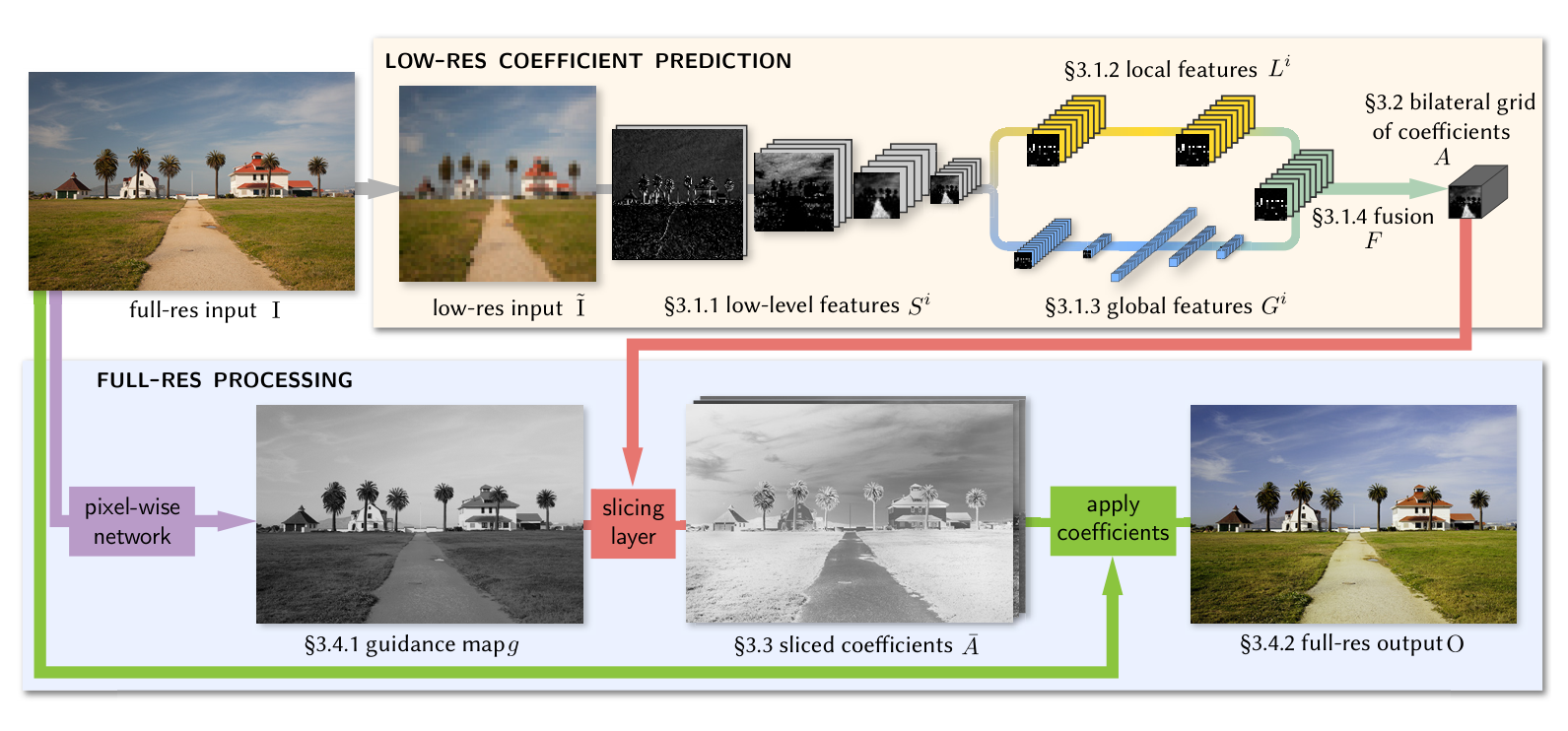
Figure source: [28], arXiv:1707.02880v2, PDF page 4. Original PDF.
A low-resolution network predicts coefficients. The RGB input is resized to 256 × 256 for the main network. Convolutional features branch into a local path, retaining spatial variation, and a global path with fully connected layers, encoding image-wide context. Their fused features predict a 16 × 16 × 8 bilateral grid. Each node stores 12 numbers: a 3 × 4 affine RGB transformation. The grid therefore contains 24,576 coefficients, calculated as ; these image-dependent coefficients are not the total number of learned network weights.
The third grid axis is guidance intensity, not geometric depth or the blue channel. A node can supply a different transform for two pixels at similar positions but on opposite sides of a tonal edge. Conversely, pixels that fall into the same coarse spatial/guidance region receive related transforms.
A full-resolution guide supplies edge information. A small pointwise network transforms the input color and combines learned piecewise-linear channel functions to produce guide value . The channel functions use sums of scaled ReLUs with learned thresholds. This is cheap enough to compute for every original pixel. Its purpose is to choose an appropriate location on the grid’s guidance axis; it does not reconstruct missing texture.
Differentiable slicing interpolates coefficients. For full-resolution position , convert its spatial coordinates and guide value into grid coordinates. Trilinear interpolation combines the eight surrounding grid nodes:
Here is a node’s affine matrix, is the set of eight enclosing corners, and is the product of the three one-dimensional interpolation weights. The weights sum to one inside the lattice. are the original RGB channels, is the output and the final constant permits an additive bias. Boundary behavior and coordinate scaling must be consistent at both resolutions.
This arrangement preserves original-pixel detail when the desired edit is representable by the local affine model. It does not upsample the enhanced thumbnail. Slicing is differentiable with respect to coefficients and, piecewise, guide coordinates, so output reconstruction loss trains both the low-resolution predictor and the guide.
Training observes full-resolution targets. Input/target pairs can come from running an existing operator, a black-box editing pipeline or human retouching. The loss measures the reconstructed full-resolution output against that target. This matters for non-scale-invariant operators: the network learns how the full-resolution operation should behave instead of assuming that running it on a thumbnail gives the correct target.
Deployment has two compute streams. Heavy coefficient prediction runs on the fixed thumbnail. Guide evaluation, slicing and affine application run at full resolution. The second stream still grows with pixel count and memory traffic. Fixed-size global fully connected features constrain the network’s thumbnail input size, even though its output can be applied to many original image sizes. The coefficient grid is an image-specific intermediate representation, not a stored LUT shared across the whole dataset.
Results
Table 2 reports operator-approximation PSNR: 28.8 dB for HDR+, 33.5 dB for Local Laplacian and 30.3 dB for the strong Local Laplacian setting. The comparison’s bilateral-guided-upsample baseline gives 26.9, 32.2 and 20.6 dB respectively. Another baseline, Transform Recipes, gives 29.0, 38.6 and 31.8 dB, showing that HDRNet does not have the highest fidelity on every operator.
The phone implementation processes 1920 × 1080 viewfinder frames at a reported 40–50 Hz on a Google Pixel. The paper describes approximately 14 ms CPU inference, 1 ms coefficient upload and 18 ms GPU rendering, with overlapping execution. These numbers must not be added and then called the reported steady-state throughput; per-frame latency and pipelined throughput are distinct. It reports 61 ms for a 12-megapixel image. This is a disclosed implementation result, not a claim for all phone hardware.
Ablations
Figure 11 changes grid depth, spatial grid resolution and feature width on the Local Laplacian task. Increasing capacity improves approximation at higher predictor cost; doubling intermediate features gives a reported 0.5 dB improvement. The plotted points do not establish that the largest grid is always the best deployment choice.
The discussion also replaces simple RGB full-resolution features with a three-level Gaussian-pyramid feature representation. This triples affine coefficients per node from 12 to 36 and increases intermediate capacity. It improves the strong Local Laplacian task by about 2 dB, while slowing the network by roughly 3–4×. This tests the expressiveness/cost trade-off of the full-resolution representation, rather than attributing all quality to the thumbnail CNN.
Conclusion
HDRNet learns where and how to apply a compact local transform, preserving original pixels for the final step. Its useful abstraction is coefficient prediction plus guided application. A method that predicts an illumination map or color table can reuse this separation without being identical to HDRNet.
Problems
The local affine model is poorly suited to creating edges, removing complex blur or recovering heavily degraded detail. The paper’s limitations include dehazing, matting and colorization examples that violate its assumptions. Coarse cells and guide ambiguity can soften boundaries or create halos. For low-light deployment, assess noise restoration separately: an accurately approximated brightening operator can still accurately amplify noise.
References
- Shyandram, “簡介Deep Learning Low-Light Image Enhancement (LLIE)” (Introduction to deep-learning low-light image enhancement, in Chinese), Medium post, 2024; updated 2026. link
- A. Foi, M. Trimeche, V. Katkovnik and K. Egiazarian, “Practical Poissonian-Gaussian noise modeling and fitting for single-image raw-data,” IEEE Transactions on Image Processing, vol. 17, no. 10, pp. 1737–1754, 2008. doi
- K. He, J. Sun and X. Tang, “Single image haze removal using dark channel prior,” IEEE Transactions on Pattern Analysis and Machine Intelligence, vol. 33, no. 12, pp. 2341–2353, 2011. doi
- X. Guo, Y. Li and H. Ling, “LIME: Low-light image enhancement via illumination map estimation,” IEEE Transactions on Image Processing, vol. 26, no. 2, pp. 982–993, 2017. doi
- ITU-R, “Recommendation BT.601-7: Studio encoding parameters of digital television for standard 4:3 and wide-screen 16:9 aspect ratios,” 2011. ITU
- Q. Yan, Y. Feng, C. Zhang, et al., “HVI: A new color space for low-light image enhancement,” in Proc. IEEE/CVF CVPR, 2025. arXiv
- S. M. Pizer, E. P. Amburn, J. D. Austin, et al., “Adaptive histogram equalization and its variations,” Computer Vision, Graphics, and Image Processing, vol. 39, no. 3, pp. 355–368, 1987. doi
- K. Zuiderveld, “Contrast limited adaptive histogram equalization,” in Graphics Gems IV, Academic Press, 1994, pp. 474–485. doi
- E. H. Land, “The retinex theory of color vision,” Scientific American, vol. 237, no. 6, pp. 108–128, 1977. doi
- D. J. Jobson, Z. Rahman and G. A. Woodell, “Properties and performance of a center/surround retinex,” IEEE Transactions on Image Processing, vol. 6, pp. 451–462, 1997. doi
- D. J. Jobson, Z. Rahman and G. A. Woodell, “A multiscale retinex for bridging the gap between color images and the human observation of scenes,” IEEE Transactions on Image Processing, vol. 6, no. 7, pp. 965–976, 1997. doi
- X. Dong, Y. Pang and J. Wen, “Fast efficient algorithm for enhancement of low lighting video,” ACM SIGGRAPH 2010 Posters, 2010. SIGGRAPH history doi
- S. Wang, J. Zheng, H.-M. Hu and B. Li, “Naturalness preserved enhancement algorithm for non-uniform illumination images,” IEEE Transactions on Image Processing, vol. 22, no. 9, pp. 3538–3548, 2013. doi
- C. Lee, C. Lee and C.-S. Kim, “Contrast enhancement based on layered difference representation of 2D histograms,” IEEE Transactions on Image Processing, vol. 22, no. 12, pp. 5372–5384, 2013. doi
- C. Li, C. Guo, L. Han, J. Jiang, M.-M. Cheng, J. Gu and C. C. Loy, “Low-light image and video enhancement using deep learning: A survey,” IEEE Transactions on Pattern Analysis and Machine Intelligence, vol. 44, no. 12, pp. 9396–9416, 2022. arXiv
- C. Wei, W. Wang, W. Yang and J. Liu, “Deep retinex decomposition for low-light enhancement,” in Proc. British Machine Vision Conference (BMVC), 2018. arXiv project
- Y. Jiang, X. Gong, D. Liu, et al., “EnlightenGAN: Deep light enhancement without paired supervision,” IEEE Transactions on Image Processing, vol. 30, pp. 2340–2349, 2021. arXiv
- C. Guo, C. Li, J. Guo, et al., “Zero-reference deep curve estimation for low-light image enhancement,” in Proc. IEEE/CVF CVPR, 2020, pp. 1777–1786. arXiv
- C. Li, C. Guo and C. C. Loy, “Learning to enhance low-light image via zero-reference deep curve estimation,” IEEE Transactions on Pattern Analysis and Machine Intelligence, vol. 44, no. 8, 2022. arXiv
- R. Liu, L. Ma, J. Zhang, X. Fan and Z. Luo, “Retinex-inspired unrolling with cooperative prior architecture search for low-light image enhancement,” in Proc. IEEE/CVF CVPR, 2021, pp. 10556–10565. arXiv
- L. Ma, T. Ma, R. Liu, X. Fan and Z. Luo, “Toward fast, flexible, and robust low-light image enhancement,” in Proc. IEEE/CVF CVPR, 2022, pp. 5627–5636. arXiv
- Y. Cai, H. Bian, J. Lin, H. Wang, R. Timofte and Y. Zhang, “Retinexformer: One-stage Retinex-based transformer for low-light image enhancement,” in Proc. IEEE/CVF ICCV, 2023. arXiv code
- Y. Wang, R. Wan, W. Yang, H. Li, L.-P. Chau and A. C. Kot, “Low-light image enhancement with normalizing flow,” in Proc. AAAI Conference on Artificial Intelligence, vol. 36, no. 3, pp. 2604–2612, 2022. arXiv
- X. Yi, H. Xu, H. Zhang, L. Tang and J. Ma, “Diff-Retinex: Rethinking low-light image enhancement with a generative diffusion model,” in Proc. IEEE/CVF ICCV, 2023. arXiv
- J. Hou, Z. Zhu, J. Hou, H. Liu, H. Zeng and H. Yuan, “Global structure-aware diffusion process for low-light image enhancement,” in Advances in Neural Information Processing Systems (NeurIPS), 2023. arXiv
- H. Jiang, A. Luo, X. Liu, S. Han and S. Liu, “LightenDiffusion: Unsupervised low-light image enhancement with latent-Retinex diffusion models,” in Proc. European Conference on Computer Vision (ECCV), 2024. arXiv
- C. He, C. Fang, Y. Zhang, et al., “Reti-Diff: Illumination degradation image restoration with Retinex-based latent diffusion model,” in Proc. International Conference on Learning Representations (ICLR), 2025. proceedings
- M. Gharbi, J. Chen, J. T. Barron, S. W. Hasinoff and F. Durand, “Deep bilateral learning for real-time image enhancement,” ACM Transactions on Graphics (Proc. SIGGRAPH), vol. 36, no. 4, art. 118, 2017. doi arXiv
- H. Zeng, J. Cai, L. Li, Z. Cao and L. Zhang, “Learning image-adaptive 3D lookup tables for high performance photo enhancement in real-time,” IEEE Transactions on Pattern Analysis and Machine Intelligence, vol. 44, no. 4, 2022. doi arXiv
- K. G. Lore, A. Akintayo and S. Sarkar, “LLNet: A deep autoencoder approach to natural low-light image enhancement,” Pattern Recognition, vol. 61, pp. 650–662, 2017. doi
- L. Tao, C. Zhu, J. Song, T. Lu, H. Jia and X. Xie, “Low-light image enhancement using CNN and bright channel prior,” in Proc. IEEE International Conference on Image Processing (ICIP), 2017, pp. 3215–3219. doi
- S. W. Zamir, A. Arora, S. Khan, et al., “Learning enriched features for real image restoration and enhancement,” in Proc. European Conference on Computer Vision (ECCV), 2020, pp. 492–511. arXiv
- X. Xu, R. Wang, C.-W. Fu and J. Jia, “SNR-aware low-light image enhancement,” in Proc. IEEE/CVF CVPR, 2022, pp. 17693–17703. doi
- Z. Cui, K. Li, L. Gu, S. Su, P. Gao, Z. Jiang, Y. Qiao and T. Harada, “You only need 90K parameters to adapt light: A light weight transformer for image enhancement and exposure correction,” in Proc. British Machine Vision Conference (BMVC), 2022. paper arXiv
- X. Ding, X. Zhang, N. Ma, J. Han, G. Ding and J. Sun, “RepVGG: Making VGG-style ConvNets great again,” in Proc. IEEE/CVF CVPR, 2021, pp. 13728–13737. doi arXiv
- Y. Zhang, J. Zhang and X. Guo, “Kindling the darkness: A practical low-light image enhancer,” in Proc. ACM International Conference on Multimedia (ACM MM), 2019, pp. 1632–1640. doi
- Y. Zhang, X. Guo, J. Ma, W. Liu and J. Zhang, “Beyond brightening low-light images,” International Journal of Computer Vision, vol. 129, no. 4, pp. 1013–1037, 2021. doi
- J. Bai, Y. Yin, Q. He, Y. Li and X. Zhang, “RetinexMamba: Retinex-based Mamba for low-light image enhancement,” arXiv:2405.03349, 2024. arXiv
- S.-E. Weng, S.-G. Miaou and R. Christanto, “A lightweight low-light image enhancement network via channel prior and gamma correction,” International Journal of Pattern Recognition and Artificial Intelligence, vol. 39, no. 12, art. 2554013, 2025. doi code manuscript
- S.-E. Weng, C.-Y. Hsiao, L.-W. Lu, et al., “Rethinking theoretical illumination for efficient low-light image enhancement” (CPGA-Net+), arXiv:2409.05274, 2024. arXiv
- W. Wu, J. Weng, P. Zhang, X. Wang, W. Yang and J. Jiang, “URetinex-Net: Retinex-based deep unfolding network for low-light image enhancement,” in Proc. IEEE/CVF CVPR, 2022, pp. 5891–5900. doi
- Z. Liang, C. Li, S. Zhou, R. Feng and C. C. Loy, “Iterative prompt learning for unsupervised backlit image enhancement,” in Proc. IEEE/CVF ICCV, 2023. arXiv
- C. Yang, M. Jin, X. Jia, Y. Xu and Y. Chen, “AdaInt: Learning adaptive intervals for 3D lookup tables on real-time image enhancement,” in Proc. IEEE/CVF CVPR, 2022, pp. 17522–17531. CVF arXiv
- C. Yang, M. Jin, Y. Xu, R. Zhang, Y. Chen and H. Liu, “SepLUT: Separable image-adaptive lookup tables for real-time image enhancement,” in Proc. European Conference on Computer Vision (ECCV), 2022, pp. 201–217. doi arXiv
- T. Wang, Y. Li, J. Peng, Y. Ma, X. Wang, F. Song and Y. Yan, “Real-time image enhancer via learnable spatial-aware 3D lookup tables,” in Proc. IEEE/CVF ICCV, 2021, pp. 2471–2480. CVF arXiv
- C. Liu, H. Yang, J. Fu and X. Qian, “4D LUT: Learnable context-aware 4D lookup table for image enhancement,” IEEE Transactions on Image Processing, vol. 32, pp. 4742–4756, 2023. doi arXiv
- W. Kim and N. I. Cho, “Image-adaptive 3D lookup tables for real-time image enhancement with bilateral grids,” in Proc. European Conference on Computer Vision (ECCV), 2024, pp. 91–108. doi ECCV
- C. Chen, Q. Chen, J. Xu and V. Koltun, “Learning to see in the dark,” in Proc. IEEE/CVF CVPR, 2018, pp. 3291–3300. arXiv
- M. V. Conde, G. Geigle and R. Timofte, “InstructIR: High-quality image restoration following human instructions,” in Proc. European Conference on Computer Vision (ECCV), 2024. arXiv
- Z. Cui, G.-J. Qi, L. Gu, S. You, Z. Zhang and T. Harada, “Multitask AET with orthogonal tangent regularity for dark object detection,” in Proc. IEEE/CVF ICCV, 2021. arXiv
- K. A. Hashmi, G. Kallempudi, D. Stricker and M. Z. Afzal, “FeatEnHancer: Enhancing hierarchical features for object detection and beyond under low-light vision,” in Proc. IEEE/CVF ICCV, 2023. arXiv
- M. Dehghani, A. Arnab, L. Beyer, A. Vaswani and Y. Tay, “The efficiency misnomer,” in Proc. International Conference on Learning Representations (ICLR), 2022. ICLR arXiv
- A. Ignatov, R. Timofte, S. Liu, et al., “Learned smartphone ISP on mobile GPUs with deep learning, Mobile AI & AIM 2022 challenge: Report,” in Proc. European Conference on Computer Vision (ECCV) Workshops, 2023, pp. 44–70. doi arXiv
- Z. Wang, A. C. Bovik, H. R. Sheikh and E. P. Simoncelli, “Image quality assessment: From error visibility to structural similarity,” IEEE Transactions on Image Processing, vol. 13, no. 4, pp. 600–612, 2004. doi
- R. Zhang, P. Isola, A. A. Efros, E. Shechtman and O. Wang, “The unreasonable effectiveness of deep features as a perceptual metric,” in Proc. IEEE/CVF CVPR, 2018. arXiv
- K. Ma, K. Zeng and Z. Wang, “Perceptual quality assessment for multi-exposure image fusion,” IEEE Transactions on Image Processing, vol. 24, no. 11, pp. 3345–3356, 2015. doi
- V. Vonikakis, “Datasets” (source of the VV test images), personal web page. link
- A. Mittal, R. Soundararajan and A. C. Bovik, “Making a ‘completely blind’ image quality analyzer,” IEEE Signal Processing Letters, vol. 20, no. 3, pp. 209–212, 2013. doi
- A. Mittal, A. K. Moorthy and A. C. Bovik, “No-reference image quality assessment in the spatial domain,” IEEE Transactions on Image Processing, vol. 21, no. 12, pp. 4695–4708, 2012. doi
- Y. Blau, R. Mechrez, R. Timofte, T. Michaeli and L. Zelnik-Manor, “The 2018 PIRM challenge on perceptual image super-resolution,” in Proc. European Conference on Computer Vision (ECCV) Workshops, 2018. arXiv
- C. Ma, C.-Y. Yang, X. Yang and M.-H. Yang, “Learning a no-reference quality metric for single-image super-resolution,” Computer Vision and Image Understanding, vol. 158, pp. 1–16, 2017. doi arXiv
- D. Hasler and S. E. Süsstrunk, “Measuring colorfulness in natural images,” in Proc. SPIE 5007, Human Vision and Electronic Imaging VIII, 2003. doi
- J. Immerkær, “Fast noise variance estimation,” Computer Vision and Image Understanding, vol. 64, no. 2, pp. 300–302, 1996. doi
- J. Liao, S. Hao, R. Hong and M. Wang, “GT-Mean loss: A simple yet effective solution for brightness mismatch in low-light image enhancement,” in Proc. IEEE/CVF ICCV, 2025. arXiv
- Y. P. Loh and C. S. Chan, “Getting to know low-light images with the Exclusively Dark dataset,” Computer Vision and Image Understanding, vol. 178, pp. 30–42, 2019. arXiv
- F. Liu and L. Fan, “A review of advancements in low-light image enhancement using deep learning,” Neurocomputing, vol. 652, art. 131052, 2025. arXiv
- J. Liu, D. Xu, W. Yang, M. Fan and H. Huang, “Benchmarking low-light image enhancement and beyond,” International Journal of Computer Vision, vol. 129, no. 4, pp. 1153–1184, 2021. doi project
- W. Yang, W. Wang, H. Huang, S. Wang and J. Liu, “Sparse gradient regularized deep Retinex network for robust low-light image enhancement,” IEEE Transactions on Image Processing, vol. 30, pp. 2072–2086, 2021. doi
- J. Hai, Z. Xuan, R. Yang, et al., “R2RNet: Low-light image enhancement via Real-low to Real-normal Network,” Journal of Visual Communication and Image Representation, vol. 90, art. 103712, 2023. arXiv
- R. Wang, X. Xu, C.-W. Fu, et al., “Seeing dynamic scene in the dark: A high-quality video dataset with mechatronic alignment,” in Proc. IEEE/CVF ICCV, 2021, pp. 9680–9689. doi code
- V. Bychkovsky, S. Paris, E. Chan and F. Durand, “Learning photographic global tonal adjustment with a database of input/output image pairs,” in Proc. IEEE CVPR, 2011, pp. 97–104. dataset
- J. Cai, S. Gu and L. Zhang, “Learning a deep single image contrast enhancer from multi-exposure images,” IEEE Transactions on Image Processing, vol. 27, no. 4, pp. 2049–2062, 2018. doi
- X. Liu, Z. Wu, A. Li, et al., “NTIRE 2024 challenge on low light image enhancement: Methods and results,” in Proc. IEEE/CVF CVPR Workshops, 2024. arXiv
- X. Liu, Z. Wu, F.-A. Vasluianu, et al., “NTIRE 2025 challenge on low light image enhancement: Methods and results,” in Proc. IEEE/CVF CVPR Workshops, 2025. arXiv
- S. Zheng, Y. Ma, J. Pan, C. Lu and G. Gupta, “Low-light image and video enhancement: A comprehensive survey and beyond,” arXiv:2212.10772, 2022. arXiv
- E. Adhikarla, Y. Liu and B. D. Davison, “Diffusion models for low-light image enhancement: A multi-perspective taxonomy and performance analysis,” arXiv:2510.05976, 2025. arXiv
- J. Yan, C. Tu, W. Zhang, Z. Wang, P. Cao, Q. Lin, Y. Fang, X. Liu, Z. Wu, Z. Zhou and R. Timofte, “NTIRE 2026 challenge on efficient low light image enhancement: Methods and results,” NTIRE 2026 workshop report, arXiv:2605.02212, 2026. arXiv
- O. Ronneberger, P. Fischer and T. Brox, “U-Net: Convolutional networks for biomedical image segmentation,” in Proc. Medical Image Computing and Computer-Assisted Intervention (MICCAI), 2015, pp. 234–241. doi arXiv
- J. Chen, A. Adams, N. Wadhwa and S. W. Hasinoff, “Bilateral guided upsampling,” ACM Transactions on Graphics (Proc. SIGGRAPH Asia), vol. 35, no. 6, 2016. doi project
- K. He, J. Sun and X. Tang, “Guided image filtering,” IEEE Transactions on Pattern Analysis and Machine Intelligence, vol. 35, no. 6, pp. 1397–1409, 2013. doi
- C. Chen and J. Mo, “IQA-PyTorch: PyTorch toolbox for image quality assessment,” software (pip package
pyiqa). GitHub - J. Ke, Q. Wang, Y. Wang, P. Milanfar and F. Yang, “MUSIQ: Multi-scale image quality transformer,” in Proc. IEEE/CVF ICCV, 2021. arXiv
- J. Wang, K. C. K. Chan and C. C. Loy, “Exploring CLIP for assessing the look and feel of images,” in Proc. AAAI Conference on Artificial Intelligence, 2023. arXiv
- V. Kannan, S. Malik, N. C. Babu and R. Soundararajan, “Quality assessment of low-light restored images: A subjective study and an unsupervised model,” IEEE Access, vol. 11, pp. 68216–68230, 2023. doi arXiv
- ITU-R, “Recommendation BT.500-15: Methodologies for the subjective assessment of the quality of television images,” 2023. ITU
- R. A. Bradley and M. E. Terry, “Rank analysis of incomplete block designs: The method of paired comparisons,” Biometrika, vol. 39, no. 3–4, pp. 324–345, 1952. doi
- H. Talebi and P. Milanfar, “NIMA: Neural image assessment,” IEEE Transactions on Image Processing, 2018. arXiv
- S. Yang, T. Wu, S. Shi, et al., “MANIQA: Multi-dimension attention network for no-reference image quality assessment,” in Proc. IEEE/CVF CVPR Workshops, 2022, pp. 1190–1199. doi arXiv
- H. Wu, Z. Zhang, W. Zhang, C. Chen, et al., “Q-Align: Teaching LMMs for visual scoring via discrete text-defined levels,” in Proc. International Conference on Machine Learning (ICML), PMLR 235, 2024. arXiv
- A. G. Howard, M. Zhu, B. Chen, D. Kalenichenko, W. Wang, T. Weyand, M. Andreetto and H. Adam, “MobileNets: Efficient convolutional neural networks for mobile vision applications,” arXiv:1704.04861, 2017. arXiv
- M. Sandler, A. Howard, M. Zhu, A. Zhmoginov and L.-C. Chen, “MobileNetV2: Inverted residuals and linear bottlenecks,” in Proc. IEEE/CVF CVPR, 2018, pp. 4510–4520. doi arXiv
- W.-S. Lai, J.-B. Huang, O. Wang, E. Shechtman, E. Yumer and M.-H. Yang, “Learning blind video temporal consistency,” in Proc. European Conference on Computer Vision (ECCV), 2018, pp. 179–195. doi arXiv
- S. W. Hasinoff, D. Sharlet, R. Geiss, A. Adams, J. T. Barron, F. Kainz, J. Chen and M. Levoy, “Burst photography for high dynamic range and low-light imaging on mobile cameras,” ACM Transactions on Graphics (Proc. SIGGRAPH Asia), vol. 35, no. 6, 2016. doi
- J. Chen, S. Paris and F. Durand, “Real-time edge-aware image processing with the bilateral grid,” ACM Transactions on Graphics (Proc. SIGGRAPH), vol. 26, no. 3, art. 103, 2007. doi
- C. Tomasi and R. Manduchi, “Bilateral filtering for gray and color images,” in Proc. IEEE International Conference on Computer Vision (ICCV), 1998, pp. 839–846. doi
- S. Paris and F. Durand, “A fast approximation of the bilateral filter using a signal processing approach,” International Journal of Computer Vision, vol. 81, no. 1, pp. 24–52, 2009. doi
- H. Wu, S. Zheng, J. Zhang and K. Huang, “Fast end-to-end trainable guided filter,” in Proc. IEEE/CVF CVPR, 2018, pp. 1838–1847. doi arXiv
- R. Wang, Q. Zhang, C.-W. Fu, X. Shen, W.-S. Zheng and J. Jia, “Underexposed photo enhancement using deep illumination estimation,” in Proc. IEEE/CVF CVPR, 2019, pp. 6842–6850. doi CVF
- Y. Lin, Z. Fu, K. Wen, T. Ye, S. Chen, G. Meng, Y. Wang, et al., “DPLUT: Unsupervised low-light image enhancement with lookup tables and diffusion priors,” in Proc. AAAI Conference on Artificial Intelligence, vol. 39, no. 5, pp. 5316–5324, 2025. doi arXiv
- K. Dabov, A. Foi, V. Katkovnik and K. Egiazarian, “Image denoising by sparse 3-D transform-domain collaborative filtering,” IEEE Transactions on Image Processing, 2007. doi
- K. Simonyan and A. Zisserman, “Very deep convolutional networks for large-scale image recognition,” ICLR, 2015. arXiv
- J. Deng, W. Dong, R. Socher, L.-J. Li, K. Li and L. Fei-Fei, “ImageNet: A large-scale hierarchical image database,” CVPR, 2009. doi
- A. Brateanu, T. Mu, C. O. Ancuti and C. Ancuti, “Multinex: Lightweight Low-light Image Enhancement via Multi-prior Retinex,” in Proc. IEEE/CVF CVPR, 2026. paper supplement