TransWeather: learned weather queries for a shared restoration model
Optional · paper guide 3 of 13 for DLCV 09 · Deep Image Restoration: Low-Level Vision. Citation numbers refer to the reference list at the bottom of this page.
Navigate: this page and this track: Navigate: this page and this track
On this page
- Blind super-resolution: conditioning on and estimating the kernel
- Plug-and-play priors and half-quadratic splitting
- Super-resolution milestones, families and benchmarks
- Classical and learned blind-deblurring methods
- All-in-one methods in more detail
- Human-rated IQA datasets
- PIQE and the Perceptual Index
- How the learned NR assessors work
- CLIP-IQA and Q-Align scores
- Fitting the Bradley–Terry model
- Metric-by-metric summary table
- Restormer: global channel relationships without pixel-wise attention
- AirNet: infer the degradation before conditioning restoration
- TransWeather: learned weather queries for a shared restoration model
- PromptIR: input-conditioned feature prompts, without language instructions
- AdaIR: adaptively separate and exchange frequency information
- DA-CLIP: separate content guidance from degradation guidance
- InstructIR: route image features with a human instruction
- AutoDIR: diagnose degradation, guide diffusion, then correct structure
- AgenticIR: plan, inspect and revise a sequence of restoration tools
- 4KAgent: select restoration experts for a configured fidelity goal
- PromptFix: combine instructions, visual diagnosis and high-frequency preservation
- Deep Image Prior: the network as the prior
- Survey papers in detail
Deep Learning for Computer Vision
Challenge
Rain streaks, snow, raindrops and haze can obscure images in different ways. TransWeather [52] asks whether one transformer-based model can address adverse weather without separate encoders for each known weather type. Its weather queries are learned network parameters, not sentences typed by a user.
Method
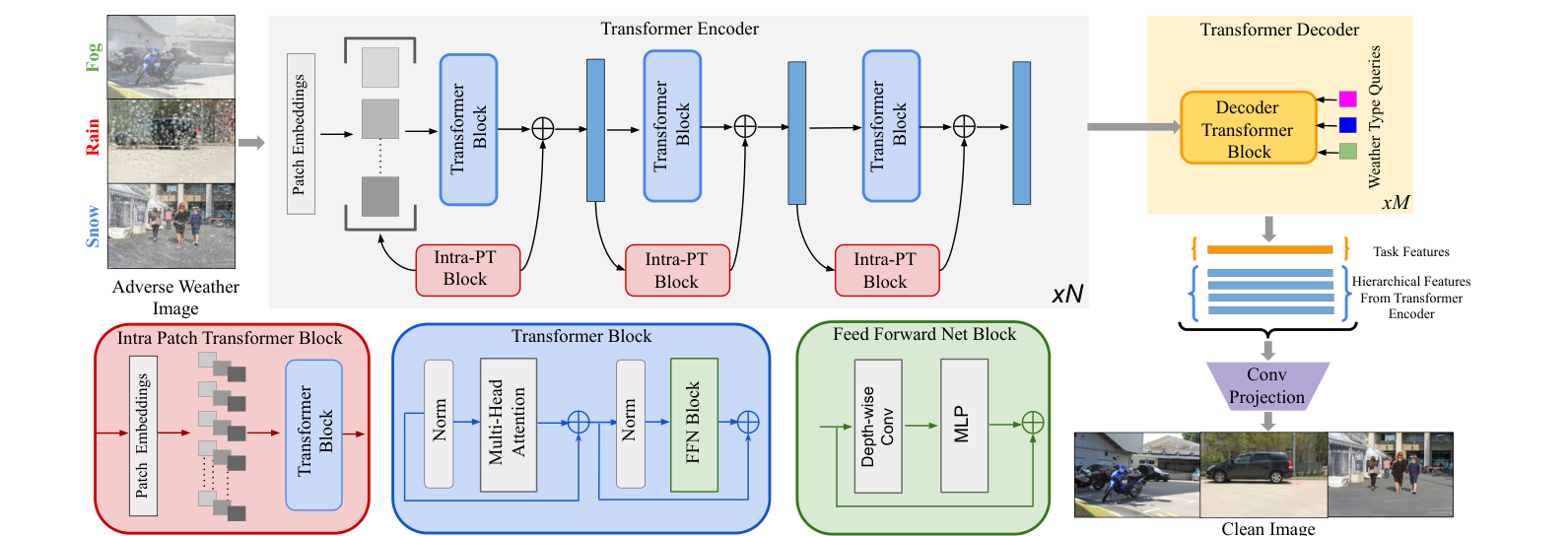
Figure source: [52], PDF page 4. Original PDF.
Encode at several scales. A hierarchical transformer encoder builds feature maps at progressively lower resolutions. The intra-patch transformer component processes smaller regions within a patch to recover detail that a coarse patch representation could miss. Local detail and broad context are needed together: a single bright streak should not be mistaken for a scene boundary.
Let queries retrieve useful weather-related features. In the decoder, learned weather query vectors supply the queries, while encoder features supply keys and values. Cross-attention mixes the encoded evidence into query-conditioned decoder features. The model learns which information is useful for restoration through clean-target supervision; it does not first prove a unique physical classification of each weather event.
A convolutional projection tail combines the hierarchical features and reconstructs the clean image. The learning objective combines a smooth pixel reconstruction loss with a VGG-based perceptual feature loss. The former anchors the result to paired targets; the latter compares learned feature structure. They measure different discrepancies and neither alone guarantees a physically correct clear-weather scene.
The AllWeather mixture used in the paper includes 9,000 Snow100K examples, 1,069 raindrop examples and 9,000 Outdoor-Rain examples. This explicitly specified training mixture matters when comparing with a model trained only on one weather dataset.
Read the figure and choose a baseline. Trace the input through the encoder, then examine how learned queries interact with encoded image features before reconstruction. A weather query is a trained vector, not a user-written weather instruction or a measured atmospheric parameter. The useful comparison is therefore shared learned restoration versus separate task models under the same test setting. When inspecting an output, check thin structures as well as weather removal: a rain-like wire and an actual rain streak can supply similar local evidence. Training coverage and surrounding context determine whether the model can distinguish them.
Results
Table 1 reports 31.05 dB PSNR / 0.9509 SSIM on Test1, the fog-and-rain test setting. The paper also evaluates snow and adherent raindrops. The evidence supports a shared learned model across these tested weather distributions, not arbitrary visibility recovery through dense occlusion.
Read the per-dataset rows rather than treating “all weather” as a single benchmark. Different weather effects remove different amounts of evidence, and the training datasets have different sizes and generation processes.
Ablations
Table 4 uses the raindrop setting and adds components cumulatively. The baseline is 30.12 dB / 0.8512, the hierarchical design 31.62 / 0.8671, adding intra-patch processing 32.37 / 0.9463, and adding weather queries 34.55 / 0.9502.
These are cumulative variants: the last difference measures adding queries to the already modified network. It does not isolate how the same queries would behave in every possible backbone. The combined result supports complementary scale/detail/query processing under this experimental setup.
Conclusion
TransWeather uses hierarchy for context, intra-patch processing for detail and learned queries for restoration-oriented feature retrieval. It is an early shared adverse-weather architecture, conceptually different from language-instructed restoration.
Problems
Synthetic weather and paired training captures cannot cover every real storm, nighttime exposure or moving windshield artifact. Occluded content may be absent rather than merely noisy. Learned queries can represent recurring training patterns without becoming interpretable weather categories. Deployment also needs latency and downstream-task evaluation; image similarity alone does not establish safer perception.
References
- Shyandram, “Low-Level Vision Task-Image Restoration簡介,” Medium post (in Traditional Chinese), 2023; updated 2026. link
- Z. Chen, Z. Wu, E. Zamfir, K. Zhang, Y. Zhang, R. Timofte et al., “NTIRE 2024 Challenge on Image Super-Resolution (×4): Methods and Results,” in Proc. IEEE/CVF CVPR Workshops, 2024. arXiv
- Z. Chen, K. Liu, J. Gong, J. Wang, L. Sun et al., “NTIRE 2025 Challenge on Image Super-Resolution (×4): Methods and Results,” in Proc. IEEE/CVF CVPR Workshops, 2025. arXiv
- X. Wang, L. Xie, C. Dong and Y. Shan, “Real-ESRGAN: Training Real-World Blind Super-Resolution with Pure Synthetic Data,” in Proc. IEEE/CVF ICCV Workshops, 2021. arXiv
- E. H. Land and J. J. McCann, “Lightness and Retinex Theory,” Journal of the Optical Society of America, vol. 61, no. 1, pp. 1–11, 1971. doi
- C. Dong, C. C. Loy, K. He and X. Tang, “Image Super-Resolution Using Deep Convolutional Networks,” IEEE TPAMI, 2016 (conference version ECCV 2014). arXiv
- C. Dong, C. C. Loy and X. Tang, “Accelerating the Super-Resolution Convolutional Neural Network,” in Proc. ECCV, 2016. arXiv
- W. Shi, J. Caballero, F. Huszár, J. Totz, A. P. Aitken, R. Bishop, D. Rueckert and Z. Wang, “Real-Time Single Image and Video Super-Resolution Using an Efficient Sub-Pixel Convolutional Neural Network,” in Proc. IEEE CVPR, 2016. arXiv
- A. Odena, V. Dumoulin and C. Olah, “Deconvolution and Checkerboard Artifacts,” Distill, 2016. link
- B. Lim, S. Son, H. Kim, S. Nah and K. M. Lee, “Enhanced Deep Residual Networks for Single Image Super-Resolution,” in Proc. IEEE CVPR Workshops, 2017. arXiv
- Y. Zhang, K. Li, K. Li, L. Wang, B. Zhong and Y. Fu, “Image Super-Resolution Using Very Deep Residual Channel Attention Networks,” in Proc. ECCV, 2018. arXiv
- C. Ledig, L. Theis, F. Huszár, J. Caballero, A. Cunningham, A. Acosta, A. Aitken, A. Tejani, J. Totz, Z. Wang and W. Shi, “Photo-Realistic Single Image Super-Resolution Using a Generative Adversarial Network,” in Proc. IEEE CVPR, 2017. arXiv
- X. Wang, K. Yu, S. Wu, J. Gu, Y. Liu, C. Dong, C. C. Loy, Y. Qiao and X. Tang, “ESRGAN: Enhanced Super-Resolution Generative Adversarial Networks,” in Proc. ECCV Workshops, 2018. arXiv
- J. Liang, J. Cao, G. Sun, K. Zhang, L. Van Gool and R. Timofte, “SwinIR: Image Restoration Using Swin Transformer,” in Proc. IEEE/CVF ICCV Workshops, 2021. arXiv
- X. Chen, X. Wang, J. Zhou, Y. Qiao and C. Dong, “Activating More Pixels in Image Super-Resolution Transformer,” in Proc. IEEE/CVF CVPR, 2023. arXiv
- X. Lin, J. He, Z. Chen, Z. Lyu, B. Dai, F. Yu, W. Ouyang, Y. Qiao and C. Dong, “DiffBIR: Towards Blind Image Restoration with Generative Diffusion Prior,” arXiv:2308.15070, 2023. arXiv
- F. Yu, J. Gu, Z. Li, J. Hu, X. Kong, X. Wang, J. He, Y. Qiao and C. Dong, “Scaling Up to Excellence: Practicing Model Scaling for Photo-Realistic Image Restoration In the Wild,” in Proc. IEEE/CVF CVPR, 2024. arXiv
- R. Wu, L. Sun, Z. Ma and L. Zhang, “One-Step Effective Diffusion Network for Real-World Image Super-Resolution,” in Proc. NeurIPS, 2024. arXiv
- E. Agustsson and R. Timofte, “NTIRE 2017 Challenge on Single Image Super-Resolution: Dataset and Study,” in Proc. IEEE CVPR Workshops, 2017. doi
- K. Zhang, W. Zuo, Y. Chen, D. Meng and L. Zhang, “Beyond a Gaussian Denoiser: Residual Learning of Deep CNN for Image Denoising,” IEEE Transactions on Image Processing, vol. 26, no. 7, pp. 3142–3155, 2017. arXiv
- K. Zhang, W. Zuo and L. Zhang, “FFDNet: Toward a Fast and Flexible Solution for CNN-Based Image Denoising,” IEEE Transactions on Image Processing, 2018. arXiv
- A. Abdelhamed, S. Lin and M. S. Brown, “A High-Quality Denoising Dataset for Smartphone Cameras,” in Proc. IEEE/CVF CVPR, 2018. doi
- S. W. Zamir, A. Arora, S. Khan, M. Hayat, F. S. Khan and M.-H. Yang, “Restormer: Efficient Transformer for High-Resolution Image Restoration,” in Proc. IEEE/CVF CVPR, 2022. arXiv
- L. Chen, X. Chu, X. Zhang and J. Sun, “Simple Baselines for Image Restoration,” in Proc. ECCV, 2022. arXiv
- K. He, J. Sun and X. Tang, “Single Image Haze Removal Using Dark Channel Prior,” in Proc. IEEE CVPR, 2009. doi
- B. Cai, X. Xu, K. Jia, C. Qing and D. Tao, “DehazeNet: An End-to-End System for Single Image Haze Removal,” IEEE Transactions on Image Processing, 2016. arXiv
- B. Li, X. Peng, Z. Wang, J. Xu and D. Feng, “AOD-Net: All-in-One Dehazing Network,” in Proc. IEEE ICCV, 2017. doi · arXiv
- X. Liu, Y. Ma, Z. Shi and J. Chen, “GridDehazeNet: Attention-Based Multi-Scale Network for Image Dehazing,” in Proc. IEEE/CVF ICCV, 2019. arXiv
- X. Qin, Z. Wang, Y. Bai, X. Xie and H. Jia, “FFA-Net: Feature Fusion Attention Network for Single Image Dehazing,” in Proc. AAAI, 2020. arXiv
- S. W. Zamir, A. Arora, S. Khan, M. Hayat, F. S. Khan, M.-H. Yang and L. Shao, “Learning Enriched Features for Real Image Restoration and Enhancement,” in Proc. ECCV, 2020. arXiv
- Y. Song, Z. He, H. Qian and X. Du, “Vision Transformers for Single Image Dehazing,” IEEE Transactions on Image Processing, vol. 32, 2023. arXiv
- B. Li, W. Ren, D. Fu, D. Tao, D. Feng, W. Zeng and Z. Wang, “Benchmarking Single-Image Dehazing and Beyond,” IEEE Transactions on Image Processing, 2019. arXiv
- C. O. Ancuti, C. Ancuti, R. Timofte and C. De Vleeschouwer, “O-HAZE: A Dehazing Benchmark with Real Hazy and Haze-Free Outdoor Images,” in Proc. IEEE/CVF CVPR Workshops, 2018. doi
- C. O. Ancuti, C. Ancuti, M. Sbert and R. Timofte, “Dense-Haze: A Benchmark for Image Dehazing with Dense-Haze and Haze-Free Images,” in Proc. IEEE ICIP, 2019. doi
- A. Geiger, P. Lenz and R. Urtasun, “Are We Ready for Autonomous Driving? The KITTI Vision Benchmark Suite,” in Proc. IEEE CVPR, 2012. project page
- Y.-F. Liu, D.-W. Jaw, S.-C. Huang and J.-N. Hwang, “DesnowNet: Context-Aware Deep Network for Snow Removal,” IEEE Transactions on Image Processing, 2018. arXiv
- W.-T. Chen, H.-Y. Fang, J.-J. Ding, C.-C. Tsai and S.-Y. Kuo, “JSTASR: Joint Size and Transparency-Aware Snow Removal Algorithm Based on Modified Partial Convolution and Veiling Effect Removal,” in Proc. ECCV, 2020. doi
- W. Yang, R. T. Tan, J. Feng, J. Liu, Z. Guo and S. Yan, “Deep Joint Rain Detection and Removal from a Single Image,” in Proc. IEEE CVPR, 2017. arXiv
- R. Qian, R. T. Tan, W. Yang, J. Su and J. Liu, “Attentive Generative Adversarial Network for Raindrop Removal from a Single Image,” in Proc. IEEE/CVF CVPR, 2018. arXiv
- X. Li, Y. Jin, X. Jin, Z. Wu, B. Li, Y. Wang et al., “NTIRE 2025 Challenge on Day and Night Raindrop Removal for Dual-Focused Images: Methods and Results,” in Proc. IEEE/CVF CVPR Workshops, 2025. arXiv
- C. Wei, W. Wang, W. Yang and J. Liu, “Deep Retinex Decomposition for Low-Light Enhancement,” in Proc. BMVC, 2018. arXiv
- Y. Cai, H. Bian, J. Lin, H. Wang, R. Timofte and Y. Zhang, “Retinexformer: One-stage Retinex-based Transformer for Low-light Image Enhancement,” in Proc. IEEE/CVF ICCV, 2023. arXiv
- H. Zhang, H. Xu, X. Tian, J. Jiang and J. Ma, “Image Fusion Meets Deep Learning: A Survey and Perspective,” Information Fusion, vol. 76, pp. 323–336, 2021. doi
- S. Nah, T. H. Kim and K. M. Lee, “Deep Multi-scale Convolutional Neural Network for Dynamic Scene Deblurring,” in Proc. IEEE CVPR, 2017. doi · arXiv
- K. He, X. Chen, S. Xie, Y. Li, P. Dollár and R. Girshick, “Masked Autoencoders Are Scalable Vision Learners,” in Proc. IEEE/CVF CVPR, 2022. arXiv
- R. Suvorov, E. Logacheva, A. Mashikhin, A. Remizova, A. Ashukha, A. Silvestrov, N. Kong, H. Goka, K. Park and V. Lempitsky, “Resolution-robust Large Mask Inpainting with Fourier Convolutions,” in Proc. IEEE/CVF WACV, 2022. arXiv
- S. Sengupta, V. Jayaram, B. Curless, S. Seitz and I. Kemelmacher-Shlizerman, “Background Matting: The World is Your Green Screen,” in Proc. IEEE/CVF CVPR, 2020. arXiv
- O. Ronneberger, P. Fischer and T. Brox, “U-Net: Convolutional Networks for Biomedical Image Segmentation,” in Proc. MICCAI, 2015. arXiv
- H. Guo, J. Li, T. Dai, Z. Ouyang, X. Ren and S.-T. Xia, “MambaIR: A Simple Baseline for Image Restoration with State-Space Model,” in Proc. ECCV, 2024. arXiv
- H. Guo, Y. Guo, Y. Zha, Y. Zhang, W. Li, T. Dai, S.-T. Xia and Y. Li, “MambaIRv2: Attentive State Space Restoration,” in Proc. IEEE/CVF CVPR, 2025. arXiv
- B. Li, X. Liu, P. Hu, Z. Wu, J. Lv and X. Peng, “All-In-One Image Restoration for Unknown Corruption,” in Proc. IEEE/CVF CVPR, 2022. code & paper
- J. M. J. Valanarasu, R. Yasarla and V. M. Patel, “TransWeather: Transformer-based Restoration of Images Degraded by Adverse Weather Conditions,” in Proc. IEEE/CVF CVPR, 2022. arXiv
- V. Potlapalli, S. W. Zamir, S. Khan and F. S. Khan, “PromptIR: Prompting for All-in-One Image Restoration,” in Proc. NeurIPS, 2023. arXiv
- Y. Cui, S. W. Zamir, S. Khan, A. Knoll, M. Shah and F. S. Khan, “AdaIR: Adaptive All-in-One Image Restoration via Frequency Mining and Modulation,” in Proc. ICLR, 2025. arXiv
- Z. Luo, F. K. Gustafsson, Z. Zhao, J. Sjölund and T. B. Schön, “Controlling Vision-Language Models for Multi-Task Image Restoration,” in Proc. ICLR, 2024. arXiv
- M. V. Conde, G. Geigle and R. Timofte, “InstructIR: High-Quality Image Restoration Following Human Instructions,” in Proc. ECCV, 2024. arXiv
- H. Zhao, O. Gallo, I. Frosio and J. Kautz, “Loss Functions for Image Restoration with Neural Networks,” IEEE Transactions on Computational Imaging, 2017 (arXiv title: “Loss Functions for Neural Networks for Image Processing”). arXiv
- J. Johnson, A. Alahi and L. Fei-Fei, “Perceptual Losses for Real-Time Style Transfer and Super-Resolution,” in Proc. ECCV, 2016. doi · arXiv
- L. Jiang, B. Dai, W. Wu and C. C. Loy, “Focal Frequency Loss for Image Reconstruction and Synthesis,” in Proc. IEEE/CVF ICCV, 2021. arXiv
- Z. Wang, A. C. Bovik, H. R. Sheikh and E. P. Simoncelli, “Image Quality Assessment: From Error Visibility to Structural Similarity,” IEEE Transactions on Image Processing, vol. 13, no. 4, pp. 600–612, 2004. doi
- R. Zhang, P. Isola, A. A. Efros, E. Shechtman and O. Wang, “The Unreasonable Effectiveness of Deep Features as a Perceptual Metric,” in Proc. IEEE/CVF CVPR, 2018. arXiv
- A. Mittal, R. Soundararajan and A. C. Bovik, “Making a ‘Completely Blind’ Image Quality Analyzer,” IEEE Signal Processing Letters, 2013. doi
- Y. Blau, R. Mechrez, R. Timofte, T. Michaeli and L. Zelnik-Manor, “The 2018 PIRM Challenge on Perceptual Image Super-resolution,” in Proc. ECCV Workshops, 2018. arXiv
- M. Heusel, H. Ramsauer, T. Unterthiner, B. Nessler and S. Hochreiter, “GANs Trained by a Two Time-Scale Update Rule Converge to a Local Nash Equilibrium,” in Proc. NeurIPS, 2017. arXiv
- Y. Blau and T. Michaeli, “The Perception-Distortion Tradeoff,” in Proc. IEEE/CVF CVPR, 2018. arXiv
- Z. Wang, J. Chen and S. C. H. Hoi, “Deep Learning for Image Super-Resolution: A Survey,” IEEE TPAMI, 2021. arXiv
- C. Tian, L. Fei, W. Zheng, Y. Xu, W. Zuo and C.-W. Lin, “Deep Learning on Image Denoising: An Overview,” Neural Networks, vol. 131, pp. 251–275, 2020. arXiv
- M. Elad, B. Kawar and G. Vaksman, “Image Denoising: The Deep Learning Revolution and Beyond — A Survey Paper,” SIAM Journal on Imaging Sciences, vol. 16, no. 3, pp. 1594–1654, 2023. doi · arXiv
- K. Zhang, W. Ren, W. Luo, W.-S. Lai, B. Stenger, M.-H. Yang and H. Li, “Deep Image Deblurring: A Survey,” International Journal of Computer Vision, 2022. arXiv
- J. Gui, X. Cong, Y. Cao, W. Ren, J. Zhang, J. Zhang, J. Cao and D. Tao, “A Comprehensive Survey and Taxonomy on Single Image Dehazing Based on Deep Learning,” ACM Computing Surveys, 2023. doi · arXiv
- W. Yang, R. T. Tan, S. Wang, Y. Fang and J. Liu, “Single Image Deraining: From Model-Based to Data-Driven and Beyond,” IEEE TPAMI, 2021. doi · arXiv
- J. Jiang, Z. Zuo, G. Wu, K. Jiang and X. Liu, “A Survey on All-in-One Image Restoration: Taxonomy, Evaluation and Future Trends,” IEEE TPAMI, 2025. arXiv
- X. Li, Y. Ren, X. Jin, C. Lan, X. Wang, W. Zeng, X. Wang and Z. Chen, “Diffusion Models for Image Restoration and Enhancement: A Comprehensive Survey,” International Journal of Computer Vision, 2025. arXiv
- A. Levin, Y. Weiss, F. Durand and W. T. Freeman, “Understanding and Evaluating Blind Deconvolution Algorithms,” in Proc. IEEE CVPR, 2009, pp. 1964–1971. doi
- R. Fergus, B. Singh, A. Hertzmann, S. T. Roweis and W. T. Freeman, “Removing Camera Shake from a Single Photograph,” ACM Transactions on Graphics (Proc. SIGGRAPH), vol. 25, no. 3, pp. 787–794, 2006. doi
- Q. Shan, J. Jia and A. Agarwala, “High-quality Motion Deblurring from a Single Image,” ACM Transactions on Graphics (Proc. SIGGRAPH), vol. 27, no. 3, 2008. doi
- S. Cho and S. Lee, “Fast Motion Deblurring,” ACM Transactions on Graphics (Proc. SIGGRAPH Asia), vol. 28, no. 5, 2009. doi
- L. Xu and J. Jia, “Two-Phase Kernel Estimation for Robust Motion Deblurring,” in Proc. ECCV, 2010, pp. 157–170. doi
- D. Krishnan, T. Tay and R. Fergus, “Blind Deconvolution Using a Normalized Sparsity Measure,” in Proc. IEEE CVPR, 2011, pp. 233–240. doi
- J. Pan, D. Sun, H. Pfister and M.-H. Yang, “Blind Image Deblurring Using Dark Channel Prior,” in Proc. IEEE CVPR, 2016, pp. 1628–1636. doi
- J. Sun, W. Cao, Z. Xu and J. Ponce, “Learning a Convolutional Neural Network for Non-uniform Motion Blur Removal,” in Proc. IEEE CVPR, 2015. arXiv
- C. J. Schuler, M. Hirsch, S. Harmeling and B. Schölkopf, “Learning to Deblur,” IEEE TPAMI, vol. 38, no. 7, pp. 1439–1451, 2016. doi · arXiv
- A. Chakrabarti, “A Neural Approach to Blind Motion Deblurring,” in Proc. ECCV, 2016. arXiv
- D. Ulyanov, A. Vedaldi and V. Lempitsky, “Deep Image Prior,” in Proc. IEEE/CVF CVPR, 2018, pp. 9446–9454. doi · arXiv
- D. Ren, K. Zhang, Q. Wang, Q. Hu and W. Zuo, “Neural Blind Deconvolution Using Deep Priors,” in Proc. IEEE/CVF CVPR, 2020. arXiv
- O. Kupyn, V. Budzan, M. Mykhailych, D. Mishkin and J. Matas, “DeblurGAN: Blind Motion Deblurring Using Conditional Adversarial Networks,” in Proc. IEEE/CVF CVPR, 2018. arXiv
- K. Zhang, W. Zuo and L. Zhang, “Learning a Single Convolutional Super-Resolution Network for Multiple Degradations,” in Proc. IEEE/CVF CVPR, 2018. arXiv
- J. Gu, H. Lu, W. Zuo and C. Dong, “Blind Super-Resolution With Iterative Kernel Correction,” in Proc. IEEE/CVF CVPR, 2019. arXiv
- S. Bell-Kligler, A. Shocher and M. Irani, “Blind Super-Resolution Kernel Estimation using an Internal-GAN,” in Proc. NeurIPS, 2019. link · arXiv
- Z. Luo, Y. Huang, S. Li, L. Wang and T. Tan, “Unfolding the Alternating Optimization for Blind Super Resolution,” in Proc. NeurIPS, 2020. arXiv
- K. Zhang, L. Van Gool and R. Timofte, “Deep Unfolding Network for Image Super-Resolution,” in Proc. IEEE/CVF CVPR, 2020. arXiv
- K. Zhang, J. Liang, L. Van Gool and R. Timofte, “Designing a Practical Degradation Model for Deep Blind Image Super-Resolution,” in Proc. IEEE/CVF ICCV, 2021. arXiv
- A. Liu, Y. Liu, J. Gu, Y. Qiao and C. Dong, “Blind Image Super-Resolution: A Survey and Beyond,” IEEE TPAMI, 2022 (early access). doi · arXiv
- A. Mittal, A. K. Moorthy and A. C. Bovik, “No-Reference Image Quality Assessment in the Spatial Domain,” IEEE Transactions on Image Processing, vol. 21, no. 12, pp. 4695–4708, 2012. doi
- C. Ma, C.-Y. Yang, X. Yang and M.-H. Yang, “Learning a No-Reference Quality Metric for Single-Image Super-Resolution,” Computer Vision and Image Understanding, vol. 158, pp. 1–16, 2017. doi · arXiv
- N. Venkatanath, D. Praneeth, M. C. Bh, S. S. Channappayya and S. S. Medasani, “Blind Image Quality Evaluation Using Perception Based Features,” in Proc. Twenty First National Conference on Communications (NCC), 2015, pp. 1–6. doi · MATLAB documentation
- H. Talebi and P. Milanfar, “NIMA: Neural Image Assessment,” IEEE Transactions on Image Processing, vol. 27, no. 8, pp. 3998–4011, 2018. doi · arXiv
- S. Su, Q. Yan, Y. Zhu, C. Zhang, X. Ge, J. Sun and Y. Zhang, “Blindly Assess Image Quality in the Wild Guided by a Self-Adaptive Hyper Network,” in Proc. IEEE/CVF CVPR, 2020, pp. 3664–3673. doi
- J. Ke, Q. Wang, Y. Wang, P. Milanfar and F. Yang, “MUSIQ: Multi-scale Image Quality Transformer,” in Proc. IEEE/CVF ICCV, 2021, pp. 5128–5137. doi · arXiv
- S. Yang, T. Wu, S. Shi, S. Lao, Y. Gong, M. Cao, J. Wang and Y. Yang, “MANIQA: Multi-dimension Attention Network for No-Reference Image Quality Assessment,” in Proc. IEEE/CVF CVPR Workshops, 2022, pp. 1190–1199. doi · arXiv
- C. Chen, J. Mo, J. Hou, H. Wu, L. Liao, W. Sun, Q. Yan and W. Lin, “TOPIQ: A Top-Down Approach From Semantics to Distortions for Image Quality Assessment,” IEEE Transactions on Image Processing, vol. 33, pp. 2404–2418, 2024. doi · arXiv
- J. Wang, K. C. K. Chan and C. C. Loy, “Exploring CLIP for Assessing the Look and Feel of Images,” in Proc. AAAI Conference on Artificial Intelligence, 2023. arXiv
- H. Wu, Z. Zhang, W. Zhang, C. Chen, L. Liao, C. Li, Y. Gao, A. Wang, E. Zhang, W. Sun, Q. Yan, X. Min, G. Zhai and W. Lin, “Q-Align: Teaching LMMs for Visual Scoring via Discrete Text-Defined Levels,” in Proc. ICML, PMLR 235, pp. 54015–54029, 2024. link · arXiv
- H. R. Sheikh, M. F. Sabir and A. C. Bovik, “A Statistical Evaluation of Recent Full Reference Image Quality Assessment Algorithms,” IEEE Transactions on Image Processing, vol. 15, no. 11, pp. 3440–3451, 2006 (LIVE Image Quality Assessment Database). doi · database
- N. Ponomarenko, L. Jin, O. Ieremeiev, V. Lukin, K. Egiazarian, J. Astola, B. Vozel, K. Chehdi, M. Carli, F. Battisti and C.-C. J. Kuo, “Image Database TID2013: Peculiarities, Results and Perspectives,” Signal Processing: Image Communication, vol. 30, pp. 57–77, 2015. doi · database
- H. Lin, V. Hosu and D. Saupe, “KADID-10k: A Large-scale Artificially Distorted IQA Database,” in Proc. Eleventh International Conference on Quality of Multimedia Experience (QoMEX), 2019. doi · database
- V. Hosu, H. Lin, T. Sziranyi and D. Saupe, “KonIQ-10k: An Ecologically Valid Database for Deep Learning of Blind Image Quality Assessment,” IEEE Transactions on Image Processing, vol. 29, pp. 4041–4056, 2020. arXiv
- Y. Fang, H. Zhu, Y. Zeng, K. Ma and Z. Wang, “Perceptual Quality Assessment of Smartphone Photography,” in Proc. IEEE/CVF CVPR, 2020, pp. 3674–3683. doi
- J. Gu, H. Cai, H. Chen, X. Ye, J. Ren and C. Dong, “PIPAL: A Large-Scale Image Quality Assessment Dataset for Perceptual Image Restoration,” in Proc. ECCV, 2020. arXiv
- C. Chen and J. Mo, “IQA-PyTorch: PyTorch Toolbox for Image Quality Assessment,” software (pip package
pyiqa), 2022. GitHub - ITU-R, “Recommendation BT.500-15: Methodologies for the Subjective Assessment of the Quality of Television Images,” 2023. ITU
- R. A. Bradley and M. E. Terry, “Rank Analysis of Incomplete Block Designs: The Method of Paired Comparisons,” Biometrika, vol. 39, no. 3–4, pp. 324–345, 1952. doi
- D. Geman and C. Yang, “Nonlinear Image Recovery with Half-Quadratic Regularization,” IEEE Transactions on Image Processing, vol. 4, no. 7, pp. 932–946, 1995. doi
- S. V. Venkatakrishnan, C. A. Bouman and B. Wohlberg, “Plug-and-Play Priors for Model Based Reconstruction,” in Proc. IEEE Global Conference on Signal and Information Processing (GlobalSIP), 2013, pp. 945–948. doi
- K. Zhang, W. Zuo, S. Gu and L. Zhang, “Learning Deep CNN Denoiser Prior for Image Restoration,” in Proc. IEEE/CVF CVPR, 2017, pp. 2808–2817. doi · arXiv
- A. Chambolle, “An Algorithm for Total Variation Minimization and Applications,” Journal of Mathematical Imaging and Vision, vol. 20, no. 1–2, pp. 89–97, 2004. doi
- A. Buades, B. Coll and J.-M. Morel, “A Non-Local Algorithm for Image Denoising,” in Proc. IEEE CVPR, vol. 2, 2005, pp. 60–65. doi
- D. Ulyanov, A. Vedaldi and V. Lempitsky, “Deep Image Prior,” International Journal of Computer Vision, vol. 128, no. 7, pp. 1867–1888, 2020. doi · arXiv
- Y. Jiang, Z. Zhang, T. Xue and J. Gu, “AutoDIR: Automatic All-in-One Image Restoration with Latent Diffusion,” in Proc. ECCV, 2024. paper
- K. Zhu, J. Gu, Z. You, Y. Qiao and C. Dong, “An Intelligent Agentic System for Complex Image Restoration Problems,” in Proc. ICLR, 2025. paper
- Y. Zuo, Q. Zheng, M. Wu, X. Jiang, R. Li, J. Wang, Y. Zhang, G. Mai, L. V. Wang, J. Zou, X. Wang, M.-H. Yang and Z. Tu, “4KAgent: Agentic Any Image to 4K Super-Resolution,” in Proc. NeurIPS, 2025. paper
- Y. Yu, Z. Zeng, H. Hua, J. Fu and J. Luo, “PromptFix: You Prompt and We Fix the Photo,” in Proc. NeurIPS, 2024. paper