AgenticIR: plan, inspect and revise a sequence of restoration tools
Optional · paper guide 9 of 13 for DLCV 09 · Deep Image Restoration: Low-Level Vision. Citation numbers refer to the reference list at the bottom of this page.
Navigate: this page and this track: Navigate: this page and this track
On this page
- Blind super-resolution: conditioning on and estimating the kernel
- Plug-and-play priors and half-quadratic splitting
- Super-resolution milestones, families and benchmarks
- Classical and learned blind-deblurring methods
- All-in-one methods in more detail
- Human-rated IQA datasets
- PIQE and the Perceptual Index
- How the learned NR assessors work
- CLIP-IQA and Q-Align scores
- Fitting the Bradley–Terry model
- Metric-by-metric summary table
- Restormer: global channel relationships without pixel-wise attention
- AirNet: infer the degradation before conditioning restoration
- TransWeather: learned weather queries for a shared restoration model
- PromptIR: input-conditioned feature prompts, without language instructions
- AdaIR: adaptively separate and exchange frequency information
- DA-CLIP: separate content guidance from degradation guidance
- InstructIR: route image features with a human instruction
- AutoDIR: diagnose degradation, guide diffusion, then correct structure
- AgenticIR: plan, inspect and revise a sequence of restoration tools
- 4KAgent: select restoration experts for a configured fidelity goal
- PromptFix: combine instructions, visual diagnosis and high-frequency preservation
- Deep Image Prior: the network as the prior
- Survey papers in detail
Deep Learning for Computer Vision
Challenge
With several degradations present, choosing good individual models is insufficient: their order changes what later tools receive. AgenticIR [120] studies how a language-model agent can orchestrate pretrained image-restoration tools, inspect outcomes and revise a failed plan. The main contribution is tool coordination rather than a new universal pixel-restoration network.
Method
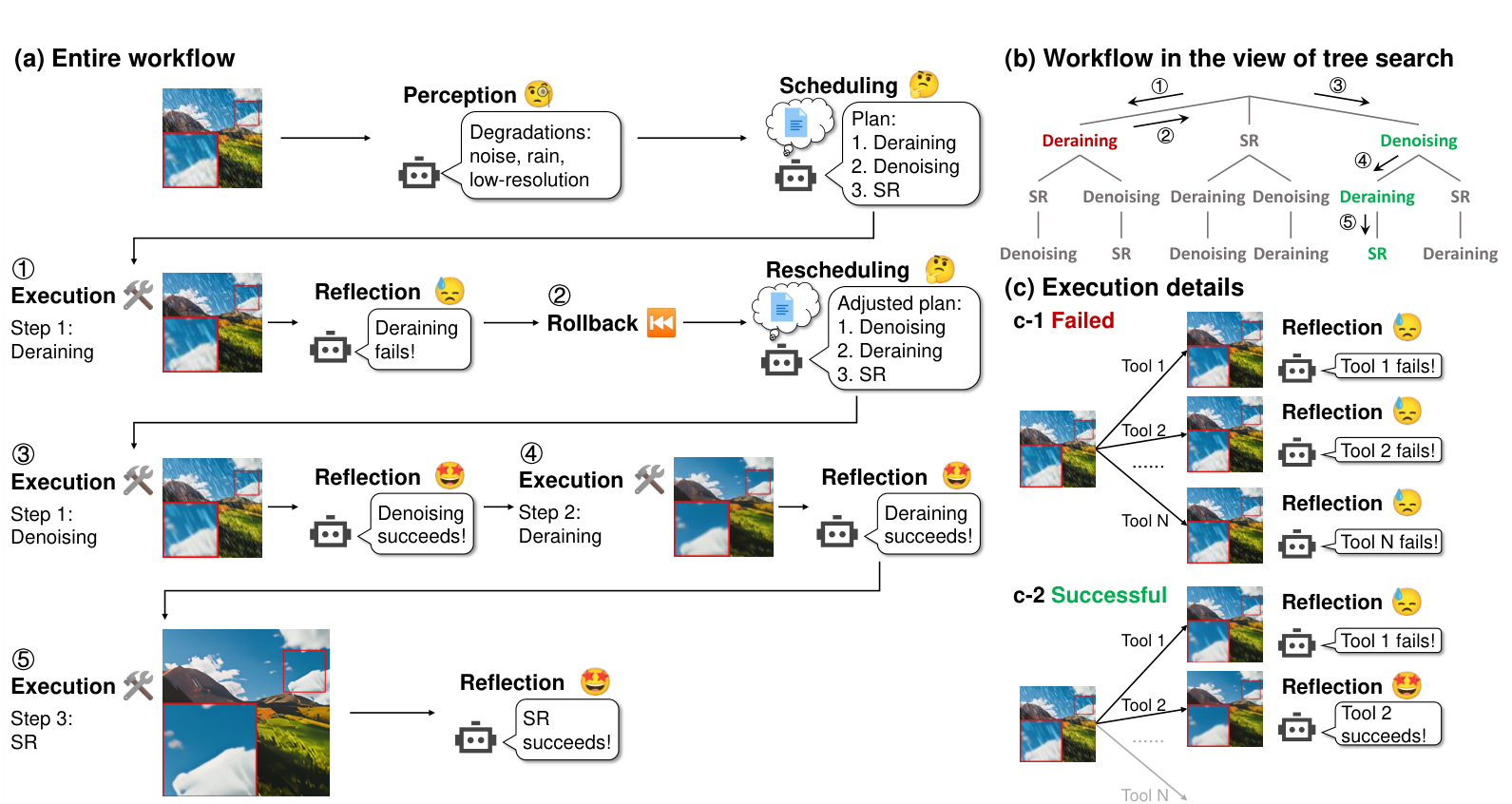
Figure source: [120], PDF page 4. Original PDF.
Perceive, then schedule. A degradation/quality-aware multimodal model analyzes the input. The language model combines this diagnosis, restoration knowledge and previously gathered experience to propose an ordered list of operations. Denoising before dehazing can avoid amplified noise; enlarging rain streaks before removing them can make the remaining tool’s job harder. These are reasons to plan, not universal ordering laws.
Execute with feedback. For the next operation, the system tries available tools and uses the multimodal evaluator to check whether the intended effect was achieved. Successful operations advance the plan. If a step fails, it can return to an earlier image state, update the plan and try another path. Saving those intermediate states is essential: merely applying another filter to an already damaged image is not rollback.
The paper interprets rescheduling as a guided depth-first search over operation paths. Reflection decides whether to accept an intermediate result; rollback makes a failed choice reversible within the stored search state. Neither the language model nor the quality evaluator proves that the accepted path is globally optimal.
Acquire experience before deployment. The agent explores tool sequences on multi-degradation examples, evaluates the outcomes and asks a language model to summarize the observations into a knowledge base. At inference, this experience informs scheduling. Thus “self-exploration” describes an explicit preparation stage, not a claim that a general language model already knows every restoration tool’s behavior.
Read the figure and choose a baseline. Follow one decision cycle: assess the current image, choose an operation, execute a tool, evaluate the new state, then either continue or return to a stored state. The rollback arrow requires an actual saved image and history; verbal reconsideration cannot undo destructive processing by itself. For a practical comparison, record tool calls, rejected outputs and total latency alongside final quality. This proposed evaluation distinguishes a better policy from simply spending more computation. The evaluator is also part of the method: an incorrect quality judgment can accept a harmful edit or reject a useful one.
Results
Table 6’s Group A complex-degradation test gives AgenticIR 21.04 dB / 0.6818 SSIM / 0.3148 LPIPS, versus PromptIR 20.06 / 0.6088 / 0.4127 under this paper’s comparison protocol. The paper itself warns that this is evidence for the feasibility of assembling specialist tools, not a blanket superiority claim over all-in-one networks.
Diagnosis is imperfect: Table 2 gives motion-blur recall 0.52 and defocus-blur recall 0.65 for the fine-tuned evaluator. A downstream planning system inherits these errors, even if its written reasoning sounds plausible.
Ablations
Table 3 compares the proposed order with a different random permutation. Group A PSNR changes 21.14 to 20.79 dB, while not every metric in every group favors the original order. Table 4 separately compares random tool invocation. These isolate different questions: ordering and complete tool selection.
Table 5 removes reflection and rollback. Without reflection, rollback must also be disabled, since the system lacks the failure signal that triggers it. The rollback ablation is calculated only on cases where rollback occurs, so it cannot be read as an average effect on every image. For Group A in that subset, rollback raises PSNR 19.77 to 20.23 but worsens LPIPS 0.3067 to 0.3249: improved decisions are still metric-dependent.
Conclusion
AgenticIR makes restoration an observable, revisable tool workflow. Its useful ingredients are grounded diagnosis, learned experience about order, intermediate-result checking and genuine state rollback.
Problems
The system depends on its toolbox, evaluator, language model and experience distribution. Several tool trials and repeated evaluation increase latency and cost. A quality judge may reward pleasing hallucinations or miss subtle structural damage. Search is limited rather than exhaustive, and a successful stopping decision is not proof of recovering the original scene.
References
- Shyandram, “Low-Level Vision Task-Image Restoration簡介,” Medium post (in Traditional Chinese), 2023; updated 2026. link
- Z. Chen, Z. Wu, E. Zamfir, K. Zhang, Y. Zhang, R. Timofte et al., “NTIRE 2024 Challenge on Image Super-Resolution (×4): Methods and Results,” in Proc. IEEE/CVF CVPR Workshops, 2024. arXiv
- Z. Chen, K. Liu, J. Gong, J. Wang, L. Sun et al., “NTIRE 2025 Challenge on Image Super-Resolution (×4): Methods and Results,” in Proc. IEEE/CVF CVPR Workshops, 2025. arXiv
- X. Wang, L. Xie, C. Dong and Y. Shan, “Real-ESRGAN: Training Real-World Blind Super-Resolution with Pure Synthetic Data,” in Proc. IEEE/CVF ICCV Workshops, 2021. arXiv
- E. H. Land and J. J. McCann, “Lightness and Retinex Theory,” Journal of the Optical Society of America, vol. 61, no. 1, pp. 1–11, 1971. doi
- C. Dong, C. C. Loy, K. He and X. Tang, “Image Super-Resolution Using Deep Convolutional Networks,” IEEE TPAMI, 2016 (conference version ECCV 2014). arXiv
- C. Dong, C. C. Loy and X. Tang, “Accelerating the Super-Resolution Convolutional Neural Network,” in Proc. ECCV, 2016. arXiv
- W. Shi, J. Caballero, F. Huszár, J. Totz, A. P. Aitken, R. Bishop, D. Rueckert and Z. Wang, “Real-Time Single Image and Video Super-Resolution Using an Efficient Sub-Pixel Convolutional Neural Network,” in Proc. IEEE CVPR, 2016. arXiv
- A. Odena, V. Dumoulin and C. Olah, “Deconvolution and Checkerboard Artifacts,” Distill, 2016. link
- B. Lim, S. Son, H. Kim, S. Nah and K. M. Lee, “Enhanced Deep Residual Networks for Single Image Super-Resolution,” in Proc. IEEE CVPR Workshops, 2017. arXiv
- Y. Zhang, K. Li, K. Li, L. Wang, B. Zhong and Y. Fu, “Image Super-Resolution Using Very Deep Residual Channel Attention Networks,” in Proc. ECCV, 2018. arXiv
- C. Ledig, L. Theis, F. Huszár, J. Caballero, A. Cunningham, A. Acosta, A. Aitken, A. Tejani, J. Totz, Z. Wang and W. Shi, “Photo-Realistic Single Image Super-Resolution Using a Generative Adversarial Network,” in Proc. IEEE CVPR, 2017. arXiv
- X. Wang, K. Yu, S. Wu, J. Gu, Y. Liu, C. Dong, C. C. Loy, Y. Qiao and X. Tang, “ESRGAN: Enhanced Super-Resolution Generative Adversarial Networks,” in Proc. ECCV Workshops, 2018. arXiv
- J. Liang, J. Cao, G. Sun, K. Zhang, L. Van Gool and R. Timofte, “SwinIR: Image Restoration Using Swin Transformer,” in Proc. IEEE/CVF ICCV Workshops, 2021. arXiv
- X. Chen, X. Wang, J. Zhou, Y. Qiao and C. Dong, “Activating More Pixels in Image Super-Resolution Transformer,” in Proc. IEEE/CVF CVPR, 2023. arXiv
- X. Lin, J. He, Z. Chen, Z. Lyu, B. Dai, F. Yu, W. Ouyang, Y. Qiao and C. Dong, “DiffBIR: Towards Blind Image Restoration with Generative Diffusion Prior,” arXiv:2308.15070, 2023. arXiv
- F. Yu, J. Gu, Z. Li, J. Hu, X. Kong, X. Wang, J. He, Y. Qiao and C. Dong, “Scaling Up to Excellence: Practicing Model Scaling for Photo-Realistic Image Restoration In the Wild,” in Proc. IEEE/CVF CVPR, 2024. arXiv
- R. Wu, L. Sun, Z. Ma and L. Zhang, “One-Step Effective Diffusion Network for Real-World Image Super-Resolution,” in Proc. NeurIPS, 2024. arXiv
- E. Agustsson and R. Timofte, “NTIRE 2017 Challenge on Single Image Super-Resolution: Dataset and Study,” in Proc. IEEE CVPR Workshops, 2017. doi
- K. Zhang, W. Zuo, Y. Chen, D. Meng and L. Zhang, “Beyond a Gaussian Denoiser: Residual Learning of Deep CNN for Image Denoising,” IEEE Transactions on Image Processing, vol. 26, no. 7, pp. 3142–3155, 2017. arXiv
- K. Zhang, W. Zuo and L. Zhang, “FFDNet: Toward a Fast and Flexible Solution for CNN-Based Image Denoising,” IEEE Transactions on Image Processing, 2018. arXiv
- A. Abdelhamed, S. Lin and M. S. Brown, “A High-Quality Denoising Dataset for Smartphone Cameras,” in Proc. IEEE/CVF CVPR, 2018. doi
- S. W. Zamir, A. Arora, S. Khan, M. Hayat, F. S. Khan and M.-H. Yang, “Restormer: Efficient Transformer for High-Resolution Image Restoration,” in Proc. IEEE/CVF CVPR, 2022. arXiv
- L. Chen, X. Chu, X. Zhang and J. Sun, “Simple Baselines for Image Restoration,” in Proc. ECCV, 2022. arXiv
- K. He, J. Sun and X. Tang, “Single Image Haze Removal Using Dark Channel Prior,” in Proc. IEEE CVPR, 2009. doi
- B. Cai, X. Xu, K. Jia, C. Qing and D. Tao, “DehazeNet: An End-to-End System for Single Image Haze Removal,” IEEE Transactions on Image Processing, 2016. arXiv
- B. Li, X. Peng, Z. Wang, J. Xu and D. Feng, “AOD-Net: All-in-One Dehazing Network,” in Proc. IEEE ICCV, 2017. doi · arXiv
- X. Liu, Y. Ma, Z. Shi and J. Chen, “GridDehazeNet: Attention-Based Multi-Scale Network for Image Dehazing,” in Proc. IEEE/CVF ICCV, 2019. arXiv
- X. Qin, Z. Wang, Y. Bai, X. Xie and H. Jia, “FFA-Net: Feature Fusion Attention Network for Single Image Dehazing,” in Proc. AAAI, 2020. arXiv
- S. W. Zamir, A. Arora, S. Khan, M. Hayat, F. S. Khan, M.-H. Yang and L. Shao, “Learning Enriched Features for Real Image Restoration and Enhancement,” in Proc. ECCV, 2020. arXiv
- Y. Song, Z. He, H. Qian and X. Du, “Vision Transformers for Single Image Dehazing,” IEEE Transactions on Image Processing, vol. 32, 2023. arXiv
- B. Li, W. Ren, D. Fu, D. Tao, D. Feng, W. Zeng and Z. Wang, “Benchmarking Single-Image Dehazing and Beyond,” IEEE Transactions on Image Processing, 2019. arXiv
- C. O. Ancuti, C. Ancuti, R. Timofte and C. De Vleeschouwer, “O-HAZE: A Dehazing Benchmark with Real Hazy and Haze-Free Outdoor Images,” in Proc. IEEE/CVF CVPR Workshops, 2018. doi
- C. O. Ancuti, C. Ancuti, M. Sbert and R. Timofte, “Dense-Haze: A Benchmark for Image Dehazing with Dense-Haze and Haze-Free Images,” in Proc. IEEE ICIP, 2019. doi
- A. Geiger, P. Lenz and R. Urtasun, “Are We Ready for Autonomous Driving? The KITTI Vision Benchmark Suite,” in Proc. IEEE CVPR, 2012. project page
- Y.-F. Liu, D.-W. Jaw, S.-C. Huang and J.-N. Hwang, “DesnowNet: Context-Aware Deep Network for Snow Removal,” IEEE Transactions on Image Processing, 2018. arXiv
- W.-T. Chen, H.-Y. Fang, J.-J. Ding, C.-C. Tsai and S.-Y. Kuo, “JSTASR: Joint Size and Transparency-Aware Snow Removal Algorithm Based on Modified Partial Convolution and Veiling Effect Removal,” in Proc. ECCV, 2020. doi
- W. Yang, R. T. Tan, J. Feng, J. Liu, Z. Guo and S. Yan, “Deep Joint Rain Detection and Removal from a Single Image,” in Proc. IEEE CVPR, 2017. arXiv
- R. Qian, R. T. Tan, W. Yang, J. Su and J. Liu, “Attentive Generative Adversarial Network for Raindrop Removal from a Single Image,” in Proc. IEEE/CVF CVPR, 2018. arXiv
- X. Li, Y. Jin, X. Jin, Z. Wu, B. Li, Y. Wang et al., “NTIRE 2025 Challenge on Day and Night Raindrop Removal for Dual-Focused Images: Methods and Results,” in Proc. IEEE/CVF CVPR Workshops, 2025. arXiv
- C. Wei, W. Wang, W. Yang and J. Liu, “Deep Retinex Decomposition for Low-Light Enhancement,” in Proc. BMVC, 2018. arXiv
- Y. Cai, H. Bian, J. Lin, H. Wang, R. Timofte and Y. Zhang, “Retinexformer: One-stage Retinex-based Transformer for Low-light Image Enhancement,” in Proc. IEEE/CVF ICCV, 2023. arXiv
- H. Zhang, H. Xu, X. Tian, J. Jiang and J. Ma, “Image Fusion Meets Deep Learning: A Survey and Perspective,” Information Fusion, vol. 76, pp. 323–336, 2021. doi
- S. Nah, T. H. Kim and K. M. Lee, “Deep Multi-scale Convolutional Neural Network for Dynamic Scene Deblurring,” in Proc. IEEE CVPR, 2017. doi · arXiv
- K. He, X. Chen, S. Xie, Y. Li, P. Dollár and R. Girshick, “Masked Autoencoders Are Scalable Vision Learners,” in Proc. IEEE/CVF CVPR, 2022. arXiv
- R. Suvorov, E. Logacheva, A. Mashikhin, A. Remizova, A. Ashukha, A. Silvestrov, N. Kong, H. Goka, K. Park and V. Lempitsky, “Resolution-robust Large Mask Inpainting with Fourier Convolutions,” in Proc. IEEE/CVF WACV, 2022. arXiv
- S. Sengupta, V. Jayaram, B. Curless, S. Seitz and I. Kemelmacher-Shlizerman, “Background Matting: The World is Your Green Screen,” in Proc. IEEE/CVF CVPR, 2020. arXiv
- O. Ronneberger, P. Fischer and T. Brox, “U-Net: Convolutional Networks for Biomedical Image Segmentation,” in Proc. MICCAI, 2015. arXiv
- H. Guo, J. Li, T. Dai, Z. Ouyang, X. Ren and S.-T. Xia, “MambaIR: A Simple Baseline for Image Restoration with State-Space Model,” in Proc. ECCV, 2024. arXiv
- H. Guo, Y. Guo, Y. Zha, Y. Zhang, W. Li, T. Dai, S.-T. Xia and Y. Li, “MambaIRv2: Attentive State Space Restoration,” in Proc. IEEE/CVF CVPR, 2025. arXiv
- B. Li, X. Liu, P. Hu, Z. Wu, J. Lv and X. Peng, “All-In-One Image Restoration for Unknown Corruption,” in Proc. IEEE/CVF CVPR, 2022. code & paper
- J. M. J. Valanarasu, R. Yasarla and V. M. Patel, “TransWeather: Transformer-based Restoration of Images Degraded by Adverse Weather Conditions,” in Proc. IEEE/CVF CVPR, 2022. arXiv
- V. Potlapalli, S. W. Zamir, S. Khan and F. S. Khan, “PromptIR: Prompting for All-in-One Image Restoration,” in Proc. NeurIPS, 2023. arXiv
- Y. Cui, S. W. Zamir, S. Khan, A. Knoll, M. Shah and F. S. Khan, “AdaIR: Adaptive All-in-One Image Restoration via Frequency Mining and Modulation,” in Proc. ICLR, 2025. arXiv
- Z. Luo, F. K. Gustafsson, Z. Zhao, J. Sjölund and T. B. Schön, “Controlling Vision-Language Models for Multi-Task Image Restoration,” in Proc. ICLR, 2024. arXiv
- M. V. Conde, G. Geigle and R. Timofte, “InstructIR: High-Quality Image Restoration Following Human Instructions,” in Proc. ECCV, 2024. arXiv
- H. Zhao, O. Gallo, I. Frosio and J. Kautz, “Loss Functions for Image Restoration with Neural Networks,” IEEE Transactions on Computational Imaging, 2017 (arXiv title: “Loss Functions for Neural Networks for Image Processing”). arXiv
- J. Johnson, A. Alahi and L. Fei-Fei, “Perceptual Losses for Real-Time Style Transfer and Super-Resolution,” in Proc. ECCV, 2016. doi · arXiv
- L. Jiang, B. Dai, W. Wu and C. C. Loy, “Focal Frequency Loss for Image Reconstruction and Synthesis,” in Proc. IEEE/CVF ICCV, 2021. arXiv
- Z. Wang, A. C. Bovik, H. R. Sheikh and E. P. Simoncelli, “Image Quality Assessment: From Error Visibility to Structural Similarity,” IEEE Transactions on Image Processing, vol. 13, no. 4, pp. 600–612, 2004. doi
- R. Zhang, P. Isola, A. A. Efros, E. Shechtman and O. Wang, “The Unreasonable Effectiveness of Deep Features as a Perceptual Metric,” in Proc. IEEE/CVF CVPR, 2018. arXiv
- A. Mittal, R. Soundararajan and A. C. Bovik, “Making a ‘Completely Blind’ Image Quality Analyzer,” IEEE Signal Processing Letters, 2013. doi
- Y. Blau, R. Mechrez, R. Timofte, T. Michaeli and L. Zelnik-Manor, “The 2018 PIRM Challenge on Perceptual Image Super-resolution,” in Proc. ECCV Workshops, 2018. arXiv
- M. Heusel, H. Ramsauer, T. Unterthiner, B. Nessler and S. Hochreiter, “GANs Trained by a Two Time-Scale Update Rule Converge to a Local Nash Equilibrium,” in Proc. NeurIPS, 2017. arXiv
- Y. Blau and T. Michaeli, “The Perception-Distortion Tradeoff,” in Proc. IEEE/CVF CVPR, 2018. arXiv
- Z. Wang, J. Chen and S. C. H. Hoi, “Deep Learning for Image Super-Resolution: A Survey,” IEEE TPAMI, 2021. arXiv
- C. Tian, L. Fei, W. Zheng, Y. Xu, W. Zuo and C.-W. Lin, “Deep Learning on Image Denoising: An Overview,” Neural Networks, vol. 131, pp. 251–275, 2020. arXiv
- M. Elad, B. Kawar and G. Vaksman, “Image Denoising: The Deep Learning Revolution and Beyond — A Survey Paper,” SIAM Journal on Imaging Sciences, vol. 16, no. 3, pp. 1594–1654, 2023. doi · arXiv
- K. Zhang, W. Ren, W. Luo, W.-S. Lai, B. Stenger, M.-H. Yang and H. Li, “Deep Image Deblurring: A Survey,” International Journal of Computer Vision, 2022. arXiv
- J. Gui, X. Cong, Y. Cao, W. Ren, J. Zhang, J. Zhang, J. Cao and D. Tao, “A Comprehensive Survey and Taxonomy on Single Image Dehazing Based on Deep Learning,” ACM Computing Surveys, 2023. doi · arXiv
- W. Yang, R. T. Tan, S. Wang, Y. Fang and J. Liu, “Single Image Deraining: From Model-Based to Data-Driven and Beyond,” IEEE TPAMI, 2021. doi · arXiv
- J. Jiang, Z. Zuo, G. Wu, K. Jiang and X. Liu, “A Survey on All-in-One Image Restoration: Taxonomy, Evaluation and Future Trends,” IEEE TPAMI, 2025. arXiv
- X. Li, Y. Ren, X. Jin, C. Lan, X. Wang, W. Zeng, X. Wang and Z. Chen, “Diffusion Models for Image Restoration and Enhancement: A Comprehensive Survey,” International Journal of Computer Vision, 2025. arXiv
- A. Levin, Y. Weiss, F. Durand and W. T. Freeman, “Understanding and Evaluating Blind Deconvolution Algorithms,” in Proc. IEEE CVPR, 2009, pp. 1964–1971. doi
- R. Fergus, B. Singh, A. Hertzmann, S. T. Roweis and W. T. Freeman, “Removing Camera Shake from a Single Photograph,” ACM Transactions on Graphics (Proc. SIGGRAPH), vol. 25, no. 3, pp. 787–794, 2006. doi
- Q. Shan, J. Jia and A. Agarwala, “High-quality Motion Deblurring from a Single Image,” ACM Transactions on Graphics (Proc. SIGGRAPH), vol. 27, no. 3, 2008. doi
- S. Cho and S. Lee, “Fast Motion Deblurring,” ACM Transactions on Graphics (Proc. SIGGRAPH Asia), vol. 28, no. 5, 2009. doi
- L. Xu and J. Jia, “Two-Phase Kernel Estimation for Robust Motion Deblurring,” in Proc. ECCV, 2010, pp. 157–170. doi
- D. Krishnan, T. Tay and R. Fergus, “Blind Deconvolution Using a Normalized Sparsity Measure,” in Proc. IEEE CVPR, 2011, pp. 233–240. doi
- J. Pan, D. Sun, H. Pfister and M.-H. Yang, “Blind Image Deblurring Using Dark Channel Prior,” in Proc. IEEE CVPR, 2016, pp. 1628–1636. doi
- J. Sun, W. Cao, Z. Xu and J. Ponce, “Learning a Convolutional Neural Network for Non-uniform Motion Blur Removal,” in Proc. IEEE CVPR, 2015. arXiv
- C. J. Schuler, M. Hirsch, S. Harmeling and B. Schölkopf, “Learning to Deblur,” IEEE TPAMI, vol. 38, no. 7, pp. 1439–1451, 2016. doi · arXiv
- A. Chakrabarti, “A Neural Approach to Blind Motion Deblurring,” in Proc. ECCV, 2016. arXiv
- D. Ulyanov, A. Vedaldi and V. Lempitsky, “Deep Image Prior,” in Proc. IEEE/CVF CVPR, 2018, pp. 9446–9454. doi · arXiv
- D. Ren, K. Zhang, Q. Wang, Q. Hu and W. Zuo, “Neural Blind Deconvolution Using Deep Priors,” in Proc. IEEE/CVF CVPR, 2020. arXiv
- O. Kupyn, V. Budzan, M. Mykhailych, D. Mishkin and J. Matas, “DeblurGAN: Blind Motion Deblurring Using Conditional Adversarial Networks,” in Proc. IEEE/CVF CVPR, 2018. arXiv
- K. Zhang, W. Zuo and L. Zhang, “Learning a Single Convolutional Super-Resolution Network for Multiple Degradations,” in Proc. IEEE/CVF CVPR, 2018. arXiv
- J. Gu, H. Lu, W. Zuo and C. Dong, “Blind Super-Resolution With Iterative Kernel Correction,” in Proc. IEEE/CVF CVPR, 2019. arXiv
- S. Bell-Kligler, A. Shocher and M. Irani, “Blind Super-Resolution Kernel Estimation using an Internal-GAN,” in Proc. NeurIPS, 2019. link · arXiv
- Z. Luo, Y. Huang, S. Li, L. Wang and T. Tan, “Unfolding the Alternating Optimization for Blind Super Resolution,” in Proc. NeurIPS, 2020. arXiv
- K. Zhang, L. Van Gool and R. Timofte, “Deep Unfolding Network for Image Super-Resolution,” in Proc. IEEE/CVF CVPR, 2020. arXiv
- K. Zhang, J. Liang, L. Van Gool and R. Timofte, “Designing a Practical Degradation Model for Deep Blind Image Super-Resolution,” in Proc. IEEE/CVF ICCV, 2021. arXiv
- A. Liu, Y. Liu, J. Gu, Y. Qiao and C. Dong, “Blind Image Super-Resolution: A Survey and Beyond,” IEEE TPAMI, 2022 (early access). doi · arXiv
- A. Mittal, A. K. Moorthy and A. C. Bovik, “No-Reference Image Quality Assessment in the Spatial Domain,” IEEE Transactions on Image Processing, vol. 21, no. 12, pp. 4695–4708, 2012. doi
- C. Ma, C.-Y. Yang, X. Yang and M.-H. Yang, “Learning a No-Reference Quality Metric for Single-Image Super-Resolution,” Computer Vision and Image Understanding, vol. 158, pp. 1–16, 2017. doi · arXiv
- N. Venkatanath, D. Praneeth, M. C. Bh, S. S. Channappayya and S. S. Medasani, “Blind Image Quality Evaluation Using Perception Based Features,” in Proc. Twenty First National Conference on Communications (NCC), 2015, pp. 1–6. doi · MATLAB documentation
- H. Talebi and P. Milanfar, “NIMA: Neural Image Assessment,” IEEE Transactions on Image Processing, vol. 27, no. 8, pp. 3998–4011, 2018. doi · arXiv
- S. Su, Q. Yan, Y. Zhu, C. Zhang, X. Ge, J. Sun and Y. Zhang, “Blindly Assess Image Quality in the Wild Guided by a Self-Adaptive Hyper Network,” in Proc. IEEE/CVF CVPR, 2020, pp. 3664–3673. doi
- J. Ke, Q. Wang, Y. Wang, P. Milanfar and F. Yang, “MUSIQ: Multi-scale Image Quality Transformer,” in Proc. IEEE/CVF ICCV, 2021, pp. 5128–5137. doi · arXiv
- S. Yang, T. Wu, S. Shi, S. Lao, Y. Gong, M. Cao, J. Wang and Y. Yang, “MANIQA: Multi-dimension Attention Network for No-Reference Image Quality Assessment,” in Proc. IEEE/CVF CVPR Workshops, 2022, pp. 1190–1199. doi · arXiv
- C. Chen, J. Mo, J. Hou, H. Wu, L. Liao, W. Sun, Q. Yan and W. Lin, “TOPIQ: A Top-Down Approach From Semantics to Distortions for Image Quality Assessment,” IEEE Transactions on Image Processing, vol. 33, pp. 2404–2418, 2024. doi · arXiv
- J. Wang, K. C. K. Chan and C. C. Loy, “Exploring CLIP for Assessing the Look and Feel of Images,” in Proc. AAAI Conference on Artificial Intelligence, 2023. arXiv
- H. Wu, Z. Zhang, W. Zhang, C. Chen, L. Liao, C. Li, Y. Gao, A. Wang, E. Zhang, W. Sun, Q. Yan, X. Min, G. Zhai and W. Lin, “Q-Align: Teaching LMMs for Visual Scoring via Discrete Text-Defined Levels,” in Proc. ICML, PMLR 235, pp. 54015–54029, 2024. link · arXiv
- H. R. Sheikh, M. F. Sabir and A. C. Bovik, “A Statistical Evaluation of Recent Full Reference Image Quality Assessment Algorithms,” IEEE Transactions on Image Processing, vol. 15, no. 11, pp. 3440–3451, 2006 (LIVE Image Quality Assessment Database). doi · database
- N. Ponomarenko, L. Jin, O. Ieremeiev, V. Lukin, K. Egiazarian, J. Astola, B. Vozel, K. Chehdi, M. Carli, F. Battisti and C.-C. J. Kuo, “Image Database TID2013: Peculiarities, Results and Perspectives,” Signal Processing: Image Communication, vol. 30, pp. 57–77, 2015. doi · database
- H. Lin, V. Hosu and D. Saupe, “KADID-10k: A Large-scale Artificially Distorted IQA Database,” in Proc. Eleventh International Conference on Quality of Multimedia Experience (QoMEX), 2019. doi · database
- V. Hosu, H. Lin, T. Sziranyi and D. Saupe, “KonIQ-10k: An Ecologically Valid Database for Deep Learning of Blind Image Quality Assessment,” IEEE Transactions on Image Processing, vol. 29, pp. 4041–4056, 2020. arXiv
- Y. Fang, H. Zhu, Y. Zeng, K. Ma and Z. Wang, “Perceptual Quality Assessment of Smartphone Photography,” in Proc. IEEE/CVF CVPR, 2020, pp. 3674–3683. doi
- J. Gu, H. Cai, H. Chen, X. Ye, J. Ren and C. Dong, “PIPAL: A Large-Scale Image Quality Assessment Dataset for Perceptual Image Restoration,” in Proc. ECCV, 2020. arXiv
- C. Chen and J. Mo, “IQA-PyTorch: PyTorch Toolbox for Image Quality Assessment,” software (pip package
pyiqa), 2022. GitHub - ITU-R, “Recommendation BT.500-15: Methodologies for the Subjective Assessment of the Quality of Television Images,” 2023. ITU
- R. A. Bradley and M. E. Terry, “Rank Analysis of Incomplete Block Designs: The Method of Paired Comparisons,” Biometrika, vol. 39, no. 3–4, pp. 324–345, 1952. doi
- D. Geman and C. Yang, “Nonlinear Image Recovery with Half-Quadratic Regularization,” IEEE Transactions on Image Processing, vol. 4, no. 7, pp. 932–946, 1995. doi
- S. V. Venkatakrishnan, C. A. Bouman and B. Wohlberg, “Plug-and-Play Priors for Model Based Reconstruction,” in Proc. IEEE Global Conference on Signal and Information Processing (GlobalSIP), 2013, pp. 945–948. doi
- K. Zhang, W. Zuo, S. Gu and L. Zhang, “Learning Deep CNN Denoiser Prior for Image Restoration,” in Proc. IEEE/CVF CVPR, 2017, pp. 2808–2817. doi · arXiv
- A. Chambolle, “An Algorithm for Total Variation Minimization and Applications,” Journal of Mathematical Imaging and Vision, vol. 20, no. 1–2, pp. 89–97, 2004. doi
- A. Buades, B. Coll and J.-M. Morel, “A Non-Local Algorithm for Image Denoising,” in Proc. IEEE CVPR, vol. 2, 2005, pp. 60–65. doi
- D. Ulyanov, A. Vedaldi and V. Lempitsky, “Deep Image Prior,” International Journal of Computer Vision, vol. 128, no. 7, pp. 1867–1888, 2020. doi · arXiv
- Y. Jiang, Z. Zhang, T. Xue and J. Gu, “AutoDIR: Automatic All-in-One Image Restoration with Latent Diffusion,” in Proc. ECCV, 2024. paper
- K. Zhu, J. Gu, Z. You, Y. Qiao and C. Dong, “An Intelligent Agentic System for Complex Image Restoration Problems,” in Proc. ICLR, 2025. paper
- Y. Zuo, Q. Zheng, M. Wu, X. Jiang, R. Li, J. Wang, Y. Zhang, G. Mai, L. V. Wang, J. Zou, X. Wang, M.-H. Yang and Z. Tu, “4KAgent: Agentic Any Image to 4K Super-Resolution,” in Proc. NeurIPS, 2025. paper
- Y. Yu, Z. Zeng, H. Hua, J. Fu and J. Luo, “PromptFix: You Prompt and We Fix the Photo,” in Proc. NeurIPS, 2024. paper