Ghosh et al., “GenEval: An Object-Focused Framework for Evaluating Text-to-Image Alignment” (NeurIPS 2023)
Optional · paper guide 3 of 3 for DLCV 12 · Image Generation: From GANs to Text-to-Image Systems. Citation numbers refer to the reference list at the bottom of this page.
Navigate: this page and this track: Navigate: this page and this track
Challenge
FID measures overall image statistics and CLIPScore overall image–text similarity; neither tells you whether a model drew two dogs, a red car, or a cup left of a laptop. Human evaluation does, but it is slow and expensive [55].
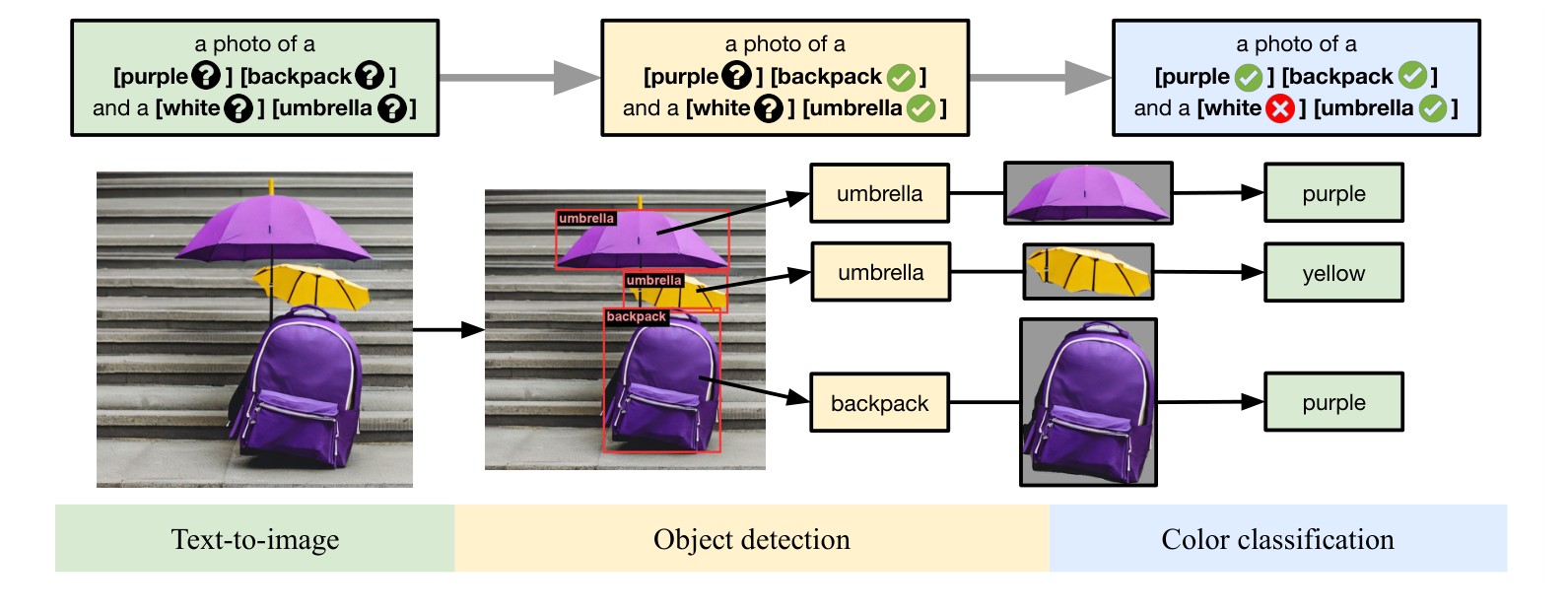
Figure source: [55], arXiv:2310.11513v1, PDF page 2. Original PDF.
Method
Turn alignment into object-level checks performed by existing vision models. Prompts are generated from templates for six tasks: single object (80 prompts), two objects (99), counting (80), colors (94), position (100) and attribute binding (100), with objects drawn from the 80 COCO classes, colors from 11 basic color terms, counts of 2, 3 or 4, and four relative positions. A Mask2Former instance-segmentation model trained on COCO detects objects (confidence threshold 0.3, raised to 0.9 for counting); positions are judged from bounding-box centroids; colors are classified by CLIP ViT-L/14 on the object’s crop with the background replaced by gray. Each image is scored correct or incorrect, and four images are generated per prompt.
Results
In a human study of 6,000 annotations on 1,200 images, GenEval agreed with annotators 83% of the time, against an inter-annotator agreement of 88%, and agreed with humans much better than CLIPScore on the compositional tasks. Single objects were easy for every model tested, but even the best model at the time produced correct relative positions in 15% and correct attribute binding in 35% of images.
Reading the evidence
Start with Table 1 (tasks and templates) and Section 3.2 (the scoring pipeline), then the human-agreement analysis, then the benchmark table. Check: (a) that the overall score is an average over tasks, so a model can hide a weak task behind strong easy tasks; read per-task columns; (b) the detector thresholds and their effect on counting; (c) which models were tested (open-source models of 2023); later papers report GenEval for newer models, so compare scores only within one table and one version of the benchmark code.
Problems
The authors note that GenEval is bounded by its detector: COCO-trained detectors know a fixed set of classes, cannot check fine details such as the number of fingers, and generalize poorly to artistic styles. Template prompts are short and unlike real user prompts, and once a benchmark is popular, models may be tuned toward it.
Conclusion
It is the model for the object-level checks of the evaluation section and the source of several of the failure-mode numbers; it is now reported by many text-to-image papers, including Stable Diffusion 3 [20].
References
- T. Karras, S. Laine and T. Aila, “A Style-Based Generator Architecture for Generative Adversarial Networks,” CVPR, 2019. arXiv
- A. Brock, J. Donahue and K. Simonyan, “Large Scale GAN Training for High Fidelity Natural Image Synthesis,” ICLR, 2019. arXiv
- W. Peebles and S. Xie, “Scalable Diffusion Models with Transformers,” ICCV, 2023. CVF
- C. Saharia, W. Chan, S. Saxena et al., “Photorealistic Text-to-Image Diffusion Models with Deep Language Understanding,” NeurIPS, 2022. arXiv · project page
- R. Rombach, A. Blattmann, D. Lorenz, P. Esser and B. Ommer, “High-Resolution Image Synthesis with Latent Diffusion Models,” CVPR, 2022. CVF
- C. Meng, Y. He, Y. Song et al., “SDEdit: Guided Image Synthesis and Editing with Stochastic Differential Equations,” ICLR, 2022. arXiv
- L. Zhang, A. Rao and M. Agrawala, “Adding Conditional Control to Text-to-Image Diffusion Models,” ICCV, 2023. CVF
- A. Hertz, R. Mokady, J. Tenenbaum et al., “Prompt-to-Prompt Image Editing with Cross-Attention Control,” ICLR, 2023. arXiv
- T. Brooks, A. Holynski and A. A. Efros, “InstructPix2Pix: Learning to Follow Image Editing Instructions,” CVPR, 2023. CVF
- A. Lugmayr, M. Danelljan, A. Romero et al., “RePaint: Inpainting using Denoising Diffusion Probabilistic Models,” CVPR, 2022. CVF
- J. Ho and T. Salimans, “Classifier-Free Diffusion Guidance,” NeurIPS 2021 Workshop on Deep Generative Models and Downstream Applications; arXiv:2207.12598, 2022. arXiv
- I. J. Goodfellow, J. Pouget-Abadie, M. Mirza et al., “Generative Adversarial Nets,” NeurIPS, 2014. arXiv
- D. P. Kingma and M. Welling, “Auto-Encoding Variational Bayes,” ICLR, 2014. arXiv
- A. van den Oord, O. Vinyals and K. Kavukcuoglu, “Neural Discrete Representation Learning,” NeurIPS, 2017. arXiv
- P. Esser, R. Rombach and B. Ommer, “Taming Transformers for High-Resolution Image Synthesis,” CVPR, 2021. CVF
- J. Ho, A. Jain and P. Abbeel, “Denoising Diffusion Probabilistic Models,” NeurIPS, 2020. arXiv
- P. Dhariwal and A. Nichol, “Diffusion Models Beat GANs on Image Synthesis,” NeurIPS, 2021. arXiv
- Y. Lipman, R. T. Q. Chen, H. Ben-Hamu, M. Nickel and M. Le, “Flow Matching for Generative Modeling,” ICLR, 2023. arXiv
- X. Liu, C. Gong and Q. Liu, “Flow Straight and Fast: Learning to Generate and Transfer Data with Rectified Flow,” ICLR, 2023. arXiv
- P. Esser, S. Kulal, A. Blattmann et al., “Scaling Rectified Flow Transformers for High-Resolution Image Synthesis,” ICML, PMLR 235, 2024. arXiv
- T. Li, Y. Tian, H. Li, M. Deng and K. He, “Autoregressive Image Generation without Vector Quantization,” NeurIPS, 2024. arXiv
- A. Sauer, D. Lorenz, A. Blattmann and R. Rombach, “Adversarial Diffusion Distillation,” ECCV, LNCS, pp. 87–103, 2024. doi · arXiv
- A. Radford, J. W. Kim, C. Hallacy et al., “Learning Transferable Visual Models From Natural Language Supervision,” ICML, PMLR 139, 2021. arXiv
- C. Raffel, N. Shazeer, A. Roberts et al., “Exploring the Limits of Transfer Learning with a Unified Text-to-Text Transformer,” Journal of Machine Learning Research, vol. 21, 2020. arXiv
- D. Podell, Z. English, K. Lacey et al., “SDXL: Improving Latent Diffusion Models for High-Resolution Image Synthesis,” ICLR, 2024. arXiv
- R. Liu, D. Garrette, C. Saharia et al., “Character-Aware Models Improve Visual Text Rendering,” ACL, 2023. ACL Anthology
- A. Ramesh, P. Dhariwal, A. Nichol, C. Chu and M. Chen, “Hierarchical Text-Conditional Image Generation with CLIP Latents,” arXiv:2204.06125, 2022. arXiv
- H. Chefer, Y. Alaluf, Y. Vinker, L. Wolf and D. Cohen-Or, “Attend-and-Excite: Attention-Based Semantic Guidance for Text-to-Image Diffusion Models,” ACM Transactions on Graphics, vol. 42, no. 4 (SIGGRAPH), 2023. doi · arXiv
- O. Ronneberger, P. Fischer and T. Brox, “U-Net: Convolutional Networks for Biomedical Image Segmentation,” MICCAI, 2015. arXiv
- J. Yu, Y. Xu, J. Y. Koh et al., “Scaling Autoregressive Models for Content-Rich Text-to-Image Generation,” Transactions on Machine Learning Research, 2022. arXiv
- H. Chang, H. Zhang, J. Barber et al., “Muse: Text-To-Image Generation via Masked Generative Transformers,” ICML, PMLR 202, 2023. arXiv
- R. Gal, Y. Alaluf, Y. Atzmon et al., “An Image is Worth One Word: Personalizing Text-to-Image Generation using Textual Inversion,” ICLR, 2023. arXiv
- N. Ruiz, Y. Li, V. Jampani, Y. Pritch, M. Rubinstein and K. Aberman, “DreamBooth: Fine Tuning Text-to-Image Diffusion Models for Subject-Driven Generation,” CVPR, 2023. CVF
- E. J. Hu, Y. Shen, P. Wallis et al., “LoRA: Low-Rank Adaptation of Large Language Models,” ICLR, 2022. arXiv
- Y. Huang, J. Huang, Y. Liu et al., “Diffusion Model-Based Image Editing: A Survey,” IEEE Transactions on Pattern Analysis and Machine Intelligence, 2025. doi · arXiv
- J. Song, C. Meng and S. Ermon, “Denoising Diffusion Implicit Models,” ICLR, 2021. arXiv
- T. Salimans and J. Ho, “Progressive Distillation for Fast Sampling of Diffusion Models,” ICLR, 2022. arXiv
- Y. Song, P. Dhariwal, M. Chen and I. Sutskever, “Consistency Models,” ICML, PMLR 202, 2023. arXiv
- P. Sun, Y. Jiang, S. Chen et al., “Autoregressive Model Beats Diffusion: Llama for Scalable Image Generation,” arXiv:2406.06525, 2024. arXiv
- H. Chang, H. Zhang, L. Jiang, C. Liu and W. T. Freeman, “MaskGIT: Masked Generative Image Transformer,” CVPR, 2022. CVF
- K. Tian, Y. Jiang, Z. Yuan, B. Peng and L. Wang, “Visual Autoregressive Modeling: Scalable Image Generation via Next-Scale Prediction,” NeurIPS, 2024. arXiv
- L. Yu, J. Lezama, N. B. Gundavarapu et al., “Language Model Beats Diffusion — Tokenizer is Key to Visual Generation,” ICLR, 2024. arXiv
- Chameleon Team, “Chameleon: Mixed-Modal Early-Fusion Foundation Models,” arXiv:2405.09818, 2024. arXiv
- X. Wang, Y. Cui, J. Wang et al., “Multimodal learning with next-token prediction for large multimodal models,” Nature, vol. 650, pp. 327–333, 2026 (preprint “Emu3: Next-Token Prediction is All You Need,” 2024). doi · arXiv
- C. Zhou, L. Yu, A. Babu et al., “Transfusion: Predict the Next Token and Diffuse Images with One Multi-Modal Model,” ICLR, 2025. arXiv
- J. Xie, W. Mao, Z. Bai et al., “Show-o: One Single Transformer to Unify Multimodal Understanding and Generation,” ICLR, 2025. arXiv
- C. Wu, X. Chen, Z. Wu et al., “Janus: Decoupling Visual Encoding for Unified Multimodal Understanding and Generation,” CVPR, 2025. CVF
- T.-Y. Lin, M. Maire, S. Belongie et al., “Microsoft COCO: Common Objects in Context,” ECCV, 2014. arXiv
- M. J. Chong and D. Forsyth, “Effectively Unbiased FID and Inception Score and Where to Find Them,” CVPR, 2020. arXiv
- G. Parmar, R. Zhang and J.-Y. Zhu, “On Aliased Resizing and Surprising Subtleties in GAN Evaluation,” CVPR, 2022. CVF
- T. Kynkäänniemi, T. Karras, M. Aittala, T. Aila and J. Lehtinen, “The Role of ImageNet Classes in Fréchet Inception Distance,” ICLR, 2023. arXiv
- G. Stein, J. C. Cresswell, R. Hosseinzadeh et al., “Exposing Flaws of Generative Model Evaluation Metrics and Their Unfair Treatment of Diffusion Models,” NeurIPS, 2023. arXiv
- S. Jayasumana, S. Ramalingam, A. Veit, D. Glasner, A. Chakrabarti and S. Kumar, “Rethinking FID: Towards a Better Evaluation Metric for Image Generation,” CVPR, 2024. CVF
- J. Hessel, A. Holtzman, M. Forbes, R. Le Bras and Y. Choi, “CLIPScore: A Reference-free Evaluation Metric for Image Captioning,” EMNLP, 2021. ACL Anthology
- D. Ghosh, H. Hajishirzi and L. Schmidt, “GenEval: An Object-Focused Framework for Evaluating Text-to-Image Alignment,” NeurIPS Datasets and Benchmarks Track, 2023. arXiv
- K. Huang, K. Sun, E. Xie, Z. Li and X. Liu, “T2I-CompBench: A Comprehensive Benchmark for Open-world Compositional Text-to-image Generation,” NeurIPS Datasets and Benchmarks Track, 2023. proceedings
- J. Xu, X. Liu, Y. Wu et al., “ImageReward: Learning and Evaluating Human Preferences for Text-to-Image Generation,” NeurIPS, 2023. arXiv
- Y. Kirstain, A. Polyak, U. Singer et al., “Pick-a-Pic: An Open Dataset of User Preferences for Text-to-Image Generation,” NeurIPS, 2023. arXiv
- T. Lee, M. Yasunaga, C. Meng et al., “Holistic Evaluation of Text-To-Image Models,” NeurIPS Datasets and Benchmarks Track, 2023. arXiv
- J. Deng, W. Dong, R. Socher, L.-J. Li, K. Li and L. Fei-Fei, “ImageNet: A Large-Scale Hierarchical Image Database,” CVPR, 2009. doi
- C. Schuhmann, R. Beaumont, R. Vencu et al., “LAION-5B: An Open Large-Scale Dataset for Training Next Generation Image-Text Models,” NeurIPS Datasets and Benchmarks Track, 2022. arXiv
- A. Birhane, V. U. Prabhu and E. Kahembwe, “Multimodal datasets: misogyny, pornography, and malignant stereotypes,” arXiv:2110.01963, 2021. arXiv
- N. Carlini, J. Hayes, M. Nasr et al., “Extracting Training Data from Diffusion Models,” USENIX Security Symposium, 2023. USENIX · arXiv
- G. Somepalli, V. Singla, M. Goldblum, J. Geiping and T. Goldstein, “Diffusion Art or Digital Forgery? Investigating Data Replication in Diffusion Models,” CVPR, 2023. CVF
- F. Bianchi, P. Kalluri, E. Durmus et al., “Easily Accessible Text-to-Image Generation Amplifies Demographic Stereotypes at Large Scale,” ACM FAccT, 2023. doi
- A. S. Luccioni, C. Akiki, M. Mitchell and Y. Jernite, “Stable Bias: Analyzing Societal Representations in Diffusion Models,” NeurIPS Datasets and Benchmarks Track, 2023. arXiv
- Coalition for Content Provenance and Authenticity (C2PA), “C2PA Technical Specification,” version 2.1, 2024. specification
- Y. Wen, J. Kirchenbauer, J. Geiping and T. Goldstein, “Tree-Ring Watermarks: Fingerprints for Diffusion Images that are Invisible and Robust,” NeurIPS, 2023. arXiv
- P. Fernandez, G. Couairon, H. Jégou, M. Douze and T. Furon, “The Stable Signature: Rooting Watermarks in Latent Diffusion Models,” ICCV, 2023. CVF
- X. Zhao, K. Zhang, Z. Su et al., “Invisible Image Watermarks Are Provably Removable Using Generative AI,” NeurIPS, 2024. arXiv
- M. Saberi, V. S. Sadasivan, K. Rezaei et al., “Robustness of AI-Image Detectors: Fundamental Limits and Practical Attacks,” ICLR, 2024. arXiv
- W. Lu, Y. Xu, J. Zhang, C. Wang and D. Tao, “HandRefiner: Refining Malformed Hands in Generated Images by Diffusion-based Conditional Inpainting,” ACM Multimedia, 2024, pp. 7085–7093. doi
- C. Zhang, C. Zhang, M. Zhang, I. S. Kweon and J. Kim, “Text-to-image Diffusion Models in Generative AI: A Survey,” arXiv:2303.07909, 2023. arXiv
- F.-A. Croitoru, V. Hondru, R. T. Ionescu and M. Shah, “Diffusion Models in Vision: A Survey,” IEEE Transactions on Pattern Analysis and Machine Intelligence, 2023. doi
- J. Xiong, G. Liu, L. Huang et al., “Autoregressive Models in Vision: A Survey,” Transactions on Machine Learning Research, 2025. arXiv