Guide to the Modern view surveys
Optional · paper guide 1 of 1 for DLCV 02 · Deep Image Classification. Citation numbers refer to the reference list at the bottom of this page.
Navigate: this page and this track: Navigate: this page and this track
On this page
- A worked macro-versus-micro example
- Cohen’s kappa: agreement beyond chance
- Multi-label metrics in detail
- Evaluation benchmarks in detail
- How reliable are ImageNet numbers?
- Why residual networks train: the unrolled gradient
- Two more CNN designs: DenseNet and RegNet
- Squeeze-and-excitation: attention inside a CNN
- Contrastive learning in detail: SimCLR and MoCo
Deep Learning for Computer Vision
Choose a reading by topic: Shape, Local keypoints, Texture, Matching.
Surveys worth reading
Li et al. [1] review CNNs from their history and basic building blocks through classic and advanced models, highlighting the key ideas behind each, and run experiments that compare activation functions, loss functions and optimizers to derive rules of thumb; they close with applications of 1-D, 2-D and multi-dimensional convolution and a list of open issues. Khan et al. [25] survey vision transformers across tasks. For classification they group them into uniform-scale models (ViT, DeiT), multi-scale hierarchical models (such as Swin), hybrids with convolutions, and self-supervised transformers (such as DINO), and they stress the reliance on large-scale pre-training and the cost of quadratic attention. Gui et al. [41] survey self-supervised learning and divide it into context-based methods (pretext tasks such as rotation prediction or jigsaw puzzles), contrastive methods (with negative pairs, self-distillation as in DINO, or feature decorrelation), generative methods (masked image modeling as in MAE), and hybrids of contrastive and generative objectives, before covering combinations with semi-supervised and multi-modal learning. On the reliability of benchmarks, the ImageNetV2 study [7], the re-labelling study of Beyer et al. [8] and the label-error analysis of Northcutt et al. [9] together argue for multiple test sets, multi-label evaluation and reporting variance.
Reading these papers critically
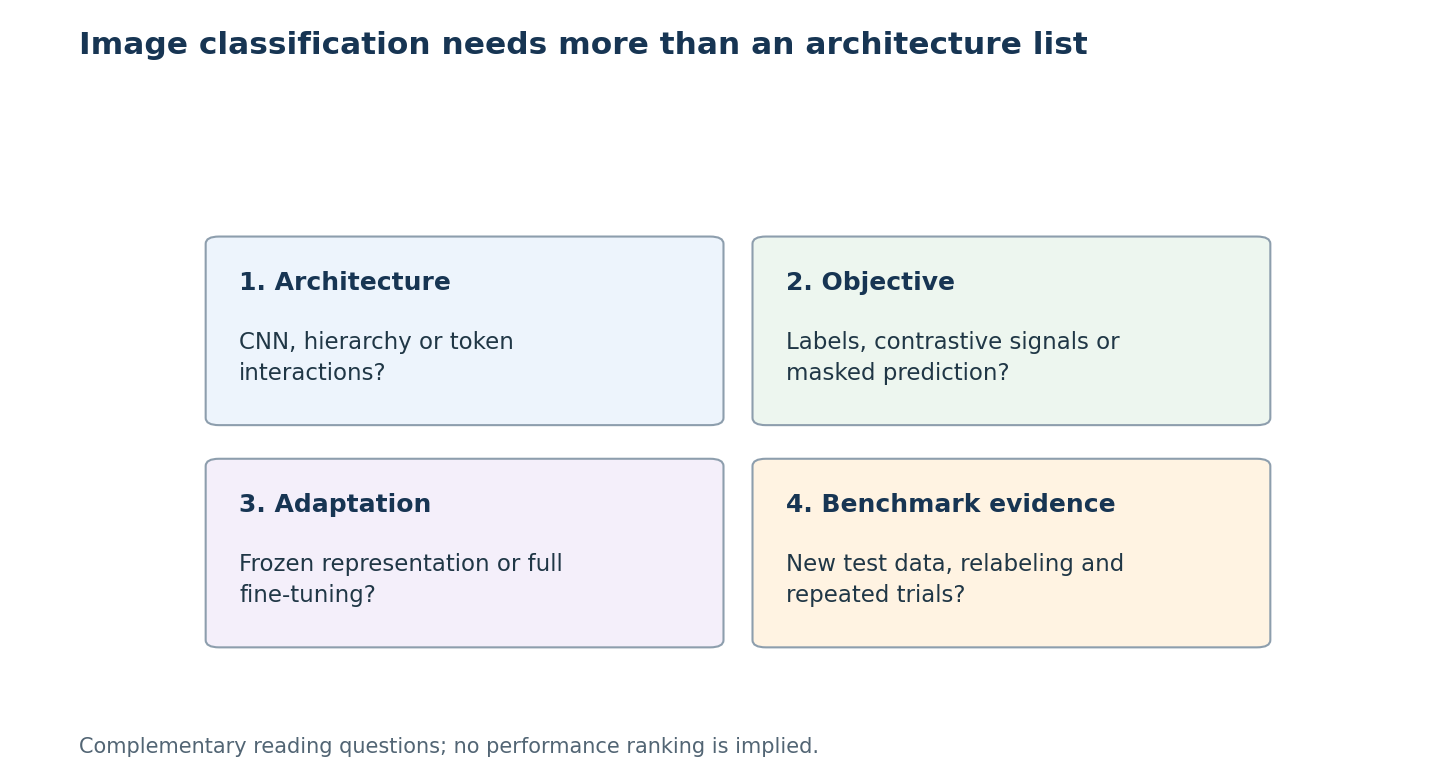
Read the architecture and self-supervision surveys on separate axes. Convolution, attention and hierarchy describe how features are computed; contrastive learning, self-distillation and masked prediction describe how they are trained. One architecture can support several objectives, and similar objectives can be implemented by different backbones. A taxonomy helps identify those combinations, but cannot by itself explain a score difference between systems with different data and training budgets.
The benchmark studies make the evidence conditional. A model selected on the original validation set may rank differently on newly collected images, and a single-label accuracy can penalize a valid alternative description of an ambiguous image. Relabeling is not the same intervention as gathering a new test set. Before citing a comparison, record pretraining overlap, label definitions, adaptation rules and run-to-run variation. For a beginner, the useful next step is one controlled question—such as frozen features versus fine-tuning—with a fixed dataset and evaluation rule, rather than choosing a model solely from a survey’s year-by-year list.
References
- Z. Li, F. Liu, W. Yang, S. Peng, and J. Zhou, “A Survey of Convolutional Neural Networks: Analysis, Applications, and Prospects,” IEEE Transactions on Neural Networks and Learning Systems, vol. 33, no. 12, pp. 6999–7019, 2022. doi:10.1109/TNNLS.2021.3084827
- O. Russakovsky, J. Deng, H. Su, J. Krause, S. Satheesh, S. Ma, et al., “ImageNet Large Scale Visual Recognition Challenge,” International Journal of Computer Vision, vol. 115, pp. 211–252, 2015. doi:10.1007/s11263-015-0816-y
- Y. LeCun, L. Bottou, Y. Bengio, and P. Haffner, “Gradient-Based Learning Applied to Document Recognition,” Proceedings of the IEEE, vol. 86, no. 11, pp. 2278–2324, 1998. doi:10.1109/5.726791
- A. Krizhevsky, “Learning Multiple Layers of Features from Tiny Images,” technical report, University of Toronto, 2009. dataset page
- T. Ridnik, E. Ben-Baruch, A. Noy, and L. Zelnik-Manor, “ImageNet-21K Pretraining for the Masses,” NeurIPS, 2021. arXiv
- G. Van Horn, O. Mac Aodha, Y. Song, Y. Cui, C. Sun, A. Shepard, et al., “The iNaturalist Species Classification and Detection Dataset,” CVPR, 2018. arXiv
- B. Recht, R. Roelofs, L. Schmidt, and V. Shankar, “Do ImageNet Classifiers Generalize to ImageNet?,” ICML, PMLR vol. 97, 2019. paper
- L. Beyer, O. J. Hénaff, A. Kolesnikov, X. Zhai, and A. van den Oord, “Are We Done with ImageNet?,” arXiv:2006.07159, 2020. arXiv
- C. G. Northcutt, A. Athalye, and J. Mueller, “Pervasive Label Errors in Test Sets Destabilize Machine Learning Benchmarks,” NeurIPS, 2021. arXiv
- A. Krizhevsky, I. Sutskever, and G. E. Hinton, “ImageNet Classification with Deep Convolutional Neural Networks,” Advances in Neural Information Processing Systems 25 (NIPS), 2012. paper
- K. Simonyan and A. Zisserman, “Very Deep Convolutional Networks for Large-Scale Image Recognition,” ICLR, 2015. arXiv
- C. Szegedy, W. Liu, Y. Jia, P. Sermanet, S. Reed, D. Anguelov, D. Erhan, V. Vanhoucke, and A. Rabinovich, “Going Deeper with Convolutions,” CVPR, 2015. doi:10.1109/CVPR.2015.7298594
- C. Szegedy, V. Vanhoucke, S. Ioffe, J. Shlens, and Z. Wojna, “Rethinking the Inception Architecture for Computer Vision,” CVPR, 2016. doi:10.1109/CVPR.2016.308
- K. He, X. Zhang, S. Ren, and J. Sun, “Deep Residual Learning for Image Recognition,” CVPR, 2016. doi:10.1109/CVPR.2016.90
- K. He, X. Zhang, S. Ren, and J. Sun, “Identity Mappings in Deep Residual Networks,” ECCV, 2016. arXiv
- G. Huang, Z. Liu, L. van der Maaten, and K. Q. Weinberger, “Densely Connected Convolutional Networks,” CVPR, 2017. arXiv
- A. G. Howard, M. Zhu, B. Chen, D. Kalenichenko, W. Wang, T. Weyand, M. Andreetto, and H. Adam, “MobileNets: Efficient Convolutional Neural Networks for Mobile Vision Applications,” arXiv:1704.04861, 2017. arXiv
- M. Tan and Q. V. Le, “EfficientNet: Rethinking Model Scaling for Convolutional Neural Networks,” ICML, 2019. arXiv
- I. Radosavovic, R. P. Kosaraju, R. Girshick, K. He, and P. Dollár, “Designing Network Design Spaces,” CVPR, 2020. arXiv
- Z. Liu, H. Mao, C.-Y. Wu, C. Feichtenhofer, T. Darrell, and S. Xie, “A ConvNet for the 2020s,” CVPR, 2022. arXiv
- J. Hu, L. Shen, S. Albanie, G. Sun, and E. Wu, “Squeeze-and-Excitation Networks,” arXiv:1709.01507, 2017 (journal version in IEEE TPAMI). arXiv
- A. Dosovitskiy, L. Beyer, A. Kolesnikov, D. Weissenborn, X. Zhai, T. Unterthiner, et al., “An Image is Worth 16x16 Words: Transformers for Image Recognition at Scale,” ICLR, 2021. arXiv
- H. Touvron, M. Cord, M. Douze, F. Massa, A. Sablayrolles, and H. Jégou, “Training Data-Efficient Image Transformers & Distillation through Attention,” ICML, PMLR vol. 139, 2021. paper
- Z. Liu, Y. Lin, Y. Cao, H. Hu, Y. Wei, Z. Zhang, S. Lin, and B. Guo, “Swin Transformer: Hierarchical Vision Transformer using Shifted Windows,” ICCV, 2021. doi:10.1109/ICCV48922.2021.00986
- S. Khan, M. Naseer, M. Hayat, S. W. Zamir, F. S. Khan, and M. Shah, “Transformers in Vision: A Survey,” ACM Computing Surveys, 2022. arXiv
- H. Zhang, M. Cisse, Y. N. Dauphin, and D. Lopez-Paz, “mixup: Beyond Empirical Risk Minimization,” ICLR, 2018. arXiv
- S. Yun, D. Han, S. J. Oh, S. Chun, J. Choe, and Y. Yoo, “CutMix: Regularization Strategy to Train Strong Classifiers with Localizable Features,” ICCV, 2019. arXiv
- E. D. Cubuk, B. Zoph, J. Shlens, and Q. V. Le, “RandAugment: Practical Automated Data Augmentation with a Reduced Search Space,” CVPR Workshops, 2020. doi:10.1109/CVPRW50498.2020.00359
- I. Loshchilov and F. Hutter, “Decoupled Weight Decay Regularization,” ICLR, 2019. arXiv
- I. Loshchilov and F. Hutter, “SGDR: Stochastic Gradient Descent with Warm Restarts,” ICLR, 2017. arXiv
- G. Huang, Y. Sun, Z. Liu, D. Sedra, and K. Q. Weinberger, “Deep Networks with Stochastic Depth,” ECCV, 2016. doi:10.1007/978-3-319-46493-0_39
- R. Wightman, H. Touvron, and H. Jégou, “ResNet Strikes Back: An Improved Training Procedure in timm,” arXiv:2110.00476, 2021. arXiv
- S. Kornblith, J. Shlens, and Q. V. Le, “Do Better ImageNet Models Transfer Better?,” CVPR, 2019. arXiv
- T. Chen, S. Kornblith, M. Norouzi, and G. Hinton, “A Simple Framework for Contrastive Learning of Visual Representations,” ICML, 2020. arXiv
- K. He, H. Fan, Y. Wu, S. Xie, and R. Girshick, “Momentum Contrast for Unsupervised Visual Representation Learning,” CVPR, 2020. arXiv
- M. Caron, H. Touvron, I. Misra, H. Jégou, J. Mairal, P. Bojanowski, and A. Joulin, “Emerging Properties in Self-Supervised Vision Transformers,” ICCV, 2021. doi:10.1109/ICCV48922.2021.00951
- K. He, X. Chen, S. Xie, Y. Li, P. Dollár, and R. Girshick, “Masked Autoencoders Are Scalable Vision Learners,” CVPR, 2022. doi:10.1109/CVPR52688.2022.01553
- M. Oquab, T. Darcet, T. Moutakanni, H. Vo, M. Szafraniec, V. Khalidov, et al., “DINOv2: Learning Robust Visual Features without Supervision,” Transactions on Machine Learning Research, 2024. arXiv
- O. Siméoni, H. V. Vo, M. Seitzer, F. Baldassarre, M. Oquab, C. Jose, et al., “DINOv3,” arXiv:2508.10104, 2025. arXiv
- A. Radford, J. W. Kim, C. Hallacy, A. Ramesh, G. Goh, S. Agarwal, et al., “Learning Transferable Visual Models From Natural Language Supervision,” ICML, PMLR vol. 139, 2021. paper
- J. Gui, T. Chen, J. Zhang, Q. Cao, Z. Sun, H. Luo, and D. Tao, “A Survey on Self-Supervised Learning: Algorithms, Applications, and Future Trends,” IEEE Transactions on Pattern Analysis and Machine Intelligence (arXiv:2301.05712, 2023). arXiv
- D. Hendrycks and T. Dietterich, “Benchmarking Neural Network Robustness to Common Corruptions and Perturbations,” ICLR, 2019. arXiv
- D. Hendrycks, S. Basart, N. Mu, S. Kadavath, F. Wang, E. Dorundo, et al., “The Many Faces of Robustness: A Critical Analysis of Out-of-Distribution Generalization,” ICCV, 2021. arXiv
- D. Hendrycks, K. Zhao, S. Basart, J. Steinhardt, and D. Song, “Natural Adversarial Examples,” CVPR, 2021. arXiv
- I. J. Goodfellow, J. Shlens, and C. Szegedy, “Explaining and Harnessing Adversarial Examples,” in Proc. International Conference on Learning Representations (ICLR), 2015. arXiv
- R. Geirhos, J.-H. Jacobsen, C. Michaelis, R. Zemel, W. Brendel, M. Bethge, and F. A. Wichmann, “Shortcut Learning in Deep Neural Networks,” Nature Machine Intelligence, 2020. arXiv
- C. Guo, G. Pleiss, Y. Sun, and K. Q. Weinberger, “On Calibration of Modern Neural Networks,” ICML, 2017. arXiv
- B. Zhou, A. Khosla, A. Lapedriza, A. Oliva, and A. Torralba, “Learning Deep Features for Discriminative Localization,” CVPR, 2016. doi:10.1109/CVPR.2016.319
- R. R. Selvaraju, M. Cogswell, A. Das, R. Vedantam, D. Parikh, and D. Batra, “Grad-CAM: Visual Explanations from Deep Networks via Gradient-Based Localization,” ICCV, 2017. doi:10.1109/ICCV.2017.74
- B. Jacob, S. Kligys, B. Chen, M. Zhu, M. Tang, A. Howard, et al., “Quantization and Training of Neural Networks for Efficient Integer-Arithmetic-Only Inference,” CVPR, 2018. doi:10.1109/CVPR.2018.00286
- G. Hinton, O. Vinyals, and J. Dean, “Distilling the Knowledge in a Neural Network,” arXiv:1503.02531, 2015. arXiv
- X. Zhai, A. Kolesnikov, N. Houlsby, and L. Beyer, “Scaling Vision Transformers,” CVPR, 2022. arXiv
- M. Cherti, R. Beaumont, R. Wightman, M. Wortsman, G. Ilharco, C. Gordon, et al., “Reproducible Scaling Laws for Contrastive Language-Image Learning,” CVPR, 2023. arXiv
- T. Fawcett, “An Introduction to ROC Analysis,” Pattern Recognition Letters, vol. 27, no. 8, pp. 861–874, 2006. doi:10.1016/j.patrec.2005.10.010
- J. Davis and M. Goadrich, “The Relationship Between Precision-Recall and ROC Curves,” Proc. 23rd International Conference on Machine Learning (ICML), pp. 233–240, 2006. doi:10.1145/1143844.1143874
- T. Saito and M. Rehmsmeier, “The Precision-Recall Plot Is More Informative than the ROC Plot When Evaluating Binary Classifiers on Imbalanced Datasets,” PLOS ONE, vol. 10, no. 3, e0118432, 2015. doi:10.1371/journal.pone.0118432
- D. Chicco and G. Jurman, “The Advantages of the Matthews Correlation Coefficient (MCC) over F1 Score and Accuracy in Binary Classification Evaluation,” BMC Genomics, vol. 21, article 6, 2020. doi:10.1186/s12864-019-6413-7
- M. Sokolova and G. Lapalme, “A Systematic Analysis of Performance Measures for Classification Tasks,” Information Processing & Management, vol. 45, no. 4, pp. 427–437, 2009. doi:10.1016/j.ipm.2009.03.002
- J. Cohen, “A Coefficient of Agreement for Nominal Scales,” Educational and Psychological Measurement, vol. 20, no. 1, pp. 37–46, 1960. doi:10.1177/001316446002000104
- M.-L. Zhang and Z.-H. Zhou, “A Review on Multi-Label Learning Algorithms,” IEEE Transactions on Knowledge and Data Engineering, vol. 26, no. 8, pp. 1819–1837, 2014. doi:10.1109/TKDE.2013.39
- M. Everingham, L. Van Gool, C. K. I. Williams, J. Winn, and A. Zisserman, “The Pascal Visual Object Classes (VOC) Challenge,” International Journal of Computer Vision, vol. 88, no. 2, pp. 303–338, 2010. doi:10.1007/s11263-009-0275-4
- F. Pedregosa, G. Varoquaux, A. Gramfort, V. Michel, B. Thirion, O. Grisel, et al., “Scikit-learn: Machine Learning in Python,” Journal of Machine Learning Research, vol. 12, pp. 2825–2830, 2011. paper
- H. Wang, S. Ge, E. P. Xing, and Z. C. Lipton, “Learning Robust Global Representations by Penalizing Local Predictive Power,” NeurIPS, 2019 (introduces ImageNet-Sketch). arXiv
- A. Barbu, D. Mayo, J. Alverio, W. Luo, C. Wang, D. Gutfreund, J. Tenenbaum, and B. Katz, “ObjectNet: A Large-Scale Bias-Controlled Dataset for Pushing the Limits of Object Recognition Models,” NeurIPS, 2019. dataset page
- C. Wah, S. Branson, P. Welinder, P. Perona, and S. Belongie, “The Caltech-UCSD Birds-200-2011 Dataset,” Technical Report CNS-TR-2011-001, California Institute of Technology, 2011. dataset page
- J. Krause, M. Stark, J. Deng, and L. Fei-Fei, “3D Object Representations for Fine-Grained Categorization,” IEEE International Conference on Computer Vision Workshops (ICCVW), pp. 554–561, 2013 (introduces Stanford Cars). doi:10.1109/ICCVW.2013.77
- S. Maji, E. Rahtu, J. Kannala, M. Blaschko, and A. Vedaldi, “Fine-Grained Visual Classification of Aircraft,” arXiv:1306.5151, 2013. arXiv
- O. M. Parkhi, A. Vedaldi, A. Zisserman, and C. V. Jawahar, “Cats and Dogs,” CVPR, 2012 (introduces Oxford-IIIT Pets). dataset page
- M.-E. Nilsback and A. Zisserman, “Automated Flower Classification over a Large Number of Classes,” Indian Conference on Computer Vision, Graphics and Image Processing (ICVGIP), 2008 (introduces Oxford Flowers-102). dataset page
- L. Bossard, M. Guillaumin, and L. Van Gool, “Food-101 – Mining Discriminative Components with Random Forests,” ECCV, 2014. dataset page
- L. Fei-Fei, R. Fergus, and P. Perona, “One-Shot Learning of Object Categories,” IEEE Transactions on Pattern Analysis and Machine Intelligence, 2006 (the reference given for Caltech-101). dataset page
- X. Zhai, J. Puigcerver, A. Kolesnikov, et al., “A Large-scale Study of Representation Learning with the Visual Task Adaptation Benchmark,” arXiv:1910.04867, 2019. arXiv
- Z. Liu, Z. Miao, X. Zhan, J. Wang, B. Gong, and S. X. Yu, “Large-Scale Long-Tailed Recognition in an Open World,” CVPR, 2019 (introduces ImageNet-LT). arXiv