現代觀點綜述導讀
選讀・DLCV 02・深度影像分類 的論文導讀(第 1/1 篇)。引用編號對應本頁底部的參考文獻。
導覽:本頁與本系列: 導覽:本頁與本系列
先選要比較的是架構、監督目標、凍結或微調,還是測試資料可靠度,再查對應文獻。
本篇導讀是「現代觀點」中綜述摘要的完整版:每篇綜述涵蓋什麼,以及如何分類這個領域。
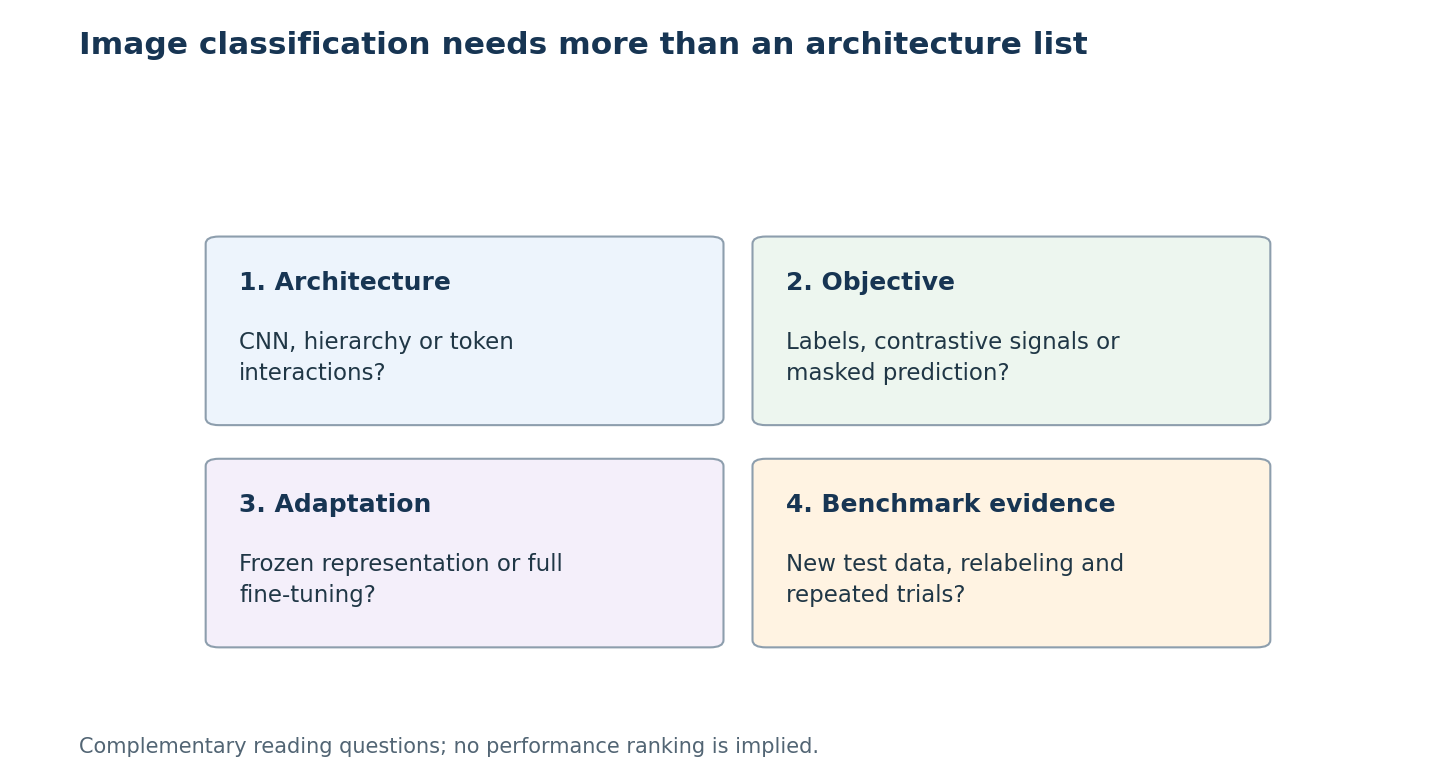
值得一讀的綜述
Li 等人 [1] 從 CNN 的歷史與基本構成元件談起,介紹經典與進階模型並點出各自的關鍵想法,再以實驗比較激活函數、損失函數與最佳化器,整理出選擇時的經驗法則;最後討論一維、二維與多維卷積的應用,以及一系列開放問題。Khan 等人 [25] 綜述各種任務上的視覺 Transformer。在分類方面,他們把模型分成:單一尺度模型(ViT、DeiT)、多尺度階層模型(如 Swin)、結合卷積的混合模型,以及自監督 Transformer(如 DINO),並強調它們對大規模預訓練的依賴,以及平方複雜度注意力的成本。Gui 等人 [41] 綜述自監督學習,把它分成:以脈絡為基礎的方法(旋轉預測、拼圖等前置任務)、對比式方法(使用負樣本對、像 DINO 的自我蒸餾,或特徵去相關)、生成式方法(像 MAE 的遮罩影像建模),以及結合對比與生成目標的混合方法,並討論與半監督、多模態學習的結合。在基準可靠性方面,ImageNetV2 研究 [7]、Beyer 等人的重新標註研究 [8] 與 Northcutt 等人的標籤錯誤分析 [9] 共同主張:使用多個測試集、多標籤評估,並回報變異。
如何判讀這些論文的證據
架構與自我監督應沿不同軸閱讀:卷積、注意力、階層描述特徵如何計算;對比、自蒸餾、遮罩預測描述如何訓練。一個架構可搭配不同目標,同一目標也可用不同骨幹。分類可協助找組合,卻不能單獨解釋不同資料、預算下的分數差異。
原驗證集選出的模型,可能在新收集影像改變排名;單標籤也可能懲罰模糊影像的合理替代答案。重標註與新測試集不是同一介入。引用前記錄預訓練重疊、標籤、調適規則與重複變異;新手可先固定資料、指標,檢查凍結特徵與微調,而非只照架構年表選模型。
參考文獻
- Z. Li, F. Liu, W. Yang, S. Peng, and J. Zhou, “A Survey of Convolutional Neural Networks: Analysis, Applications, and Prospects,” IEEE Transactions on Neural Networks and Learning Systems, vol. 33, no. 12, pp. 6999–7019, 2022. doi:10.1109/TNNLS.2021.3084827
- O. Russakovsky, J. Deng, H. Su, J. Krause, S. Satheesh, S. Ma, et al., “ImageNet Large Scale Visual Recognition Challenge,” International Journal of Computer Vision, vol. 115, pp. 211–252, 2015. doi:10.1007/s11263-015-0816-y
- Y. LeCun, L. Bottou, Y. Bengio, and P. Haffner, “Gradient-Based Learning Applied to Document Recognition,” Proceedings of the IEEE, vol. 86, no. 11, pp. 2278–2324, 1998. doi:10.1109/5.726791
- A. Krizhevsky, “Learning Multiple Layers of Features from Tiny Images,” technical report, University of Toronto, 2009. dataset page
- T. Ridnik, E. Ben-Baruch, A. Noy, and L. Zelnik-Manor, “ImageNet-21K Pretraining for the Masses,” NeurIPS, 2021. arXiv
- G. Van Horn, O. Mac Aodha, Y. Song, Y. Cui, C. Sun, A. Shepard, et al., “The iNaturalist Species Classification and Detection Dataset,” CVPR, 2018. arXiv
- B. Recht, R. Roelofs, L. Schmidt, and V. Shankar, “Do ImageNet Classifiers Generalize to ImageNet?,” ICML, PMLR vol. 97, 2019. paper
- L. Beyer, O. J. Hénaff, A. Kolesnikov, X. Zhai, and A. van den Oord, “Are We Done with ImageNet?,” arXiv:2006.07159, 2020. arXiv
- C. G. Northcutt, A. Athalye, and J. Mueller, “Pervasive Label Errors in Test Sets Destabilize Machine Learning Benchmarks,” NeurIPS, 2021. arXiv
- A. Krizhevsky, I. Sutskever, and G. E. Hinton, “ImageNet Classification with Deep Convolutional Neural Networks,” Advances in Neural Information Processing Systems 25 (NIPS), 2012. paper
- K. Simonyan and A. Zisserman, “Very Deep Convolutional Networks for Large-Scale Image Recognition,” ICLR, 2015. arXiv
- C. Szegedy, W. Liu, Y. Jia, P. Sermanet, S. Reed, D. Anguelov, D. Erhan, V. Vanhoucke, and A. Rabinovich, “Going Deeper with Convolutions,” CVPR, 2015. doi:10.1109/CVPR.2015.7298594
- C. Szegedy, V. Vanhoucke, S. Ioffe, J. Shlens, and Z. Wojna, “Rethinking the Inception Architecture for Computer Vision,” CVPR, 2016. doi:10.1109/CVPR.2016.308
- K. He, X. Zhang, S. Ren, and J. Sun, “Deep Residual Learning for Image Recognition,” CVPR, 2016. doi:10.1109/CVPR.2016.90
- K. He, X. Zhang, S. Ren, and J. Sun, “Identity Mappings in Deep Residual Networks,” ECCV, 2016. arXiv
- G. Huang, Z. Liu, L. van der Maaten, and K. Q. Weinberger, “Densely Connected Convolutional Networks,” CVPR, 2017. arXiv
- A. G. Howard, M. Zhu, B. Chen, D. Kalenichenko, W. Wang, T. Weyand, M. Andreetto, and H. Adam, “MobileNets: Efficient Convolutional Neural Networks for Mobile Vision Applications,” arXiv:1704.04861, 2017. arXiv
- M. Tan and Q. V. Le, “EfficientNet: Rethinking Model Scaling for Convolutional Neural Networks,” ICML, 2019. arXiv
- I. Radosavovic, R. P. Kosaraju, R. Girshick, K. He, and P. Dollár, “Designing Network Design Spaces,” CVPR, 2020. arXiv
- Z. Liu, H. Mao, C.-Y. Wu, C. Feichtenhofer, T. Darrell, and S. Xie, “A ConvNet for the 2020s,” CVPR, 2022. arXiv
- J. Hu, L. Shen, S. Albanie, G. Sun, and E. Wu, “Squeeze-and-Excitation Networks,” arXiv:1709.01507, 2017 (journal version in IEEE TPAMI). arXiv
- A. Dosovitskiy, L. Beyer, A. Kolesnikov, D. Weissenborn, X. Zhai, T. Unterthiner, et al., “An Image is Worth 16x16 Words: Transformers for Image Recognition at Scale,” ICLR, 2021. arXiv
- H. Touvron, M. Cord, M. Douze, F. Massa, A. Sablayrolles, and H. Jégou, “Training Data-Efficient Image Transformers & Distillation through Attention,” ICML, PMLR vol. 139, 2021. paper
- Z. Liu, Y. Lin, Y. Cao, H. Hu, Y. Wei, Z. Zhang, S. Lin, and B. Guo, “Swin Transformer: Hierarchical Vision Transformer using Shifted Windows,” ICCV, 2021. doi:10.1109/ICCV48922.2021.00986
- S. Khan, M. Naseer, M. Hayat, S. W. Zamir, F. S. Khan, and M. Shah, “Transformers in Vision: A Survey,” ACM Computing Surveys, 2022. arXiv
- H. Zhang, M. Cisse, Y. N. Dauphin, and D. Lopez-Paz, “mixup: Beyond Empirical Risk Minimization,” ICLR, 2018. arXiv
- S. Yun, D. Han, S. J. Oh, S. Chun, J. Choe, and Y. Yoo, “CutMix: Regularization Strategy to Train Strong Classifiers with Localizable Features,” ICCV, 2019. arXiv
- E. D. Cubuk, B. Zoph, J. Shlens, and Q. V. Le, “RandAugment: Practical Automated Data Augmentation with a Reduced Search Space,” CVPR Workshops, 2020. doi:10.1109/CVPRW50498.2020.00359
- I. Loshchilov and F. Hutter, “Decoupled Weight Decay Regularization,” ICLR, 2019. arXiv
- I. Loshchilov and F. Hutter, “SGDR: Stochastic Gradient Descent with Warm Restarts,” ICLR, 2017. arXiv
- G. Huang, Y. Sun, Z. Liu, D. Sedra, and K. Q. Weinberger, “Deep Networks with Stochastic Depth,” ECCV, 2016. doi:10.1007/978-3-319-46493-0_39
- R. Wightman, H. Touvron, and H. Jégou, “ResNet Strikes Back: An Improved Training Procedure in timm,” arXiv:2110.00476, 2021. arXiv
- S. Kornblith, J. Shlens, and Q. V. Le, “Do Better ImageNet Models Transfer Better?,” CVPR, 2019. arXiv
- T. Chen, S. Kornblith, M. Norouzi, and G. Hinton, “A Simple Framework for Contrastive Learning of Visual Representations,” ICML, 2020. arXiv
- K. He, H. Fan, Y. Wu, S. Xie, and R. Girshick, “Momentum Contrast for Unsupervised Visual Representation Learning,” CVPR, 2020. arXiv
- M. Caron, H. Touvron, I. Misra, H. Jégou, J. Mairal, P. Bojanowski, and A. Joulin, “Emerging Properties in Self-Supervised Vision Transformers,” ICCV, 2021. doi:10.1109/ICCV48922.2021.00951
- K. He, X. Chen, S. Xie, Y. Li, P. Dollár, and R. Girshick, “Masked Autoencoders Are Scalable Vision Learners,” CVPR, 2022. doi:10.1109/CVPR52688.2022.01553
- M. Oquab, T. Darcet, T. Moutakanni, H. Vo, M. Szafraniec, V. Khalidov, et al., “DINOv2: Learning Robust Visual Features without Supervision,” Transactions on Machine Learning Research, 2024. arXiv
- O. Siméoni, H. V. Vo, M. Seitzer, F. Baldassarre, M. Oquab, C. Jose, et al., “DINOv3,” arXiv:2508.10104, 2025. arXiv
- A. Radford, J. W. Kim, C. Hallacy, A. Ramesh, G. Goh, S. Agarwal, et al., “Learning Transferable Visual Models From Natural Language Supervision,” ICML, PMLR vol. 139, 2021. paper
- J. Gui, T. Chen, J. Zhang, Q. Cao, Z. Sun, H. Luo, and D. Tao, “A Survey on Self-Supervised Learning: Algorithms, Applications, and Future Trends,” IEEE Transactions on Pattern Analysis and Machine Intelligence (arXiv:2301.05712, 2023). arXiv
- D. Hendrycks and T. Dietterich, “Benchmarking Neural Network Robustness to Common Corruptions and Perturbations,” ICLR, 2019. arXiv
- D. Hendrycks, S. Basart, N. Mu, S. Kadavath, F. Wang, E. Dorundo, et al., “The Many Faces of Robustness: A Critical Analysis of Out-of-Distribution Generalization,” ICCV, 2021. arXiv
- D. Hendrycks, K. Zhao, S. Basart, J. Steinhardt, and D. Song, “Natural Adversarial Examples,” CVPR, 2021. arXiv
- I. J. Goodfellow, J. Shlens, and C. Szegedy, “Explaining and Harnessing Adversarial Examples,” in Proc. International Conference on Learning Representations (ICLR), 2015. arXiv
- R. Geirhos, J.-H. Jacobsen, C. Michaelis, R. Zemel, W. Brendel, M. Bethge, and F. A. Wichmann, “Shortcut Learning in Deep Neural Networks,” Nature Machine Intelligence, 2020. arXiv
- C. Guo, G. Pleiss, Y. Sun, and K. Q. Weinberger, “On Calibration of Modern Neural Networks,” ICML, 2017. arXiv
- B. Zhou, A. Khosla, A. Lapedriza, A. Oliva, and A. Torralba, “Learning Deep Features for Discriminative Localization,” CVPR, 2016. doi:10.1109/CVPR.2016.319
- R. R. Selvaraju, M. Cogswell, A. Das, R. Vedantam, D. Parikh, and D. Batra, “Grad-CAM: Visual Explanations from Deep Networks via Gradient-Based Localization,” ICCV, 2017. doi:10.1109/ICCV.2017.74
- B. Jacob, S. Kligys, B. Chen, M. Zhu, M. Tang, A. Howard, et al., “Quantization and Training of Neural Networks for Efficient Integer-Arithmetic-Only Inference,” CVPR, 2018. doi:10.1109/CVPR.2018.00286
- G. Hinton, O. Vinyals, and J. Dean, “Distilling the Knowledge in a Neural Network,” arXiv:1503.02531, 2015. arXiv
- X. Zhai, A. Kolesnikov, N. Houlsby, and L. Beyer, “Scaling Vision Transformers,” CVPR, 2022. arXiv
- M. Cherti, R. Beaumont, R. Wightman, M. Wortsman, G. Ilharco, C. Gordon, et al., “Reproducible Scaling Laws for Contrastive Language-Image Learning,” CVPR, 2023. arXiv
- T. Fawcett, “An Introduction to ROC Analysis,” Pattern Recognition Letters, vol. 27, no. 8, pp. 861–874, 2006. doi:10.1016/j.patrec.2005.10.010
- J. Davis and M. Goadrich, “The Relationship Between Precision-Recall and ROC Curves,” Proc. 23rd International Conference on Machine Learning (ICML), pp. 233–240, 2006. doi:10.1145/1143844.1143874
- T. Saito and M. Rehmsmeier, “The Precision-Recall Plot Is More Informative than the ROC Plot When Evaluating Binary Classifiers on Imbalanced Datasets,” PLOS ONE, vol. 10, no. 3, e0118432, 2015. doi:10.1371/journal.pone.0118432
- D. Chicco and G. Jurman, “The Advantages of the Matthews Correlation Coefficient (MCC) over F1 Score and Accuracy in Binary Classification Evaluation,” BMC Genomics, vol. 21, article 6, 2020. doi:10.1186/s12864-019-6413-7
- M. Sokolova and G. Lapalme, “A Systematic Analysis of Performance Measures for Classification Tasks,” Information Processing & Management, vol. 45, no. 4, pp. 427–437, 2009. doi:10.1016/j.ipm.2009.03.002
- J. Cohen, “A Coefficient of Agreement for Nominal Scales,” Educational and Psychological Measurement, vol. 20, no. 1, pp. 37–46, 1960. doi:10.1177/001316446002000104
- M.-L. Zhang and Z.-H. Zhou, “A Review on Multi-Label Learning Algorithms,” IEEE Transactions on Knowledge and Data Engineering, vol. 26, no. 8, pp. 1819–1837, 2014. doi:10.1109/TKDE.2013.39
- M. Everingham, L. Van Gool, C. K. I. Williams, J. Winn, and A. Zisserman, “The Pascal Visual Object Classes (VOC) Challenge,” International Journal of Computer Vision, vol. 88, no. 2, pp. 303–338, 2010. doi:10.1007/s11263-009-0275-4
- F. Pedregosa, G. Varoquaux, A. Gramfort, V. Michel, B. Thirion, O. Grisel, et al., “Scikit-learn: Machine Learning in Python,” Journal of Machine Learning Research, vol. 12, pp. 2825–2830, 2011. paper
- H. Wang, S. Ge, E. P. Xing, and Z. C. Lipton, “Learning Robust Global Representations by Penalizing Local Predictive Power,” NeurIPS, 2019 (introduces ImageNet-Sketch). arXiv
- A. Barbu, D. Mayo, J. Alverio, W. Luo, C. Wang, D. Gutfreund, J. Tenenbaum, and B. Katz, “ObjectNet: A Large-Scale Bias-Controlled Dataset for Pushing the Limits of Object Recognition Models,” NeurIPS, 2019. dataset page
- C. Wah, S. Branson, P. Welinder, P. Perona, and S. Belongie, “The Caltech-UCSD Birds-200-2011 Dataset,” Technical Report CNS-TR-2011-001, California Institute of Technology, 2011. dataset page
- J. Krause, M. Stark, J. Deng, and L. Fei-Fei, “3D Object Representations for Fine-Grained Categorization,” IEEE International Conference on Computer Vision Workshops (ICCVW), pp. 554–561, 2013 (introduces Stanford Cars). doi:10.1109/ICCVW.2013.77
- S. Maji, E. Rahtu, J. Kannala, M. Blaschko, and A. Vedaldi, “Fine-Grained Visual Classification of Aircraft,” arXiv:1306.5151, 2013. arXiv
- O. M. Parkhi, A. Vedaldi, A. Zisserman, and C. V. Jawahar, “Cats and Dogs,” CVPR, 2012 (introduces Oxford-IIIT Pets). dataset page
- M.-E. Nilsback and A. Zisserman, “Automated Flower Classification over a Large Number of Classes,” Indian Conference on Computer Vision, Graphics and Image Processing (ICVGIP), 2008 (introduces Oxford Flowers-102). dataset page
- L. Bossard, M. Guillaumin, and L. Van Gool, “Food-101 – Mining Discriminative Components with Random Forests,” ECCV, 2014. dataset page
- L. Fei-Fei, R. Fergus, and P. Perona, “One-Shot Learning of Object Categories,” IEEE Transactions on Pattern Analysis and Machine Intelligence, 2006 (the reference given for Caltech-101). dataset page
- X. Zhai, J. Puigcerver, A. Kolesnikov, et al., “A Large-scale Study of Representation Learning with the Visual Task Adaptation Benchmark,” arXiv:1910.04867, 2019. arXiv
- Z. Liu, Z. Miao, X. Zhan, J. Wang, B. Gong, and S. X. Yu, “Large-Scale Long-Tailed Recognition in an Open World,” CVPR, 2019 (introduces ImageNet-LT). arXiv