RAFT (Teed and Deng, 2020)
Optional · paper guide 1 of 3 for DLCV 11A · Depth Estimation and Optical Flow. Citation numbers refer to the reference list at the bottom of this page.
Navigate: this page and this track: Navigate: this page and this track
Challenge
In 2020, learned optical flow used coarse-to-fine pyramids (PWC-Net) or stacks of networks (FlowNet 2.0). Coarse-to-fine schemes can miss small, fast objects that disappear at low resolution, and stacked networks are large and limited to a fixed number of refinement stages [41].
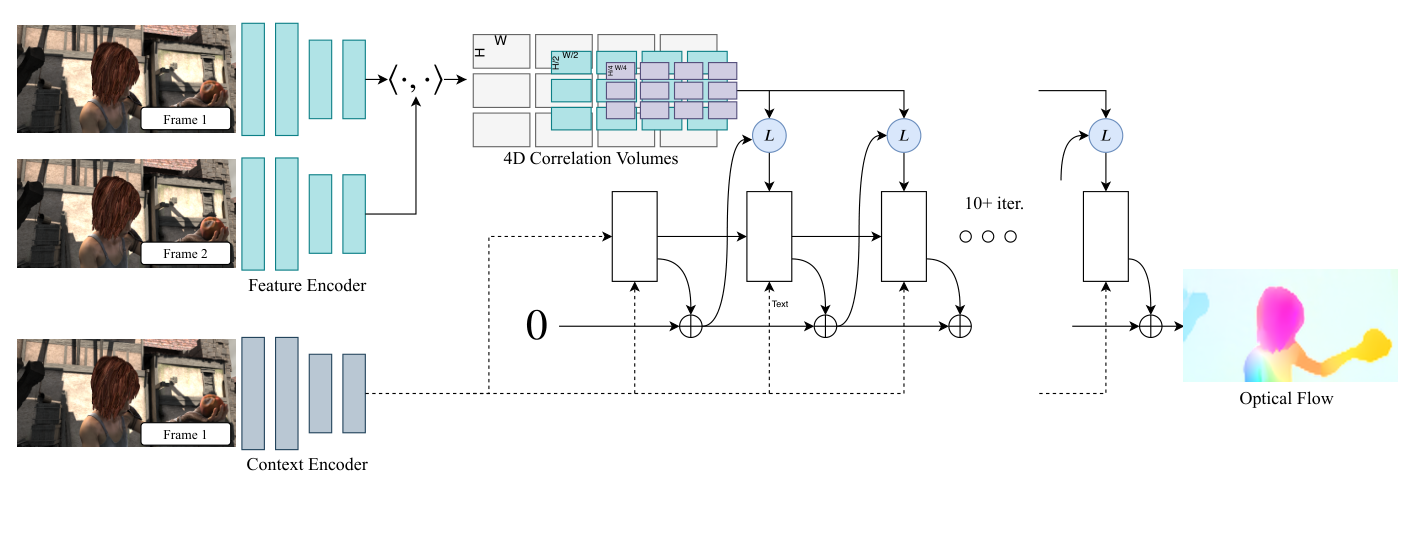
Figure source: [41], arXiv:2003.12039v3, PDF page 2. Original PDF.
Method
Compute visual similarity once, for all pairs of pixels, and then refine a single flow field with one small, shared recurrent update operator that looks up the similarity volume around its current estimate. The paper’s sections follow the three parts: feature extraction, the 4D correlation pyramid with its lookup operator, and the ConvGRU update with convex upsampling, followed by the sequence loss [41].
Results
RAFT reported state-of-the-art accuracy on Sintel and KITTI at the time, strong cross-dataset generalization when trained only on synthetic data, and efficiency in inference time, training and parameter count [41]. Its iteration study shows that results improve quickly in the first few updates and continue to improve with more, without diverging even after 200 updates [41].
Reading the evidence
Separate the rows by training data: “C+T” (Flying Chairs then FlyingThings3D) measures generalization to Sintel and KITTI training sets, while the fine-tuned rows measure benchmark test accuracy. Sintel has two columns, clean and final; the final pass, with motion blur and atmospheric effects, is the harder one. KITTI is reported as EPE and Fl-all. The ablation table varies one design choice at a time (update operator, weight tying, context, feature scale, lookup radius, correlation pooling, correlation range, features for refinement, upsampling); read it to see which pieces matter most for each dataset.
Problems
The all-pairs volume has memory quadratic in the number of pixels at 1/8 resolution; the paper describes an equivalent on-demand computation that trades memory for time [41]. Like all supervised flow models, RAFT relies on synthetic pre-training and target-domain fine-tuning for its best numbers.
Conclusion
RAFT’s recipe became the template for RAFT-Stereo, RAFT-3D and most current flow and stereo networks.
References
- R. Hartley and A. Zisserman, Multiple View Geometry in Computer Vision, 2nd ed., Cambridge University Press, 2004. doi
- D. Scharstein and R. Szeliski, “A taxonomy and evaluation of dense two-frame stereo correspondence algorithms,” International Journal of Computer Vision, vol. 47, no. 1–3, pp. 7–42, 2002. doi
- D. Scharstein, R. Szeliski and H. Hirschmüller, “Middlebury Stereo Evaluation — Version 3,” official benchmark page (bad 2.0 metric, non-occluded and all masks). link · stereo home page
- R. Zabih and J. Woodfill, “Non-parametric local transforms for computing visual correspondence,” in Computer Vision — ECCV ‘94 (Lecture Notes in Computer Science), pp. 151–158, Springer, 1994. doi
- H. Hirschmüller, “Stereo processing by semiglobal matching and mutual information,” IEEE Transactions on Pattern Analysis and Machine Intelligence, vol. 30, no. 2, pp. 328–341, 2008. doi
- J. Žbontar and Y. LeCun, “Stereo matching by training a convolutional neural network to compare image patches,” Journal of Machine Learning Research, vol. 17, no. 65, pp. 1–32, 2016. JMLR · arXiv
- OpenCV contributors, “cv::StereoSGBM class documentation,” OpenCV source,
modules/calib3d/include/opencv2/calib3d.hpp(4.x branch). source - H. Laga, L. V. Jospin, F. Boussaid and M. Bennamoun, “A survey on deep learning techniques for stereo-based depth estimation,” IEEE Transactions on Pattern Analysis and Machine Intelligence, vol. 44, no. 4, pp. 1738–1764, 2022. doi · arXiv
- F. Tosi, L. Bartolomei and M. Poggi, “A survey on deep stereo matching in the twenties,” International Journal of Computer Vision, vol. 133, no. 7, pp. 4245–4276, 2025. doi · arXiv
- N. Mayer, E. Ilg, P. Häusser, P. Fischer, D. Cremers, A. Dosovitskiy and T. Brox, “A large dataset to train convolutional networks for disparity, optical flow, and scene flow estimation,” in Proc. IEEE CVPR, pp. 4040–4048, 2016. CVF · doi
- A. Kendall, H. Martirosyan, S. Dasgupta, P. Henry, R. Kennedy, A. Bachrach and A. Bry, “End-to-end learning of geometry and context for deep stereo regression,” in Proc. IEEE ICCV, 2017. CVF
- J.-R. Chang and Y.-S. Chen, “Pyramid stereo matching network,” in Proc. IEEE/CVF CVPR, 2018. CVF
- L. Lipson, Z. Teed and J. Deng, “RAFT-Stereo: Multilevel recurrent field transforms for stereo matching,” in Proc. International Conference on 3D Vision (3DV), pp. 218–227, 2021. doi · arXiv
- G. Xu, X. Wang, X. Ding and X. Yang, “Iterative geometry encoding volume for stereo matching,” in Proc. IEEE/CVF CVPR, 2023. CVF
- M. Poggi, F. Tosi, K. Batsos, P. Mordohai and S. Mattoccia, “On the synergies between machine learning and binocular stereo for depth estimation from images: A survey,” IEEE Transactions on Pattern Analysis and Machine Intelligence, 2021. doi · arXiv
- B. Wen, M. Trepte, J. Aribido, J. Kautz, O. Gallo and S. Birchfield, “FoundationStereo: Zero-shot stereo matching,” in Proc. IEEE/CVF CVPR, 2025. CVF · arXiv
- D. Eigen, C. Puhrsch and R. Fergus, “Depth map prediction from a single image using a multi-scale deep network,” in Proc. NeurIPS, 2014. proceedings · arXiv
- R. Ranftl, K. Lasinger, D. Hafner, K. Schindler and V. Koltun, “Towards robust monocular depth estimation: Mixing datasets for zero-shot cross-dataset transfer,” IEEE Transactions on Pattern Analysis and Machine Intelligence, vol. 44, no. 3, pp. 1623–1637, 2022. doi · arXiv
- L. Yang, B. Kang, Z. Huang, X. Xu, J. Feng and H. Zhao, “Depth Anything: Unleashing the power of large-scale unlabeled data,” in Proc. IEEE/CVF CVPR, 2024. CVF · arXiv
- R. Ranftl, A. Bochkovskiy and V. Koltun, “Vision transformers for dense prediction,” in Proc. IEEE/CVF ICCV, 2021. CVF
- L. Yang, B. Kang, Z. Huang, Z. Zhao, X. Xu, J. Feng and H. Zhao, “Depth Anything V2,” in Proc. NeurIPS, 2024. proceedings · arXiv
- B. Ke, A. Obukhov, S. Huang, N. Metzger, R. C. Daudt and K. Schindler, “Repurposing diffusion-based image generators for monocular depth estimation,” in Proc. IEEE/CVF CVPR, 2024. CVF · arXiv
- S. F. Bhat, R. Birkl, D. Wofk, P. Wonka and M. Müller, “ZoeDepth: Zero-shot transfer by combining relative and metric depth,” arXiv:2302.12288, 2023. arXiv
- W. Yin, C. Zhang, H. Chen, Z. Cai, G. Yu, K. Wang, X. Chen and C. Shen, “Metric3D: Towards zero-shot metric 3D prediction from a single image,” in Proc. IEEE/CVF ICCV, 2023. CVF · arXiv
- M. Hu, W. Yin, C. Zhang, Z. Cai, X. Long, K. Wang, H. Chen, G. Yu, C. Shen and S. Shen, “Metric3D v2: A versatile monocular geometric foundation model for zero-shot metric depth and surface normal estimation,” IEEE Transactions on Pattern Analysis and Machine Intelligence, vol. 46, no. 12, pp. 10579–10596, 2024. doi · arXiv
- L. Piccinelli, Y.-H. Yang, C. Sakaridis, M. Segu, S. Li, L. Van Gool and F. Yu, “UniDepth: Universal monocular metric depth estimation,” in Proc. IEEE/CVF CVPR, 2024. CVF · arXiv
- A. Bochkovskii, A. Delaunoy, H. Germain, M. Santos, Y. Zhou, S. R. Richter and V. Koltun, “Depth Pro: Sharp monocular metric depth in less than a second,” in Proc. ICLR, 2025. OpenReview · arXiv
- R. Garg, V. Kumar B.G., G. Carneiro and I. Reid, “Unsupervised CNN for single view depth estimation: Geometry to the rescue,” in Proc. ECCV (Lecture Notes in Computer Science), pp. 740–756, 2016. doi · arXiv
- C. Godard, O. Mac Aodha and G. J. Brostow, “Unsupervised monocular depth estimation with left-right consistency,” in Proc. IEEE CVPR, 2017. CVF
- T. Zhou, M. Brown, N. Snavely and D. G. Lowe, “Unsupervised learning of depth and ego-motion from video,” in Proc. IEEE CVPR, 2017. CVF
- C. Godard, O. Mac Aodha, M. Firman and G. J. Brostow, “Digging into self-supervised monocular depth estimation,” in Proc. IEEE/CVF ICCV, 2019. CVF · arXiv
- Z. Wang, A. C. Bovik, H. R. Sheikh and E. P. Simoncelli, “Image quality assessment: From error visibility to structural similarity,” IEEE Transactions on Image Processing, vol. 13, no. 4, pp. 600–612, 2004. doi
- B. K. P. Horn and B. G. Schunck, “Determining optical flow,” Artificial Intelligence, vol. 17, no. 1–3, pp. 185–203, 1981. doi
- B. D. Lucas and T. Kanade, “An iterative image registration technique with an application to stereo vision,” in Proc. International Joint Conference on Artificial Intelligence (IJCAI), 1981. pdf
- G. Farnebäck, “Two-frame motion estimation based on polynomial expansion,” in Image Analysis (Lecture Notes in Computer Science), pp. 363–370, Springer, 2003. doi
- J. Hur and S. Roth, “Optical flow estimation in the deep learning age,” in Modelling Human Motion, N. Noceti, A. Sciutti and F. Rea, Eds., pp. 119–140, Springer, 2020. doi · arXiv
- A. Dosovitskiy, P. Fischer, E. Ilg, P. Häusser, C. Hazırbaş, V. Golkov, P. van der Smagt, D. Cremers and T. Brox, “FlowNet: Learning optical flow with convolutional networks,” in Proc. IEEE ICCV, 2015. CVF · arXiv
- E. Ilg, N. Mayer, T. Saikia, M. Keuper, A. Dosovitskiy and T. Brox, “FlowNet 2.0: Evolution of optical flow estimation with deep networks,” in Proc. IEEE CVPR, 2017. CVF
- A. Ranjan and M. J. Black, “Optical flow estimation using a spatial pyramid network,” in Proc. IEEE CVPR, 2017. CVF
- D. Sun, X. Yang, M.-Y. Liu and J. Kautz, “PWC-Net: CNNs for optical flow using pyramid, warping, and cost volume,” in Proc. IEEE/CVF CVPR, 2018. CVF
- Z. Teed and J. Deng, “RAFT: Recurrent all-pairs field transforms for optical flow,” in Proc. ECCV (Lecture Notes in Computer Science), pp. 402–419, 2020. doi · arXiv
- Z. Teed and J. Deng, “RAFT-3D: Scene flow using rigid-motion embeddings,” in Proc. IEEE/CVF CVPR, 2021. CVF · arXiv
- H. Xu, J. Zhang, J. Cai, H. Rezatofighi and D. Tao, “GMFlow: Learning optical flow via global matching,” in Proc. IEEE/CVF CVPR, 2022. CVF
- H. Xu, J. Zhang, J. Cai, H. Rezatofighi, F. Yu, D. Tao and A. Geiger, “Unifying flow, stereo and depth estimation,” IEEE Transactions on Pattern Analysis and Machine Intelligence, vol. 45, no. 11, pp. 13941–13958, 2023. doi · arXiv
- Z. Huang, X. Shi, C. Zhang, Q. Wang, K. C. Cheung, H. Qin, J. Dai and H. Li, “FlowFormer: A transformer architecture for optical flow,” in Proc. ECCV (Lecture Notes in Computer Science), pp. 668–685, 2022. doi · arXiv
- Y. Wang, L. Lipson and J. Deng, “SEA-RAFT: Simple, efficient, accurate RAFT for optical flow,” in Proc. ECCV (Lecture Notes in Computer Science), pp. 36–54, 2024. doi · arXiv
- S. Vedula, S. Baker, P. Rander, R. Collins and T. Kanade, “Three-dimensional scene flow,” in Proc. IEEE ICCV, vol. 2, pp. 722–729, 1999. doi
- M. Menze and A. Geiger, “Object scene flow for autonomous vehicles,” in Proc. IEEE CVPR, pp. 3061–3070, 2015. CVF · doi
- A. Geiger, P. Lenz, C. Stiller and R. Urtasun, “Scene flow evaluation 2015 (stereo 2015, flow 2015, scene flow 2015),” The KITTI Vision Benchmark Suite, official benchmark page (dataset size, D1, D2, Fl and SF outlier definitions). link
- A. Geiger, P. Lenz, C. Stiller and R. Urtasun, “Stereo evaluation 2012,” The KITTI Vision Benchmark Suite, official benchmark page (dataset size, Out-Noc and Out-All at 2–5 px). link
- A. Geiger, P. Lenz and R. Urtasun, “Are we ready for autonomous driving? The KITTI vision benchmark suite,” in Proc. IEEE CVPR, pp. 3354–3361, 2012. doi
- D. Scharstein, H. Hirschmüller, Y. Kitajima, G. Krathwohl, N. Nešić, X. Wang and P. Westling, “High-resolution stereo datasets with subpixel-accurate ground truth,” in Pattern Recognition (Proc. GCPR) (Lecture Notes in Computer Science), pp. 31–42, Springer, 2014. doi · datasets
- T. Schöps, J. L. Schönberger, S. Galliani, T. Sattler, K. Schindler, M. Pollefeys and A. Geiger, “A multi-view stereo benchmark with high-resolution images and multi-camera videos,” in Proc. IEEE CVPR, pp. 2538–2547, 2017. CVF · datasets
- D. J. Butler, J. Wulff, G. B. Stanley and M. J. Black, “A naturalistic open source movie for optical flow evaluation,” in Proc. ECCV (Lecture Notes in Computer Science), pp. 611–625, 2012. doi · project page
- N. Silberman, D. Hoiem, P. Kohli and R. Fergus, “Indoor segmentation and support inference from RGBD images,” in Proc. ECCV (Lecture Notes in Computer Science), pp. 746–760, 2012. doi · dataset page
- U. Rajapaksha, F. Sohel, H. Laga, D. Diepeveen and M. Bennamoun, “Deep learning-based depth estimation methods from monocular image and videos: A comprehensive survey,” ACM Computing Surveys, vol. 56, no. 12, 2024. doi · arXiv