MiDaS (Ranftl et al., 2022)
Optional · paper guide 2 of 3 for DLCV 11A · Depth Estimation and Optical Flow. Citation numbers refer to the reference list at the bottom of this page.
Navigate: this page and this track: Navigate: this page and this track
Challenge
A depth model trained on one dataset can learn its camera, scenes and annotation conventions rather than general depth cues. MiDaS [18] studies how to combine heterogeneous training data and evaluate on different, unseen datasets. The goal is transferable relative inverse depth, not automatically calibrated distance in meters.
Method
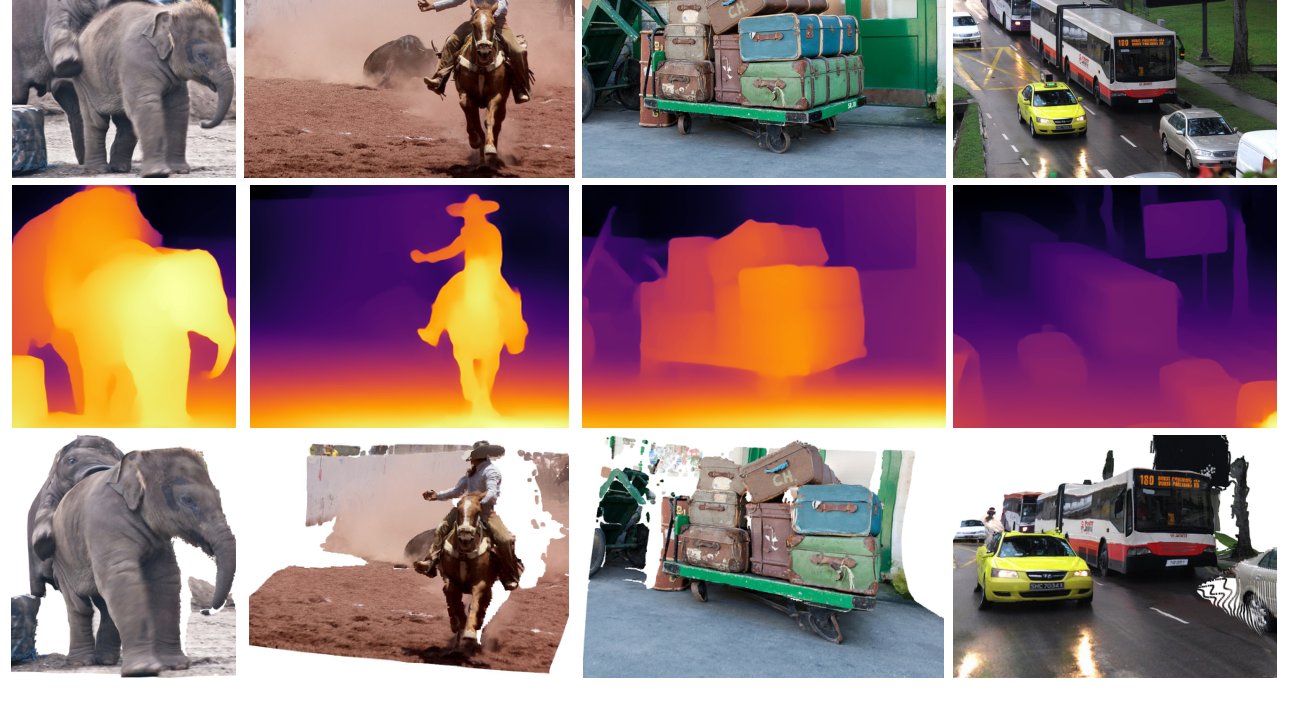
Figure source: [18], arXiv:1907.01341v3, PDF page 2. Original PDF.
Make incompatible supervision comparable. Training sources can provide metric depth, disparity, or depth with unknown scale/shift. Let be predicted inverse depth and a target at valid pixel . An illustrative alignment objective is
is the valid-pixel set, a scale and an offset. Optimizing them per image removes nuisance scale/shift before comparing predictions with that image’s target. It does not recover a physical metric scale from an uncalibrated photograph.
The paper studies scale/shift-invariant losses, including a robust trimmed variant, together with multi-scale gradient matching that encourages structural boundaries. Trimming the largest residuals can reduce sensitivity to bad targets but can also reduce supervision on difficult valid regions. These are tested choices, not interchangeable loss names.
Mix datasets without letting one dominate trivially. A shared encoder–decoder learns from several sources. The paper studies balancing dataset objectives through multi-objective optimization as well as different encoders and training mixtures. Stereo-derived movie data adds varied scenes, while its own failure modes and unknown disparity offsets require the invariant formulation.
Evaluate across datasets. Zero-shot cross-dataset transfer means evaluating on a target dataset without training the depth estimator on that target’s training split. Alignments needed for relative-depth evaluation can still use test ground-truth depth to compute the metric; that is an evaluation convention, not an input available to deployment.
Results
The paper’s cross-dataset comparisons support improved transfer from heterogeneous training rather than optimizing only an in-domain benchmark. Tables of relative improvement/rank summarize several targets with different metrics. A better average rank does not mean the same absolute depth error, or improvement on every target.
The released model family later acquired additional versions. This guide concerns the Ranftl et al. paper; a later MiDaS checkpoint, a DPT architecture and a metric-depth model should not silently share the same reported result.
Ablations
Figure 3 compares loss formulations, Figure 4 compares encoders, and the training-mixture tables examine how adding datasets changes held-out transfer. Together they test the roles of invariance, representation strength and data diversity.
Ablations must preserve which datasets were used for training and evaluation. More images and more diverse sources are different interventions. Likewise, an encoder comparison can change pretraining and capacity; it is not necessarily a parameter-matched test of dataset mixing alone.
Conclusion
MiDaS treats generalization as a data-and-supervision problem: align heterogeneous targets, train across sources and test on separate domains. Relative depth can transfer well without providing metric scale.
Problems
Scale/shift ambiguity limits direct geometric measurement. Camera/viewpoint differences, reflective or transparent surfaces and unusual content can still cause errors. Evaluation alignment can hide global calibration errors. A plausible smooth depth map is not proof of accurate boundaries or distances, and unseen-dataset performance is not a guarantee for all real environments.
References
- R. Hartley and A. Zisserman, Multiple View Geometry in Computer Vision, 2nd ed., Cambridge University Press, 2004. doi
- D. Scharstein and R. Szeliski, “A taxonomy and evaluation of dense two-frame stereo correspondence algorithms,” International Journal of Computer Vision, vol. 47, no. 1–3, pp. 7–42, 2002. doi
- D. Scharstein, R. Szeliski and H. Hirschmüller, “Middlebury Stereo Evaluation — Version 3,” official benchmark page (bad 2.0 metric, non-occluded and all masks). link · stereo home page
- R. Zabih and J. Woodfill, “Non-parametric local transforms for computing visual correspondence,” in Computer Vision — ECCV ‘94 (Lecture Notes in Computer Science), pp. 151–158, Springer, 1994. doi
- H. Hirschmüller, “Stereo processing by semiglobal matching and mutual information,” IEEE Transactions on Pattern Analysis and Machine Intelligence, vol. 30, no. 2, pp. 328–341, 2008. doi
- J. Žbontar and Y. LeCun, “Stereo matching by training a convolutional neural network to compare image patches,” Journal of Machine Learning Research, vol. 17, no. 65, pp. 1–32, 2016. JMLR · arXiv
- OpenCV contributors, “cv::StereoSGBM class documentation,” OpenCV source,
modules/calib3d/include/opencv2/calib3d.hpp(4.x branch). source - H. Laga, L. V. Jospin, F. Boussaid and M. Bennamoun, “A survey on deep learning techniques for stereo-based depth estimation,” IEEE Transactions on Pattern Analysis and Machine Intelligence, vol. 44, no. 4, pp. 1738–1764, 2022. doi · arXiv
- F. Tosi, L. Bartolomei and M. Poggi, “A survey on deep stereo matching in the twenties,” International Journal of Computer Vision, vol. 133, no. 7, pp. 4245–4276, 2025. doi · arXiv
- N. Mayer, E. Ilg, P. Häusser, P. Fischer, D. Cremers, A. Dosovitskiy and T. Brox, “A large dataset to train convolutional networks for disparity, optical flow, and scene flow estimation,” in Proc. IEEE CVPR, pp. 4040–4048, 2016. CVF · doi
- A. Kendall, H. Martirosyan, S. Dasgupta, P. Henry, R. Kennedy, A. Bachrach and A. Bry, “End-to-end learning of geometry and context for deep stereo regression,” in Proc. IEEE ICCV, 2017. CVF
- J.-R. Chang and Y.-S. Chen, “Pyramid stereo matching network,” in Proc. IEEE/CVF CVPR, 2018. CVF
- L. Lipson, Z. Teed and J. Deng, “RAFT-Stereo: Multilevel recurrent field transforms for stereo matching,” in Proc. International Conference on 3D Vision (3DV), pp. 218–227, 2021. doi · arXiv
- G. Xu, X. Wang, X. Ding and X. Yang, “Iterative geometry encoding volume for stereo matching,” in Proc. IEEE/CVF CVPR, 2023. CVF
- M. Poggi, F. Tosi, K. Batsos, P. Mordohai and S. Mattoccia, “On the synergies between machine learning and binocular stereo for depth estimation from images: A survey,” IEEE Transactions on Pattern Analysis and Machine Intelligence, 2021. doi · arXiv
- B. Wen, M. Trepte, J. Aribido, J. Kautz, O. Gallo and S. Birchfield, “FoundationStereo: Zero-shot stereo matching,” in Proc. IEEE/CVF CVPR, 2025. CVF · arXiv
- D. Eigen, C. Puhrsch and R. Fergus, “Depth map prediction from a single image using a multi-scale deep network,” in Proc. NeurIPS, 2014. proceedings · arXiv
- R. Ranftl, K. Lasinger, D. Hafner, K. Schindler and V. Koltun, “Towards robust monocular depth estimation: Mixing datasets for zero-shot cross-dataset transfer,” IEEE Transactions on Pattern Analysis and Machine Intelligence, vol. 44, no. 3, pp. 1623–1637, 2022. doi · arXiv
- L. Yang, B. Kang, Z. Huang, X. Xu, J. Feng and H. Zhao, “Depth Anything: Unleashing the power of large-scale unlabeled data,” in Proc. IEEE/CVF CVPR, 2024. CVF · arXiv
- R. Ranftl, A. Bochkovskiy and V. Koltun, “Vision transformers for dense prediction,” in Proc. IEEE/CVF ICCV, 2021. CVF
- L. Yang, B. Kang, Z. Huang, Z. Zhao, X. Xu, J. Feng and H. Zhao, “Depth Anything V2,” in Proc. NeurIPS, 2024. proceedings · arXiv
- B. Ke, A. Obukhov, S. Huang, N. Metzger, R. C. Daudt and K. Schindler, “Repurposing diffusion-based image generators for monocular depth estimation,” in Proc. IEEE/CVF CVPR, 2024. CVF · arXiv
- S. F. Bhat, R. Birkl, D. Wofk, P. Wonka and M. Müller, “ZoeDepth: Zero-shot transfer by combining relative and metric depth,” arXiv:2302.12288, 2023. arXiv
- W. Yin, C. Zhang, H. Chen, Z. Cai, G. Yu, K. Wang, X. Chen and C. Shen, “Metric3D: Towards zero-shot metric 3D prediction from a single image,” in Proc. IEEE/CVF ICCV, 2023. CVF · arXiv
- M. Hu, W. Yin, C. Zhang, Z. Cai, X. Long, K. Wang, H. Chen, G. Yu, C. Shen and S. Shen, “Metric3D v2: A versatile monocular geometric foundation model for zero-shot metric depth and surface normal estimation,” IEEE Transactions on Pattern Analysis and Machine Intelligence, vol. 46, no. 12, pp. 10579–10596, 2024. doi · arXiv
- L. Piccinelli, Y.-H. Yang, C. Sakaridis, M. Segu, S. Li, L. Van Gool and F. Yu, “UniDepth: Universal monocular metric depth estimation,” in Proc. IEEE/CVF CVPR, 2024. CVF · arXiv
- A. Bochkovskii, A. Delaunoy, H. Germain, M. Santos, Y. Zhou, S. R. Richter and V. Koltun, “Depth Pro: Sharp monocular metric depth in less than a second,” in Proc. ICLR, 2025. OpenReview · arXiv
- R. Garg, V. Kumar B.G., G. Carneiro and I. Reid, “Unsupervised CNN for single view depth estimation: Geometry to the rescue,” in Proc. ECCV (Lecture Notes in Computer Science), pp. 740–756, 2016. doi · arXiv
- C. Godard, O. Mac Aodha and G. J. Brostow, “Unsupervised monocular depth estimation with left-right consistency,” in Proc. IEEE CVPR, 2017. CVF
- T. Zhou, M. Brown, N. Snavely and D. G. Lowe, “Unsupervised learning of depth and ego-motion from video,” in Proc. IEEE CVPR, 2017. CVF
- C. Godard, O. Mac Aodha, M. Firman and G. J. Brostow, “Digging into self-supervised monocular depth estimation,” in Proc. IEEE/CVF ICCV, 2019. CVF · arXiv
- Z. Wang, A. C. Bovik, H. R. Sheikh and E. P. Simoncelli, “Image quality assessment: From error visibility to structural similarity,” IEEE Transactions on Image Processing, vol. 13, no. 4, pp. 600–612, 2004. doi
- B. K. P. Horn and B. G. Schunck, “Determining optical flow,” Artificial Intelligence, vol. 17, no. 1–3, pp. 185–203, 1981. doi
- B. D. Lucas and T. Kanade, “An iterative image registration technique with an application to stereo vision,” in Proc. International Joint Conference on Artificial Intelligence (IJCAI), 1981. pdf
- G. Farnebäck, “Two-frame motion estimation based on polynomial expansion,” in Image Analysis (Lecture Notes in Computer Science), pp. 363–370, Springer, 2003. doi
- J. Hur and S. Roth, “Optical flow estimation in the deep learning age,” in Modelling Human Motion, N. Noceti, A. Sciutti and F. Rea, Eds., pp. 119–140, Springer, 2020. doi · arXiv
- A. Dosovitskiy, P. Fischer, E. Ilg, P. Häusser, C. Hazırbaş, V. Golkov, P. van der Smagt, D. Cremers and T. Brox, “FlowNet: Learning optical flow with convolutional networks,” in Proc. IEEE ICCV, 2015. CVF · arXiv
- E. Ilg, N. Mayer, T. Saikia, M. Keuper, A. Dosovitskiy and T. Brox, “FlowNet 2.0: Evolution of optical flow estimation with deep networks,” in Proc. IEEE CVPR, 2017. CVF
- A. Ranjan and M. J. Black, “Optical flow estimation using a spatial pyramid network,” in Proc. IEEE CVPR, 2017. CVF
- D. Sun, X. Yang, M.-Y. Liu and J. Kautz, “PWC-Net: CNNs for optical flow using pyramid, warping, and cost volume,” in Proc. IEEE/CVF CVPR, 2018. CVF
- Z. Teed and J. Deng, “RAFT: Recurrent all-pairs field transforms for optical flow,” in Proc. ECCV (Lecture Notes in Computer Science), pp. 402–419, 2020. doi · arXiv
- Z. Teed and J. Deng, “RAFT-3D: Scene flow using rigid-motion embeddings,” in Proc. IEEE/CVF CVPR, 2021. CVF · arXiv
- H. Xu, J. Zhang, J. Cai, H. Rezatofighi and D. Tao, “GMFlow: Learning optical flow via global matching,” in Proc. IEEE/CVF CVPR, 2022. CVF
- H. Xu, J. Zhang, J. Cai, H. Rezatofighi, F. Yu, D. Tao and A. Geiger, “Unifying flow, stereo and depth estimation,” IEEE Transactions on Pattern Analysis and Machine Intelligence, vol. 45, no. 11, pp. 13941–13958, 2023. doi · arXiv
- Z. Huang, X. Shi, C. Zhang, Q. Wang, K. C. Cheung, H. Qin, J. Dai and H. Li, “FlowFormer: A transformer architecture for optical flow,” in Proc. ECCV (Lecture Notes in Computer Science), pp. 668–685, 2022. doi · arXiv
- Y. Wang, L. Lipson and J. Deng, “SEA-RAFT: Simple, efficient, accurate RAFT for optical flow,” in Proc. ECCV (Lecture Notes in Computer Science), pp. 36–54, 2024. doi · arXiv
- S. Vedula, S. Baker, P. Rander, R. Collins and T. Kanade, “Three-dimensional scene flow,” in Proc. IEEE ICCV, vol. 2, pp. 722–729, 1999. doi
- M. Menze and A. Geiger, “Object scene flow for autonomous vehicles,” in Proc. IEEE CVPR, pp. 3061–3070, 2015. CVF · doi
- A. Geiger, P. Lenz, C. Stiller and R. Urtasun, “Scene flow evaluation 2015 (stereo 2015, flow 2015, scene flow 2015),” The KITTI Vision Benchmark Suite, official benchmark page (dataset size, D1, D2, Fl and SF outlier definitions). link
- A. Geiger, P. Lenz, C. Stiller and R. Urtasun, “Stereo evaluation 2012,” The KITTI Vision Benchmark Suite, official benchmark page (dataset size, Out-Noc and Out-All at 2–5 px). link
- A. Geiger, P. Lenz and R. Urtasun, “Are we ready for autonomous driving? The KITTI vision benchmark suite,” in Proc. IEEE CVPR, pp. 3354–3361, 2012. doi
- D. Scharstein, H. Hirschmüller, Y. Kitajima, G. Krathwohl, N. Nešić, X. Wang and P. Westling, “High-resolution stereo datasets with subpixel-accurate ground truth,” in Pattern Recognition (Proc. GCPR) (Lecture Notes in Computer Science), pp. 31–42, Springer, 2014. doi · datasets
- T. Schöps, J. L. Schönberger, S. Galliani, T. Sattler, K. Schindler, M. Pollefeys and A. Geiger, “A multi-view stereo benchmark with high-resolution images and multi-camera videos,” in Proc. IEEE CVPR, pp. 2538–2547, 2017. CVF · datasets
- D. J. Butler, J. Wulff, G. B. Stanley and M. J. Black, “A naturalistic open source movie for optical flow evaluation,” in Proc. ECCV (Lecture Notes in Computer Science), pp. 611–625, 2012. doi · project page
- N. Silberman, D. Hoiem, P. Kohli and R. Fergus, “Indoor segmentation and support inference from RGBD images,” in Proc. ECCV (Lecture Notes in Computer Science), pp. 746–760, 2012. doi · dataset page
- U. Rajapaksha, F. Sohel, H. Laga, D. Diepeveen and M. Bennamoun, “Deep learning-based depth estimation methods from monocular image and videos: A comprehensive survey,” ACM Computing Surveys, vol. 56, no. 12, 2024. doi · arXiv