NeRF (Mildenhall et al., 2020)
Optional · paper guide 1 of 3 for DLCV 11 · 3D Reconstruction: From Multi-View Geometry to NeRF and Gaussian Splatting. Citation numbers refer to the reference list at the bottom of this page.
Navigate: this page and this track: Navigate: this page and this track
Challenge
NeRF [5] reconstructs a scene representation from photographs so that a new camera view can be rendered. The photographs constrain only rays from observed viewpoints. A representation must therefore connect appearance across views without pretending that unobserved geometry has been directly measured.
Method
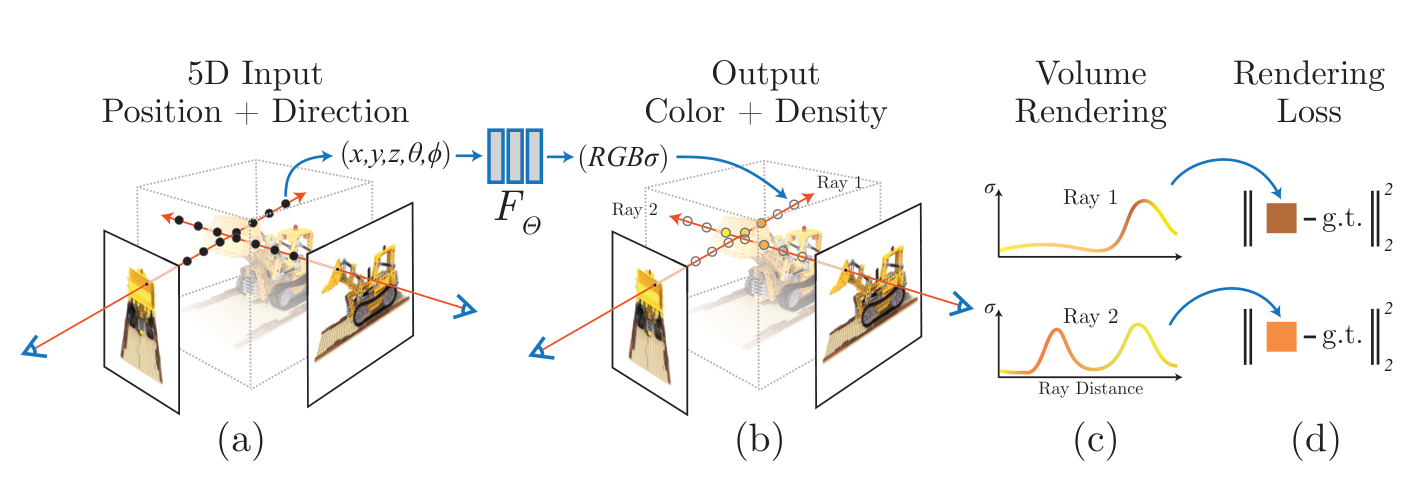
Figure source: [5], arXiv:2003.08934v2, PDF page 5. Original PDF.
Represent a field, not one image. A multilayer perceptron receives a 3D position and viewing direction . It predicts nonnegative volume density and RGB color . Density is position-dependent; color can depend on direction to model view-dependent appearance. Positional encoding maps coordinates to multiple sinusoidal frequencies, allowing the network to fit finer variation than raw coordinates alone.
Render along a ray. For sampled positions on a camera ray, the discrete rendering rule is
is the predicted pixel color, the density at sample , the distance to the next sample, its view-conditioned color, and the transmittance through earlier samples. Front samples can obscure later ones. This connects a continuous field to differentiable image formation; density is not automatically a clean surface mesh.
Spend samples where they matter. A coarse network estimates ray weights. Hierarchical importance sampling uses that distribution to place extra samples for a fine network, reducing wasted evaluations in empty or uninformative regions. The two networks’ rendered colors are supervised with training-image pixel errors using known camera rays. At test time, the learned field is queried along rays from a new camera.
Results
Table 1 evaluates synthetic scenes and real forward-facing captures using held-out views and reference image metrics. It supports high-quality novel-view synthesis under these capture conditions. Training-set reconstruction and held-out rendering answer different questions; a memorized training view alone would not establish 3D generalization.
The original system needs many field evaluations per ray and per-scene optimization. Its image quality should therefore be read together with training/rendering cost, rather than interpreted through the speed of later accelerated NeRF variants.
Ablations
Table 2 averages the realistic synthetic scene set and removes positional encoding, view-direction dependence or hierarchical sampling. These controls test whether fine coordinate variation, directional appearance and adaptive sample placement contribute to the full renderer. Figure 4 visually connects representation choices to reconstruction quality.
The changes interact: a different sample allocation changes which field locations receive image supervision. An improvement from one component in this protocol does not prove the same gain for every scene, camera coverage or lighting condition.
Conclusion
NeRF turns image reconstruction into optimization of a continuous density-and-radiance field through a differentiable renderer. The field, positional encoding and hierarchical ray sampling jointly support new-view synthesis.
Problems
The original formulation assumes a static scene with reasonably consistent appearance and accurate camera poses. Moving objects, sparse coverage, reflective/transparent surfaces and lighting changes can produce artifacts or ambiguous geometry. Unseen surfaces remain prior-dependent. A good rendered photograph does not by itself certify metric geometry, and a per-scene field is not a feed-forward model for arbitrary new scenes.
References
- R. Hartley and A. Zisserman, Multiple View Geometry in Computer Vision, 2nd ed., Cambridge University Press, 2004. doi
- J. L. Schönberger and J.-M. Frahm, “Structure-from-motion revisited,” in Proc. IEEE CVPR, 2016. CVF
- J. L. Schönberger, E. Zheng, J.-M. Frahm and M. Pollefeys, “Pixelwise view selection for unstructured multi-view stereo,” in Proc. ECCV, 2016. doi
- J. L. Schönberger et al., “COLMAP,” official documentation (general-purpose structure-from-motion and multi-view stereo pipeline). link
- B. Mildenhall, P. P. Srinivasan, M. Tancik, J. T. Barron, R. Ramamoorthi and R. Ng, “NeRF: Representing scenes as neural radiance fields for view synthesis,” in Proc. ECCV, 2020; also Communications of the ACM, vol. 65, no. 1, pp. 99–106, 2022. doi · CACM doi · arXiv
- B. Kerbl, G. Kopanas, T. Leimkühler and G. Drettakis, “3D Gaussian Splatting for real-time radiance field rendering,” ACM Transactions on Graphics, vol. 42, no. 4, 2023. doi · arXiv
- H. C. Longuet-Higgins, “A computer algorithm for reconstructing a scene from two projections,” Nature, vol. 293, pp. 133–135, 1981. doi
- R. I. Hartley, “In defense of the eight-point algorithm,” IEEE TPAMI, vol. 19, no. 6, pp. 580–593, 1997. doi
- D. Nistér, “An efficient solution to the five-point relative pose problem,” IEEE TPAMI, vol. 26, no. 6, pp. 756–770, 2004. doi
- M. A. Fischler and R. C. Bolles, “Random sample consensus: A paradigm for model fitting with applications to image analysis and automated cartography,” Communications of the ACM, vol. 24, no. 6, pp. 381–395, 1981. doi
- D. G. Lowe, “Distinctive image features from scale-invariant keypoints,” International Journal of Computer Vision, vol. 60, no. 2, pp. 91–110, 2004. doi
- N. Snavely, S. M. Seitz and R. Szeliski, “Photo tourism: Exploring photo collections in 3D,” ACM Transactions on Graphics, vol. 25, no. 3, pp. 835–846, 2006. doi
- B. Triggs, P. F. McLauchlan, R. I. Hartley and A. W. Fitzgibbon, “Bundle adjustment — A modern synthesis,” in Vision Algorithms: Theory and Practice, LNCS 1883, pp. 298–372, Springer, 2000. doi
- R. T. Collins, “A space-sweep approach to true multi-image matching,” in Proc. IEEE CVPR, pp. 358–363, 1996. doi
- B. Curless and M. Levoy, “A volumetric method for building complex models from range images,” in Proc. SIGGRAPH, pp. 303–312, 1996. doi
- Y. Yao, Z. Luo, S. Li, T. Fang and L. Quan, “MVSNet: Depth inference for unstructured multi-view stereo,” in Proc. ECCV, 2018. CVF · doi
- N. Max, “Optical models for direct volume rendering,” IEEE Transactions on Visualization and Computer Graphics, vol. 1, no. 2, pp. 99–108, 1995. doi
- M. Tancik, P. P. Srinivasan, B. Mildenhall, S. Fridovich-Keil, N. Raghavan, U. Singhal, R. Ramamoorthi, J. T. Barron and R. Ng, “Fourier features let networks learn high frequency functions in low dimensional domains,” in Proc. NeurIPS, 2020. proceedings
- T. Müller, A. Evans, C. Schied and A. Keller, “Instant neural graphics primitives with a multiresolution hash encoding,” ACM Transactions on Graphics, vol. 41, no. 4, 2022. doi · arXiv
- J. J. Park, P. Florence, J. Straub, R. Newcombe and S. Lovegrove, “DeepSDF: Learning continuous signed distance functions for shape representation,” in Proc. IEEE/CVF CVPR, 2019. CVF
- L. Mescheder, M. Oechsle, M. Niemeyer, S. Nowozin and A. Geiger, “Occupancy networks: Learning 3D reconstruction in function space,” in Proc. IEEE/CVF CVPR, 2019. CVF
- P. Wang, L. Liu, Y. Liu, C. Theobalt, T. Komura and W. Wang, “NeuS: Learning neural implicit surfaces by volume rendering for multi-view reconstruction,” in Proc. NeurIPS, 2021. proceedings · arXiv
- M. Zwicker, H. Pfister, J. van Baar and M. Gross, “EWA volume splatting,” in Proc. IEEE Visualization, 2001. doi
- W. E. Lorensen and H. E. Cline, “Marching cubes: A high resolution 3D surface construction algorithm,” in Proc. SIGGRAPH, pp. 163–169, 1987. doi
- M. Kazhdan, M. Bolitho and H. Hoppe, “Poisson surface reconstruction,” in Proc. Eurographics Symposium on Geometry Processing, 2006. doi
- M. Kazhdan and H. Hoppe, “Screened Poisson surface reconstruction,” ACM Transactions on Graphics, vol. 32, no. 3, 2013. doi
- A. Guédon and V. Lepetit, “SuGaR: Surface-aligned Gaussian splatting for efficient 3D mesh reconstruction and high-quality mesh rendering,” in Proc. IEEE/CVF CVPR, 2024. CVF · arXiv
- B. Huang, Z. Yu, A. Chen, A. Geiger and S. Gao, “2D Gaussian splatting for geometrically accurate radiance fields,” in Proc. SIGGRAPH (Conference Papers), 2024. doi · arXiv
- S. Wang, V. Leroy, Y. Cabon, B. Chidlovskii and J. Revaud, “DUSt3R: Geometric 3D vision made easy,” in Proc. IEEE/CVF CVPR, 2024. CVF · arXiv
- V. Leroy, Y. Cabon and J. Revaud, “Grounding image matching in 3D with MASt3R,” in Proc. ECCV, 2024. doi · arXiv
- J. Wang, M. Chen, N. Karaev, A. Vedaldi, C. Rupprecht and D. Novotny, “VGGT: Visual geometry grounded transformer,” in Proc. IEEE/CVF CVPR, 2025. CVF · arXiv
- A. Pumarola, E. Corona, G. Pons-Moll and F. Moreno-Noguer, “D-NeRF: Neural radiance fields for dynamic scenes,” in Proc. IEEE/CVF CVPR, 2021. CVF
- G. Wu, T. Yi, J. Fang, L. Xie, X. Zhang, W. Wei, W. Liu, Q. Tian and X. Wang, “4D Gaussian splatting for real-time dynamic scene rendering,” in Proc. IEEE/CVF CVPR, 2024. CVF · arXiv
- Z. Wang, A. C. Bovik, H. R. Sheikh and E. P. Simoncelli, “Image quality assessment: From error visibility to structural similarity,” IEEE Transactions on Image Processing, vol. 13, no. 4, pp. 600–612, 2004. doi
- R. Zhang, P. Isola, A. A. Efros, E. Shechtman and O. Wang, “The unreasonable effectiveness of deep features as a perceptual metric,” in Proc. IEEE/CVF CVPR, 2018. CVF
- H. Fan, H. Su and L. J. Guibas, “A point set generation network for 3D object reconstruction from a single image,” in Proc. IEEE CVPR, 2017. CVF
- R. Jensen, A. Dahl, G. Vogiatzis, E. Tola and H. Aanæs, “Large scale multi-view stereopsis evaluation,” in Proc. IEEE CVPR, pp. 406–413, 2014. doi
- A. Knapitsch, J. Park, Q.-Y. Zhou and V. Koltun, “Tanks and Temples: Benchmarking large-scale scene reconstruction,” ACM Transactions on Graphics, vol. 36, no. 4, 2017. doi · benchmark
- J. T. Barron, B. Mildenhall, D. Verbin, P. P. Srinivasan and P. Hedman, “Mip-NeRF 360: Unbounded anti-aliased neural radiance fields,” in Proc. IEEE/CVF CVPR, 2022. CVF · arXiv
- D. Verbin, P. Hedman, B. Mildenhall, T. Zickler, J. T. Barron and P. P. Srinivasan, “Ref-NeRF: Structured view-dependent appearance for neural radiance fields,” in Proc. IEEE/CVF CVPR, 2022. CVF
- C.-H. Lin, W.-C. Ma, A. Torralba and S. Lucey, “BARF: Bundle-adjusting neural radiance fields,” in Proc. IEEE/CVF ICCV, 2021. CVF
- S. M. Seitz, B. Curless, J. Diebel, D. Scharstein and R. Szeliski, “A comparison and evaluation of multi-view stereo reconstruction algorithms,” in Proc. IEEE CVPR, vol. 1, pp. 519–528, 2006. doi
- Y. Furukawa and C. Hernández, “Multi-view stereo: A tutorial,” Foundations and Trends in Computer Graphics and Vision, vol. 9, no. 1–2, pp. 1–148, 2015. doi
- A. Tewari, J. Thies, B. Mildenhall, P. Srinivasan, E. Tretschk, W. Yifan, C. Lassner, V. Sitzmann et al., “Advances in neural rendering,” Computer Graphics Forum, vol. 41, no. 2, pp. 703–735, 2022. doi · arXiv
- G. Chen and W. Wang, “A survey on 3D Gaussian splatting,” ACM Computing Surveys, vol. 58, no. 12, 2026. doi · arXiv
- scikit-image contributors, “skimage.measure.marching_cubes,” scikit-image documentation (API reference). docs
- A. Dosovitskiy, L. Beyer, A. Kolesnikov, D. Weissenborn, X. Zhai et al., “An image is worth 16x16 words: Transformers for image recognition at scale,” in Proc. ICLR, 2021. arXiv
- A. Vaswani, N. Shazeer, N. Parmar, J. Uszkoreit, L. Jones, A. N. Gomez, Ł. Kaiser and I. Polosukhin, “Attention is all you need,” in Proc. NeurIPS, 2017. proceedings
- D. P. Kingma and J. Ba, “Adam: A method for stochastic optimization,” in Proc. ICLR, 2015. arXiv