3D Gaussian Splatting (Kerbl et al., 2023)
Optional · paper guide 2 of 3 for DLCV 11 · 3D Reconstruction: From Multi-View Geometry to NeRF and Gaussian Splatting. Citation numbers refer to the reference list at the bottom of this page.
Navigate: this page and this track: Navigate: this page and this track
Challenge
A scene representation can render good novel views yet be too slow for interaction. 3D Gaussian Splatting [6] combines an explicit optimizable representation with a GPU rasterizer, targeting high-quality real-time rendering. Representation and rendering engineering are separate, cooperating parts of the contribution.
Method
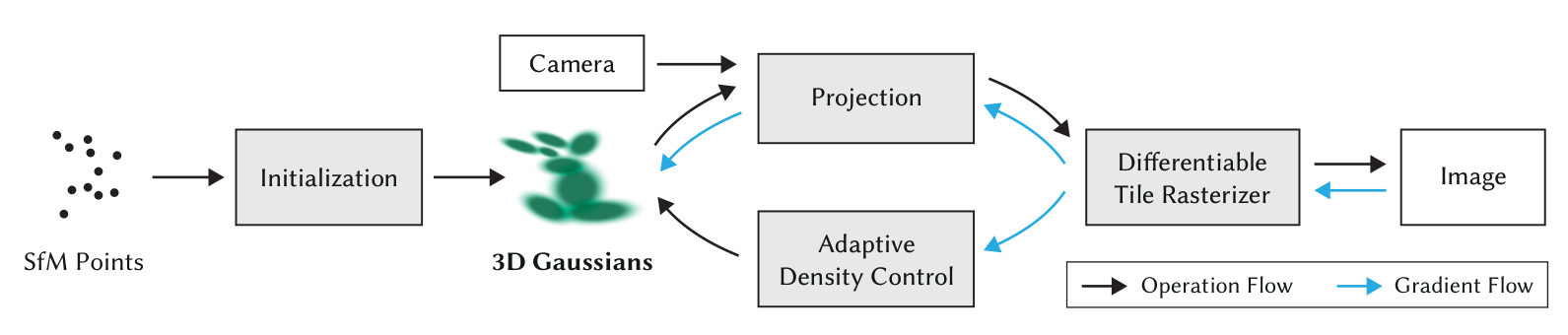
Figure source: [6], arXiv:2308.04079v1, PDF page 5. Original PDF.
Start from calibrated observations. Structure-from-motion points initialize Gaussian centers. Each primitive has a 3D position, opacity, anisotropic covariance and spherical-harmonic color coefficients. Rotation and positive scale parameters construct a valid covariance; anisotropy lets a primitive stretch along a surface instead of using only spherical blobs.
Project, sort and blend. The renderer projects each Gaussian to a screen-space footprint, groups it into tiles and sorts for visibility-aware alpha blending. At a pixel, the compositing rule has the form
combines the primitive’s opacity with its projected Gaussian contribution at that pixel, is view-dependent RGB color, and is transmittance through earlier sorted contributions. These projected opacities are not identical to NeRF’s sampled volume densities. Tile-level sorting is an efficient approximation, not exact arbitrary per-ray volumetric integration.
Optimize both parameters and population. Image reconstruction combines pixel and structural losses. Gradient-based optimization changes primitive attributes, while adaptive density control clones/splits useful Gaussians and prunes ineffective ones. Densification changes the representation itself: learning cannot be described as optimizing a fixed point cloud only.
The fast differentiable rasterizer lets many visible primitives receive gradients. Spherical harmonics handle directional appearance without requiring a large per-ray neural network. At inference, the optimized scene is projected and blended for the requested camera.
Results
Table 1 compares image quality, training time, rendering speed and storage across the evaluated real-scene datasets. The work reaches the intended interactive rendering regime with competitive image quality. The benchmark distinguishes copied baseline results from author-run results; preserve that distinction when interpreting speed or quality differences.
The standard real-scene protocol holds out every eighth view. Its coverage and calibrated cameras matter: this is scene reconstruction from multiple observations, not recovery of an arbitrary unseen scene from one image.
Ablations
Table 3 and Section 7.3 remove or alter SfM initialization, adaptive density control, anisotropic covariance, gradient participation and spherical-harmonic appearance. These tests connect observed quality to both the representation and the optimization/rendering implementation.
Cloning and splitting address different reconstruction situations. Limiting contributions/gradients can discard useful background evidence; replacing anisotropic shapes with a single scale reduces representational flexibility. The ablations support their tested roles without proving that every additional Gaussian or every directional coefficient improves every scene.
Conclusion
3DGS replaces repeated neural ray marching with explicit projected primitives and efficient sorting/blending, while adapting the primitive population during optimization. Fast rendering is achieved through the whole representation–optimizer–rasterizer design.
Problems
Poorly observed regions can contain elongated or floating Gaussians, and changes in visibility can cause popping. Storage/memory can be much larger than compact neural-field alternatives. Static-scene assumptions and camera errors remain limitations. A visually convincing splat representation is not automatically a clean mesh or a physically accurate account of transparent and reflective surfaces.
References
- R. Hartley and A. Zisserman, Multiple View Geometry in Computer Vision, 2nd ed., Cambridge University Press, 2004. doi
- J. L. Schönberger and J.-M. Frahm, “Structure-from-motion revisited,” in Proc. IEEE CVPR, 2016. CVF
- J. L. Schönberger, E. Zheng, J.-M. Frahm and M. Pollefeys, “Pixelwise view selection for unstructured multi-view stereo,” in Proc. ECCV, 2016. doi
- J. L. Schönberger et al., “COLMAP,” official documentation (general-purpose structure-from-motion and multi-view stereo pipeline). link
- B. Mildenhall, P. P. Srinivasan, M. Tancik, J. T. Barron, R. Ramamoorthi and R. Ng, “NeRF: Representing scenes as neural radiance fields for view synthesis,” in Proc. ECCV, 2020; also Communications of the ACM, vol. 65, no. 1, pp. 99–106, 2022. doi · CACM doi · arXiv
- B. Kerbl, G. Kopanas, T. Leimkühler and G. Drettakis, “3D Gaussian Splatting for real-time radiance field rendering,” ACM Transactions on Graphics, vol. 42, no. 4, 2023. doi · arXiv
- H. C. Longuet-Higgins, “A computer algorithm for reconstructing a scene from two projections,” Nature, vol. 293, pp. 133–135, 1981. doi
- R. I. Hartley, “In defense of the eight-point algorithm,” IEEE TPAMI, vol. 19, no. 6, pp. 580–593, 1997. doi
- D. Nistér, “An efficient solution to the five-point relative pose problem,” IEEE TPAMI, vol. 26, no. 6, pp. 756–770, 2004. doi
- M. A. Fischler and R. C. Bolles, “Random sample consensus: A paradigm for model fitting with applications to image analysis and automated cartography,” Communications of the ACM, vol. 24, no. 6, pp. 381–395, 1981. doi
- D. G. Lowe, “Distinctive image features from scale-invariant keypoints,” International Journal of Computer Vision, vol. 60, no. 2, pp. 91–110, 2004. doi
- N. Snavely, S. M. Seitz and R. Szeliski, “Photo tourism: Exploring photo collections in 3D,” ACM Transactions on Graphics, vol. 25, no. 3, pp. 835–846, 2006. doi
- B. Triggs, P. F. McLauchlan, R. I. Hartley and A. W. Fitzgibbon, “Bundle adjustment — A modern synthesis,” in Vision Algorithms: Theory and Practice, LNCS 1883, pp. 298–372, Springer, 2000. doi
- R. T. Collins, “A space-sweep approach to true multi-image matching,” in Proc. IEEE CVPR, pp. 358–363, 1996. doi
- B. Curless and M. Levoy, “A volumetric method for building complex models from range images,” in Proc. SIGGRAPH, pp. 303–312, 1996. doi
- Y. Yao, Z. Luo, S. Li, T. Fang and L. Quan, “MVSNet: Depth inference for unstructured multi-view stereo,” in Proc. ECCV, 2018. CVF · doi
- N. Max, “Optical models for direct volume rendering,” IEEE Transactions on Visualization and Computer Graphics, vol. 1, no. 2, pp. 99–108, 1995. doi
- M. Tancik, P. P. Srinivasan, B. Mildenhall, S. Fridovich-Keil, N. Raghavan, U. Singhal, R. Ramamoorthi, J. T. Barron and R. Ng, “Fourier features let networks learn high frequency functions in low dimensional domains,” in Proc. NeurIPS, 2020. proceedings
- T. Müller, A. Evans, C. Schied and A. Keller, “Instant neural graphics primitives with a multiresolution hash encoding,” ACM Transactions on Graphics, vol. 41, no. 4, 2022. doi · arXiv
- J. J. Park, P. Florence, J. Straub, R. Newcombe and S. Lovegrove, “DeepSDF: Learning continuous signed distance functions for shape representation,” in Proc. IEEE/CVF CVPR, 2019. CVF
- L. Mescheder, M. Oechsle, M. Niemeyer, S. Nowozin and A. Geiger, “Occupancy networks: Learning 3D reconstruction in function space,” in Proc. IEEE/CVF CVPR, 2019. CVF
- P. Wang, L. Liu, Y. Liu, C. Theobalt, T. Komura and W. Wang, “NeuS: Learning neural implicit surfaces by volume rendering for multi-view reconstruction,” in Proc. NeurIPS, 2021. proceedings · arXiv
- M. Zwicker, H. Pfister, J. van Baar and M. Gross, “EWA volume splatting,” in Proc. IEEE Visualization, 2001. doi
- W. E. Lorensen and H. E. Cline, “Marching cubes: A high resolution 3D surface construction algorithm,” in Proc. SIGGRAPH, pp. 163–169, 1987. doi
- M. Kazhdan, M. Bolitho and H. Hoppe, “Poisson surface reconstruction,” in Proc. Eurographics Symposium on Geometry Processing, 2006. doi
- M. Kazhdan and H. Hoppe, “Screened Poisson surface reconstruction,” ACM Transactions on Graphics, vol. 32, no. 3, 2013. doi
- A. Guédon and V. Lepetit, “SuGaR: Surface-aligned Gaussian splatting for efficient 3D mesh reconstruction and high-quality mesh rendering,” in Proc. IEEE/CVF CVPR, 2024. CVF · arXiv
- B. Huang, Z. Yu, A. Chen, A. Geiger and S. Gao, “2D Gaussian splatting for geometrically accurate radiance fields,” in Proc. SIGGRAPH (Conference Papers), 2024. doi · arXiv
- S. Wang, V. Leroy, Y. Cabon, B. Chidlovskii and J. Revaud, “DUSt3R: Geometric 3D vision made easy,” in Proc. IEEE/CVF CVPR, 2024. CVF · arXiv
- V. Leroy, Y. Cabon and J. Revaud, “Grounding image matching in 3D with MASt3R,” in Proc. ECCV, 2024. doi · arXiv
- J. Wang, M. Chen, N. Karaev, A. Vedaldi, C. Rupprecht and D. Novotny, “VGGT: Visual geometry grounded transformer,” in Proc. IEEE/CVF CVPR, 2025. CVF · arXiv
- A. Pumarola, E. Corona, G. Pons-Moll and F. Moreno-Noguer, “D-NeRF: Neural radiance fields for dynamic scenes,” in Proc. IEEE/CVF CVPR, 2021. CVF
- G. Wu, T. Yi, J. Fang, L. Xie, X. Zhang, W. Wei, W. Liu, Q. Tian and X. Wang, “4D Gaussian splatting for real-time dynamic scene rendering,” in Proc. IEEE/CVF CVPR, 2024. CVF · arXiv
- Z. Wang, A. C. Bovik, H. R. Sheikh and E. P. Simoncelli, “Image quality assessment: From error visibility to structural similarity,” IEEE Transactions on Image Processing, vol. 13, no. 4, pp. 600–612, 2004. doi
- R. Zhang, P. Isola, A. A. Efros, E. Shechtman and O. Wang, “The unreasonable effectiveness of deep features as a perceptual metric,” in Proc. IEEE/CVF CVPR, 2018. CVF
- H. Fan, H. Su and L. J. Guibas, “A point set generation network for 3D object reconstruction from a single image,” in Proc. IEEE CVPR, 2017. CVF
- R. Jensen, A. Dahl, G. Vogiatzis, E. Tola and H. Aanæs, “Large scale multi-view stereopsis evaluation,” in Proc. IEEE CVPR, pp. 406–413, 2014. doi
- A. Knapitsch, J. Park, Q.-Y. Zhou and V. Koltun, “Tanks and Temples: Benchmarking large-scale scene reconstruction,” ACM Transactions on Graphics, vol. 36, no. 4, 2017. doi · benchmark
- J. T. Barron, B. Mildenhall, D. Verbin, P. P. Srinivasan and P. Hedman, “Mip-NeRF 360: Unbounded anti-aliased neural radiance fields,” in Proc. IEEE/CVF CVPR, 2022. CVF · arXiv
- D. Verbin, P. Hedman, B. Mildenhall, T. Zickler, J. T. Barron and P. P. Srinivasan, “Ref-NeRF: Structured view-dependent appearance for neural radiance fields,” in Proc. IEEE/CVF CVPR, 2022. CVF
- C.-H. Lin, W.-C. Ma, A. Torralba and S. Lucey, “BARF: Bundle-adjusting neural radiance fields,” in Proc. IEEE/CVF ICCV, 2021. CVF
- S. M. Seitz, B. Curless, J. Diebel, D. Scharstein and R. Szeliski, “A comparison and evaluation of multi-view stereo reconstruction algorithms,” in Proc. IEEE CVPR, vol. 1, pp. 519–528, 2006. doi
- Y. Furukawa and C. Hernández, “Multi-view stereo: A tutorial,” Foundations and Trends in Computer Graphics and Vision, vol. 9, no. 1–2, pp. 1–148, 2015. doi
- A. Tewari, J. Thies, B. Mildenhall, P. Srinivasan, E. Tretschk, W. Yifan, C. Lassner, V. Sitzmann et al., “Advances in neural rendering,” Computer Graphics Forum, vol. 41, no. 2, pp. 703–735, 2022. doi · arXiv
- G. Chen and W. Wang, “A survey on 3D Gaussian splatting,” ACM Computing Surveys, vol. 58, no. 12, 2026. doi · arXiv
- scikit-image contributors, “skimage.measure.marching_cubes,” scikit-image documentation (API reference). docs
- A. Dosovitskiy, L. Beyer, A. Kolesnikov, D. Weissenborn, X. Zhai et al., “An image is worth 16x16 words: Transformers for image recognition at scale,” in Proc. ICLR, 2021. arXiv
- A. Vaswani, N. Shazeer, N. Parmar, J. Uszkoreit, L. Jones, A. N. Gomez, Ł. Kaiser and I. Polosukhin, “Attention is all you need,” in Proc. NeurIPS, 2017. proceedings
- D. P. Kingma and J. Ba, “Adam: A method for stochastic optimization,” in Proc. ICLR, 2015. arXiv