Lift-Splat-Shoot: a reading guide
Optional · paper guide 3 of 3 for DLCV 03B · 3D Object Detection: LiDAR, Cameras and Bird's-Eye View. Citation numbers refer to the reference list at the bottom of this page.
Navigate: this page and this track: Navigate: this page and this track
Challenge
A planner wants one BEV map around the car, but six cameras give six perspective images with no depth. Processing each camera on its own and merging the outputs afterwards leaves the fusion to hand-written rules; LSS wants one model that learns from the entire camera rig how to fuse it [32].
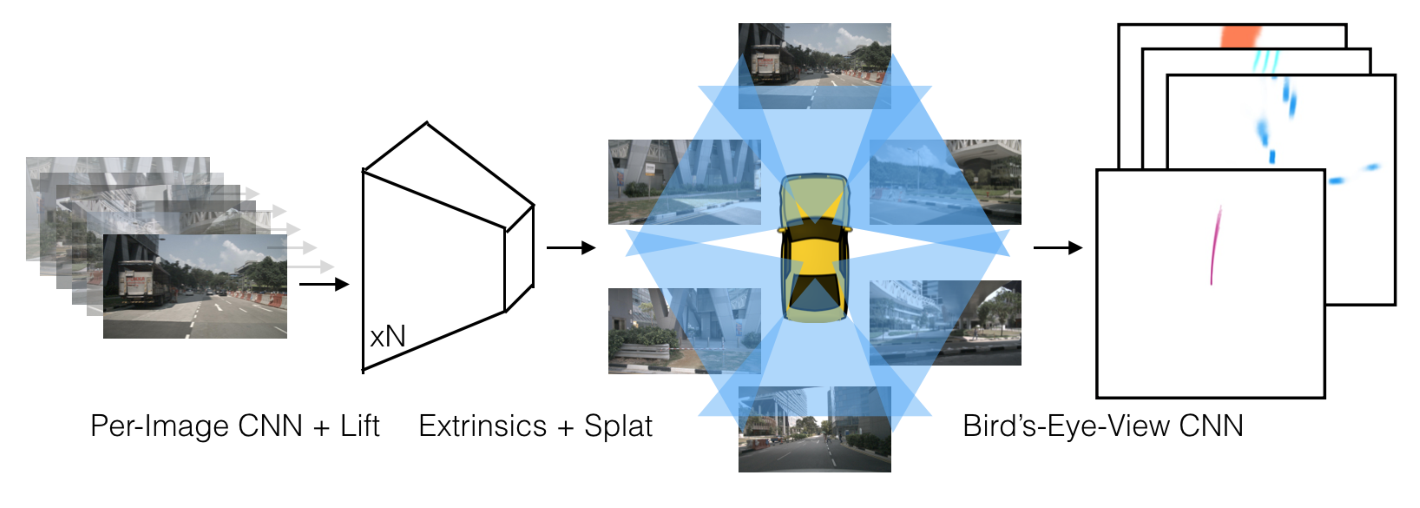
Figure source: [32], arXiv:2008.05711v1, PDF page 6. Original PDF.
Method
Lift each pixel to a frustum of features using a predicted depth distribution (), splat all frustums from all cameras into one BEV grid with sum pooling, and train end to end from BEV labels. The architecture uses the camera calibration explicitly, so it adapts when intrinsics and extrinsics change between cars.
Results
On nuScenes BEV segmentation of cars and vehicles, and of the drivable area and lane boundaries, the method outperforms a CNN baseline without 3D structure, a version with a frozen image encoder, and earlier BEV baselines (its Tables 1 and 2). Its robustness experiments show that training with noisy extrinsics helps under strong test-time noise, and that randomly dropping a camera during training improves results both with dropped cameras and with all six present (Figure 6). It also adds cameras unseen in training at test time and improves without retraining (Table 3).
Reading the evidence
The paper’s grid is 100 m × 100 m at 0.5 m cells, with depth bins from 4 to 45 m in 1 m steps [32]. The tasks are BEV segmentation and planning, not 3D box detection, so its numbers are IoUs of BEV masks; detection results with this view transform come from follow-up work such as BEVDet [24]. Some of the compared numbers in its tables come from concurrent works that use different BEV grids and splits, and the paper itself warns that those comparisons are not exact.
Problems
Depth is supervised only indirectly by the BEV task, which BEVDepth later showed to be a weakness [33]; the frustum point sets are large, which made efficient BEV pooling a research topic of its own [43]; and the fixed depth range limits far detection.
Conclusion
LSS is the “lift” in most camera BEV detectors and in BEV fusion; understanding is understanding how a 2D image becomes a 3D map.
References
- J. Mao, S. Shi, X. Wang and H. Li, “3D object detection for autonomous driving: A comprehensive survey,” International Journal of Computer Vision, vol. 131, no. 8, 2023. doi
- R. Qian, X. Lai and X. Li, “3D object detection for autonomous driving: A survey,” Pattern Recognition, vol. 130, 2022. doi
- P. Sun, H. Kretzschmar, X. Dotiwalla, A. Chouard, V. Patnaik et al., “Scalability in perception for autonomous driving: Waymo Open Dataset,” in Proc. IEEE/CVF CVPR, 2020. CVF
- H. Caesar, V. Bankiti, A. H. Lang, S. Vora, V. E. Liong et al., “nuScenes: A multimodal dataset for autonomous driving,” in Proc. IEEE/CVF CVPR, 2020. CVF
- M. A. Fischler and R. C. Bolles, “Random sample consensus: A paradigm for model fitting with applications to image analysis and automated cartography,” Communications of the ACM, vol. 24, no. 6, 1981. doi
- M. Ester, H.-P. Kriegel, J. Sander and X. Xu, “A density-based algorithm for discovering clusters in large spatial databases with noise,” in Proc. KDD, 1996. AAAI
- X. Zhang, W. Xu, C. Dong and J. M. Dolan, “Efficient L-shape fitting for vehicle detection using laser scanners,” in Proc. IEEE Intelligent Vehicles Symposium (IV), 2017. doi
- Y. Zhou and O. Tuzel, “VoxelNet: End-to-end learning for point cloud based 3D object detection,” in Proc. IEEE CVPR, 2018. CVF
- Y. Yan, Y. Mao and B. Li, “SECOND: Sparsely embedded convolutional detection,” Sensors, vol. 18, no. 10, 3337, 2018. doi
- A. H. Lang, S. Vora, H. Caesar, L. Zhou, J. Yang and O. Beijbom, “PointPillars: Fast encoders for object detection from point clouds,” in Proc. IEEE/CVF CVPR, 2019. CVF
- T. Yin, X. Zhou and P. Krähenbühl, “Center-based 3D object detection and tracking,” in Proc. IEEE/CVF CVPR, 2021. CVF
- I. E. Sutherland and G. W. Hodgman, “Reentrant polygon clipping,” Communications of the ACM, vol. 17, no. 1, 1974. doi
- X. Zhou, D. Wang and P. Krähenbühl, “Objects as points,” arXiv:1904.07850, 2019. arXiv
- N. Carion, F. Massa, G. Synnaeve, N. Usunier, A. Kirillov and S. Zagoruyko, “End-to-end object detection with transformers,” in Proc. ECCV, 2020. doi
- Y. Wang, V. Guizilini, T. Zhang, Y. Wang, H. Zhao and J. Solomon, “DETR3D: 3D object detection from multi-view images via 3D-to-2D queries,” in Proc. Conference on Robot Learning (CoRL), 2021. arXiv
- C. R. Qi, H. Su, K. Mo and L. J. Guibas, “PointNet: Deep learning on point sets for 3D classification and segmentation,” in Proc. IEEE CVPR, 2017. arXiv
- C. R. Qi, L. Yi, H. Su and L. J. Guibas, “PointNet++: Deep hierarchical feature learning on point sets in a metric space,” in Advances in Neural Information Processing Systems (NeurIPS), 2017. NeurIPS
- S. Shi, X. Wang and H. Li, “PointRCNN: 3D object proposal generation and detection from point cloud,” in Proc. IEEE/CVF CVPR, 2019. arXiv
- S. Ren, K. He, R. Girshick and J. Sun, “Faster R-CNN: Towards real-time object detection with region proposal networks,” IEEE TPAMI, vol. 39, no. 6, 2017. doi
- B. Graham, M. Engelcke and L. van der Maaten, “3D semantic segmentation with submanifold sparse convolutional networks,” in Proc. IEEE CVPR, 2018. CVF
- S. Shi, C. Guo, L. Jiang, Z. Wang, J. Shi, X. Wang and H. Li, “PV-RCNN: Point-voxel feature set abstraction for 3D object detection,” in Proc. IEEE/CVF CVPR, 2020. arXiv
- W. Liu, D. Anguelov, D. Erhan, C. Szegedy, S. Reed, C.-Y. Fu and A. C. Berg, “SSD: Single shot multibox detector,” in Proc. ECCV, 2016. arXiv
- T.-Y. Lin, P. Goyal, R. Girshick, K. He and P. Dollár, “Focal loss for dense object detection,” in Proc. IEEE ICCV, 2017. doi
- J. Huang, G. Huang, Z. Zhu, Y. Ye and D. Du, “BEVDet: High-performance multi-camera 3D object detection in bird-eye-view,” arXiv:2112.11790, 2021. arXiv
- L. Fan, Z. Pang, T. Zhang, Y.-X. Wang, H. Zhao, F. Wang, N. Wang and Z. Zhang, “Embracing single stride 3D object detector with sparse transformer,” in Proc. IEEE/CVF CVPR, 2022. CVF
- H. Wang, C. Shi, S. Shi, M. Lei, S. Wang, D. He, B. Schiele and L. Wang, “DSVT: Dynamic sparse voxel transformer with rotated sets,” in Proc. IEEE/CVF CVPR, 2023. CVF
- Z. Liu, J. Hou, X. Wang, X. Ye, J. Wang, H. Zhao and X. Bai, “LION: Linear group RNN for 3D object detection in point clouds,” in Advances in Neural Information Processing Systems (NeurIPS), 2024. NeurIPS
- G. Zhang, L. Fan, C. He, Z. Lei, Z. Zhang and L. Zhang, “Voxel Mamba: Group-free state space models for point cloud based 3D object detection,” in Advances in Neural Information Processing Systems (NeurIPS), 2024. NeurIPS
- T. Wang, X. Zhu, J. Pang and D. Lin, “FCOS3D: Fully convolutional one-stage monocular 3D object detection,” in Proc. IEEE/CVF ICCV Workshops, 2021. arXiv
- Z. Tian, C. Shen, H. Chen and T. He, “FCOS: Fully convolutional one-stage object detection,” in Proc. IEEE/CVF ICCV, 2019. arXiv
- Y. Wang, W.-L. Chao, D. Garg, B. Hariharan, M. Campbell and K. Q. Weinberger, “Pseudo-LiDAR from visual depth estimation: Bridging the gap in 3D object detection for autonomous driving,” in Proc. IEEE/CVF CVPR, 2019. arXiv
- J. Philion and S. Fidler, “Lift, splat, shoot: Encoding images from arbitrary camera rigs by implicitly unprojecting to 3D,” in Proc. ECCV, 2020. arXiv
- Y. Li, Z. Ge, G. Yu, J. Yang, Z. Wang, Y. Shi, J. Sun and Z. Li, “BEVDepth: Acquisition of reliable depth for multi-view 3D object detection,” in Proc. AAAI, 2023. arXiv
- Y. Liu, T. Wang, X. Zhang and J. Sun, “PETR: Position embedding transformation for multi-view 3D object detection,” in Proc. ECCV, 2022. arXiv
- Z. Li, W. Wang, H. Li, E. Xie, C. Sima, T. Lu, Y. Qiao and J. Dai, “BEVFormer: Learning bird’s-eye-view representation from multi-camera images via spatiotemporal transformers,” in Proc. ECCV, 2022. arXiv
- X. Zhu, W. Su, L. Lu, B. Li, X. Wang and J. Dai, “Deformable DETR: Deformable transformers for end-to-end object detection,” in Proc. ICLR, 2021. arXiv
- S. Wang, Y. Liu, T. Wang, Y. Li and X. Zhang, “Exploring object-centric temporal modeling for efficient multi-view 3D object detection,” in Proc. IEEE/CVF ICCV, 2023. CVF
- X. Jiang, S. Li, Y. Liu, S. Wang, F. Jia, T. Wang, L. Han and X. Zhang, “Far3D: Expanding the horizon for surround-view 3D object detection,” in Proc. AAAI, 2024. arXiv
- Y. Wang, Q. Mao, H. Zhu, J. Deng, Y. Zhang, J. Ji, H. Li and Y. Zhang, “Multi-modal 3D object detection in autonomous driving: A survey,” International Journal of Computer Vision, vol. 131, no. 8, 2023. doi
- S. Vora, A. H. Lang, B. Helou and O. Beijbom, “PointPainting: Sequential fusion for 3D object detection,” in Proc. IEEE/CVF CVPR, 2020. arXiv
- X. Chen, H. Ma, J. Wan, B. Li and T. Xia, “Multi-view 3D object detection network for autonomous driving,” in Proc. IEEE CVPR, 2017. arXiv
- C. R. Qi, W. Liu, C. Wu, H. Su and L. J. Guibas, “Frustum PointNets for 3D object detection from RGB-D data,” in Proc. IEEE CVPR, 2018. CVF
- Z. Liu, H. Tang, A. Amini, X. Yang, H. Mao, D. Rus and S. Han, “BEVFusion: Multi-task multi-sensor fusion with unified bird’s-eye view representation,” in Proc. IEEE ICRA, 2023. arXiv
- T. Liang, H. Xie, K. Yu, Z. Xia, Z. Lin, Y. Wang, T. Tang, B. Wang et al., “BEVFusion: A simple and robust LiDAR-camera fusion framework,” in Advances in Neural Information Processing Systems (NeurIPS), 2022. arXiv
- X. Bai, Z. Hu, X. Zhu, Q. Huang, Y. Chen, H. Fu and C.-L. Tai, “TransFusion: Robust LiDAR-camera fusion for 3D object detection with transformers,” in Proc. IEEE/CVF CVPR, 2022. arXiv
- H. Wang, H. Tang, S. Shi, A. Li, Z. Li, B. Schiele and L. Wang, “UniTR: A unified and efficient multi-modal transformer for bird’s-eye-view representation,” in Proc. IEEE/CVF ICCV, 2023. arXiv
- R. Nabati and H. Qi, “CenterFusion: Center-based radar and camera fusion for 3D object detection,” in Proc. IEEE/CVF WACV, 2021. doi
- A. Geiger, P. Lenz, C. Stiller and R. Urtasun, “3D object detection evaluation 2017,” The KITTI Vision Benchmark Suite, official benchmark page (data sizes, IoU thresholds, difficulty levels, 40 recall positions). link
- A. Geiger, P. Lenz and R. Urtasun, “Are we ready for autonomous driving? The KITTI vision benchmark suite,” in Proc. IEEE CVPR, 2012. doi
- nuScenes devkit, “nuScenes detection task,” official evaluation documentation (classes, detection ranges, mAP, TP metrics, NDS, submission rules). link
- Waymo Open Dataset, “3D detection challenge (2020),” official challenge page (APH, IoU thresholds, LEVEL_1/LEVEL_2, range breakdown). link
- A. Simonelli, S. Rota Bulò, L. Porzi, M. López-Antequera and P. Kontschieder, “Disentangling monocular 3D object detection,” in Proc. IEEE/CVF ICCV, 2019. doi
- Waymo Open Dataset,
metrics_utils.cc, official metric implementation (functionComputeHeadingAccuracy). code - M. Hahner, C. Sakaridis, D. Dai and L. Van Gool, “Fog simulation on real LiDAR point clouds for 3D object detection in adverse weather,” in Proc. IEEE/CVF ICCV, 2021. arXiv
- Y. Dong, C. Kang, J. Zhang, Z. Zhu, Y. Wang, X. Yang, H. Su, X. Wei et al., “Benchmarking robustness of 3D object detection to common corruptions in autonomous driving,” in Proc. IEEE/CVF CVPR, 2023. arXiv
- Y. Wang, X. Chen, Y. You, L. E. Li, B. Hariharan, M. Campbell, K. Q. Weinberger and W.-L. Chao, “Train in Germany, test in the USA: Making 3D object detectors generalize,” in Proc. IEEE/CVF CVPR, 2020. arXiv
- Y. Guo, H. Wang, Q. Hu, H. Liu, L. Liu and M. Bennamoun, “Deep learning for 3D point clouds: A survey,” IEEE TPAMI, vol. 43, no. 12, 2021. doi
- Y. Ma, T. Wang, X. Bai, H. Yang, Y. Hou, Y. Wang, Y. Qiao, R. Yang and X. Zhu, “Vision-centric BEV perception: A survey,” IEEE TPAMI, vol. 46, no. 12, 2024. doi
- H. Li, C. Sima, J. Dai, W. Wang, L. Lu, H. Wang, J. Zeng, Z. Li et al., “Delving into the devils of bird’s-eye-view perception: A review, evaluation and recipe,” IEEE TPAMI, vol. 46, no. 4, 2024. doi
- X. Wu, L. Jiang, P.-S. Wang, Z. Liu, X. Liu, Y. Qiao, W. Ouyang, T. He and H. Zhao, “Point Transformer V3: Simpler, faster, stronger,” in Proc. IEEE/CVF CVPR, 2024. arXiv
- Y. Hu, J. Yang, L. Chen, K. Li, C. Sima, X. Zhu, S. Chai, S. Du et al., “Planning-oriented autonomous driving,” in Proc. IEEE/CVF CVPR, 2023. arXiv