Guide to the Modern view surveys
Optional · paper guide 1 of 3 for DLCV 03B · 3D Object Detection: LiDAR, Cameras and Bird's-Eye View. Citation numbers refer to the reference list at the bottom of this page.
Navigate: this page and this track: Navigate: this page and this track
On this page
- 3D Object Detection for Autonomous Driving: A Comprehensive Survey
- 3D Object Detection for Autonomous Driving: A Survey
- Deep Learning for 3D Point Clouds: A Survey
- Vision-Centric BEV Perception: A Survey
- Multi-Modal 3D Object Detection in Autonomous Driving: A Survey
- How to read these surveys
- Reading these papers critically
- References
Deep Learning for Computer Vision
Choose a reading by topic: Shape, Local keypoints, Texture, Matching.
3D Object Detection for Autonomous Driving: A Comprehensive Survey
(Mao, Shi, Wang and Li, IJCV, 2023) [1]. The most complete single map of the field. It defines the task, sensors, datasets and metrics, then organizes LiDAR detectors by data representation: point-based, grid-based (voxels, pillars, BEV maps), point–voxel and range-image methods, followed by learning objectives. Camera methods are split into monocular, stereo and multi-view; then come multi-modal fusion, transformer-based, temporal and label-efficient detection, and related topics such as simulation and robustness. Its analysis section collects accuracy and speed statistics on KITTI, nuScenes and Waymo, and observes that LiDAR results on KITTI converged quickly, pushing research toward the larger datasets. Read it to place any method in the landscape.
3D Object Detection for Autonomous Driving: A Survey
(Qian, Lai and Li, Pattern Recognition, 2022) [2]. Shorter and more practical. It identifies three core challenges (recovering 3D from images without depth, learning from occluded and unstructured point clouds, and aligning heterogeneous features across modalities) and adds a case study of fifteen representative methods with runtime, error and robustness analyses. Read it for a compact introduction with quantitative comparisons.
Deep Learning for 3D Point Clouds: A Survey
(Guo et al., IEEE TPAMI, 2021) [57]. A survey of point-cloud learning in general, covering shape classification, detection and tracking, and segmentation. Read it for the backbone side: how point-based, voxel-based and graph-based operators relate, beyond driving.
Vision-Centric BEV Perception: A Survey
(Ma et al., IEEE TPAMI, 2024) [58] and Delving into the Devils of Bird’s-Eye-View Perception: A Review, Evaluation and Recipe (Li et al., IEEE TPAMI, 2024) [59]. Both focus on bird’s-eye-view perception from cameras and its extensions. Li et al. organize the field around four questions: how to recover 3D through the view transform, how to obtain BEV ground truth, how to build pipelines that fuse different sources and views, and how to generalize when the sensor setup changes. They also describe industrial system designs and a practical guide of tricks for camera, LiDAR and fusion inputs. Read them before implementing a BEV model; they collect the details that papers leave out.
Multi-Modal 3D Object Detection in Autonomous Driving: A Survey
(Wang et al., IJCV, 2023) [39]. Introduces the sensors and their data properties, the datasets suitable for fusion, and then reviews fusion networks by three design choices: the fusion stage, the fusion inputs and the fusion granularity, and how these choices evolved. Read it when designing a fusion model.
How to read these surveys
Survey tables compile numbers from many papers with different training data, splits, test-time augmentation and hardware. Use them to see trends, not to rank two methods; for a fair comparison, look for papers that re-run baselines under one protocol.
Reading these papers critically
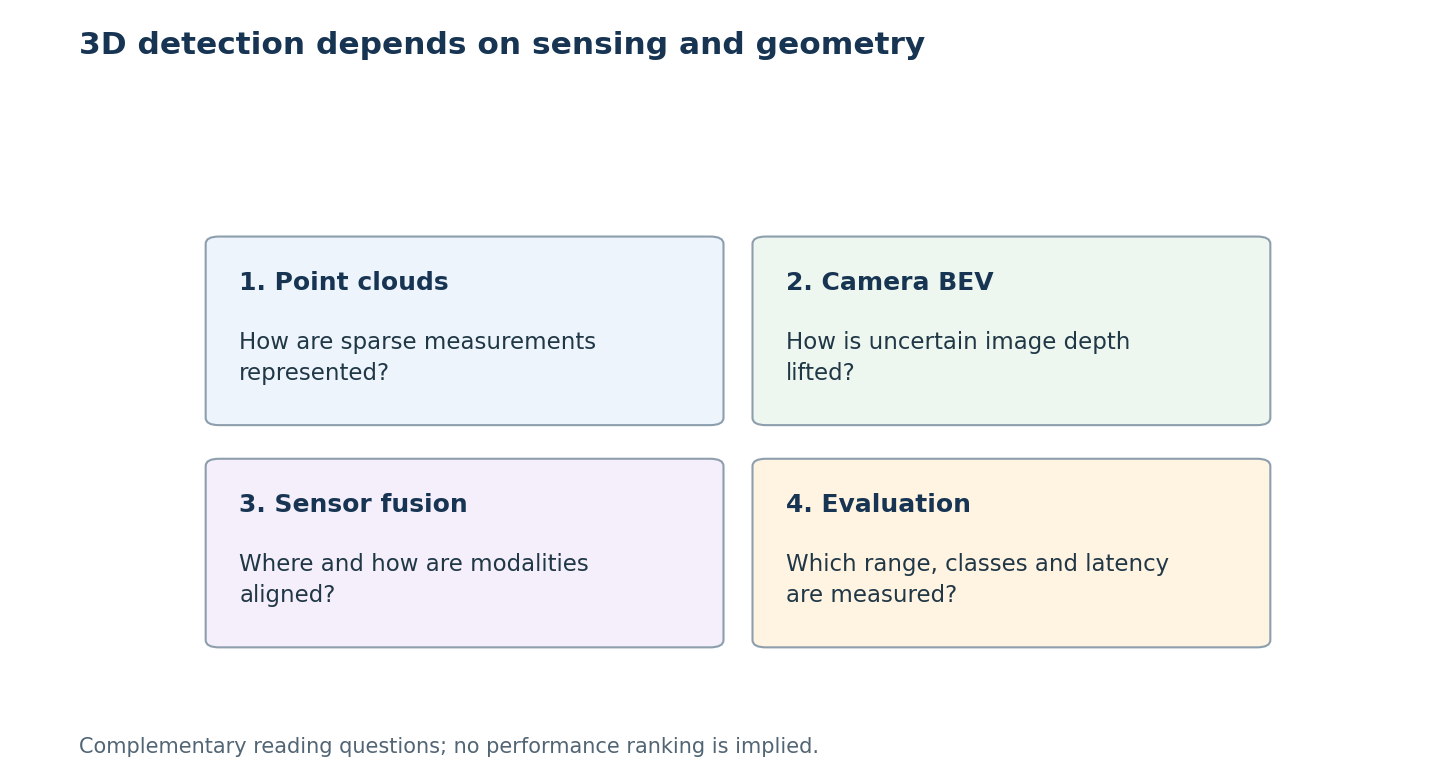
Organize these surveys by the evidence a model receives. Point-cloud methods exploit measured range but must handle sparsity and visibility. Camera-to-BEV methods infer depth or occupancy from images. Multi-modal methods combine complementary sensors and inherit calibration, timing and correspondence requirements. BEV is a representation choice, not a sensor or an automatic guarantee of accurate 3D geometry.
Benchmark differences can dominate a comparison. Check the coordinate frame, box convention, sensor configuration, training split, range and class definitions before comparing detection metrics. Extra frames or sensors change available information, while temporal aggregation also changes latency and synchronization requirements. Efficiency claims must include the relevant preprocessing and feature construction. The surveys help locate representation and fusion choices; the original methods establish what data and geometric supervision were actually used. A useful next reading is one complete path from a sensor sample to a box in world coordinates, with uncertainty and calibration assumptions written down at each conversion.
References
- J. Mao, S. Shi, X. Wang and H. Li, “3D object detection for autonomous driving: A comprehensive survey,” International Journal of Computer Vision, vol. 131, no. 8, 2023. doi
- R. Qian, X. Lai and X. Li, “3D object detection for autonomous driving: A survey,” Pattern Recognition, vol. 130, 2022. doi
- P. Sun, H. Kretzschmar, X. Dotiwalla, A. Chouard, V. Patnaik et al., “Scalability in perception for autonomous driving: Waymo Open Dataset,” in Proc. IEEE/CVF CVPR, 2020. CVF
- H. Caesar, V. Bankiti, A. H. Lang, S. Vora, V. E. Liong et al., “nuScenes: A multimodal dataset for autonomous driving,” in Proc. IEEE/CVF CVPR, 2020. CVF
- M. A. Fischler and R. C. Bolles, “Random sample consensus: A paradigm for model fitting with applications to image analysis and automated cartography,” Communications of the ACM, vol. 24, no. 6, 1981. doi
- M. Ester, H.-P. Kriegel, J. Sander and X. Xu, “A density-based algorithm for discovering clusters in large spatial databases with noise,” in Proc. KDD, 1996. AAAI
- X. Zhang, W. Xu, C. Dong and J. M. Dolan, “Efficient L-shape fitting for vehicle detection using laser scanners,” in Proc. IEEE Intelligent Vehicles Symposium (IV), 2017. doi
- Y. Zhou and O. Tuzel, “VoxelNet: End-to-end learning for point cloud based 3D object detection,” in Proc. IEEE CVPR, 2018. CVF
- Y. Yan, Y. Mao and B. Li, “SECOND: Sparsely embedded convolutional detection,” Sensors, vol. 18, no. 10, 3337, 2018. doi
- A. H. Lang, S. Vora, H. Caesar, L. Zhou, J. Yang and O. Beijbom, “PointPillars: Fast encoders for object detection from point clouds,” in Proc. IEEE/CVF CVPR, 2019. CVF
- T. Yin, X. Zhou and P. Krähenbühl, “Center-based 3D object detection and tracking,” in Proc. IEEE/CVF CVPR, 2021. CVF
- I. E. Sutherland and G. W. Hodgman, “Reentrant polygon clipping,” Communications of the ACM, vol. 17, no. 1, 1974. doi
- X. Zhou, D. Wang and P. Krähenbühl, “Objects as points,” arXiv:1904.07850, 2019. arXiv
- N. Carion, F. Massa, G. Synnaeve, N. Usunier, A. Kirillov and S. Zagoruyko, “End-to-end object detection with transformers,” in Proc. ECCV, 2020. doi
- Y. Wang, V. Guizilini, T. Zhang, Y. Wang, H. Zhao and J. Solomon, “DETR3D: 3D object detection from multi-view images via 3D-to-2D queries,” in Proc. Conference on Robot Learning (CoRL), 2021. arXiv
- C. R. Qi, H. Su, K. Mo and L. J. Guibas, “PointNet: Deep learning on point sets for 3D classification and segmentation,” in Proc. IEEE CVPR, 2017. arXiv
- C. R. Qi, L. Yi, H. Su and L. J. Guibas, “PointNet++: Deep hierarchical feature learning on point sets in a metric space,” in Advances in Neural Information Processing Systems (NeurIPS), 2017. NeurIPS
- S. Shi, X. Wang and H. Li, “PointRCNN: 3D object proposal generation and detection from point cloud,” in Proc. IEEE/CVF CVPR, 2019. arXiv
- S. Ren, K. He, R. Girshick and J. Sun, “Faster R-CNN: Towards real-time object detection with region proposal networks,” IEEE TPAMI, vol. 39, no. 6, 2017. doi
- B. Graham, M. Engelcke and L. van der Maaten, “3D semantic segmentation with submanifold sparse convolutional networks,” in Proc. IEEE CVPR, 2018. CVF
- S. Shi, C. Guo, L. Jiang, Z. Wang, J. Shi, X. Wang and H. Li, “PV-RCNN: Point-voxel feature set abstraction for 3D object detection,” in Proc. IEEE/CVF CVPR, 2020. arXiv
- W. Liu, D. Anguelov, D. Erhan, C. Szegedy, S. Reed, C.-Y. Fu and A. C. Berg, “SSD: Single shot multibox detector,” in Proc. ECCV, 2016. arXiv
- T.-Y. Lin, P. Goyal, R. Girshick, K. He and P. Dollár, “Focal loss for dense object detection,” in Proc. IEEE ICCV, 2017. doi
- J. Huang, G. Huang, Z. Zhu, Y. Ye and D. Du, “BEVDet: High-performance multi-camera 3D object detection in bird-eye-view,” arXiv:2112.11790, 2021. arXiv
- L. Fan, Z. Pang, T. Zhang, Y.-X. Wang, H. Zhao, F. Wang, N. Wang and Z. Zhang, “Embracing single stride 3D object detector with sparse transformer,” in Proc. IEEE/CVF CVPR, 2022. CVF
- H. Wang, C. Shi, S. Shi, M. Lei, S. Wang, D. He, B. Schiele and L. Wang, “DSVT: Dynamic sparse voxel transformer with rotated sets,” in Proc. IEEE/CVF CVPR, 2023. CVF
- Z. Liu, J. Hou, X. Wang, X. Ye, J. Wang, H. Zhao and X. Bai, “LION: Linear group RNN for 3D object detection in point clouds,” in Advances in Neural Information Processing Systems (NeurIPS), 2024. NeurIPS
- G. Zhang, L. Fan, C. He, Z. Lei, Z. Zhang and L. Zhang, “Voxel Mamba: Group-free state space models for point cloud based 3D object detection,” in Advances in Neural Information Processing Systems (NeurIPS), 2024. NeurIPS
- T. Wang, X. Zhu, J. Pang and D. Lin, “FCOS3D: Fully convolutional one-stage monocular 3D object detection,” in Proc. IEEE/CVF ICCV Workshops, 2021. arXiv
- Z. Tian, C. Shen, H. Chen and T. He, “FCOS: Fully convolutional one-stage object detection,” in Proc. IEEE/CVF ICCV, 2019. arXiv
- Y. Wang, W.-L. Chao, D. Garg, B. Hariharan, M. Campbell and K. Q. Weinberger, “Pseudo-LiDAR from visual depth estimation: Bridging the gap in 3D object detection for autonomous driving,” in Proc. IEEE/CVF CVPR, 2019. arXiv
- J. Philion and S. Fidler, “Lift, splat, shoot: Encoding images from arbitrary camera rigs by implicitly unprojecting to 3D,” in Proc. ECCV, 2020. arXiv
- Y. Li, Z. Ge, G. Yu, J. Yang, Z. Wang, Y. Shi, J. Sun and Z. Li, “BEVDepth: Acquisition of reliable depth for multi-view 3D object detection,” in Proc. AAAI, 2023. arXiv
- Y. Liu, T. Wang, X. Zhang and J. Sun, “PETR: Position embedding transformation for multi-view 3D object detection,” in Proc. ECCV, 2022. arXiv
- Z. Li, W. Wang, H. Li, E. Xie, C. Sima, T. Lu, Y. Qiao and J. Dai, “BEVFormer: Learning bird’s-eye-view representation from multi-camera images via spatiotemporal transformers,” in Proc. ECCV, 2022. arXiv
- X. Zhu, W. Su, L. Lu, B. Li, X. Wang and J. Dai, “Deformable DETR: Deformable transformers for end-to-end object detection,” in Proc. ICLR, 2021. arXiv
- S. Wang, Y. Liu, T. Wang, Y. Li and X. Zhang, “Exploring object-centric temporal modeling for efficient multi-view 3D object detection,” in Proc. IEEE/CVF ICCV, 2023. CVF
- X. Jiang, S. Li, Y. Liu, S. Wang, F. Jia, T. Wang, L. Han and X. Zhang, “Far3D: Expanding the horizon for surround-view 3D object detection,” in Proc. AAAI, 2024. arXiv
- Y. Wang, Q. Mao, H. Zhu, J. Deng, Y. Zhang, J. Ji, H. Li and Y. Zhang, “Multi-modal 3D object detection in autonomous driving: A survey,” International Journal of Computer Vision, vol. 131, no. 8, 2023. doi
- S. Vora, A. H. Lang, B. Helou and O. Beijbom, “PointPainting: Sequential fusion for 3D object detection,” in Proc. IEEE/CVF CVPR, 2020. arXiv
- X. Chen, H. Ma, J. Wan, B. Li and T. Xia, “Multi-view 3D object detection network for autonomous driving,” in Proc. IEEE CVPR, 2017. arXiv
- C. R. Qi, W. Liu, C. Wu, H. Su and L. J. Guibas, “Frustum PointNets for 3D object detection from RGB-D data,” in Proc. IEEE CVPR, 2018. CVF
- Z. Liu, H. Tang, A. Amini, X. Yang, H. Mao, D. Rus and S. Han, “BEVFusion: Multi-task multi-sensor fusion with unified bird’s-eye view representation,” in Proc. IEEE ICRA, 2023. arXiv
- T. Liang, H. Xie, K. Yu, Z. Xia, Z. Lin, Y. Wang, T. Tang, B. Wang et al., “BEVFusion: A simple and robust LiDAR-camera fusion framework,” in Advances in Neural Information Processing Systems (NeurIPS), 2022. arXiv
- X. Bai, Z. Hu, X. Zhu, Q. Huang, Y. Chen, H. Fu and C.-L. Tai, “TransFusion: Robust LiDAR-camera fusion for 3D object detection with transformers,” in Proc. IEEE/CVF CVPR, 2022. arXiv
- H. Wang, H. Tang, S. Shi, A. Li, Z. Li, B. Schiele and L. Wang, “UniTR: A unified and efficient multi-modal transformer for bird’s-eye-view representation,” in Proc. IEEE/CVF ICCV, 2023. arXiv
- R. Nabati and H. Qi, “CenterFusion: Center-based radar and camera fusion for 3D object detection,” in Proc. IEEE/CVF WACV, 2021. doi
- A. Geiger, P. Lenz, C. Stiller and R. Urtasun, “3D object detection evaluation 2017,” The KITTI Vision Benchmark Suite, official benchmark page (data sizes, IoU thresholds, difficulty levels, 40 recall positions). link
- A. Geiger, P. Lenz and R. Urtasun, “Are we ready for autonomous driving? The KITTI vision benchmark suite,” in Proc. IEEE CVPR, 2012. doi
- nuScenes devkit, “nuScenes detection task,” official evaluation documentation (classes, detection ranges, mAP, TP metrics, NDS, submission rules). link
- Waymo Open Dataset, “3D detection challenge (2020),” official challenge page (APH, IoU thresholds, LEVEL_1/LEVEL_2, range breakdown). link
- A. Simonelli, S. Rota Bulò, L. Porzi, M. López-Antequera and P. Kontschieder, “Disentangling monocular 3D object detection,” in Proc. IEEE/CVF ICCV, 2019. doi
- Waymo Open Dataset,
metrics_utils.cc, official metric implementation (functionComputeHeadingAccuracy). code - M. Hahner, C. Sakaridis, D. Dai and L. Van Gool, “Fog simulation on real LiDAR point clouds for 3D object detection in adverse weather,” in Proc. IEEE/CVF ICCV, 2021. arXiv
- Y. Dong, C. Kang, J. Zhang, Z. Zhu, Y. Wang, X. Yang, H. Su, X. Wei et al., “Benchmarking robustness of 3D object detection to common corruptions in autonomous driving,” in Proc. IEEE/CVF CVPR, 2023. arXiv
- Y. Wang, X. Chen, Y. You, L. E. Li, B. Hariharan, M. Campbell, K. Q. Weinberger and W.-L. Chao, “Train in Germany, test in the USA: Making 3D object detectors generalize,” in Proc. IEEE/CVF CVPR, 2020. arXiv
- Y. Guo, H. Wang, Q. Hu, H. Liu, L. Liu and M. Bennamoun, “Deep learning for 3D point clouds: A survey,” IEEE TPAMI, vol. 43, no. 12, 2021. doi
- Y. Ma, T. Wang, X. Bai, H. Yang, Y. Hou, Y. Wang, Y. Qiao, R. Yang and X. Zhu, “Vision-centric BEV perception: A survey,” IEEE TPAMI, vol. 46, no. 12, 2024. doi
- H. Li, C. Sima, J. Dai, W. Wang, L. Lu, H. Wang, J. Zeng, Z. Li et al., “Delving into the devils of bird’s-eye-view perception: A review, evaluation and recipe,” IEEE TPAMI, vol. 46, no. 4, 2024. doi
- X. Wu, L. Jiang, P.-S. Wang, Z. Liu, X. Liu, Y. Qiao, W. Ouyang, T. He and H. Zhao, “Point Transformer V3: Simpler, faster, stronger,” in Proc. IEEE/CVF CVPR, 2024. arXiv
- Y. Hu, J. Yang, L. Chen, K. Li, C. Sima, X. Zhu, S. Chai, S. Du et al., “Planning-oriented autonomous driving,” in Proc. IEEE/CVF CVPR, 2023. arXiv