InvSR:學得的影像條件起點(CVPR 2025)
選讀・DLCV 09A.2・單步擴散超解析度 的論文導讀(第 6/8 篇)。引用編號對應本頁底部的參考文獻。
導覽:本頁與本系列: 導覽:本頁與本系列
挑戰
固定反向擴散已有影像先驗,但 LR 不提供能通往未知 HR 的正確吵狀態。InvSR [7] 學習起點建構,讓少數反向步產生復原,而非只調適反向去雜訊器。
逐張最佳化反演昂貴,逐步預測整串雜訊也複雜,因此只預測選定中間時間的起始擾動。
方法
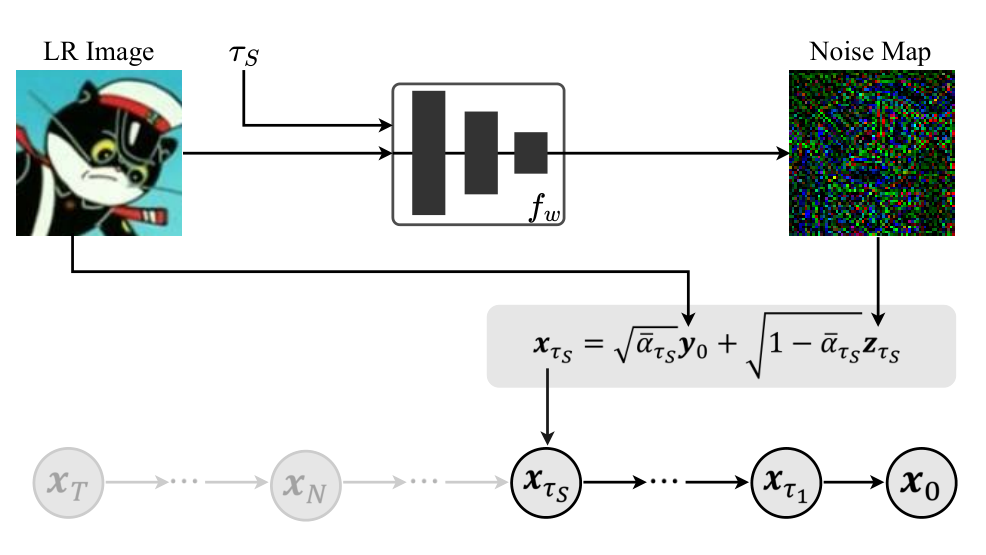
圖片來源: [7], arXiv:2412.09013v2, PDF 第 5 頁. 原始 PDF.
部分預測。 從較高訊雜比的中間時間開始,利用 LR 已有結構,再以快速取樣跳步。主實驗考慮 一至五個反向步,不必回到原純雜訊邊界。
學得狀態。 時間條件預測器 接收放大 LR 或潛在表示,產生擾動,形成:
是 LR 表示, 是起始時間, 是預訓練排程。預測器可藉平均與變異數參數化擾動;擾動允許與輸入相關,以補償 取代未知 HR,不必是獨立零均值標準高斯。
固定反向先驗。 從預測狀態執行 ADD 衍生快速先驗 [14],也比較一般潛在擴散 [29]。凍結權重仍可讓梯度穿過網路訓練起點,且訓練/部署仍須付出執行成本。
中間隨機性。 不為每個訪問狀態另預測擾動,而沿用預訓練程序的取樣雜訊。額外中間預測器在選定高訊雜比範圍效益很小,不能外推所有擴散反演皆只需一個預測。
損失。 在選定反向程序後評估 L2、感知及對抗項。實作在潛在域計算並調適感知比較器,訓練起點使固定先驗輸出有用結果;部署不需 HR 或逐圖最佳化。
預算選擇。 時間嵌入讓預測器學多種起始時間;推論選起點及跳步序列。起始時間與反向步數是不同控制,更多更新也可能放大雜訊。「任意步數」須限於已訓練及驗證範圍。
結果
ImageNet-Test 單步列的 PSNR/LPIPS/NIQE/MUSIQ 為 24.14/0.2517/4.3815/72.2900;RealSR 24.50/0.2872/4.2189/67.4586。依原文起始時間及前處理而定;小起點網路參數不代表完整大型先驗的大小。
固定一個反向步,起始時間 250 得 PSNR/MUSIQ 23.84/72.5773,時間 100 為 24.66/70.8251。同樣步數也有不同保真/外觀,不能只用步數識別操作點。
消融實驗
一步、起始時間 200,快速先驗 LPIPS 0.2517,一般替代先驗 0.2647。這支持特定骨幹設定,不代表蒸餾普遍改善所有反演方法。
五步加入中間雜訊預測,LPIPS 顯示精度下仍 0.2844→0.2844,MUSIQ 69.8427→69.8466,效益極小。L2-only 為 PSNR/LPIPS 26.71/0.2850,合併感知/對抗為 24.14/0.2517。感知改善伴隨像素保真下降,更多步也可能放大輸入雜訊。
結論
學有用起點,可讓固定生成先驗成為短預算復原器;起始時間、預測器及取樣器都是系統的一部分。
限制與問題
陌生退化可能讓起點不適合,大型先驗及解碼器仍保留。一次反向步還有起點預測與表示處理,不是總共一次網路呼叫。合理軌跡不證明輸出紋理真的屬於原照片。
參考文獻
- R. Wu, L. Sun, Z. Ma, L. Zhang, “One-Step Effective Diffusion Network for Real-World Image Super-Resolution,” NeurIPS, 2024. source
- Z. Yue, J. Wang, C. C. Loy, “ResShift: Efficient Diffusion Model for Image Super-resolution by Residual Shifting,” NeurIPS, 2023. source
- Y. Wang, W. Yang, X. Chen, et al., “SinSR: Diffusion-Based Image Super-Resolution in a Single Step,” CVPR, 2024. source · supplementary ablations
- A. Zhang, Z. Yue, R. Pei, W. Ren, X. Cao, “Degradation-Guided One-Step Image Super-Resolution with Diffusion Priors,” arXiv preprint, 2024. paper
- Y. Tai, R. Xie, C. Zhao, K. Zhang, Z. Zhang, J. Zhou, J. Yang, “AddSR: Accelerating diffusion-based blind super-resolution with adversarial diffusion distillation,” Pattern Recognition, 2026. published version · manuscript supplying the discussed tables
- L. Dong, Q. Fan, Y. Guo, Z. Wang, Q. Zhang, J. Chen, Y. Luo, C. Zou, “TSD-SR: One-Step Diffusion with Target Score Distillation for Real-World Image Super-Resolution,” CVPR, 2025. paper
- Z. Yue, K. Liao, C. C. Loy, “Arbitrary-steps Image Super-resolution via Diffusion Inversion,” CVPR, 2025. paper
- L. Sun, R. Wu, Z. Ma, S. Liu, Q. Yi, L. Zhang, “Pixel-level and Semantic-level Adjustable Super-resolution: A Dual-LoRA Approach,” CVPR, 2025. paper
- A. Liu, Y. Liu, J. Gu, Y. Qiao, C. Dong, “Blind Image Super-Resolution: A Survey and Beyond,” IEEE TPAMI (early access), 2022. source
- B. B. Moser, A. S. Shanbhag, F. Raue, S. Frolov, S. Palacio and A. Dengel, “Diffusion Models, Image Super-Resolution, and Everything: A Survey,” IEEE Transactions on Neural Networks and Learning Systems, vol. 36, no. 7, pp. 11793–11813, 2025. doi · arXiv
- E. J. Hu, Y. Shen, P. Wallis, Z. Allen-Zhu, Y. Li, S. Wang, L. Wang, W. Chen, “LoRA: Low-Rank Adaptation of Large Language Models,” ICLR, 2022. source
- R. Zhang, P. Isola, A. A. Efros, E. Shechtman and O. Wang, “The Unreasonable Effectiveness of Deep Features as a Perceptual Metric,” in Proc. IEEE/CVF CVPR, 2018, pp. 586–595. doi · arXiv
- Z. Wang, C. Lu, Y. Wang, F. Bao, C. Li, H. Su, J. Zhu, “ProlificDreamer: High-Fidelity and Diverse Text-to-3D Generation with Variational Score Distillation,” NeurIPS, 2023. paper
- A. Sauer, D. Lorenz, A. Blattmann, R. Rombach, “Adversarial Diffusion Distillation,” ECCV, 2024. paper
- J. Cai, H. Zeng, H. Yong, Z. Cao, L. Zhang, “Toward Real-World Single Image Super-Resolution: A New Benchmark and a New Model,” Proceedings of the IEEE/CVF International Conference on Computer Vision, 2019. source
- P. Wei, Z. Xie, H. Lu, Z. Zhan, Q. Ye, W. Zuo, L. Lin, “Component Divide-and-Conquer for Real-World Image Super-Resolution,” ECCV, 2020. source
- E. Agustsson and R. Timofte, “NTIRE 2017 Challenge on Single Image Super-Resolution: Dataset and Study,” in Proc. IEEE CVPR Workshops, 2017, pp. 1122–1131. doi · CVF
- Z. Wang, A. C. Bovik, H. R. Sheikh and E. P. Simoncelli, “Image Quality Assessment: From Error Visibility to Structural Similarity,” IEEE Transactions on Image Processing, vol. 13, no. 4, pp. 600–612, 2004. doi
- K. Ding, K. Ma, S. Wang, E. P. Simoncelli, “Image Quality Assessment: Unifying Structure and Texture Similarity,” IEEE TPAMI, 2022. source
- A. Mittal, R. Soundararajan and A. C. Bovik, “Making a “Completely Blind” Image Quality Analyzer,” IEEE Signal Processing Letters, vol. 20, no. 3, pp. 209–212, 2013. doi
- J. Ke, Q. Wang, Y. Wang, P. Milanfar, F. Yang, “MUSIQ: Multi-scale Image Quality Transformer,” ICCV, 2021. source
- S. Yang, T. Wu, S. Shi, S. Lao, Y. Gong, M. Cao, J. Wang, Y. Yang, “MANIQA: Multi-dimension Attention Network for No-Reference Image Quality Assessment,” CVPR Workshops, 2022. source
- J. Wang, K. C. K. Chan, C. C. Loy, “Exploring CLIP for Assessing the Look and Feel of Images,” AAAI, 2023. source
- X. Fan, Z. Wu, H. Wu, L. Cao, “A Survey on Pre-Trained Diffusion Model Distillations,” arXiv preprint, version 2, 2025. paper
- Z. Wu, Y. Dong, X. Wei, “TUDSR: Twice Upsampling-Diffusion for Higher Super-Resolution,” CVPR, 2026. paper
- P. Esser, R. Rombach, B. Ommer, “Taming Transformers for High-Resolution Image Synthesis,” CVPR, 2021. paper
- X. Wang, L. Xie, C. Dong, Y. Shan, “Real-ESRGAN: Training Real-World Blind Super-Resolution With Pure Synthetic Data,” Proceedings of the IEEE/CVF International Conference on Computer Vision, 2021. source
- J. Deng, W. Dong, R. Socher, L. Li, Kai Li, Li Fei-Fei, “ImageNet: A large-scale hierarchical image database,” CVPR, 2009. doi
- R. Rombach, A. Blattmann, D. Lorenz, P. Esser, B. Ommer, “High-Resolution Image Synthesis with Latent Diffusion Models,” CVPR, 2022. source
- R. Wu, T. Yang, L. Sun, Z. Zhang, S. Li, L. Zhang, “SeeSR: Towards Semantics-Aware Real-World Image Super-Resolution,” Proceedings of the IEEE/CVF Conference on Computer Vision and Pattern Recognition, 2024. source · supplementary experiments
- H. Liu, C. Li, Q. Wu, Y. J. Lee, “Visual Instruction Tuning,” NeurIPS, 2023. source
- Y. Li, K. Zhang, J. Liang, et al., “LSDIR: A Large Scale Dataset for Image Restoration,” CVPR Workshops, 2023. paper
- T. Karras, S. Laine, T. Aila, “A Style-Based Generator Architecture for Generative Adversarial Networks,” CVPR, 2019. paper
- I. Loshchilov, F. Hutter, “Decoupled Weight Decay Regularization,” ICLR, 2019. paper
- P. Esser, S. Kulal, A. Blattmann, et al., “Scaling Rectified Flow Transformers for High-Resolution Image Synthesis,” ICML, 2024. paper
- J. Ho, T. Salimans, “Classifier-Free Diffusion Guidance,” arXiv preprint, 2022. paper
- R. Timofte, E. Agustsson, L. Van Gool, M.-H. Yang, L. Zhang et al., “NTIRE 2017 Challenge on Single Image Super-Resolution: Methods and Results,” in Proc. IEEE CVPR Workshops, 2017, pp. 1110–1121. doi · CVF