BasicVSR and IconVSR
Optional · paper guide 1 of 2 for DLCV 09A.3 · Video Super-Resolution: Using Time to Recover Detail. Citation numbers refer to the reference list at the bottom of this page.
Navigate: this page and this track: Navigate: this page and this track
Challenge
By 2020 VSR methods had become complex and dissimilar (multi-scale deformable alignment with attention in EDVR, several projection modules in RBPN), which made them slow, hard to reimplement and hard to compare fairly. BasicVSR [7] asks which components actually matter.
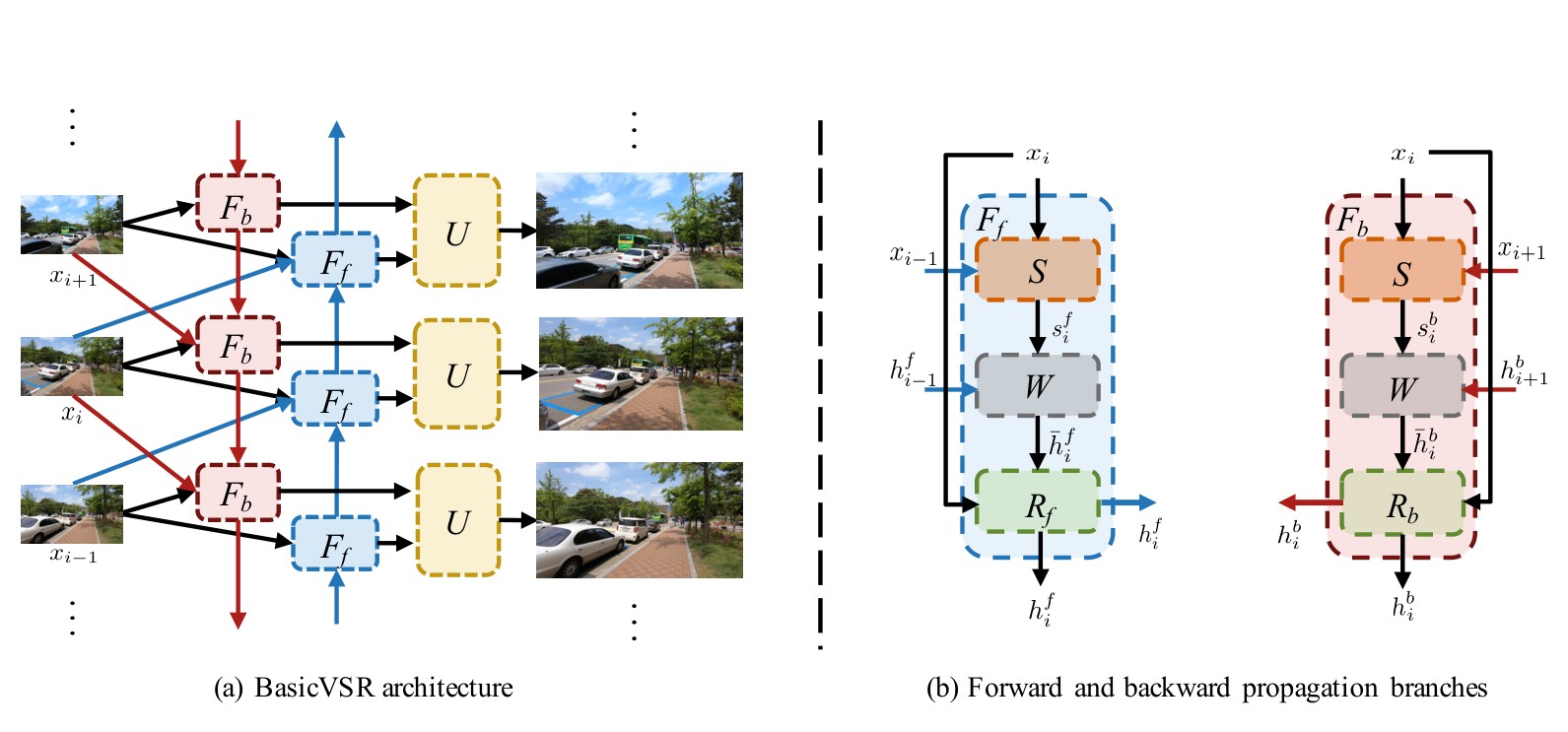
Figure source: [7], Published paper PDF, PDF page 3. Original PDF.
Method
Decompose VSR methods into four functions, propagation, alignment, aggregation and upsampling, and test the options for each with minimal designs. The paper’s Table 1 classifies existing methods this way (local, unidirectional or bidirectional propagation; no alignment, flow or deformable alignment; concatenation-based aggregation; pixel-shuffle upsampling). BasicVSR itself is the simplest combination that worked best: bidirectional propagation, flow-based (SPyNet) alignment of features, concatenation and pixel shuffle.
Results
The ablations are the core of the paper, and the numbers here are the paper’s own. Splitting test sequences into independent segments lowers PSNR, most at segment ends, which argues for long-range propagation (its Fig. 3). A unidirectional variant is markedly worse at early frames and, overall, about 0.5 dB worse than the bidirectional model (Fig. 4). Removing alignment costs 1.19 dB, and warping images instead of features costs 0.17 dB. The extension IconVSR adds keyframe information-refill and coupled propagation to reduce error accumulation, reporting up to 0.31 dB over BasicVSR.
Reading the evidence
Start with Table 1 and Section 3.1, which together are a compact map of the field. In the main comparison table, check: (a) the degradation of each column (REDS4 under BI only, UDM10 under BD only, Vimeo-90K-T and Vid4 under both); (b) the channel (Y everywhere except REDS4, which is RGB); (c) the training set behind each column (REDS for REDS4, Vimeo-90K for the rest); (d) runtimes, which depend on hardware and LR size. In the ablations, note that each one modifies a variant of BasicVSR, so the drops measure the component’s value inside this design, not in general.
Problems
Bidirectional propagation needs the whole sequence, so BasicVSR is an offline method. Flow-based alignment inherits flow errors under large motion and occlusion, which BasicVSR++ addresses with flow-guided deformable alignment [20]. The study is on clean BI/BD degradations; RealBasicVSR [27] shows that the same long-range propagation can amplify severe real-world artifacts.
Conclusion
It gives the vocabulary used throughout this chapter, and it is the baseline from which BasicVSR++, RealBasicVSR and several diffusion VSR models were built.
References
- S. Farsiu, M. D. Robinson, M. Elad and P. Milanfar, “Fast and Robust Multiframe Super Resolution,” IEEE Transactions on Image Processing, vol. 13, no. 10, pp. 1327–1344, 2004. doi
- J. Caballero, C. Ledig, A. Aitken, A. Acosta, J. Totz, Z. Wang and W. Shi, “Real-Time Video Super-Resolution with Spatio-Temporal Networks and Motion Compensation,” in Proc. IEEE CVPR, 2017. CVF · arXiv
- M. S. M. Sajjadi, R. Vemulapalli and M. Brown, “Frame-Recurrent Video Super-Resolution,” in Proc. IEEE/CVF CVPR, 2018. CVF · arXiv
- M. Irani and S. Peleg, “Improving Resolution by Image Registration,” CVGIP: Graphical Models and Image Processing, vol. 53, no. 3, pp. 231–239, 1991. doi
- M. Haris, G. Shakhnarovich and N. Ukita, “Recurrent Back-Projection Network for Video Super-Resolution,” in Proc. IEEE/CVF CVPR, 2019. CVF · arXiv
- M. Guizar-Sicairos, S. T. Thurman and J. R. Fienup, “Efficient Subpixel Image Registration Algorithms,” Optics Letters, vol. 33, no. 2, p. 156, 2008. doi
- K. C. K. Chan, X. Wang, K. Yu, C. Dong and C. C. Loy, “BasicVSR: The Search for Essential Components in Video Super-Resolution and Beyond,” in Proc. IEEE/CVF CVPR, 2021. CVF · arXiv
- B. K. P. Horn and B. G. Schunck, “Determining Optical Flow,” Artificial Intelligence, vol. 17, no. 1–3, pp. 185–203, 1981. doi
- G. Farnebäck, “Two-Frame Motion Estimation Based on Polynomial Expansion,” in Image Analysis (Lecture Notes in Computer Science), pp. 363–370, Springer, 2003. doi
- A. Ranjan and M. J. Black, “Optical Flow Estimation Using a Spatial Pyramid Network,” in Proc. IEEE CVPR, 2017. CVF · arXiv
- Z. Teed and J. Deng, “RAFT: Recurrent All-Pairs Field Transforms for Optical Flow,” in Proc. ECCV (Lecture Notes in Computer Science), pp. 402–419, 2020. doi · arXiv
- M. Jaderberg, K. Simonyan, A. Zisserman and K. Kavukcuoglu, “Spatial Transformer Networks,” in Advances in Neural Information Processing Systems (NeurIPS), 2015. proceedings · arXiv
- W. Shi, J. Caballero, F. Huszár, J. Totz, A. P. Aitken, R. Bishop, D. Rueckert and Z. Wang, “Real-Time Single Image and Video Super-Resolution Using an Efficient Sub-Pixel Convolutional Neural Network,” in Proc. IEEE CVPR, 2016. arXiv
- T. Xue, B. Chen, J. Wu, D. Wei and W. T. Freeman, “Video Enhancement with Task-Oriented Flow,” International Journal of Computer Vision, vol. 127, no. 8, pp. 1106–1125, 2019. doi · arXiv
- J. Dai, H. Qi, Y. Xiong, Y. Li, G. Zhang, H. Hu and Y. Wei, “Deformable Convolutional Networks,” in Proc. IEEE ICCV, 2017. CVF · arXiv
- X. Zhu, H. Hu, S. Lin and J. Dai, “Deformable ConvNets V2: More Deformable, Better Results,” in Proc. IEEE/CVF CVPR, 2019. CVF · arXiv
- Y. Tian, Y. Zhang, Y. Fu and C. Xu, “TDAN: Temporally-Deformable Alignment Network for Video Super-Resolution,” in Proc. IEEE/CVF CVPR, 2020. CVF · arXiv
- X. Wang, K. C. K. Chan, K. Yu, C. Dong and C. C. Loy, “EDVR: Video Restoration with Enhanced Deformable Convolutional Networks,” in Proc. IEEE/CVF CVPR Workshops, 2019. CVF · arXiv
- K. C. K. Chan, X. Wang, K. Yu, C. Dong and C. C. Loy, “Understanding Deformable Alignment in Video Super-Resolution,” in Proc. AAAI Conference on Artificial Intelligence, vol. 35, no. 2, pp. 973–981, 2021. doi · arXiv
- K. C. K. Chan, S. Zhou, X. Xu and C. C. Loy, “BasicVSR++: Improving Video Super-Resolution with Enhanced Propagation and Alignment,” in Proc. IEEE/CVF CVPR, 2022. CVF · arXiv
- Y. Jo, S. W. Oh, J. Kang and S. J. Kim, “Deep Video Super-Resolution Network Using Dynamic Upsampling Filters Without Explicit Motion Compensation,” in Proc. IEEE/CVF CVPR, 2018. CVF
- P. Yi, Z. Wang, K. Jiang, J. Jiang and J. Ma, “Progressive Fusion Video Super-Resolution Network via Exploiting Non-Local Spatio-Temporal Correlations,” in Proc. IEEE/CVF ICCV, 2019. CVF · code and test data (Vid4, UDM10)
- J. Liang, J. Cao, Y. Fan, K. Zhang, R. Ranjan, Y. Li, R. Timofte and L. Van Gool, “VRT: A Video Restoration Transformer,” IEEE Transactions on Image Processing, vol. 33, pp. 2171–2182, 2024. doi · arXiv
- J. Liang, Y. Fan, X. Xiang, R. Ranjan, E. Ilg, S. Green, J. Cao, K. Zhang, R. Timofte and L. Van Gool, “Recurrent Video Restoration Transformer with Guided Deformable Attention,” in Advances in Neural Information Processing Systems (NeurIPS), vol. 35, pp. 378–393, 2022. arXiv
- T. Wiegand, G. J. Sullivan, G. Bjøntegaard and A. Luthra, “Overview of the H.264/AVC Video Coding Standard,” IEEE Transactions on Circuits and Systems for Video Technology, vol. 13, no. 7, pp. 560–576, 2003. doi
- Y. Li, P. Jin, F. Yang, C. Liu, M.-H. Yang and P. Milanfar, “COMISR: Compression-Informed Video Super-Resolution,” in Proc. IEEE/CVF ICCV, 2021. CVF · arXiv
- K. C. K. Chan, S. Zhou, X. Xu and C. C. Loy, “Investigating Tradeoffs in Real-World Video Super-Resolution,” in Proc. IEEE/CVF CVPR, 2022. CVF · arXiv
- S. Zhou, P. Yang, J. Wang, Y. Luo and C. C. Loy, “Upscale-A-Video: Temporal-Consistent Diffusion Model for Real-World Video Super-Resolution,” in Proc. IEEE/CVF CVPR, pp. 2535–2545, 2024. CVF · arXiv
- X. Yang, C. He, J. Ma and L. Zhang, “Motion-Guided Latent Diffusion for Temporally Consistent Real-World Video Super-Resolution,” in Proc. ECCV (Lecture Notes in Computer Science), pp. 224–242, 2024. doi · arXiv
- R. Xie, Y. Liu, P. Zhou, C. Zhao, J. Zhou, K. Zhang, Z. Zhang, J. Yang, Z. Yang and Y. Tai, “STAR: Spatial-Temporal Augmentation with Text-to-Video Models for Real-World Video Super-Resolution,” in Proc. IEEE/CVF ICCV, 2025. CVF · arXiv
- J. Wang, Z. Lin, M. Wei, Y. Zhao, C. Yang, C. C. Loy and L. Jiang, “SeedVR: Seeding Infinity in Diffusion Transformer Towards Generic Video Restoration,” in Proc. IEEE/CVF CVPR, 2025. CVF · arXiv
- Y. Sun, L. Sun, S. Liu, R. Wu, Z. Zhang and L. Zhang, “One-Step Diffusion for Detail-Rich and Temporally Consistent Video Super-Resolution,” in Advances in Neural Information Processing Systems (NeurIPS), vol. 38, 2025. arXiv
- W.-S. Lai, J.-B. Huang, O. Wang, E. Shechtman, E. Yumer and M.-H. Yang, “Learning Blind Video Temporal Consistency,” in Proc. ECCV, 2018. CVF · arXiv
- Z. Wang, A. C. Bovik, H. R. Sheikh and E. P. Simoncelli, “Image Quality Assessment: From Error Visibility to Structural Similarity,” IEEE Transactions on Image Processing, vol. 13, no. 4, pp. 600–612, 2004. doi
- ITU-R, “Recommendation ITU-R BT.601-7: Studio Encoding Parameters of Digital Television for Standard 4:3 and Wide-Screen 16:9 Aspect Ratios,” International Telecommunication Union, 2011. ITU
- M. Chu, Y. Xie, J. Mayer, L. Leal-Taixé and N. Thuerey, “Learning Temporal Coherence via Self-Supervision for GAN-based Video Generation,” ACM Transactions on Graphics, vol. 39, no. 4, article 75, 2020. doi · arXiv
- R. Zhang, P. Isola, A. A. Efros, E. Shechtman and O. Wang, “The Unreasonable Effectiveness of Deep Features as a Perceptual Metric,” in Proc. IEEE/CVF CVPR, 2018. CVF · arXiv
- S. Nah, S. Baik, S. Hong, G. Moon, S. Son, R. Timofte and K. M. Lee, “NTIRE 2019 Challenge on Video Deblurring and Super-Resolution: Dataset and Study,” in Proc. IEEE/CVF CVPR Workshops, 2019. CVF
- C. Liu and D. Sun, “On Bayesian Adaptive Video Super Resolution,” IEEE Transactions on Pattern Analysis and Machine Intelligence, vol. 36, no. 2, pp. 346–360, 2014. doi
- H. Liu, Z. Ruan, P. Zhao, C. Dong, F. Shang, Y. Liu, L. Yang and R. Timofte, “Video Super-Resolution Based on Deep Learning: A Comprehensive Survey,” Artificial Intelligence Review, vol. 55, no. 8, pp. 5981–6035, 2022. doi · arXiv
- S. Nah, R. Timofte, S. Gu, S. Baik, S. Hong, G. Moon, S. Son and K. M. Lee, “NTIRE 2019 Challenge on Video Super-Resolution: Methods and Results,” in Proc. IEEE/CVF CVPR Workshops, 2019. CVF
- S. Son, S. Lee, S. Nah, R. Timofte and K. M. Lee, “NTIRE 2021 Challenge on Video Super-Resolution,” in Proc. IEEE/CVF CVPR Workshops, 2021. CVF · arXiv
- A. Ignatov, R. Timofte et al., “Power Efficient Video Super-Resolution on Mobile NPUs with Deep Learning, Mobile AI & AIM 2022 Challenge: Report,” arXiv:2211.05256, 2022. arXiv
- M. V. Conde, Z. Lei, W. Li, C. Bampis, I. Katsavounidis, R. Timofte et al., “AIM 2024 Challenge on Efficient Video Super-Resolution for AV1 Compressed Content,” in Proc. ECCV Workshops (Lecture Notes in Computer Science), pp. 304–325, 2025. doi · arXiv
- Z. Tu, H. Li, W. Xie, Y. Liu, S. Zhang, B. Li and J. Yuan, “Optical Flow for Video Super-Resolution: A Survey,” Artificial Intelligence Review, vol. 55, no. 8, pp. 6505–6546, 2022. doi · arXiv
- A. A. Baniya, T.-K. Lee, P. W. Eklund and S. Aryal, “A Survey of Deep Learning Video Super-Resolution,” IEEE Transactions on Emerging Topics in Computational Intelligence, vol. 8, no. 4, pp. 2655–2676, 2024. doi · arXiv
- B. Wronski, I. Garcia-Dorado, M. Ernst, D. Kelly, M. Krainin, C.-K. Liang, M. Levoy and P. Milanfar, “Handheld Multi-Frame Super-Resolution,” ACM Transactions on Graphics, vol. 38, no. 4, 2019. doi · arXiv