Blattmann et al., “Stable Video Diffusion: Scaling Latent Video Diffusion Models to Large Datasets” (2023)
Optional · paper guide 1 of 2 for DLCV 12A · Video Generation. Citation numbers refer to the reference list at the bottom of this page.
Navigate: this page and this track: Navigate: this page and this track
Challenge
By 2023 many groups turned image latent diffusion models into video models by inserting temporal layers and fine-tuning on small, high-quality video sets, but training recipes varied widely and there was no agreed strategy for curating video data [4].
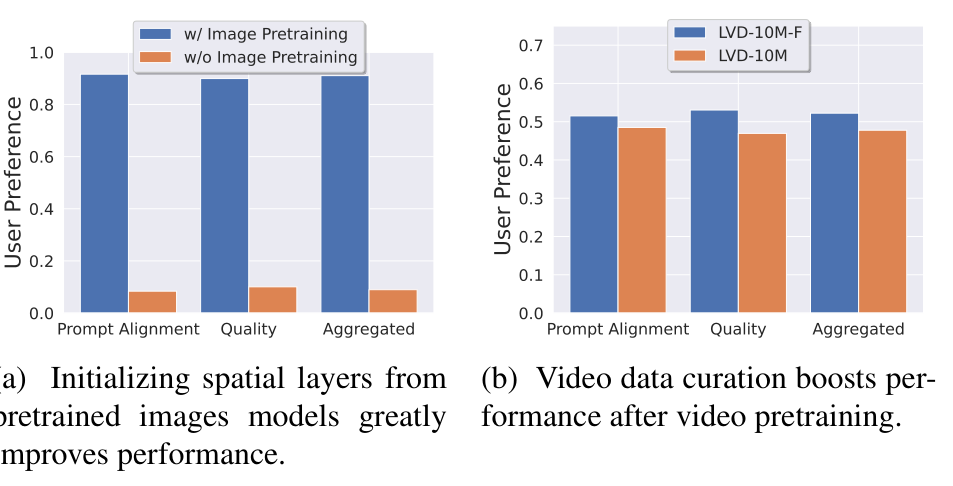
Figure source: [4], arXiv:2311.15127v1, PDF page 4. Original PDF.
Method
Treat training as three explicit stages and study each: (I) text-to-image pretraining (the model starts from a pretrained image latent diffusion model [14]); (II) video pretraining on large amounts of curated video; (III) fine-tuning on a small subset of high-quality videos at higher resolution. For stage II, build the Large Video Dataset (580M annotated clip pairs, 212 years of content) and annotate every clip with dense optical flow, OCR text detection, aesthetic scores and image–text similarities, plus synthetic captions, so that filters can be chosen systematically.
Results
An image-pretrained video model was preferred by people over the same model trained from scratch, in both quality and prompt following. Curated pretraining subsets (static clips, text-heavy clips and low-aesthetic clips removed; thresholds selected by human-preference ranking of small models) beat uncurated data of the same size, even when four times smaller, and the advantage persisted after stage III fine-tuning. The resulting base model gave a text-to-video model competitive with closed models in human studies, a strong image-to-video model (14 and 25 frames; image embedding instead of text, noise-augmented frame concatenated to the input, guidance increasing linearly over frames), camera-motion LoRAs, a frame-interpolation model and a multi-view 3D prior.
Reading the evidence
Read Section 3 (the three stages and the curation study) first; most of its evidence is in plots of human preference (Elo or win rates), not tables of FVD. Check: (a) which comparisons are made at small scale (most curation ablations) and which with the final model; (b) that human studies compare against specific closed systems at one point in time; (c) the appendix, which holds the filter thresholds, model details and the evaluation protocol.
Problems
The dataset is not released, so the curation results cannot be reproduced exactly; human-preference studies depend on prompts and annotators; the autoencoder compresses only in space, which keeps the number of latent frames equal to the number of frames.
Conclusion
It is the clearest documented case for the chapter’s point that video data curation (especially removing static clips) and staged training are as important as architecture, and it is the reference design for image-to-video conditioning.
References
- U. Singer, A. Polyak, T. Hayes et al., “Make-A-Video: Text-to-Video Generation without Text-Video Data,” arXiv:2209.14792, 2022. arXiv
- Z. Yang, J. Teng, W. Zheng et al., “CogVideoX: Text-to-Video Diffusion Models with An Expert Transformer,” ICLR, 2025. arXiv
- Team Wan, A. Wang, B. Ai, B. Wen et al., “Wan: Open and Advanced Large-Scale Video Generative Models,” arXiv:2503.20314, 2025. arXiv
- A. Blattmann, T. Dockhorn, S. Kulal et al., “Stable Video Diffusion: Scaling Latent Video Diffusion Models to Large Datasets,” arXiv:2311.15127, 2023. arXiv
- J. Xing, M. Xia, Y. Zhang et al., “DynamiCrafter: Animating Open-Domain Images with Video Diffusion Priors,” ECCV, LNCS, pp. 399–417, 2024. doi · arXiv
- J. Ho, T. Salimans, A. Gritsenko, W. Chan, M. Norouzi and D. J. Fleet, “Video Diffusion Models,” NeurIPS, 2022. proceedings · arXiv
- A. Blattmann, R. Rombach, H. Ling et al., “Align your Latents: High-Resolution Video Synthesis with Latent Diffusion Models,” CVPR, 2023. CVF
- R. Henschel, L. Khachatryan, H. Poghosyan et al., “StreamingT2V: Consistent, Dynamic, and Extendable Long Video Generation from Text,” CVPR, 2025. CVF
- J. Z. Wu, Y. Ge, X. Wang et al., “Tune-A-Video: One-Shot Tuning of Image Diffusion Models for Text-to-Video Generation,” ICCV, 2023. CVF
- L. Khachatryan, A. Movsisyan, V. Tadevosyan et al., “Text2Video-Zero: Text-to-Image Diffusion Models are Zero-Shot Video Generators,” ICCV, 2023. CVF
- Z. Wang, Z. Yuan, X. Wang et al., “MotionCtrl: A Unified and Flexible Motion Controller for Video Generation,” SIGGRAPH 2024 Conference Papers, 2024. doi · arXiv
- H. He, Y. Xu, Y. Guo et al., “CameraCtrl: Enabling Camera Control for Text-to-Video Generation,” ICLR, 2025. arXiv
- S. Yin, C. Wu, J. Liang et al., “DragNUWA: Fine-grained Control in Video Generation by Integrating Text, Image, and Trajectory,” arXiv:2308.08089, 2023. arXiv
- R. Rombach, A. Blattmann, D. Lorenz, P. Esser and B. Ommer, “High-Resolution Image Synthesis with Latent Diffusion Models,” CVPR, 2022. CVF
- L. Yu, J. Lezama, N. B. Gundavarapu et al., “Language Model Beats Diffusion — Tokenizer is Key to Visual Generation,” ICLR, 2024. arXiv
- W. Kong, Q. Tian, Z. Zhang et al., “HunyuanVideo: A Systematic Framework For Large Video Generative Models,” arXiv:2412.03603, 2024. arXiv
- A. Polyak, A. Zohar, A. Brown et al., “Movie Gen: A Cast of Media Foundation Models,” arXiv:2410.13720, 2024. arXiv
- Y. HaCohen, N. Chiprut, B. Brazowski et al., “LTX-Video: Realtime Video Latent Diffusion,” arXiv:2501.00103, 2024. arXiv
- D. Kondratyuk, L. Yu, X. Gu et al., “VideoPoet: A Large Language Model for Zero-Shot Video Generation,” ICML, PMLR 235, 2024. PMLR · arXiv
- L. Yu, Y. Cheng, K. Sohn et al., “MAGVIT: Masked Generative Video Transformer,” CVPR, 2023. CVF
- Y. Guo, C. Yang, A. Rao et al., “AnimateDiff: Animate Your Personalized Text-to-Image Diffusion Models without Specific Tuning,” ICLR, 2024. arXiv
- Z. Zheng, X. Peng, T. Yang et al., “Open-Sora: Democratizing Efficient Video Production for All,” arXiv:2412.20404, 2024. arXiv
- G. Bertasius, H. Wang and L. Torresani, “Is Space-Time Attention All You Need for Video Understanding?,” ICML, PMLR 139, 2021. PMLR
- A. Arnab, M. Dehghani, G. Heigold, C. Sun, M. Lučić and C. Schmid, “ViViT: A Video Vision Transformer,” ICCV, 2021. CVF
- X. Ma, Y. Wang, X. Chen et al., “Latte: Latent Diffusion Transformer for Video Generation,” Transactions on Machine Learning Research, 2025. arXiv
- B. Lin, Y. Ge, X. Cheng et al., “Open-Sora Plan: Open-Source Large Video Generation Model,” arXiv:2412.00131, 2024. arXiv
- J. Ho, W. Chan, C. Saharia et al., “Imagen Video: High Definition Video Generation with Diffusion Models,” arXiv:2210.02303, 2022. arXiv
- O. Bar-Tal, H. Chefer, O. Tov et al., “Lumiere: A Space-Time Diffusion Model for Video Generation,” SIGGRAPH Asia 2024 Conference Papers, 2024. doi · arXiv
- Y. Lipman, R. T. Q. Chen, H. Ben-Hamu, M. Nickel and M. Le, “Flow Matching for Generative Modeling,” arXiv:2210.02747, 2022. arXiv
- W. Peebles and S. Xie, “Scalable Diffusion Models with Transformers,” ICCV, 2023. CVF
- S. Yin, C. Wu, H. Yang et al., “NUWA-XL: Diffusion over Diffusion for eXtremely Long Video Generation,” ACL, pp. 1309–1320, 2023. doi · arXiv
- H. Qiu, M. Xia, Y. Zhang et al., “FreeNoise: Tuning-Free Longer Video Diffusion via Noise Rescheduling,” ICLR, 2024. arXiv
- R. Villegas, M. Babaeizadeh, P.-J. Kindermans et al., “Phenaki: Variable Length Video Generation From Open Domain Textual Description,” arXiv:2210.02399, 2022. arXiv
- Z. Huang, Y. He, J. Yu et al., “VBench: Comprehensive Benchmark Suite for Video Generative Models,” CVPR, 2024. CVF
- T. Yin, Q. Zhang, R. Zhang et al., “From Slow Bidirectional to Fast Autoregressive Video Diffusion Models,” CVPR, 2025. CVF
- B. Chen, D. M. Monso, Y. Du, M. Simchowitz, R. Tedrake and V. Sitzmann, “Diffusion Forcing: Next-token Prediction Meets Full-Sequence Diffusion,” NeurIPS, 2024. proceedings · arXiv
- X. Huang, Z. Li, G. He, M. Zhou and E. Shechtman, “Self Forcing: Bridging the Train-Test Gap in Autoregressive Video Diffusion,” NeurIPS, 2025. arXiv
- T. Unterthiner, S. van Steenkiste, K. Kurach, R. Marinier, M. Michalski and S. Gelly, “Towards Accurate Generative Models of Video: A New Metric & Challenges,” arXiv:1812.01717, 2018. arXiv
- J. Carreira and A. Zisserman, “Quo Vadis, Action Recognition? A New Model and the Kinetics Dataset,” CVPR, 2017. CVF
- W. Kay, J. Carreira, K. Simonyan et al., “The Kinetics Human Action Video Dataset,” arXiv:1705.06950, 2017. arXiv
- K. Soomro, A. R. Zamir and M. Shah, “UCF101: A Dataset of 101 Human Actions Classes From Videos in The Wild,” technical report CRCV-TR-12-01, arXiv:1212.0402, 2012. arXiv
- S. Ge, A. Mahapatra, G. Parmar, J.-Y. Zhu and J.-B. Huang, “On the Content Bias in Fréchet Video Distance,” CVPR, 2024. CVF
- L. Wang, B. Huang, Z. Zhao et al., “VideoMAE V2: Scaling Video Masked Autoencoders With Dual Masking,” CVPR, 2023. CVF
- Z. Huang, F. Zhang, X. Xu et al., “VBench++: Comprehensive and Versatile Benchmark Suite for Video Generative Models,” IEEE Transactions on Pattern Analysis and Machine Intelligence, vol. 48, no. 3, pp. 3268–3285, 2026. doi · arXiv
- Y. Liu, X. Cun, X. Liu et al., “EvalCrafter: Benchmarking and Evaluating Large Video Generation Models,” CVPR, 2024. CVF
- Z. Zheng, X. Peng, Y. Lou et al., “Open-Sora 2.0: Training a Commercial-Level Video Generation Model in $200k,” arXiv:2503.09642, 2025. arXiv
- M. Bain, A. Nagrani, G. Varol and A. Zisserman, “Frozen in Time: A Joint Video and Image Encoder for End-to-End Retrieval,” ICCV, 2021. CVF · arXiv
- T.-S. Chen, A. Siarohin, W. Menapace et al., “Panda-70M: Captioning 70M Videos with Multiple Cross-Modality Teachers,” CVPR, 2024. CVF
- A. Rössler, D. Cozzolino, L. Verdoliva, C. Riess, J. Thies and M. Nießner, “FaceForensics++: Learning to Detect Manipulated Facial Images,” ICCV, 2019. doi · arXiv
- P. Fernandez, H. Elsahar, I. Z. Yalniz and A. Mourachko, “Video Seal: Open and Efficient Video Watermarking,” arXiv:2412.09492, 2024. arXiv
- A. Melnik, M. Ljubljanac, C. Lu, Q. Yan, W. Ren and H. Ritter, “Video Diffusion Models: A Survey,” Transactions on Machine Learning Research, 2024. arXiv
- Z. Xing, Q. Feng, H. Chen et al., “A Survey on Video Diffusion Models,” arXiv:2310.10647, 2023. arXiv
- Y. Liu, K. Zhang, Y. Li et al., “Sora: A Review on Background, Technology, Limitations, and Opportunities of Large Vision Models,” arXiv:2402.17177, 2024. arXiv
- OpenAI, “What to know about the Sora discontinuation,” official service notice, 2026, accessed 5 November 2026. Notice.