InstaFlow: reflow, then endpoint distillation (ICLR 2024)
Optional · paper guide 3 of 7 for DLCV 12B · One-Step Generation. Citation numbers refer to the reference list at the bottom of this page.
Navigate: this page and this track: Navigate: this page and this track
On this page
- Progressive Distillation: two teacher moves in one student move (ICLR 2022)
- Consistency Models: the same endpoint along a path (ICML 2023)
- InstaFlow: reflow, then endpoint distillation (ICLR 2024)
- Latent Consistency Models: endpoints in a guided latent flow (2023)
- Adversarial Diffusion Distillation: a teacher and a discriminator (ECCV 2024)
- DMD: matching a teacher-defined distribution (CVPR 2024)
- DMD2: tracking the student and using real data (NeurIPS 2024)
Deep Learning for Computer Vision
Challenge
Directly regressing a one-step student onto a text-to-image diffusion sampler can be difficult. The teacher’s noise–image map can be highly curved and irregular even when its outputs are good. InstaFlow asks whether the map should be made easier before it is compressed [13]. Its answer combines text-conditioned reflow with endpoint distillation rather than treating one-step generation as a solver setting.
The distinction matters experimentally: a reflow model sampled with one Euler step is not the same as a one-step model distilled from the reflow map. The former still predicts local velocity. The latter explicitly predicts the finite endpoint change.
Method
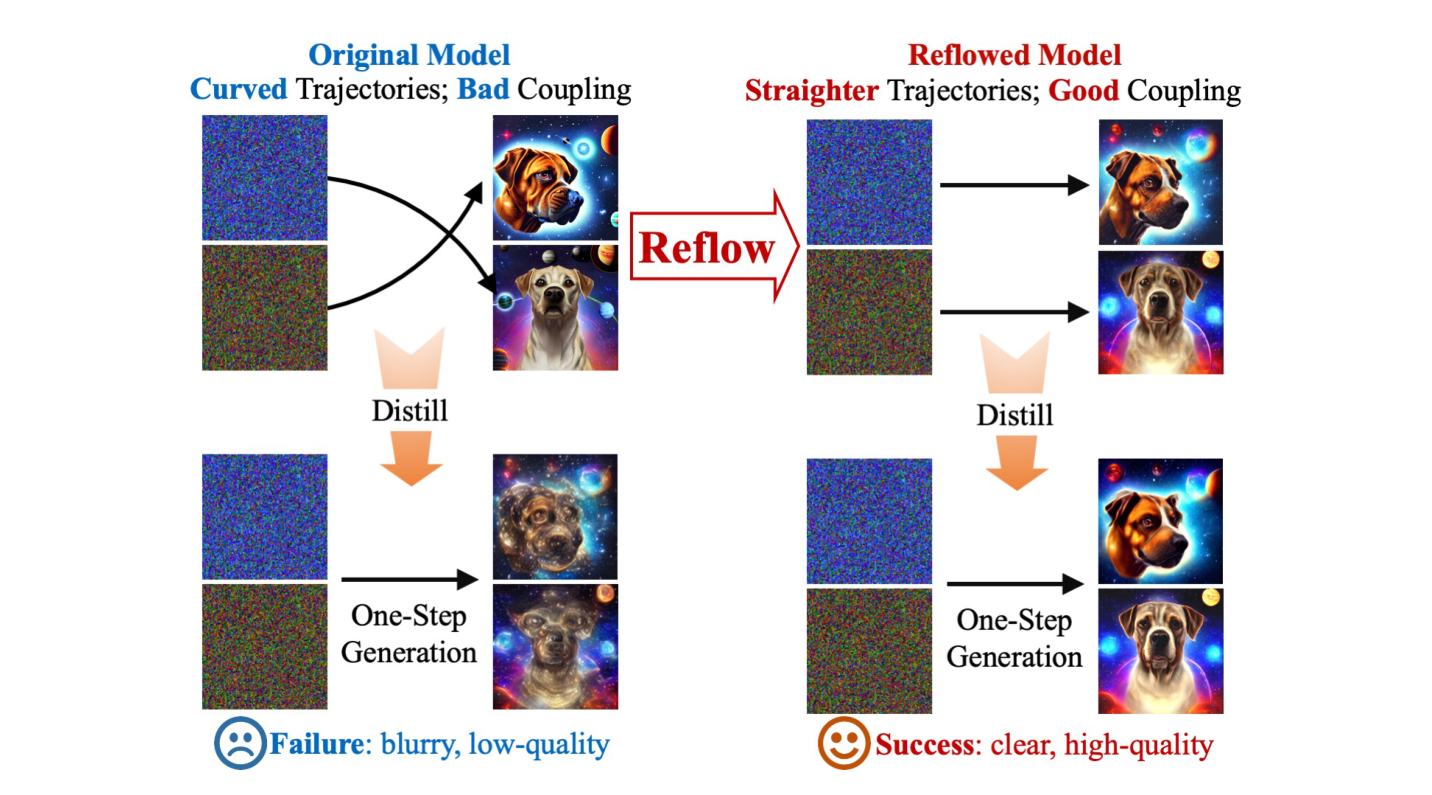
Figure source: [13], arXiv:2309.06380v2, PDF page 4. Original PDF.
Initial transport. A pretrained text-conditioned diffusion probability flow maps random noise to an image latent under prompt . The frozen autoencoder defines how latents become images [11]. Sampling this map creates paired noise–image targets. This data generation consumes a multi-step teacher during training, even though inference can eventually use one student call.
Text-conditioned rectified flow. Train a velocity field on linear interpolations with target . The network also receives time and prompt embeddings. The endpoints are paired by the previous sampler rather than sampled independently. The regression objective is an expectation over pairs, prompts and times. This is a learned marginal velocity field; different training lines can still cross in intermediate regions.
Reflow. Sample endpoints from the newly learned flow and repeat the coupling construction. In ideal conditions, reflow retains the endpoint marginal while reducing certain transport costs and tending toward straighter trajectories [12]. Finite data, approximate ODE solutions and imperfect neural fitting weaken the exact ideal statement. The paper uses a small number of reflow rounds because repeated rounds cost compute and can accumulate error.
One-step distillation. Given the selected reflow teacher endpoint , train a student displacement so that
Here measures endpoint discrepancy in the chosen representation. The output is a full generated latent, not an instantaneous Euler prediction at an arbitrary intermediate time. The student remains stochastic through its random input, even though the conditional map is deterministic.
Architecture and conditioning. The experiments compare a standard U-Net and a larger stacked-U-Net construction. Changing capacity affects quality and runtime, so the stacked result must not be presented as an objective-only ablation. Text-conditioned guidance is used when creating or sampling the learned flow; the selected prompt/guidance behavior is part of the target map. Distilling that behavior does not establish that all later text controls remain interchangeable.
Deployment. One student inference followed by the autoencoder decoder produces an image. Teacher endpoint generation, reflow fitting and endpoint distillation are training costs. The original image autoencoder is still required. A reported one-step latency should state whether text encoding and decoding are included and should retain the paper’s hardware and resolution.
Results
The preliminary comparison on 5,000 COCO 2017 samples reports FID 40.9 for direct one-step distillation from Stable Diffusion 1.4, 68.3 for taking one Euler step of the preliminary two-rectified-flow model, and 31.0 after distilling that reflow model. These three rows isolate the central conceptual difference more clearly than one headline speed number.
In the paper’s later trained system, the 0.9-billion-parameter one-step result gives COCO-2014 FID-30k 13.10 at a reported 0.09-second operating point. This is a different training setting from the preliminary rows above. The headline is an operating point under that system configuration, not a bound on what every prompt requires. The timing uses an A100 at batch size one. It should not be combined with another paper’s CPU, larger-image or cached-embedding latency to produce a method-only speedup.
Ablations
The preliminary reflow-plus-distillation comparison improves FID-5k from 40.9 to 31.0 over direct distillation with the U-Net. The stacked-U-Net direct-distillation baseline gives 52.0, whereas distilling the reflow mapping with the stacked network gives 24.6. More capacity alone therefore does not explain the benefit in that setup. Additional reflow is not uniformly better: the preliminary third-reflow stacked result is 26.3, worse than 24.6 for the second-reflow stacked result. A larger number of reflow rounds is not an automatic quality guarantee.
The paper also studies guidance and training choices. Its evidence supports the combination under its measured conditions, not a theorem that every text-to-image model becomes easy to distill after exactly one reflow round.
Conclusion
Coupling design and endpoint approximation are distinct levers. Reflow can make the teacher map more suitable for a low-budget student, and endpoint distillation can then learn the complete displacement rather than relying on a single tangent prediction.
Problems
Endpoint data generation is expensive. Each reflow and distillation stage can introduce error, and the student remains bound to its selected teacher coupling. Quality still differs across budgets and capacities. Rare prompts, guidance extrapolation and high-resolution detail require separate evaluation. Distribution-matching methods later relax samplewise teacher correspondence, but add the problem of estimating the student distribution [16].
References
- Y. Song, J. Sohl-Dickstein, D. P. Kingma, A. Kumar, S. Ermon, B. Poole, “Score-Based Generative Modeling through Stochastic Differential Equations,” ICLR, 2021. paper
- Y. Lipman, M. Havasi, P. Holderrieth, et al., “Flow Matching Guide and Code,” arXiv tutorial, 2024. paper
- T. Karras, M. Aittala, T. Aila, S. Laine, “Elucidating the Design Space of Diffusion-Based Generative Models,” NeurIPS, 2022. source
- X. Fan, Z. Wu, H. Wu, L. Cao, “A Survey on Pre-Trained Diffusion Model Distillations,” arXiv preprint, version 2, 2025. paper
- J. Song, C. Meng, S. Ermon, “Denoising Diffusion Implicit Models,” ICLR, 2021. paper
- C. Lu, Y. Zhou, F. Bao, J. Chen, C. Li, J. Zhu, “DPM-Solver: A Fast ODE Solver for Diffusion Probabilistic Model Sampling in Around 10 Steps,” NeurIPS, 2022. paper
- T. Salimans, J. Ho, “Progressive Distillation for Fast Sampling of Diffusion Models,” ICLR, 2022. paper
- Y. Song, P. Dhariwal, M. Chen, I. Sutskever, “Consistency Models,” ICML, 2023. paper
- Y. Song, P. Dhariwal, “Improved Techniques for Training Consistency Models,” ICLR, 2024. paper
- S. Luo, Y. Tan, L. Huang, J. Li, H. Zhao, “Latent Consistency Models: Synthesizing High-Resolution Images with Few-Step Inference,” arXiv preprint, 2023. paper
- R. Rombach, A. Blattmann, D. Lorenz, P. Esser, B. Ommer, “High-Resolution Image Synthesis with Latent Diffusion Models,” CVPR, 2022. source
- X. Liu, C. Gong, Q. Liu, “Flow Straight and Fast: Learning to Generate and Transfer Data with Rectified Flow,” ICLR, 2023. paper
- X. Liu, X. Zhang, J. Ma, J. Peng, Q. Liu, “InstaFlow: One Step is Enough for High-Quality Diffusion-Based Text-to-Image Generation,” ICLR, 2024. paper
- A. Sauer, D. Lorenz, A. Blattmann, R. Rombach, “Adversarial Diffusion Distillation,” ECCV, 2024. paper
- A. Sauer, F. Boesel, T. Dockhorn, A. Blattmann, P. Esser, R. Rombach, “Fast High-Resolution Image Synthesis with Latent Adversarial Diffusion Distillation,” SIGGRAPH Asia Conference Papers, 2024. paper · published version
- T. Yin, M. Gharbi, R. Zhang, E. Shechtman, F. Durand, W. T. Freeman, T. Park, “One-step Diffusion with Distribution Matching Distillation,” CVPR, 2024. paper
- T. H. Nguyen, A. Tran, “SwiftBrush: One-Step Text-to-Image Diffusion Model with Variational Score Distillation,” CVPR, 2024. paper
- M. Zhou, H. Zheng, Z. Wang, M. Yin, H. Huang, “Score identity Distillation: Exponentially Fast Distillation of Pretrained Diffusion Models for One-Step Generation,” ICML, 2024. paper
- T. Yin, M. Gharbi, T. Park, R. Zhang, E. Shechtman, F. Durand, W. T. Freeman, “Improved Distribution Matching Distillation for Fast Image Synthesis,” NeurIPS, 2024. paper
- K. Frans, D. Hafner, S. Levine, P. Abbeel, “One Step Diffusion via Shortcut Models,” ICLR, 2025. paper
- Z. Geng, M. Deng, X. Bai, J. Z. Kolter, K. He, “Mean Flows for One-step Generative Modeling,” NeurIPS, 2025. paper
- M. Heusel, H. Ramsauer, T. Unterthiner, B. Nessler, S. Hochreiter, “GANs Trained by a Two Time-Scale Update Rule Converge to a Local Nash Equilibrium,” NeurIPS, 2017. source
- A. Radford, J. W. Kim, C. Hallacy, et al., “Learning Transferable Visual Models From Natural Language Supervision,” ICML, 2021. paper
- D. Ghosh, H. Hajishirzi, L. Schmidt, “GenEval: An Object-Focused Framework for Evaluating Text-to-Image Alignment,” NeurIPS Datasets and Benchmarks, 2023. paper
- A. Krizhevsky, V. Nair and G. Hinton, “CIFAR-10 and CIFAR-100 datasets,” official dataset page; companion technical report: A. Krizhevsky, “Learning Multiple Layers of Features from Tiny Images,” 2009. dataset and report
- J. Deng, W. Dong, R. Socher, L. Li, Kai Li, Li Fei-Fei, “ImageNet: A large-scale hierarchical image database,” CVPR, 2009. doi
- T. Lin, M. Maire, S. Belongie, et al., “Microsoft COCO: Common Objects in Context,” ECCV, 2014. paper
- L. Yang, Z. Zhang, Y. Song, et al., “Diffusion Models: A Comprehensive Survey of Methods and Applications,” ACM Computing Surveys, 2023. paper
- Z. Yu, J. Yuan, H. Yang, et al., “DMAD: Distribution Matching as Adversarial Distillation for Fast Visual Generation,” arXiv preprint, 2026. paper
- R. Zhang, P. Isola, A. A. Efros, E. Shechtman and O. Wang, “The Unreasonable Effectiveness of Deep Features as a Perceptual Metric,” in Proc. IEEE/CVF CVPR, 2018, pp. 586–595. doi · arXiv
- C. Schuhmann, R. Beaumont, R. Vencu, et al., “LAION-5B: An open large-scale dataset for training next generation image-text models,” NeurIPS Datasets and Benchmarks, 2022. paper