The tracking surveys in more detail
Optional · paper guide 1 of 1 for DLCV 07 · Object Tracking: From Single-Object to Multi-Object. Citation numbers refer to the reference list at the bottom of this page.
Navigate: this page and this track: Navigate: this page and this track
On this page
- Luo et al., “Multiple object tracking: A literature review” [3]
- Ciaparrone et al., “Deep learning in video multi-object tracking: A survey” [2]
- Adžemović, “Deep learning-based multi-object tracking: A comprehensive survey from foundations to state-of-the-art” [4]
- Marvasti-Zadeh et al., “Deep learning for visual tracking: A comprehensive survey” [5]
- Thangavel (Kugarajeevan) et al., “Transformers in single object tracking: An experimental survey” [6]
- Ye et al., “Deep learning for person re-identification: A survey and outlook” [7]
- Luiten et al., “HOTA” [8]
- Reading these papers critically
- References
Deep Learning for Computer Vision
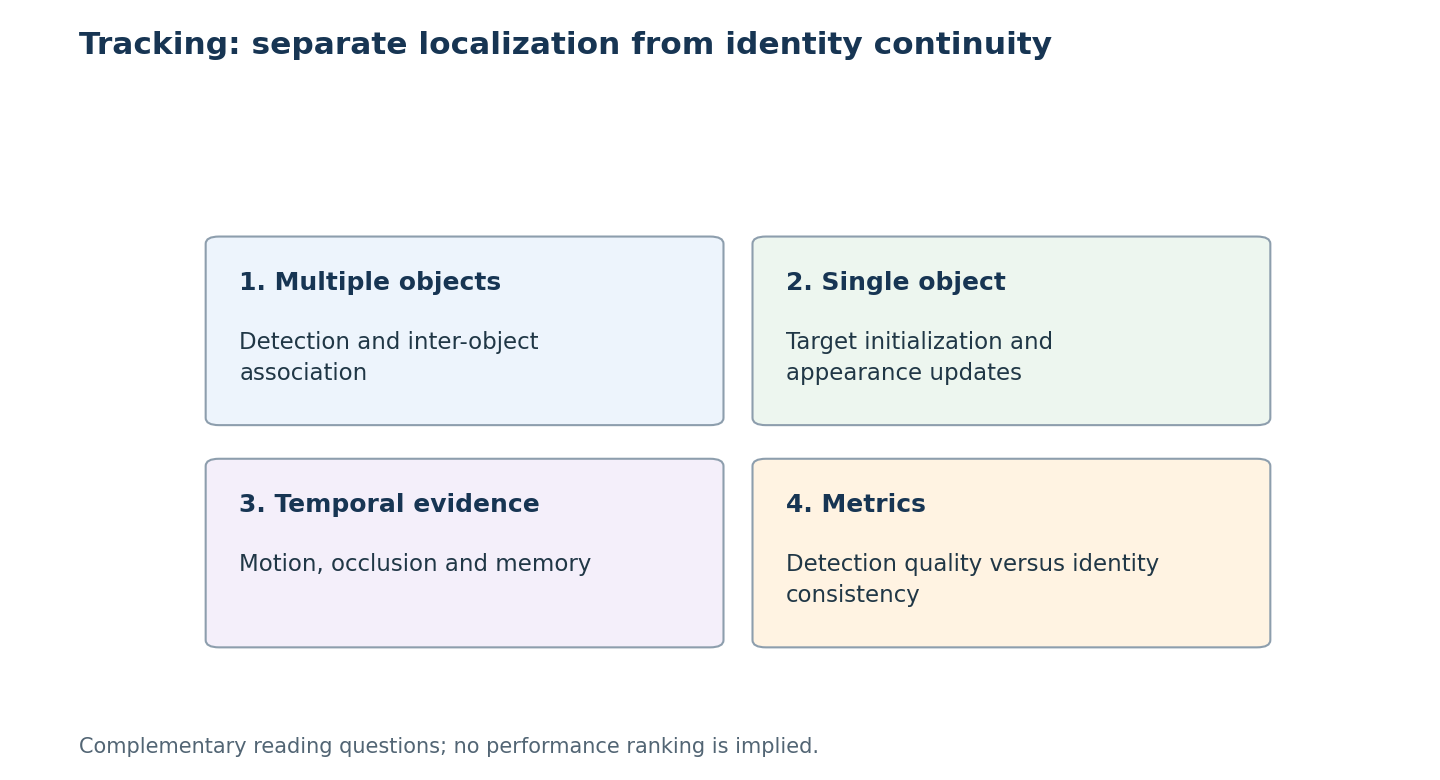
Choose a reading by topic: Multiple objects, Single object, Temporal evidence, Metrics.
Luo et al., “Multiple object tracking: A literature review” [3]
(Artificial Intelligence, 2021; first released 2014). The classical reference. It defines the MOT problem formally, categorizes methods by initialization (detection-based versus detection-free), processing mode (online versus offline) and output type (deterministic versus probabilistic), and analyzes the components — appearance model, motion model, interaction model, exclusion constraints, occlusion handling — and the inference methods. Read it to understand the problem independent of any network.
Ciaparrone et al., “Deep learning in video multi-object tracking: A survey” [2]
(Neurocomputing, 2020). Organizes deep MOT around four stages — detection, feature extraction/motion prediction, affinity computation and association — and reviews how deep learning entered each. Its main takeaway, from comparisons on MOTChallenge, is that detection quality and learned appearance features drive most gains.
Adžemović, “Deep learning-based multi-object tracking: A comprehensive survey from foundations to state-of-the-art” [4]
(arXiv, 2025). Splits tracking-by-detection into joint detection-and-embedding, heuristic-based, motion-based, affinity-learning and offline methods, and contrasts them with end-to-end trackers. It identifies 2022 (ByteTrack and MOTR) as the acceleration point and concludes that heuristic trackers lead on crowded, mostly linear scenes while learned association wins on complex motion.
Marvasti-Zadeh et al., “Deep learning for visual tracking: A comprehensive survey” [5]
(IEEE T-ITS, 2022). For SOT. Analyzes deep trackers along nine aspects (network architecture, exploitation, training, objective, output, use of correlation filters, aerial-view, long-term and online tracking) and compares them on OTB, VOT, LaSOT and aerial benchmarks.
Thangavel (Kugarajeevan) et al., “Transformers in single object tracking: An experimental survey” [6]
(IEEE Access, 2023). Classifies transformer trackers as CNN-Transformer hybrids, two-stream two-stage, and one-stream one-stage fully-transformer trackers, and evaluates their robustness and efficiency; the one-stream design (OSTrack-style) emerges as the dominant pattern.
Ye et al., “Deep learning for person re-identification: A survey and outlook” [7]
(IEEE TPAMI, 2022). Separates closed-world Re-ID (feature learning, metric learning, ranking) from open-world Re-ID (heterogeneous data, raw images, noisy labels, unsupervised and open-set settings), proposes the AGW baseline and the mINP metric, which measures the cost of finding all correct matches.
Luiten et al., “HOTA” [8]
(IJCV, 2020). Not a survey, but it re-examines the evaluation of the entire field, shows the biases of MOTA and IDF1 with worked examples and user studies, and is the reason current leaderboards rank by HOTA.
Reading these papers critically
Multiple-object tracking and single-object tracking do not share the same initialization or decision problem. MOT usually receives detections or jointly learns them and must maintain several identities; SOT is given a target to follow and must avoid drifting to a similar distractor. Motion, appearance and memory can help both, but an association improvement should not be confused with a better detector or a different target-initialization protocol.
For each comparison, record whether detections are public or private, which external training data is used, whether processing is online or offline, and how missing objects are handled. Identity switches, missed detections and localization errors affect metrics differently. A tracker with stronger detections can improve an aggregate score without isolating its association algorithm. Survey taxonomies locate the design choice; original benchmark rules determine valid comparisons. Read identity-sensitive and detection-sensitive measures together, inspect occlusion sequences, and choose the next paper according to whether the current failure is losing the box, confusing the identity or updating the appearance incorrectly.
References
- Shyandram, “物件追蹤Object Tracking 簡介” (Introduction to object tracking), Medium post (in Traditional Chinese), 2023; updated 2026. link
- G. Ciaparrone, F. Luque Sánchez, S. Tabik, L. Troiano, R. Tagliaferri and F. Herrera, “Deep learning in video multi-object tracking: A survey,” Neurocomputing, 2020. arXiv:1907.12740
- W. Luo, J. Xing, A. Milan, X. Zhang, W. Liu and T.-K. Kim, “Multiple object tracking: A literature review,” Artificial Intelligence, vol. 293, 2021 (arXiv 2014). arXiv:1409.7618
- M. Adžemović, “Deep learning-based multi-object tracking: A comprehensive survey from foundations to state-of-the-art,” arXiv:2506.13457, 2025. arXiv
- S. M. Marvasti-Zadeh, L. Cheng, H. Ghanei-Yakhdan and S. Kasaei, “Deep learning for visual tracking: A comprehensive survey,” IEEE Transactions on Intelligent Transportation Systems, vol. 23, 2022. arXiv:1912.00535
- J. Thangavel (Kugarajeevan), T. Kokul, A. Ramanan and S. Fernando, “Transformers in single object tracking: An experimental survey,” IEEE Access, vol. 11, 2023. arXiv:2302.11867
- M. Ye, J. Shen, G. Lin, T. Xiang, L. Shao and S. C. H. Hoi, “Deep learning for person re-identification: A survey and outlook,” IEEE TPAMI, vol. 44, 2022. arXiv:2001.04193
- J. Luiten, A. Ošep, P. Dendorfer, P. Torr, A. Geiger, L. Leal-Taixé and B. Leibe, “HOTA: A higher order metric for evaluating multi-object tracking,” International Journal of Computer Vision, 2020. arXiv:2009.07736
- K. Bernardin and R. Stiefelhagen, “Evaluating multiple object tracking performance: The CLEAR MOT metrics,” EURASIP Journal on Image and Video Processing, 2008. doi
- E. Ristani, F. Solera, R. S. Zou, R. Cucchiara and C. Tomasi, “Performance measures and a data set for multi-target, multi-camera tracking,” ECCV Workshop on Benchmarking Multi-Target Tracking, 2016. arXiv:1609.01775
- K. Peng, A. Mathur and A. Narayanan, “Mitigating dataset harms requires stewardship: Lessons from 1000 papers,” arXiv:2108.02922, 2021. arXiv
- L. Zheng, L. Shen, L. Tian, S. Wang, J. Wang and Q. Tian, “Scalable person re-identification: A benchmark,” ICCV, 2015. doi
- L. Wei, S. Zhang, W. Gao and Q. Tian, “Person transfer GAN to bridge domain gap for person re-identification,” CVPR, 2018. arXiv:1711.08565
- H. Luo, Y. Gu, X. Liao, S. Lai and W. Jiang, “Bag of tricks and a strong baseline for deep person re-identification,” CVPR Workshops, 2019. arXiv:1903.07071
- M. Wieczorek, B. Rychalska and J. Dąbrowski, “On the unreasonable effectiveness of centroids in image retrieval,” arXiv:2104.13643, 2021. arXiv
- S. Li, L. Sun and Q. Li, “CLIP-ReID: Exploiting vision-language model for image re-identification without concrete text labels,” AAAI, 2023. arXiv:2211.13977
- D. S. Bolme, J. R. Beveridge, B. A. Draper and Y. M. Lui, “Visual object tracking using adaptive correlation filters,” CVPR, 2010. doi
- J. F. Henriques, R. Caseiro, P. Martins and J. Batista, “High-speed tracking with kernelized correlation filters,” IEEE TPAMI, vol. 37, 2015. arXiv:1404.7584
- L. Bertinetto, J. Valmadre, J. F. Henriques, A. Vedaldi and P. H. S. Torr, “Fully-convolutional Siamese networks for object tracking,” arXiv:1606.09549, 2016 (ECCV 2016 workshops). arXiv
- B. Li, J. Yan, W. Wu, Z. Zhu and X. Hu, “High performance visual tracking with Siamese region proposal network,” CVPR, 2018. doi
- B. Ye, H. Chang, B. Ma, S. Shan and X. Chen, “Joint feature learning and relation modeling for tracking: A one-stream framework” (OSTrack), ECCV, 2022. arXiv:2203.11991
- X. Chen, H. Peng, D. Wang, H. Lu and H. Hu, “SeqTrack: Sequence to sequence learning for visual object tracking,” CVPR, 2023 (the arXiv entry was later extended as SeqTrackv2). arXiv:2304.14394
- N. Ravi, V. Gabeur, Y.-T. Hu, R. Hu, C. Ryali, T. Ma et al., “SAM 2: Segment anything in images and videos,” ICLR, 2025. arXiv:2408.00714
- C.-Y. Yang, H.-W. Huang, W. Chai, Z. Jiang and J.-N. Hwang, “SAMURAI: Adapting segment anything model for zero-shot visual tracking with motion-aware memory,” arXiv:2411.11922, 2024. arXiv
- N. Carion, L. Gustafson, Y.-T. Hu et al., “SAM 3: Segment anything with concepts,” ICLR, 2026. arXiv:2511.16719
- Y. Wu, J. Lim and M.-H. Yang, “Object tracking benchmark,” IEEE TPAMI, vol. 37, 2015. doi
- H. Fan, L. Lin, F. Yang, P. Chu, G. Deng, S. Yu et al., “LaSOT: A high-quality benchmark for large-scale single object tracking,” CVPR, 2019. arXiv:1809.07845
- L. Huang, X. Zhao and K. Huang, “GOT-10k: A large high-diversity benchmark for generic object tracking in the wild,” IEEE TPAMI, vol. 43, 2021. arXiv:1810.11981
- M. Müller, A. Bibi, S. Giancola, S. Al-Subaihi and B. Ghanem, “TrackingNet: A large-scale dataset and benchmark for object tracking in the wild,” arXiv:1803.10794, 2018 (ECCV 2018). arXiv
- R. E. Kalman, “A new approach to linear filtering and prediction problems,” Journal of Basic Engineering, vol. 82, no. 1, pp. 35–45, 1960. doi
- H. W. Kuhn, “The Hungarian method for the assignment problem,” Naval Research Logistics Quarterly, vol. 2, pp. 83–97, 1955. doi
- A. Bewley, Z. Ge, L. Ott, F. Ramos and B. Upcroft, “Simple online and realtime tracking,” ICIP, 2016. arXiv:1602.00763
- N. Wojke, A. Bewley and D. Paulus, “Simple online and realtime tracking with a deep association metric,” ICIP, 2017. doi
- Y. Zhang, P. Sun, Y. Jiang, D. Yu, F. Weng, Z. Yuan, P. Luo, W. Liu and X. Wang, “ByteTrack: Multi-object tracking by associating every detection box,” ECCV, 2022. arXiv:2110.06864
- J. Cao, J. Pang, X. Weng, R. Khirodkar and K. Kitani, “Observation-centric SORT: Rethinking SORT for robust multi-object tracking,” CVPR, 2023. arXiv:2203.14360
- N. Aharon, R. Orfaig and B.-Z. Bobrovsky, “BoT-SORT: Robust associations multi-pedestrian tracking,” arXiv:2206.14651, 2022. arXiv
- Z. Wang, L. Zheng, Y. Liu, Y. Li and S. Wang, “Towards real-time multi-object tracking” (JDE), ECCV, 2020. arXiv:1909.12605
- Y. Zhang, C. Wang, X. Wang, W. Zeng and W. Liu, “FairMOT: On the fairness of detection and re-identification in multiple object tracking,” IJCV, 2021. arXiv:2004.01888
- P. Bergmann, T. Meinhardt and L. Leal-Taixé, “Tracking without bells and whistles” (Tracktor), ICCV, 2019. arXiv:1903.05625
- F. Zeng, B. Dong, Y. Zhang, T. Wang, X. Zhang and Y. Wei, “MOTR: End-to-end multiple-object tracking with transformer,” ECCV, 2022. arXiv:2105.03247
- Y. Zhang, T. Wang and X. Zhang, “MOTRv2: Bootstrapping end-to-end multi-object tracking by pretrained object detectors,” CVPR, 2023. arXiv:2211.09791
- R. Gao, J. Qi and L. Wang, “Multiple object tracking as ID prediction” (MOTIP), CVPR, 2025. arXiv:2403.16848
- S. Li, T. Fischer, L. Ke, H. Ding, M. Danelljan and F. Yu, “OVTrack: Open-vocabulary multiple object tracking,” CVPR, 2023. arXiv:2304.08408
- A. Milan, L. Leal-Taixé, I. Reid, S. Roth and K. Schindler, “MOT16: A benchmark for multi-object tracking,” arXiv:1603.00831, 2016 (MOT16/MOT17). arXiv
- P. Dendorfer, H. Rezatofighi, A. Milan, J. Shi, D. Cremers, I. Reid, S. Roth, K. Schindler and L. Leal-Taixé, “MOT20: A benchmark for multi object tracking in crowded scenes,” arXiv:2003.09003, 2020. arXiv
- P. Sun, J. Cao, Y. Jiang, Z. Yuan, S. Bai, K. Kitani and P. Luo, “DanceTrack: Multi-object tracking in uniform appearance and diverse motion,” CVPR, 2022. arXiv:2111.14690
- Y. Cui, C. Zeng, X. Zhao, Y. Yang, G. Wu and L. Wang, “SportsMOT: A large multi-object tracking dataset in multiple sports scenes,” ICCV, 2023. arXiv:2304.05170
- F. Yu, H. Chen, X. Wang, W. Xian, Y. Chen, F. Liu, V. Madhavan and T. Darrell, “BDD100K: A diverse driving dataset for heterogeneous multitask learning,” CVPR, 2020. arXiv:1805.04687
- C. Doersch, Y. Yang, M. Vecerik, D. Gokay, A. Gupta, Y. Aytar et al., “TAPIR: Tracking any point with per-frame initialization and temporal refinement,” ICCV, 2023. arXiv:2306.08637
- N. Karaev, I. Rocco, B. Graham, N. Neverova, A. Vedaldi and C. Rupprecht, “CoTracker: It is better to track together,” ECCV, 2024. arXiv:2307.07635
- N. Karaev, I. Makarov, J. Wang, N. Neverova, A. Vedaldi and C. Rupprecht, “CoTracker3: Simpler and better point tracking by pseudo-labelling real videos,” arXiv:2410.11831, 2024. arXiv
- Z. Tang, S. Wang, D. C. Anastasiu et al., “The 9th AI City Challenge,” ICCV Workshops, 2025. arXiv:2508.13564
- VOT Challenge organizers, “The Visual Object Tracking (VOT) challenge series,” website, 2013–present. votchallenge.net
- R. Jonker and A. Volgenant, “A shortest augmenting path algorithm for dense and sparse linear assignment problems,” Computing, vol. 38, no. 4, pp. 325–340, 1987. doi
- D. F. Crouse, “On implementing 2D rectangular assignment algorithms,” IEEE Transactions on Aerospace and Electronic Systems, vol. 52, no. 4, pp. 1679–1696, 2016. doi