Guide to the Modern view surveys
Optional · paper guide 1 of 1 for DLCV 03 · Object Detection: From R-CNN to DETR. Citation numbers refer to the reference list at the bottom of this page.
Navigate: this page and this track: Navigate: this page and this track
Choose a reading by topic: Shape, Local keypoints, Texture, Matching.
Object Detection in 20 Years
(Zou et al., Proceedings of the IEEE, 2023) [1] is the broadest historical review. It covers milestone detectors from the traditional era (Viola–Jones, HOG, DPM) to deep two-stage and one-stage methods, detection datasets and metrics, fundamental building blocks (multi-scale detection, context, hard-negative mining, NMS, box regression), speed-up techniques, and recent state-of-the-art methods. Its main message is that most “new” ideas have older roots: multi-scale scanning became feature pyramids, cascades became cascaded heads, hard-negative mining became the focal loss, and NMS has been rethought several times.
Deep Learning for Generic Object Detection: A Survey
(Liu et al., IJCV, 2020) [2] reviews over 300 contributions in depth and organizes them by detection framework, object feature representation, object proposal generation, context modeling, training strategies and evaluation metrics. It is the best single reference for the pre-transformer CNN era, and it stresses that progress came as much from training strategies, data and evaluation as from architectures.
Object Detection with Transformers: A Review
(Shehzadi et al., Sensors, 2025) [45] analyses 21 recent improvements to DETR, grouped by changes to the backbone, query design and attention mechanism, and compares them on common benchmarks. Its taxonomy tracks the fixes described in the main text: multi-scale and sparse attention for small objects and speed, and better query initialization and denoising for convergence.
A Survey on Open-Vocabulary Detection and Segmentation: Past, Present, and Future
(Zhu and Chen, IEEE TPAMI, 2024) [46] organizes open-vocabulary methods by how they use weak supervision into six families: visual–semantic space mapping, novel visual feature synthesis, region-aware training, pseudo-labeling, knowledge distillation and transfer learning. It covers 2D, 3D and video tasks, and it highlights how evaluation of “novel” classes is complicated by vocabulary overlap between pretraining and test data.
Towards Large-Scale Small Object Detection
(Cheng et al., IEEE TPAMI, 2023) [39] focuses on the most stubborn failure mode, reviews the remedies by category and contributes the SODA benchmarks described in the main text. It shows that small-object accuracy remains far below that of larger objects even for strong detectors.
Reading these papers critically
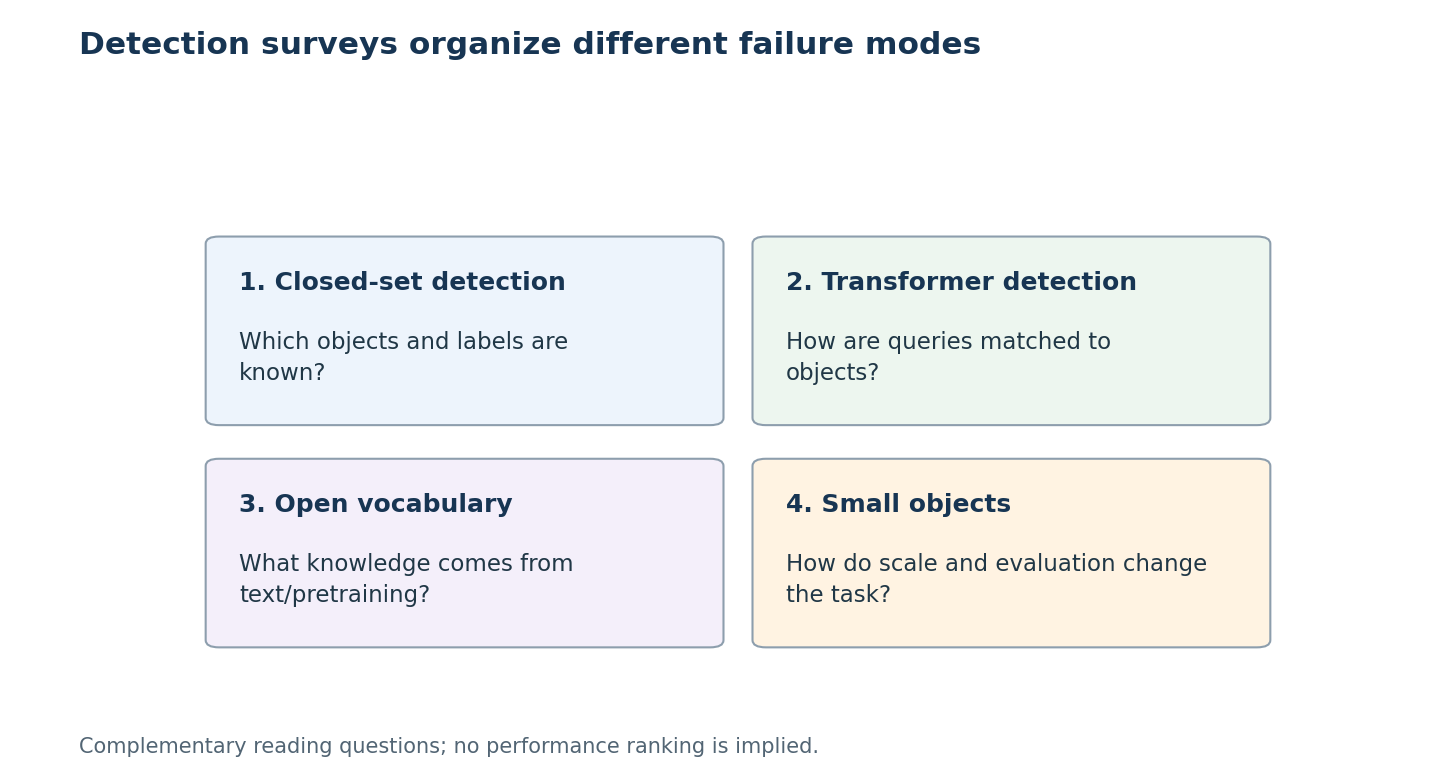
The surveys differ in scope, so compare their organizing questions before their model lists. A historical detector survey connects representation, proposals and one-stage designs; a transformer review examines query-based prediction and matching; open-vocabulary work changes the available class knowledge; and small-object detection changes the scale and evidence available per instance. The same detector can appear in several categories.
Scores are comparable only after checking data, class vocabulary, pretraining, image resolution and postprocessing. More pixels or extra image–text training can improve detection without isolating a new head’s contribution. Small-object metrics also depend on object definitions and evaluation size ranges; open-vocabulary evaluations depend on base/novel splits and permitted text or image examples. A survey comparison table is a starting point for finding candidates, not an experimentally controlled universal ordering. Return to the original paper to identify the specific intervention, its matched baseline and the failure cases that remain at the intended operating speed.
References
- Z. Zou, K. Chen, Z. Shi, Y. Guo and J. Ye, “Object detection in 20 years: A survey,” Proceedings of the IEEE, vol. 111, no. 3, 2023. doi
- L. Liu, W. Ouyang, X. Wang, P. Fieguth, J. Chen, X. Liu and M. Pietikäinen, “Deep learning for generic object detection: A survey,” International Journal of Computer Vision, 2020. doi
- M. Everingham, L. Van Gool, C. K. I. Williams, J. Winn and A. Zisserman, “The PASCAL Visual Object Classes (VOC) challenge,” International Journal of Computer Vision, vol. 88, 2010. doi
- T.-Y. Lin, M. Maire, S. Belongie, L. Bourdev, R. Girshick et al., “Microsoft COCO: Common objects in context,” in Proc. ECCV, 2014. doi
- P. Viola and M. Jones, “Rapid object detection using a boosted cascade of simple features,” in Proc. IEEE CVPR, 2001. doi
- N. Dalal and B. Triggs, “Histograms of oriented gradients for human detection,” in Proc. IEEE CVPR, 2005. doi
- P. F. Felzenszwalb, R. B. Girshick, D. McAllester and D. Ramanan, “Object detection with discriminatively trained part-based models,” IEEE TPAMI, 2010. doi
- R. Girshick, J. Donahue, T. Darrell and J. Malik, “Rich feature hierarchies for accurate object detection and semantic segmentation,” in Proc. IEEE CVPR, 2014. arXiv
- R. Girshick, “Fast R-CNN,” in Proc. IEEE ICCV, 2015. arXiv
- S. Ren, K. He, R. Girshick and J. Sun, “Faster R-CNN: Towards real-time object detection with region proposal networks,” IEEE TPAMI, 2017 (conference version 2015). doi
- H. Rezatofighi, N. Tsoi, J. Gwak, A. Sadeghian, I. Reid and S. Savarese, “Generalized intersection over union: A metric and a loss for bounding box regression,” in Proc. IEEE/CVF CVPR, 2019. arXiv
- Z. Zheng, P. Wang, W. Liu, J. Li, R. Ye and D. Ren, “Distance-IoU loss: Faster and better learning for bounding box regression,” in Proc. AAAI, 2020. arXiv
- N. Bodla, B. Singh, R. Chellappa and L. S. Davis, “Soft-NMS — Improving object detection with one line of code,” in Proc. IEEE ICCV, 2017. arXiv
- T.-Y. Lin, P. Dollár, R. Girshick, K. He, B. Hariharan and S. Belongie, “Feature pyramid networks for object detection,” in Proc. IEEE CVPR, 2017. doi
- T.-Y. Lin, P. Goyal, R. Girshick, K. He and P. Dollár, “Focal loss for dense object detection,” in Proc. IEEE ICCV, 2017. doi
- K. He, G. Gkioxari, P. Dollár and R. Girshick, “Mask R-CNN,” in Proc. IEEE ICCV, 2017. doi
- Z. Cai and N. Vasconcelos, “Cascade R-CNN: Delving into high quality object detection,” in Proc. IEEE/CVF CVPR, 2018. doi
- J. Redmon, S. Divvala, R. Girshick and A. Farhadi, “You only look once: Unified, real-time object detection,” in Proc. IEEE CVPR, 2016. doi
- J. Redmon and A. Farhadi, “YOLO9000: Better, faster, stronger,” IEEE/CVF Conference on Computer Vision and Pattern Recognition (CVPR), pp. 7263–7271, 2017. CVF · arXiv
- J. Redmon and A. Farhadi, “YOLOv3: An incremental improvement,” tech. report, arXiv:1804.02767, 2018. arXiv
- A. Bochkovskiy, C.-Y. Wang and H.-Y. M. Liao, “YOLOv4: Optimal speed and accuracy of object detection,” arXiv:2004.10934, 2020. arXiv
- C.-Y. Wang, A. Bochkovskiy and H.-Y. M. Liao, “YOLOv7: Trainable bag-of-freebies sets new state-of-the-art for real-time object detectors,” in Proc. IEEE/CVF CVPR, 2023. doi
- C.-Y. Wang, I-H. Yeh and H.-Y. M. Liao, “YOLOv9: Learning what you want to learn using programmable gradient information,” in Proc. ECCV, 2024. doi
- A. Wang, H. Chen, L. Liu, K. Chen, Z. Lin et al., “YOLOv10: Real-time end-to-end object detection,” in Proc. NeurIPS, 2024. arXiv
- Y. Tian, Q. Ye and D. Doermann, “YOLOv12: Attention-centric real-time object detectors,” arXiv:2502.12524, 2025. arXiv
- W. Liu, D. Anguelov, D. Erhan, C. Szegedy, S. Reed, C.-Y. Fu and A. C. Berg, “SSD: Single shot multibox detector,” in Proc. ECCV, 2016. arXiv
- H. Law and J. Deng, “CornerNet: Detecting objects as paired keypoints,” in Proc. ECCV, 2018. doi
- X. Zhou, D. Wang and P. Krähenbühl, “Objects as points,” arXiv:1904.07850, 2019. arXiv
- Z. Tian, C. Shen, H. Chen and T. He, “FCOS: Fully convolutional one-stage object detection,” in Proc. IEEE/CVF ICCV, 2019. arXiv
- N. Carion, F. Massa, G. Synnaeve, N. Usunier, A. Kirillov and S. Zagoruyko, “End-to-end object detection with transformers,” in Proc. ECCV, 2020. doi
- H. W. Kuhn, “The Hungarian method for the assignment problem,” Naval Research Logistics Quarterly, vol. 2, 1955. doi
- X. Zhu, W. Su, L. Lu, B. Li, X. Wang and J. Dai, “Deformable DETR: Deformable transformers for end-to-end object detection,” in Proc. ICLR, 2021. arXiv
- H. Zhang, F. Li, S. Liu, L. Zhang, H. Su, J. Zhu, L. M. Ni and H.-Y. Shum, “DINO: DETR with improved denoising anchor boxes for end-to-end object detection,” arXiv:2203.03605, 2022. arXiv
- Y. Zhao, W. Lv, S. Xu, J. Wei, G. Wang et al., “DETRs beat YOLOs on real-time object detection,” in Proc. IEEE/CVF CVPR, 2024. doi
- M. Minderer, A. Gritsenko, A. Stone, M. Neumann, D. Weissenborn et al., “Simple open-vocabulary object detection with vision transformers,” in Proc. ECCV, 2022. arXiv
- S. Liu, Z. Zeng, T. Ren, F. Li, H. Zhang et al., “Grounding DINO: Marrying DINO with grounded pre-training for open-set object detection,” in Proc. ECCV, 2024. doi
- T. Cheng, L. Song, Y. Ge, W. Liu, X. Wang et al., “YOLO-World: Real-time open-vocabulary object detection,” in Proc. IEEE/CVF CVPR, 2024. doi
- N. Carion, L. Gustafson, Y.-T. Hu, S. Debnath, R. Hu et al., “SAM 3: Segment anything with concepts,” arXiv:2511.16719, 2025. arXiv
- G. Cheng, X. Yuan, X. Yao, K. Yan, Q. Zeng et al., “Towards large-scale small object detection: Survey and benchmarks,” IEEE TPAMI, vol. 45, no. 11, 2023. arXiv
- COCO Consortium, “COCO detection evaluation,” official evaluation description (12 metrics, 101-point interpolation). link · official evaluator
- M. Everingham, S. M. A. Eslami, L. Van Gool, C. K. I. Williams, J. Winn and A. Zisserman, “The PASCAL Visual Object Classes challenge: A retrospective,” International Journal of Computer Vision, vol. 111, 2015. doi
- S. Shao, Z. Li, T. Zhang, C. Peng et al., “Objects365: A large-scale, high-quality dataset for object detection,” in Proc. IEEE/CVF ICCV, 2019. doi
- A. Kuznetsova, H. Rom, N. Alldrin, J. Uijlings, I. Krasin et al., “The Open Images Dataset V4: Unified image classification, object detection, and visual relationship detection at scale,” International Journal of Computer Vision, 2020. arXiv
- A. Gupta, P. Dollár and R. Girshick, “LVIS: A dataset for large vocabulary instance segmentation,” in Proc. IEEE/CVF CVPR, 2019. doi
- T. Shehzadi, K. A. Hashmi, M. Liwicki, D. Stricker and M. Z. Afzal, “Object detection with transformers: A review,” Sensors, vol. 25, no. 19, 2025. doi
- C. Zhu and L. Chen, “A survey on open-vocabulary detection and segmentation: Past, present, and future,” IEEE TPAMI, 2024. doi