The Lottery Ticket Hypothesis (Frankle and Carbin, ICLR 2019)
Optional · paper guide 1 of 2 for DLCV 01C · Model Compression and Efficient Inference. Citation numbers refer to the reference list at the bottom of this page.
Navigate: this page and this track: Navigate: this page and this track
Challenge
Pruning can remove most weights of a trained network, yet the resulting sparse architectures were reported to train badly from scratch. If small networks suffice at the end, why do we need large ones at the start? [13]
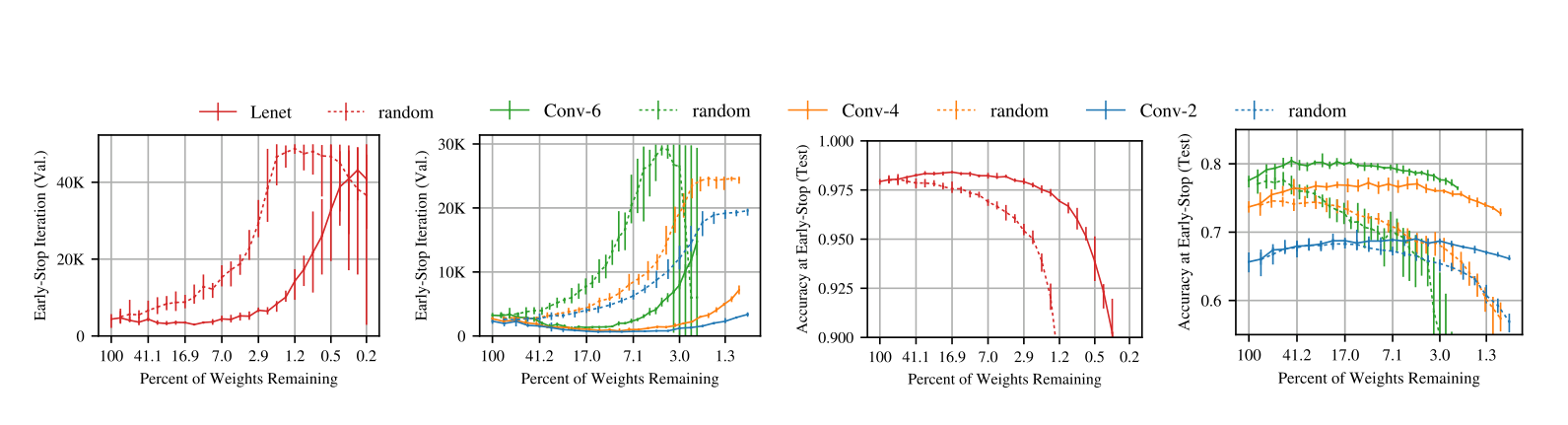
Figure source: [13], arXiv:1803.03635v5, PDF page 2. Original PDF.
Method
Train a network, prune the smallest-magnitude weights, and reset the surviving weights to the values they had at initialization, keeping the mask. Train this sparse network in isolation and compare it with the full network. Iterate (iterative magnitude pruning), removing a fixed fraction of the remaining weights in each round [13].
Results
For fully connected networks on MNIST and convolutional networks (Conv-2/4/6, variants of VGG) on CIFAR-10, the reset subnetworks (“winning tickets”) matched the original test accuracy at 10–20% of the weights or less, learned faster than the original above that size, and lost this ability when randomly reinitialized. Iterative pruning found smaller tickets than one-shot pruning. For the deeper ResNet-18 and VGG-19 the method needed learning-rate warm-up to find tickets at higher learning rates [13].
Reading the evidence
The main plots show two quantities against the percentage of weights remaining: the iteration of minimum validation loss (the authors’ proxy for learning speed, from an early-stopping criterion) and the test accuracy at that iteration. Each curve is an average over several trials, and the comparison that carries the argument is winning ticket versus the same mask with random reinitialization, not ticket versus dense network. Note the architectures and their per-layer pruning rates in the setup table: convolutional and fully connected layers are pruned at different rates [13].
Problems
All experiments are on small datasets; finding a ticket costs several full trainings, so it is not a cheaper compression method; the follow-up by Frankle et al. found that at ImageNet scale the weights must be rewound to an early training iteration rather than to initialization [14]; and Liu et al. reported that, with a tuned learning rate, winning-ticket initialization did not beat random initialization in their structured-pruning experiments [3].
Conclusion
It reframed pruning as a question about trainability: what makes a sparse network trainable, and when during training the important structure is decided.
References
- M. Dehghani, A. Arnab, L. Beyer, A. Vaswani and Y. Tay, “The efficiency misnomer,” ICLR, 2022. arXiv
- S. Williams, A. Waterman and D. Patterson, “Roofline: an insightful visual performance model for multicore architectures,” Communications of the ACM, vol. 52, no. 4, pp. 65–76, 2009. doi
- Z. Liu, M. Sun, T. Zhou, G. Huang and T. Darrell, “Rethinking the value of network pruning,” ICLR, 2019. arXiv
- D. Blalock, J. J. Gonzalez Ortiz, J. Frankle and J. Guttag, “What is the state of neural network pruning?,” MLSys, 2020. arXiv
- H. Li, A. Kadav, I. Durdanovic, H. Samet and H. P. Graf, “Pruning filters for efficient ConvNets,” ICLR, 2017. arXiv
- A. Mishra, J. Albericio Latorre, J. Pool, D. Stosic, D. Stosic, G. Venkatesh, C. Yu and P. Micikevicius, “Accelerating sparse deep neural networks,” arXiv:2104.08378, 2021. arXiv
- Z. Liu, J. Li, Z. Shen, G. Huang, S. Yan and C. Zhang, “Learning efficient convolutional networks through network slimming,” ICCV, 2017. arXiv
- T. Hoefler, D. Alistarh, T. Ben-Nun, N. Dryden and A. Peste, “Sparsity in deep learning: pruning and growth for efficient inference and training in neural networks,” Journal of Machine Learning Research, vol. 22, no. 241, pp. 1–124, 2021. paper
- G. Fang, X. Ma, M. Song, M. B. Mi and X. Wang, “DepGraph: towards any structural pruning,” CVPR, 2023. doi arXiv
- S. Han, J. Pool, J. Tran and W. J. Dally, “Learning both weights and connections for efficient neural networks,” NeurIPS (NIPS), 2015. arXiv
- S. Han, H. Mao and W. J. Dally, “Deep compression: compressing deep neural networks with pruning, trained quantization and Huffman coding,” ICLR, 2016. arXiv
- M. Zhu and S. Gupta, “To prune, or not to prune: exploring the efficacy of pruning for model compression,” arXiv:1710.01878, 2017. arXiv
- J. Frankle and M. Carbin, “The lottery ticket hypothesis: finding sparse, trainable neural networks,” ICLR, 2019. arXiv
- J. Frankle, G. K. Dziugaite, D. M. Roy and M. Carbin, “Linear mode connectivity and the lottery ticket hypothesis,” ICML, 2020. arXiv
- M. Nagel, M. Fournarakis, R. A. Amjad, Y. Bondarenko, M. van Baalen and T. Blankevoort, “A white paper on neural network quantization,” arXiv:2106.08295, 2021. arXiv
- B. Jacob, S. Kligys, B. Chen, M. Zhu, M. Tang, A. Howard, H. Adam and D. Kalenichenko, “Quantization and training of neural networks for efficient integer-arithmetic-only inference,” CVPR, 2018. doi arXiv
- M. Nagel, M. van Baalen, T. Blankevoort and M. Welling, “Data-free quantization through weight equalization and bias correction,” ICCV, 2019. arXiv
- T. Dettmers, M. Lewis, Y. Belkada and L. Zettlemoyer, “LLM.int8(): 8-bit matrix multiplication for transformers at scale,” NeurIPS, 2022. arXiv
- G. Xiao, J. Lin, M. Seznec, H. Wu, J. Demouth and S. Han, “SmoothQuant: accurate and efficient post-training quantization for large language models,” ICML, 2023. arXiv
- M. Nagel, R. A. Amjad, M. van Baalen, C. Louizos and T. Blankevoort, “Up or down? Adaptive rounding for post-training quantization,” ICML, 2020. arXiv
- Y. Bengio, N. Léonard and A. Courville, “Estimating or propagating gradients through stochastic neurons for conditional computation,” arXiv:1308.3432, 2013. arXiv
- Z. Dong, Z. Yao, A. Gholami, M. W. Mahoney and K. Keutzer, “HAWQ: Hessian aware quantization of neural networks with mixed-precision,” ICCV, 2019. arXiv
- K. Wang, Z. Liu, Y. Lin, J. Lin and S. Han, “HAQ: hardware-aware automated quantization with mixed precision,” CVPR, 2019. arXiv
- P. Micikevicius et al., “FP8 formats for deep learning,” arXiv:2209.05433, 2022. arXiv
- G. Hinton, O. Vinyals and J. Dean, “Distilling the knowledge in a neural network,” NIPS Deep Learning Workshop, 2014; arXiv:1503.02531. arXiv
- L. J. Ba and R. Caruana, “Do deep nets really need to be deep?,” NeurIPS (NIPS), 2014. arXiv
- A. Romero, N. Ballas, S. E. Kahou, A. Chassang, C. Gatta and Y. Bengio, “FitNets: hints for thin deep nets,” ICLR, 2015. arXiv
- S. Zagoruyko and N. Komodakis, “Paying more attention to attention: improving the performance of convolutional neural networks via attention transfer,” ICLR, 2017. arXiv
- J. Gou, B. Yu, S. J. Maybank and D. Tao, “Knowledge distillation: a survey,” International Journal of Computer Vision, vol. 129, no. 6, pp. 1789–1819, 2021. doi
- L. Beyer, X. Zhai, A. Royer, L. Markeeva, R. Anil and A. Kolesnikov, “Knowledge distillation: a good teacher is patient and consistent,” CVPR, 2022. arXiv
- J. H. Cho and B. Hariharan, “On the efficacy of knowledge distillation,” ICCV, 2019. arXiv
- H. Touvron, M. Cord, M. Douze, F. Massa, A. Sablayrolles and H. Jégou, “Training data-efficient image transformers & distillation through attention,” ICML, 2021. arXiv
- R. Denton, W. Zaremba, J. Bruna, Y. LeCun and R. Fergus, “Exploiting linear structure within convolutional networks for efficient evaluation,” NeurIPS (NIPS), 2014. arXiv
- M. Jaderberg, A. Vedaldi and A. Zisserman, “Speeding up convolutional neural networks with low rank expansions,” BMVC, 2014. arXiv
- X. Zhang, J. Zou, K. He and J. Sun, “Accelerating very deep convolutional networks for classification and detection,” IEEE Transactions on Pattern Analysis and Machine Intelligence, vol. 38, no. 10, pp. 1943–1955, 2016. doi arXiv
- A. G. Howard, M. Zhu, B. Chen, D. Kalenichenko, W. Wang, T. Weyand, M. Andreetto and H. Adam, “MobileNets: efficient convolutional neural networks for mobile vision applications,” arXiv:1704.04861, 2017. arXiv
- M. Sandler, A. Howard, M. Zhu, A. Zhmoginov and L.-C. Chen, “MobileNetV2: inverted residuals and linear bottlenecks,” CVPR, 2018. arXiv
- M. Tan and Q. V. Le, “EfficientNet: rethinking model scaling for convolutional neural networks,” ICML, 2019. arXiv
- X. Ding, X. Zhang, N. Ma, J. Han, G. Ding and J. Sun, “RepVGG: making VGG-style ConvNets great again,” CVPR, 2021. arXiv
- C. Li et al., “YOLOv6: a single-stage object detection framework for industrial applications,” arXiv:2209.02976, 2022. arXiv
- T. Elsken, J. H. Metzen and F. Hutter, “Neural architecture search: a survey,” Journal of Machine Learning Research, vol. 20, pp. 1–21, 2019. arXiv
- B. Zoph and Q. V. Le, “Neural architecture search with reinforcement learning,” ICLR, 2017. arXiv
- H. Pham, M. Y. Guan, B. Zoph, Q. V. Le and J. Dean, “Efficient neural architecture search via parameter sharing,” ICML, 2018. arXiv
- H. Liu, K. Simonyan and Y. Yang, “DARTS: differentiable architecture search,” ICLR, 2019. arXiv
- H. Cai, C. Gan, T. Wang, Z. Zhang and S. Han, “Once-for-all: train one network and specialize it for efficient deployment,” ICLR, 2020. arXiv
- M. Tan, B. Chen, R. Pang, V. Vasudevan, M. Sandler, A. Howard and Q. V. Le, “MnasNet: platform-aware neural architecture search for mobile,” CVPR, 2019. arXiv
- H. Cai, L. Zhu and S. Han, “ProxylessNAS: direct neural architecture search on target task and hardware,” ICLR, 2019. arXiv
- B. Wu, X. Dai, P. Zhang, Y. Wang, F. Sun, Y. Wu, Y. Tian, P. Vajda, Y. Jia and K. Keutzer, “FBNet: hardware-aware efficient ConvNet design via differentiable neural architecture search,” CVPR, 2019. doi arXiv
- L. Li and A. Talwalkar, “Random search and reproducibility for neural architecture search,” UAI, 2019. arXiv
- S. Ioffe and C. Szegedy, “Batch normalization: accelerating deep network training by reducing internal covariate shift,” ICML, 2015. arXiv
- T. Wang, L. Yuan, X. Zhang and J. Feng, “Distilling object detectors with fine-grained feature imitation,” CVPR, 2019. arXiv
- H. Li, C. Yan, S. Lin, X. Zheng, Y. Li, B. Zhang, F. Yang and R. Ji, “PAMS: quantized super-resolution via parameterized max scale,” ECCV, 2020. arXiv
- C. Hong, H. Kim, S. Baik, J. Oh and K. M. Lee, “DAQ: channel-wise distribution-aware quantization for deep image super-resolution networks,” WACV, 2022. arXiv
- B. Ren, Y. Li, N. Mehta, R. Timofte et al., “The ninth NTIRE 2024 efficient super-resolution challenge report,” CVPR Workshops, 2024. doi arXiv
- Z. Yuan, C. Xue, Y. Chen, Q. Wu and G. Sun, “PTQ4ViT: post-training quantization for vision transformers with twin uniform quantization,” ECCV, 2022. doi arXiv
- Z. Liu, Y. Wang, K. Han, S. Ma and W. Gao, “Post-training quantization for vision transformer,” NeurIPS, 2021. arXiv
- X. Li, Y. Liu, L. Lian, H. Yang, Z. Dong, D. Kang, S. Zhang and K. Keutzer, “Q-Diffusion: quantizing diffusion models,” ICCV, 2023. doi arXiv
- Y. Shang, Z. Yuan, B. Xie, B. Wu and Y. Yan, “Post-training quantization on diffusion models,” CVPR, 2023. arXiv
- A. Kirillov et al., “Segment anything,” ICCV, 2023. doi arXiv
- C. Zhang, D. Han, Y. Qiao, J. U. Kim, S.-H. Bae, S. Lee and C. S. Hong, “Faster segment anything: towards lightweight SAM for mobile applications,” arXiv:2306.14289, 2023. arXiv
- Y. Xiong et al., “EfficientSAM: leveraged masked image pretraining for efficient segment anything,” CVPR, 2024. doi arXiv
- Y. Cheng, D. Wang, P. Zhou and T. Zhang, “Model compression and acceleration for deep neural networks: the principles, progress, and challenges,” IEEE Signal Processing Magazine, vol. 35, no. 1, pp. 126–136, 2018. doi arXiv
- G. Menghani, “Efficient deep learning: a survey on making deep learning models smaller, faster, and better,” ACM Computing Surveys, vol. 55, no. 12, pp. 1–37, 2023. doi arXiv
- A. Gholami, S. Kim, Z. Dong, Z. Yao, M. W. Mahoney and K. Keutzer, “A survey of quantization methods for efficient neural network inference,” book chapter in Low-Power Computer Vision; arXiv:2103.13630, 2021. arXiv
- H. Cheng, M. Zhang and J. Q. Shi, “A survey on deep neural network pruning: taxonomy, comparison, analysis, and recommendations,” IEEE Transactions on Pattern Analysis and Machine Intelligence, vol. 46, no. 12, pp. 10558–10578, 2024. doi arXiv
- L. Wang and K.-J. Yoon, “Knowledge distillation and student-teacher learning for visual intelligence: a review and new outlooks,” IEEE Transactions on Pattern Analysis and Machine Intelligence, vol. 44, no. 6, pp. 3048–3068, 2022. doi arXiv
- C. White, M. Safari, R. Sukthanker, B. Ru, T. Elsken, A. Zela, D. Dey and F. Hutter, “Neural architecture search: insights from 1000 papers,” arXiv:2301.08727, 2023. arXiv
- E. Frantar, S. Ashkboos, T. Hoefler and D. Alistarh, “GPTQ: accurate post-training quantization for generative pre-trained transformers,” ICLR, 2023. arXiv
- J. Lin, J. Tang, H. Tang, S. Yang, W.-M. Chen, W.-C. Wang, G. Xiao, X. Dang, C. Gan and S. Han, “AWQ: activation-aware weight quantization for LLM compression and acceleration,” MLSys, 2024. arXiv
- M. Li, Y. Lin, Z. Zhang, T. Cai, X. Li, J. Guo, E. Xie, C. Meng, J.-Y. Zhu and S. Han, “SVDQuant: absorbing outliers by low-rank components for 4-bit diffusion models,” ICLR, 2025. arXiv
- Y. Li, R. Gong, X. Tan, Y. Yang, P. Hu, Q. Zhang, F. Yu, W. Wang and S. Gu, “BRECQ: pushing the limit of post-training quantization by block reconstruction,” ICLR, 2021. arXiv
- S. K. Esser, J. L. McKinstry, D. Bablani, R. Appuswamy and D. S. Modha, “Learned step size quantization,” ICLR, 2020. arXiv