DDFM: a diffusion prior with likelihood rectification
Optional · paper guide 5 of 11 for DLCV 10 · Image Fusion: Complementary Images, Useful Outputs. Citation numbers refer to the reference list at the bottom of this page.
Navigate: this page and this track: Navigate: this page and this track
On this page
- Exposure fusion (Mertens, Kautz and Van Reeth)
- VIFB: a visible and infrared image fusion benchmark
- The infrared–visible fusion survey of Liu et al. (TPAMI 2025)
- DenseFuse: learn reconstruction, choose fusion in feature space
- DDFM: a diffusion prior with likelihood rectification
- FusionGAN: thermal intensity with an adversarial visible-image prior
- IFCNN: supervised fusion with a variable number of inputs
- U2Fusion: one unsupervised model across fusion tasks
- SwinFusion: attention within and across the sources
- SeAFusion: let semantic segmentation influence the fused image
- TarDAL: fuse for both appearance and object detection
Deep Learning for Computer Vision
Zhao et al.’s ICCV 2023 paper combines a pretrained natural-image diffusion model with an explicit model of source preservation [41]. It performs conditional fusion during sampling without fine-tuning the denoiser on fusion pairs.
Challenge
An unsupervised fusion objective defines what to preserve but may not supply a strong image prior. Conversely, an unconditional generator can make plausible images that have little to do with the particular source pair. DDFM separates these roles: the diffusion model supplies a prior, and a likelihood-based correction pulls each denoised estimate toward the two observations.
The difficulty is that fusion does not come with a known physical degradation operator from one true fused image to both sensors. The likelihood must therefore be modeled, rather than treated as an already known sensor law. This assumption remains even when Bayesian notation is used.
Method
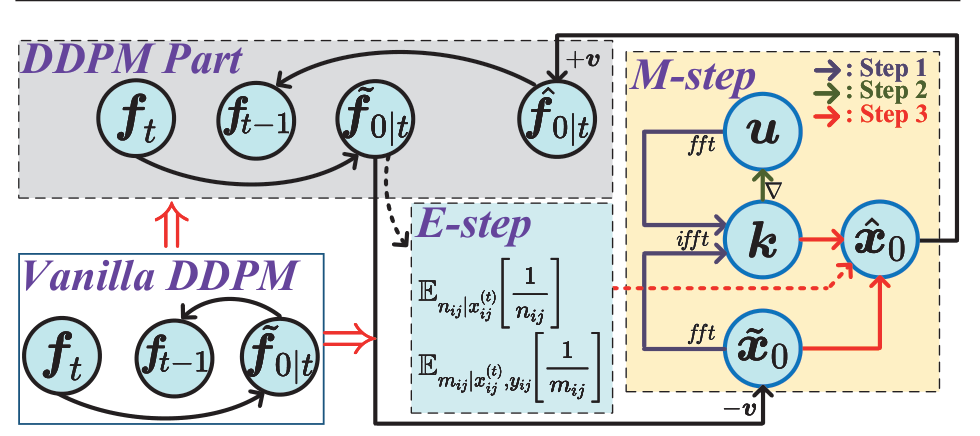
Figure source: [41], Published paper PDF, PDF page 6. Original PDF.
Unconditional denoising. At diffusion time , the pretrained model predicts a clean-image estimate from noisy state . The paper uses a pretrained ImageNet diffusion model [63], [61]. Its weights remain fixed. The denoiser supplies a natural-image preference; it does not directly decide which thermal target should survive.
Source-preservation model. Let be infrared, visible and the candidate fused image. The starting objective is
sets the relative source preference. With and known , this becomes . This change of variables makes the candidate a correction to the visible image and lets the paper express the absolute-value penalties probabilistically.
Latent variance model. Laplace-like residuals can be represented as Gaussian scale mixtures: conditioned on positive latent variances, and are Gaussian, while exponential priors on those variances produce heavy-tailed marginal penalties. The latent variables allow spatially varying effective weights instead of a single fixed global compromise.
Expectation–maximization. The E-step estimates latent precision statistics from the current residuals. The M-step updates the image correction under the resulting weighted quadratic problem. Schematically, with diagonal precision matrices and spatial difference operator , that subproblem has the form
weights the infrared residual, the visible-relative correction, and controls the regularizer. This expression summarizes the conditional quadratic structure, rather than substituting new fixed weights for the paper’s inferred variables. Its last term smooths the correction , encouraging the fused image to retain visible texture. Although called a total-variation term in the paper, the displayed squared-gradient form is quadratic, unlike the common absolute-gradient TV penalty.
One EM update inside many diffusion steps. The likelihood rectification changes into a source-informed estimate . The diffusion transition then combines the noisy state and corrected clean estimate to produce . Repeat this through the reverse trajectory. Crucially, Algorithm 1 uses one EM iteration per diffusion step; it does not solve a fully converged EM optimization afresh at every step. Nor is DDFM a one-step generator: the outer diffusion process still contains repeated denoiser evaluations.
The posterior-score argument motivates this split through approximations to conditional generation. It should not be presented as exact sampling from a known physical posterior. The prior, likelihood model, finite update and sampling discretization all affect the result.
Results
The paper evaluates infrared–visible fusion on MSRS, M3FD, RoadScene and TNO, and medical fusion on 50 Harvard pairs [41]. In Table 1, its MSRS row gives EN 6.88, MI 2.35, VIF 0.81, 0.58 and SSIM 0.94. On M3FD it gives MI 2.52 and VIF 0.80, while its SSIM 0.95 is below the listed U2Fusion value 0.98 [41]. It does not win every metric.
Table 3 reports medical VIF 0.76 and 0.60 under the paper’s toolkit [41]. Its SSIM-style values can exceed one because this is a fusion evaluation convention, not an ordinary single-reference SSIM. Neither these values nor plausible-looking medical outputs establish diagnostic accuracy.
Ablations
Table 2 uses the RoadScene setting. Removing the diffusion framework and retaining an iterative EM-only baseline gives VIF 0.60 / 0.42. Removing the correction regularizer gives 0.69 / 0.52. Replacing the inferred source trade-off with fixed or 1 gives 0.66 / 0.49 and 0.66 / 0.47. The complete model gives 0.75 / 0.65 [41].
Those rows support complementary contributions from the prior, regularization and adaptive likelihood treatment in that experiment. They do not show that every inference improvement corresponds to a more physically accurate fused image. The EM-only comparison also matches the stated iteration budget; it is not an unrestricted optimization oracle.
Conclusion
DDFM makes fusion a repeated interaction between a pretrained image prior and an explicit source-preservation model. It demonstrates a route to using generative models without training a separate fusion denoiser for each dataset.
Problems
Iterative sampling costs substantially more work than a single feed-forward fusion network. Results depend on the pretrained prior, sampler, inferred weights and registration. A strong natural-image prior may alter unusual but valid sensor evidence, while source-based metrics do not reliably expose all such changes.
The modeled likelihood is not a calibrated camera model, and a Bayesian formulation does not remove that limitation. Check whether a bright target or anatomical boundary is actually supported by the inputs. Use the original modalities alongside the fused result when quantitative sensor interpretation matters.
References
- Y. Liu, X. Chen, Z. Wang, Z. J. Wang, R. K. Ward and X. Wang, “Deep learning for pixel-level image fusion: Recent advances and future prospects,” Information Fusion, vol. 42, pp. 158–173, 2018. doi
- J. Liu, G. Wu, Z. Liu, D. Wang, Z. Jiang, L. Ma, W. Zhong, X. Fan and R. Liu, “Infrared and visible image fusion: From data compatibility to task adaption,” IEEE Transactions on Pattern Analysis and Machine Intelligence, vol. 47, no. 4, pp. 2349–2369, 2025. doi arXiv
- J. Ma, Y. Ma and C. Li, “Infrared and visible image fusion methods and applications: A survey,” Information Fusion, vol. 45, pp. 153–178, 2019. doi
- P. E. Debevec and J. Malik, “Recovering high dynamic range radiance maps from photographs,” in Proc. SIGGRAPH, 1997, pp. 369–378. doi
- T. Mertens, J. Kautz and F. Van Reeth, “Exposure fusion: A simple and practical alternative to high dynamic range photography,” Computer Graphics Forum, vol. 28, no. 1, pp. 161–171, 2009. doi
- S. Xu, X. Wei, C. Zhang, J. Liu and J. Zhang, “MFFW: A new dataset for multi-focus image fusion,” arXiv:2002.04780, 2020. arXiv
- X. Zhang, “Multi-focus image fusion: A benchmark,” arXiv:2005.01116, 2020. arXiv
- P. J. Burt and E. H. Adelson, “The Laplacian pyramid as a compact image code,” IEEE Transactions on Communications, vol. 31, no. 4, pp. 532–540, 1983. doi
- P. J. Burt and R. J. Kolczynski, “Enhanced image capture through fusion,” in Proc. 4th International Conference on Computer Vision (ICCV), 1993, pp. 173–182. doi
- P. J. Burt and E. H. Adelson, “A multiresolution spline with application to image mosaics,” ACM Transactions on Graphics, vol. 2, no. 4, pp. 217–236, 1983. doi
- H. Li, B. S. Manjunath and S. K. Mitra, “Multisensor image fusion using the wavelet transform,” Graphical Models and Image Processing, vol. 57, no. 3, pp. 235–245, 1995. doi
- S. Li, X. Kang and J. Hu, “Image fusion with guided filtering,” IEEE Transactions on Image Processing, vol. 22, no. 7, pp. 2864–2875, 2013. doi
- K. He, J. Sun and X. Tang, “Guided image filtering,” IEEE Transactions on Pattern Analysis and Machine Intelligence, vol. 35, no. 6, pp. 1397–1409, 2013. doi
- B. Yang and S. Li, “Multifocus image fusion and restoration with sparse representation,” IEEE Transactions on Instrumentation and Measurement, vol. 59, no. 4, pp. 884–892, 2010. doi
- M. Nejati, S. Samavi and S. Shirani, “Multi-focus image fusion using dictionary-based sparse representation,” Information Fusion, vol. 25, pp. 72–84, 2015. doi
- Z. Wang, A. C. Bovik, H. R. Sheikh and E. P. Simoncelli, “Image quality assessment: From error visibility to structural similarity,” IEEE Transactions on Image Processing, vol. 13, no. 4, pp. 600–612, 2004. doi
- X. Zhang, P. Ye and G. Xiao, “VIFB: A visible and infrared image fusion benchmark,” in Proc. IEEE/CVF Conference on Computer Vision and Pattern Recognition (CVPR) Workshops, 2020. CVF arXiv
- X. Zhang, “Benchmarking and comparing multi-exposure image fusion algorithms,” Information Fusion, vol. 74, pp. 111–131, 2021. doi arXiv
- A. M. Eskicioglu and P. S. Fisher, “Image quality measures and their performance,” IEEE Transactions on Communications, vol. 43, no. 12, pp. 2959–2965, 1995. doi
- G. Qu, D. Zhang and P. Yan, “Information measure for performance of image fusion,” Electronics Letters, vol. 38, no. 7, pp. 313–315, 2002. doi
- M. Hossny, S. Nahavandi and D. Creighton, “Comments on ‘Information measure for performance of image fusion’,” Electronics Letters, vol. 44, no. 18, pp. 1066–1067, 2008. doi
- C. S. Xydeas and V. Petrović, “Objective image fusion performance measure,” Electronics Letters, vol. 36, no. 4, pp. 308–309, 2000. doi
- G. Piella and H. Heijmans, “A new quality metric for image fusion,” in Proc. IEEE International Conference on Image Processing (ICIP), 2003, vol. 3, pp. III-173–176. doi
- Y. Han, Y. Cai, Y. Cao and X. Xu, “A new image fusion performance metric based on visual information fidelity,” Information Fusion, vol. 14, no. 2, pp. 127–135, 2013. doi
- K. Ma, K. Zeng and Z. Wang, “Perceptual quality assessment for multi-exposure image fusion,” IEEE Transactions on Image Processing, vol. 24, no. 11, pp. 3345–3356, 2015. doi
- Z. Liu, E. Blasch, Z. Xue, J. Zhao, R. Laganiere and W. Wu, “Objective assessment of multiresolution image fusion algorithms for context enhancement in night vision: A comparative study,” IEEE Transactions on Pattern Analysis and Machine Intelligence, vol. 34, no. 1, pp. 94–109, 2012. doi
- J. Liu, X. Fan, Z. Huang, G. Wu, R. Liu, W. Zhong and Z. Luo, “Target-aware dual adversarial learning and a multi-scenario multi-modality benchmark to fuse infrared and visible for object detection,” in Proc. IEEE/CVF Conference on Computer Vision and Pattern Recognition (CVPR), 2022, pp. 5802–5811. CVF arXiv M3FD
- J. Liu, Z. Liu, G. Wu, L. Ma, R. Liu, W. Zhong, Z. Luo and X. Fan, “Multi-interactive feature learning and a full-time multi-modality benchmark for image fusion and segmentation,” in Proc. IEEE/CVF International Conference on Computer Vision (ICCV), 2023, pp. 8115–8124. CVF arXiv
- Y. Zhang, Y. Liu, P. Sun, H. Yan, X. Zhao and L. Zhang, “IFCNN: A general image fusion framework based on convolutional neural network,” Information Fusion, vol. 54, pp. 99–118, 2020. doi
- H. Li and X.-J. Wu, “DenseFuse: A fusion approach to infrared and visible images,” IEEE Transactions on Image Processing, vol. 28, no. 5, pp. 2614–2623, 2019. doi arXiv
- K. R. Prabhakar, V. S. Srikar and R. V. Babu, “DeepFuse: A deep unsupervised approach for exposure fusion with extreme exposure image pairs,” in Proc. IEEE International Conference on Computer Vision (ICCV), 2017, pp. 4724–4732. doi CVF
- H. Xu, J. Ma, J. Jiang, X. Guo and H. Ling, “U2Fusion: A unified unsupervised image fusion network,” IEEE Transactions on Pattern Analysis and Machine Intelligence, vol. 44, no. 1, pp. 502–518, 2022. doi RoadScene
- L. Tang, J. Yuan and J. Ma, “Image fusion in the loop of high-level vision tasks: A semantic-aware real-time infrared and visible image fusion network,” Information Fusion, vol. 82, pp. 28–42, 2022. doi
- J. Ma, L. Tang, F. Fan, J. Huang, X. Mei and Y. Ma, “SwinFusion: Cross-domain long-range learning for general image fusion via Swin Transformer,” IEEE/CAA Journal of Automatica Sinica, vol. 9, no. 7, pp. 1200–1217, 2022. doi
- X. Zhang and Y. Demiris, “Visible and infrared image fusion using deep learning,” IEEE Transactions on Pattern Analysis and Machine Intelligence, vol. 45, no. 8, pp. 10535–10554, 2023. doi
- Y. Liu, X. Chen, H. Peng and Z. Wang, “Multi-focus image fusion with a deep convolutional neural network,” Information Fusion, vol. 36, pp. 191–207, 2017. doi
- K. Ma, Z. Duanmu, H. Zhu, Y. Fang and Z. Wang, “Deep guided learning for fast multi-exposure image fusion,” IEEE Transactions on Image Processing, vol. 29, pp. 2808–2819, 2020. doi
- Z. Zhao, H. Bai, J. Zhang, Y. Zhang, S. Xu, Z. Lin, R. Timofte and L. Van Gool, “CDDFuse: Correlation-driven dual-branch feature decomposition for multi-modality image fusion,” in Proc. IEEE/CVF Conference on Computer Vision and Pattern Recognition (CVPR), 2023, pp. 5906–5916. CVF arXiv
- J. Ma, W. Yu, P. Liang, C. Li and J. Jiang, “FusionGAN: A generative adversarial network for infrared and visible image fusion,” Information Fusion, vol. 48, pp. 11–26, 2019. doi · public article transcription
- H. Bai, J. Zhang, Z. Zhao, Y. Wu, L. Deng, Y. Cui, T. Feng and S. Xu, “Task-driven image fusion with learnable fusion loss,” in Proc. IEEE/CVF Conference on Computer Vision and Pattern Recognition (CVPR), 2025, pp. 7457–7468. CVF arXiv
- Z. Zhao, H. Bai, Y. Zhu, J. Zhang, S. Xu, Y. Zhang, K. Zhang, D. Meng, R. Timofte and L. Van Gool, “DDFM: Denoising diffusion model for multi-modality image fusion,” in Proc. IEEE/CVF International Conference on Computer Vision (ICCV), 2023, pp. 8082–8093. CVF arXiv
- X. Yi, H. Xu, H. Zhang, L. Tang and J. Ma, “Text-IF: Leveraging semantic text guidance for degradation-aware and interactive image fusion,” in Proc. IEEE/CVF Conference on Computer Vision and Pattern Recognition (CVPR), 2024, pp. 27026–27035. CVF arXiv
- D. Wang, J. Liu, X. Fan and R. Liu, “Unsupervised misaligned infrared and visible image fusion via cross-modality image generation and registration,” in Proc. International Joint Conference on Artificial Intelligence (IJCAI), 2022, pp. 3508–3515. doi arXiv
- L. Tang, Y. Deng, Y. Ma, J. Huang and J. Ma, “SuperFusion: A versatile image registration and fusion network with semantic awareness,” IEEE/CAA Journal of Automatica Sinica, vol. 9, no. 12, pp. 2121–2137, 2022. doi
- A. Toet, “The TNO multiband image data collection,” Data in Brief, vol. 15, pp. 249–251, 2017. doi
- L. Tang, J. Yuan, H. Zhang, X. Jiang and J. Ma, “PIAFusion: A progressive infrared and visible image fusion network based on illumination aware,” Information Fusion, vol. 83–84, pp. 79–92, 2022. doi MSRS
- Q. Ha, K. Watanabe, T. Karasawa, Y. Ushiku and T. Harada, “MFNet: Towards real-time semantic segmentation for autonomous vehicles with multi-spectral scenes,” in Proc. IEEE/RSJ International Conference on Intelligent Robots and Systems (IROS), 2017, pp. 5108–5115. doi
- X. Jia, C. Zhu, M. Li, W. Tang and W. Zhou, “LLVIP: A visible-infrared paired dataset for low-light vision,” in Proc. IEEE/CVF International Conference on Computer Vision (ICCV) Workshops, 2021, pp. 3496–3504. CVF arXiv
- J. Cai, S. Gu and L. Zhang, “Learning a deep single image contrast enhancer from multi-exposure images,” IEEE Transactions on Image Processing, vol. 27, no. 4, pp. 2049–2062, 2018. doi
- X. Zhang, “Deep learning-based multi-focus image fusion: A survey and a comparative study,” IEEE Transactions on Pattern Analysis and Machine Intelligence, vol. 44, no. 9, 2022. doi
- F. Xu, J. Liu, Y. Song, H. Sun and X. Wang, “Multi-exposure image fusion techniques: A comprehensive review,” Remote Sensing, vol. 14, no. 3, art. 771, 2022. doi
- Z. Zhao, H. Bai, J. Zhang, Y. Zhang, K. Zhang, S. Xu, D. Chen, R. Timofte and L. Van Gool, “Equivariant multi-modality image fusion,” in Proc. IEEE/CVF Conference on Computer Vision and Pattern Recognition (CVPR), 2024, pp. 25912–25921. CVF arXiv
- L. Tang, Y. Wang, M. Gong, Z. Li, Y. Deng, X. Yi, C. Li, H. Xu, H. Zhang and J. Ma, “VideoFusion: A spatio-temporal collaborative network for multi-modal video fusion,” in Proc. IEEE/CVF Conference on Computer Vision and Pattern Recognition (CVPR), 2026, pp. 19559–19569. CVF
- N. Yokoya, C. Grohnfeldt and J. Chanussot, “Hyperspectral and multispectral data fusion: A comparative review of the recent literature,” IEEE Geoscience and Remote Sensing Magazine, 2017. doi
- H. R. Sheikh and A. C. Bovik, “Image information and visual quality,” IEEE Transactions on Image Processing, 2006. doi
- H. Xu et al., “U2Fusion,” official implementation accompanying the TPAMI paper, 2022. code
- K. Simonyan and A. Zisserman, “Very deep convolutional networks for large-scale image recognition,” ICLR, 2015. arXiv
- J. Kirkpatrick et al., “Overcoming catastrophic forgetting in neural networks,” Proceedings of the National Academy of Sciences, 2017. doi
- Y. Zhang et al., “IFCNN,” official implementation and errata accompanying the Information Fusion paper, 2020. code
- K. He, X. Zhang, S. Ren and J. Sun, “Deep residual learning for image recognition,” CVPR, 2016. CVF
- J. Deng, W. Dong, R. Socher, L.-J. Li, K. Li and L. Fei-Fei, “ImageNet: A large-scale hierarchical image database,” CVPR, 2009. doi
- N. Silberman, D. Hoiem, P. Kohli and R. Fergus, “Indoor segmentation and support inference from RGBD images,” ECCV, 2012. project
- P. Dhariwal and A. Nichol, “Diffusion models beat GANs on image synthesis,” NeurIPS, 2021. arXiv
- J. Liu et al., “TarDAL,” official implementation accompanying the CVPR paper, 2022. code
- G. Jocher et al., “YOLOv5,” Ultralytics object-detection software, 2020 onward. code
- J. Ma et al., “FusionGAN,” official implementation accompanying the Information Fusion paper, 2019. code
- L. Tang, J. Yuan and J. Ma, “SeAFusion,” official implementation accompanying the Information Fusion paper, 2022. code
- T. Mertens, J. Kautz and F. Van Reeth, “Exposure Fusion,” in Proc. Pacific Graphics, 2007. paper · author project