Quo Vadis:I3D 與 Kinetics 資料集(Carreira 與 Zisserman,2017)
選讀・DLCV 08・影片理解與動作辨識 的論文導讀(第 1/3 篇)。引用編號對應本頁底部的參考文獻。
導覽:本頁與本系列: 導覽:本頁與本系列
挑戰
2017 年時,影片架構是在 UCF101 與 HMDB51 上比較的,這兩個資料集小到大多數方法的表現都差不多,所以很難判斷哪些設計真的比較好 [14]。
圖片來源: [14], Published paper PDF, PDF 第 5 頁. 原始 PDF.
方法
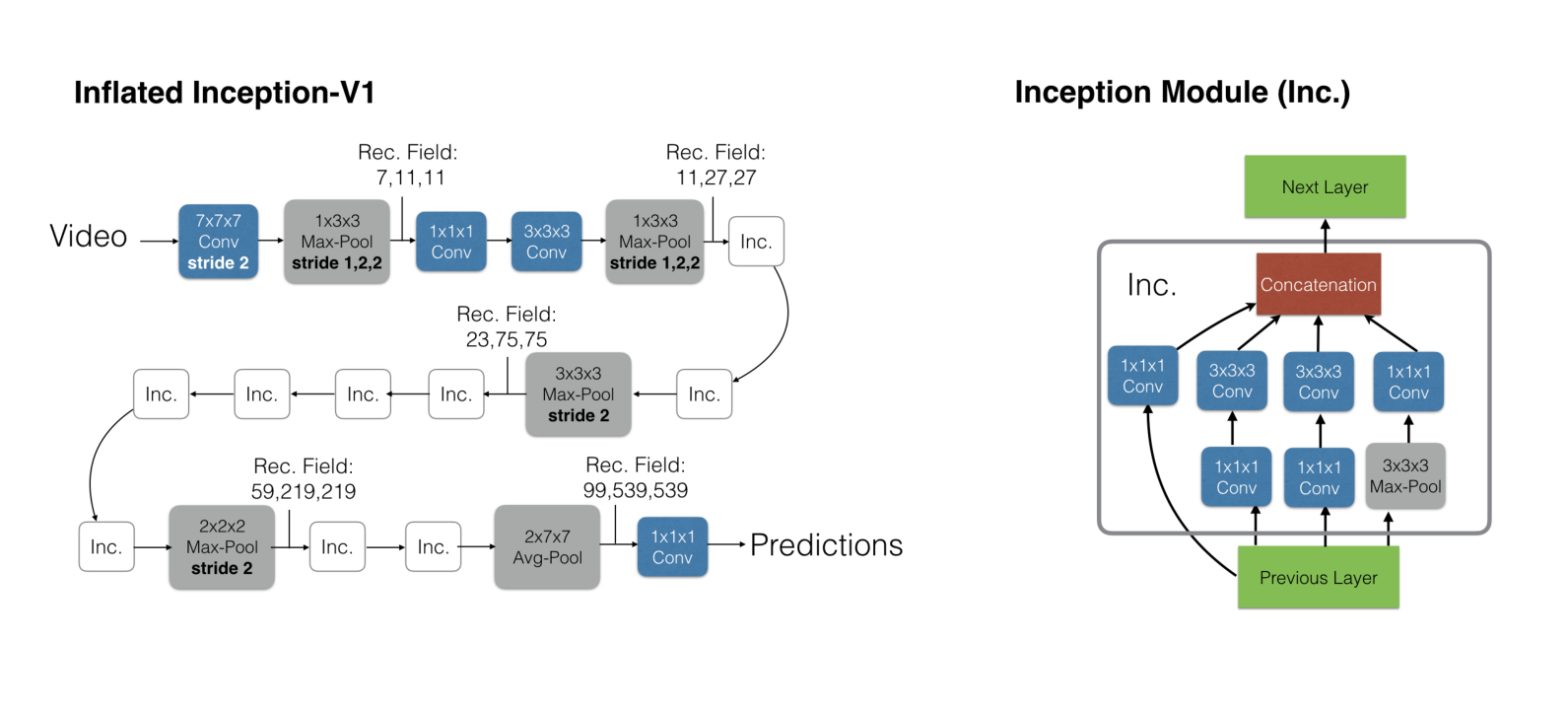
兩項貢獻。第一,在大得多的 Kinetics 資料集 [17] 上重新評估主要的架構家族:頂端接 LSTM 的 CNN、從頭訓練、類似 C3D 的 3D CNN [16]、雙流網路、「3D 融合」的雙流網路,以及新的雙流 I3D。第二,透過膨脹以 ImageNet 預訓練的 Inception-V1 [55] 來建立 I3D,並用正文所述的無聊影片規則,從 2D 濾波器引導出 3D 濾波器 [14]。
結果
不論用 RGB、光流或兩者,I3D 在三個資料集上都表現最好;雙流版本在各處都優於單流版本;在 Kinetics 上預訓練再微調,在 UCF101 與 HMDB51 上帶來大幅進步 [14]。有趣的是,光流單獨使用時,在 HMDB51 上比 RGB 強,但在 Kinetics 上比較弱,作者把這歸因於 Kinetics 中較大的相機運動 [14],這是基準所獎勵的東西會左右結論的早期跡象。
判讀證據
先看架構比較表,它在每個資料集上分別訓練並測試每個模型,再看遷移表,它比較從頭訓練、凍結的 Kinetics 特徵與微調。檢查每個模型是用什麼預訓練的(除了 3D CNN 以外,全都從 ImageNet 開始)、每個模型在訓練與測試時看多少影格,以及是否使用光流:這些差異解釋了排名的大部分原因。
限制與問題
光流流仍需要預先計算的光流;Kinetics 的片段很短,作者自己也發現在那裡 RGB 流比光流更有鑑別力 [14];而膨脹是繼承影像網路的設計,而不是去問影片網路應該長什麼樣子,這個問題後來由 R(2+1)D、SlowFast 與 X3D 回答 [20], [15], [23]。
結論
I3D 讓「膨脹預訓練的影像模型,並在 Kinetics 上預訓練」成為標準配方,它的特徵也成為常用的影片表示,包括 DLCV 12A 討論的 Fréchet Video Distance 的特徵網路。
參考文獻
- Y. Zhu, X. Li, C. Liu, M. Zolfaghari, Y. Xiong, C. Wu, Z. Zhang, J. Tighe et al., “A comprehensive study of deep video action recognition,” technical report, arXiv:2012.06567, 2020. arXiv
- Y. Kong and Y. Fu, “Human action recognition and prediction: A survey,” International Journal of Computer Vision, vol. 130, no. 5, pp. 1366–1401, 2022. doi
- J. Selva, A. S. Johansen, S. Escalera, K. Nasrollahi, T. B. Moeslund and A. Clapés, “Video transformers: A survey,” IEEE Transactions on Pattern Analysis and Machine Intelligence, vol. 45, no. 11, pp. 12922–12943, 2023. doi
- N. Madan, A. Moegelmose, R. Modi, Y. S. Rawat and T. B. Moeslund, “Foundation models for video understanding: A survey,” arXiv:2405.03770, 2024. arXiv
- Y. Tang, J. Bi, S. Xu, L. Song, S. Liang, T. Wang, D. Zhang, J. An et al., “Video understanding with large language models: A survey,” arXiv:2312.17432, 2023 (accepted to IEEE Transactions on Circuits and Systems for Video Technology according to the arXiv record). arXiv
- A. Karpathy, G. Toderici, S. Shetty, T. Leung, R. Sukthankar and L. Fei-Fei, “Large-scale video classification with convolutional neural networks,” in Proc. IEEE CVPR, pp. 1725–1732, 2014. CVF
- Y. Li, Y. Li and N. Vasconcelos, “RESOUND: Towards action recognition without representation bias,” in Proc. ECCV, 2018. CVF
- L. Sevilla-Lara, S. Zha, Z. Yan, V. Goswami, M. Feiszli and L. Torresani, “Only time can tell: Discovering temporal data for temporal modeling,” in Proc. IEEE WACV, 2021. doi
- R. Goyal, S. Ebrahimi Kahou, V. Michalski, J. Materzyńska, S. Westphal, H. Kim, V. Haenel, I. Fruend et al., “The ‘something something’ video database for learning and evaluating visual common sense,” in Proc. IEEE ICCV, 2017. CVF
- Z. Tong, Y. Song, J. Wang and L. Wang, “VideoMAE: Masked autoencoders are data-efficient learners for self-supervised video pre-training,” in Advances in Neural Information Processing Systems (NeurIPS), 2022. NeurIPS · arXiv
- S. Hochreiter and J. Schmidhuber, “Long short-term memory,” Neural Computation, vol. 9, no. 8, pp. 1735–1780, 1997. doi
- K. Simonyan and A. Zisserman, “Two-stream convolutional networks for action recognition in videos,” in Advances in Neural Information Processing Systems (NeurIPS), 2014. NeurIPS · arXiv
- L. Wang, Y. Xiong, Z. Wang, Y. Qiao, D. Lin, X. Tang and L. Van Gool, “Temporal segment networks: Towards good practices for deep action recognition,” in Proc. ECCV, pp. 20–36, 2016. doi · arXiv
- J. Carreira and A. Zisserman, “Quo vadis, action recognition? A new model and the Kinetics dataset,” in Proc. IEEE CVPR, 2017. CVF · arXiv
- C. Feichtenhofer, H. Fan, J. Malik and K. He, “SlowFast networks for video recognition,” in Proc. IEEE/CVF ICCV, 2019. CVF · arXiv
- D. Tran, L. Bourdev, R. Fergus, L. Torresani and M. Paluri, “Learning spatiotemporal features with 3D convolutional networks,” in Proc. IEEE ICCV, pp. 4489–4497, 2015. CVF
- W. Kay, J. Carreira, K. Simonyan, B. Zhang, C. Hillier, S. Vijayanarasimhan, F. Viola, T. Green et al., “The Kinetics human action video dataset,” arXiv:1705.06950, 2017. arXiv
- J. Deng, W. Dong, R. Socher, L.-J. Li, K. Li and L. Fei-Fei, “ImageNet: A large-scale hierarchical image database,” in Proc. IEEE CVPR, 2009. doi
- T. Unterthiner, S. van Steenkiste, K. Kurach, R. Marinier, M. Michalski and S. Gelly, “Towards accurate generative models of video: A new metric & challenges,” arXiv:1812.01717, 2018. arXiv
- D. Tran, H. Wang, L. Torresani, J. Ray, Y. LeCun and M. Paluri, “A closer look at spatiotemporal convolutions for action recognition,” in Proc. IEEE/CVF CVPR, 2018. CVF · arXiv
- J. Lin, C. Gan and S. Han, “TSM: Temporal shift module for efficient video understanding,” in Proc. IEEE/CVF ICCV, 2019. CVF · arXiv
- X. Wang, R. Girshick, A. Gupta and K. He, “Non-local neural networks,” in Proc. IEEE/CVF CVPR, 2018. CVF
- C. Feichtenhofer, “X3D: Expanding architectures for efficient video recognition,” in Proc. IEEE/CVF CVPR, 2020. CVF
- A. Dosovitskiy, L. Beyer, A. Kolesnikov, D. Weissenborn, X. Zhai, T. Unterthiner, M. Dehghani, M. Minderer et al., “An image is worth 16x16 words: Transformers for image recognition at scale,” in Proc. ICLR, 2021. arXiv
- A. Arnab, M. Dehghani, G. Heigold, C. Sun, M. Lučić and C. Schmid, “ViViT: A video vision transformer,” in Proc. IEEE/CVF ICCV, 2021. CVF · arXiv
- G. Bertasius, H. Wang and L. Torresani, “Is space-time attention all you need for video understanding?,” in Proc. ICML, PMLR 139, 2021. PMLR · arXiv
- H. Fan, B. Xiong, K. Mangalam, Y. Li, Z. Yan, J. Malik and C. Feichtenhofer, “Multiscale vision transformers,” in Proc. IEEE/CVF ICCV, 2021. CVF · arXiv
- Z. Liu, J. Ning, Y. Cao, Y. Wei, Z. Zhang, S. Lin and H. Hu, “Video Swin Transformer,” in Proc. IEEE/CVF CVPR, 2022. CVF · arXiv
- Z. Liu, Y. Lin, Y. Cao, H. Hu, Y. Wei, Z. Zhang, S. Lin and B. Guo, “Swin Transformer: Hierarchical vision transformer using shifted windows,” in Proc. IEEE/CVF ICCV, 2021. doi
- K. Li, X. Li, Y. Wang, Y. He, Y. Wang, L. Wang and Y. Qiao, “VideoMamba: State space model for efficient video understanding,” in Proc. ECCV, pp. 237–255, 2024. doi · arXiv
- A. Gu and T. Dao, “Mamba: Linear-time sequence modeling with selective state spaces,” in Proc. Conference on Language Modeling (COLM), 2024. arXiv
- K. He, X. Chen, S. Xie, Y. Li, P. Dollár and R. Girshick, “Masked autoencoders are scalable vision learners,” in Proc. IEEE/CVF CVPR, 2022. doi
- L. Wang, B. Huang, Z. Zhao, Z. Tong, Y. He, Y. Wang, Y. Wang and Y. Qiao, “VideoMAE V2: Scaling video masked autoencoders with dual masking,” in Proc. IEEE/CVF CVPR, 2023. CVF · arXiv
- A. Bardes, Q. Garrido, J. Ponce, X. Chen, M. Rabbat, Y. LeCun, M. Assran and N. Ballas, “Revisiting feature prediction for learning visual representations from video,” Transactions on Machine Learning Research (TMLR), 2024. OpenReview · arXiv
- M. Assran, A. Bardes, D. Fan, Q. Garrido, R. Howes et al., “V-JEPA 2: Self-supervised video models enable understanding, prediction and planning,” arXiv:2506.09985, 2025. arXiv
- A. Radford, J. W. Kim, C. Hallacy, A. Ramesh, G. Goh, S. Agarwal et al., “Learning transferable visual models from natural language supervision,” in Proc. ICML, PMLR 139, 2021. PMLR
- H. Luo, L. Ji, M. Zhong, Y. Chen, W. Lei, N. Duan and T. Li, “CLIP4Clip: An empirical study of CLIP for end to end video clip retrieval and captioning,” Neurocomputing, vol. 508, pp. 293–304, 2022. doi · arXiv
- J. Xu, T. Mei, T. Yao and Y. Rui, “MSR-VTT: A large video description dataset for bridging video and language,” in Proc. IEEE CVPR, 2016. CVF
- Y. Wang, K. Li, X. Li, J. Yu, Y. He, G. Chen, B. Pei, R. Zheng et al., “InternVideo2: Scaling foundation models for multimodal video understanding,” in Proc. ECCV, pp. 396–416, 2024. doi · arXiv
- C. Fu, Y. Dai, Y. Luo, L. Li, S. Ren, R. Zhang, Z. Wang, C. Zhou et al., “Video-MME: The first-ever comprehensive evaluation benchmark of multi-modal LLMs in video analysis,” in Proc. IEEE/CVF CVPR, 2025. CVF · arXiv
- T. Lin, X. Liu, X. Li, E. Ding and S. Wen, “BMN: Boundary-matching network for temporal action proposal generation,” in Proc. IEEE/CVF ICCV, 2019. CVF
- C.-L. Zhang, J. Wu and Y. Li, “ActionFormer: Localizing moments of actions with transformers,” in Proc. ECCV, pp. 492–510, 2022. doi · arXiv
- C. Gu, C. Sun, D. A. Ross, C. Vondrick, C. Pantofaru, Y. Li, S. Vijayanarasimhan, G. Toderici et al., “AVA: A video dataset of spatio-temporally localized atomic visual actions,” in Proc. IEEE/CVF CVPR, 2018. CVF · arXiv
- A. Shahroudy, J. Liu, T.-T. Ng and G. Wang, “NTU RGB+D: A large scale dataset for 3D human activity analysis,” in Proc. IEEE CVPR, 2016. doi · arXiv
- S. Yan, Y. Xiong and D. Lin, “Spatial temporal graph convolutional networks for skeleton-based action recognition,” in Proc. AAAI, vol. 32, no. 1, 2018. doi · arXiv
- P. Weinzaepfel and G. Rogez, “Mimetics: Towards understanding human actions out of context,” International Journal of Computer Vision, vol. 129, no. 5, pp. 1675–1690, 2021. doi · arXiv
- K. Soomro, A. R. Zamir and M. Shah, “UCF101: A dataset of 101 human actions classes from videos in the wild,” technical report CRCV-TR-12-01, arXiv:1212.0402, 2012. arXiv
- H. Kuehne, H. Jhuang, E. Garrote, T. Poggio and T. Serre, “HMDB: A large video database for human motion recognition,” in Proc. IEEE ICCV, pp. 2556–2563, 2011. doi
- G. A. Sigurdsson, G. Varol, X. Wang, A. Farhadi, I. Laptev and A. Gupta, “Hollywood in homes: Crowdsourcing data collection for activity understanding,” in Proc. ECCV, pp. 510–526, 2016. doi · arXiv
- H. Idrees, A. R. Zamir, Y.-G. Jiang, A. Gorban, I. Laptev, R. Sukthankar and M. Shah, “The THUMOS challenge on action recognition for videos ‘in the wild’,” Computer Vision and Image Understanding, vol. 155, pp. 1–23, 2017. doi
- F. Caba Heilbron, V. Escorcia, B. Ghanem and J. C. Niebles, “ActivityNet: A large-scale video benchmark for human activity understanding,” in Proc. IEEE CVPR, pp. 961–970, 2015. CVF
- D. Damen, H. Doughty, G. M. Farinella, S. Fidler, A. Furnari, E. Kazakos, D. Moltisanti, J. Munro et al., “Scaling egocentric vision: The EPIC-KITCHENS dataset,” in Proc. ECCV, 2018. CVF
- D. Damen, H. Doughty, G. M. Farinella, A. Furnari, E. Kazakos, J. Ma, D. Moltisanti, J. Munro et al., “Rescaling egocentric vision: Collection, pipeline and challenges for EPIC-KITCHENS-100,” International Journal of Computer Vision, vol. 130, no. 1, 2022. doi · arXiv
- J. Choi, C. Gao, J. C. E. Messou and J.-B. Huang, “Why can’t I dance in the mall? Learning to mitigate scene bias in action recognition,” in Advances in Neural Information Processing Systems (NeurIPS), 2019. NeurIPS · arXiv
- C. Szegedy, W. Liu, Y. Jia, P. Sermanet, S. Reed, D. Anguelov, D. Erhan, V. Vanhoucke and A. Rabinovich, “Going deeper with convolutions,” in Proc. IEEE CVPR, 2015. doi