Fine-Tuning can Distort Pretrained Features(Kumar 等人)
選讀・DLCV 01A・深度視覺模型的訓練實務 的論文導讀(第 2/2 篇)。引用編號對應本頁底部的參考文獻。
導覽:本頁與本系列: 導覽:本頁與本系列
挑戰
給定一個良好的預訓練模型,你應該只訓練新的線性分類頭(線性探測),還是更新所有權重(微調)?已知微調在與訓練資料相似的資料上更準確。Kumar 等人問的是,在偏移的資料上會發生什麼 [35]。
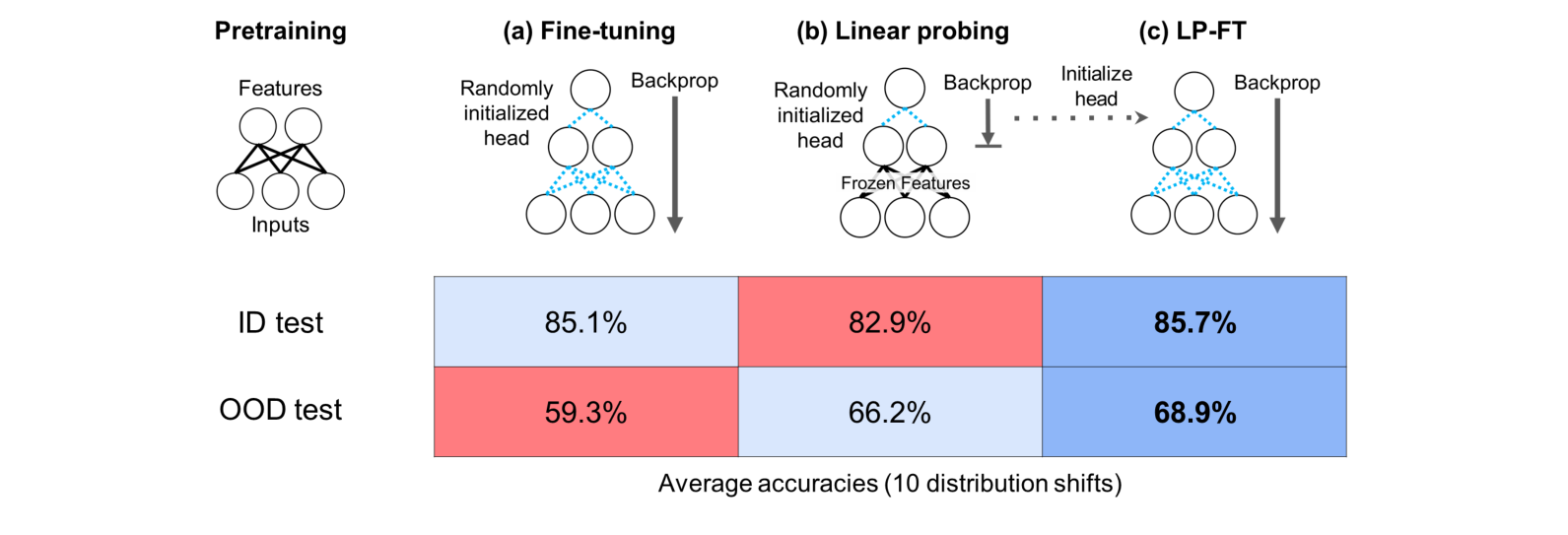
圖片來源: [35], arXiv:2202.10054v1, PDF 第 2 頁. 原始 PDF.
方法
當微調從固定或隨機的分類頭出發時,分類頭與特徵擷取器是一起被最佳化的。分布內訓練輸入的特徵會被更新以配合分類頭,而分布外輸入的特徵變動較小,所以最後的分類頭擬合的是被扭曲的分布內特徵,在其他資料上表現不佳。作者在過參數化的兩層線性網路中證明了這個取捨,並指出在那個設定下,提前停止也無法修正:微調從未經過比線性探測在分布外表現更好的參數。他們的解法是先訓練分類頭(線性探測),再從該分類頭出發微調全部(LP-FT)。
結果
在十個分布偏移基準上,微調平均在分布內比線性探測準確 2%,但在分布外低 7%;LP-FT 則在分布內勝過完整微調約 1%,在分布外勝過約 10% [35]。
判讀證據
對每個方法都看兩欄:分布內(ID)與分布外(OOD)準確率。在 ID 勝出而在 OOD 落敗的方法,擬合的是訓練分布特有的特徵。差距取決於預訓練特徵有多好以及偏移有多大:論文的主張是,當特徵很好而偏移很大時,微調可能表現不佳,而不是說它總是如此。
限制與問題
分析假設預訓練特徵良好;特徵不佳或偏移很小時,單純的微調可能是更好的選擇。LP-FT 多了一個階段,其長度與學習率都需要調整。
結論
它解釋了為什麼在重視穩健性時,「先訓練分類頭」是合理的預設,以及為什麼分類頭的初始化是微調配方的一部分,而不是細節。
參考文獻
- T. He, Z. Zhang, H. Zhang, Z. Zhang, J. Xie and M. Li, “Bag of tricks for image classification with convolutional neural networks,” in Proc. IEEE/CVF CVPR, 2019. doi
- A. Karpathy, “A recipe for training neural networks,” blog post, 2019. link
- scikit-learn developers, “load_digits,” scikit-learn documentation, version 1.9.1. link
- M. Buda, A. Maki and M. A. Mazurowski, “A systematic study of the class imbalance problem in convolutional neural networks,” Neural Networks, vol. 106, 2018. doi
- T.-Y. Lin, P. Goyal, R. Girshick, K. He and P. Dollár, “Focal loss for dense object detection,” in Proc. IEEE ICCV, 2017. doi
- A. Buslaev, V. I. Iglovikov, E. Khvedchenya, A. Parinov, M. Druzhinin and A. A. Kalinin, “Albumentations: Fast and flexible image augmentations,” Information, vol. 11, no. 2, 2020. doi
- C. Shorten and T. M. Khoshgoftaar, “A survey on image data augmentation for deep learning,” Journal of Big Data, vol. 6, 2019. doi
- K. He, X. Zhang, S. Ren and J. Sun, “Delving deep into rectifiers: Surpassing human-level performance on ImageNet classification,” in Proc. IEEE ICCV, 2015. doi
- P. Goyal, P. Dollár, R. Girshick, P. Noordhuis, L. Wesolowski, A. Kyrola, A. Tulloch, Y. Jia and K. He, “Accurate, large minibatch SGD: Training ImageNet in 1 hour,” arXiv:1706.02677 (technical report), 2017. arXiv
- S. Ioffe and C. Szegedy, “Batch normalization: Accelerating deep network training by reducing internal covariate shift,” in Proc. ICML, PMLR 37, 2015. link
- Y. Wu and K. He, “Group normalization,” in Proc. ECCV, 2018. doi
- Y. Bengio, “Practical recommendations for gradient-based training of deep architectures,” in Neural Networks: Tricks of the Trade, 2nd ed., LNCS 7700, Springer, 2012. doi
- L. N. Smith, “Cyclical learning rates for training neural networks,” in Proc. IEEE WACV, 2017. doi
- L. N. Smith, “A disciplined approach to neural network hyper-parameters: Part 1 — learning rate, batch size, momentum, and weight decay,” US Naval Research Laboratory Technical Report 5510-026, arXiv:1803.09820, 2018. arXiv
- I. Loshchilov and F. Hutter, “SGDR: Stochastic gradient descent with warm restarts,” in Proc. ICLR, 2017. arXiv
- L. N. Smith and N. Topin, “Super-convergence: Very fast training of neural networks using large learning rates,” in Artificial Intelligence and Machine Learning for Multi-Domain Operations Applications, Proc. SPIE 11006, 2019. doi
- PyTorch contributors, “torch.optim.lr_scheduler.OneCycleLR,” PyTorch 2.15 documentation, 2026. link
- K. He, X. Zhang, S. Ren and J. Sun, “Deep residual learning for image recognition,” in Proc. IEEE CVPR, 2016. doi
- J. Deng, W. Dong, R. Socher, L.-J. Li, K. Li and L. Fei-Fei, “ImageNet: A large-scale hierarchical image database,” in Proc. IEEE CVPR, 2009. doi
- D. P. Kingma and J. Ba, “Adam: A method for stochastic optimization,” in Proc. ICLR, 2015. arXiv
- I. Loshchilov and F. Hutter, “Decoupled weight decay regularization,” in Proc. ICLR, 2019. arXiv
- PyTorch contributors, “torch.optim.Adam,” PyTorch 2.15 documentation, 2026. link
- N. Srivastava, G. Hinton, A. Krizhevsky, I. Sutskever and R. Salakhutdinov, “Dropout: A simple way to prevent neural networks from overfitting,” Journal of Machine Learning Research, vol. 15, 2014. link
- G. Huang, Y. Sun, Z. Liu, D. Sedra and K. Q. Weinberger, “Deep networks with stochastic depth,” in Proc. ECCV, 2016. doi
- L. Prechelt, “Early stopping — but when?,” in Neural Networks: Tricks of the Trade, 2nd ed., LNCS 7700, Springer, 2012. doi
- V. Godbole, G. E. Dahl, J. Gilmer, C. J. Shallue and Z. Nado, “Deep learning tuning playbook,” Google Research, GitHub repository, 2023. link
- B. T. Polyak and A. B. Juditsky, “Acceleration of stochastic approximation by averaging,” SIAM Journal on Control and Optimization, vol. 30, no. 4, 1992. doi
- P. Izmailov, D. Podoprikhin, T. Garipov, D. Vetrov and A. G. Wilson, “Averaging weights leads to wider optima and better generalization,” in Proc. UAI, 2018. arXiv
- D. Morales-Brotons, T. Vogels and H. Hendrikx, “Exponential moving average of weights in deep learning: Dynamics and benefits,” Transactions on Machine Learning Research, 2024. arXiv
- P. Micikevicius, S. Narang, J. Alben, G. Diamos, E. Elsen, D. Garcia, B. Ginsburg, M. Houston, O. Kuchaiev, G. Venkatesh and H. Wu, “Mixed precision training,” in Proc. ICLR, 2018. arXiv
- PyTorch contributors, “Automatic mixed precision package — torch.amp,” PyTorch 2.15 documentation, 2026. link
- J. Yosinski, J. Clune, Y. Bengio and H. Lipson, “How transferable are features in deep neural networks?,” in Advances in Neural Information Processing Systems 27, 2014. link
- E. J. Hu, Y. Shen, P. Wallis, Z. Allen-Zhu, Y. Li, S. Wang, L. Wang and W. Chen, “LoRA: Low-rank adaptation of large language models,” in Proc. ICLR, 2022. arXiv
- J. Howard and S. Ruder, “Universal language model fine-tuning for text classification,” in Proc. ACL, 2018. doi
- A. Kumar, A. Raghunathan, R. Jones, T. Ma and P. Liang, “Fine-tuning can distort pretrained features and underperform out-of-distribution,” in Proc. ICLR, 2022. arXiv
- C. Zhang, S. Bengio, M. Hardt, B. Recht and O. Vinyals, “Understanding deep learning requires rethinking generalization,” in Proc. ICLR, 2017. arXiv
- R. Geirhos, J.-H. Jacobsen, C. Michaelis, R. Zemel, W. Brendel, M. Bethge and F. A. Wichmann, “Shortcut learning in deep neural networks,” Nature Machine Intelligence, vol. 2, 2020. doi
- PyTorch contributors, “Reproducibility,” PyTorch 2.15 documentation, 2026. link
- Y. Xin, J. Yang, S. Luo, Y. Du, Q. Qin, K. Cen, Y. He, Z. Zhang, B. Fu, X. Yang, G. Zhai, M.-H. Yang and X. Liu, “Parameter-efficient fine-tuning for pre-trained vision models: A survey and benchmark,” arXiv:2402.02242, 2024. arXiv
- G. E. Dahl, F. Schneider, Z. Nado, N. Agarwal, C. S. Sastry, P. Hennig, S. Medapati, R. Eschenhagen, P. Kasimbeg, D. Suo et al., “Benchmarking neural network training algorithms,” arXiv:2306.07179, 2023. arXiv
- P. Kasimbeg, F. Schneider, R. Eschenhagen, J. Bae, C. S. Sastry, M. Saroufim, B. Feng, L. Wright, E. Z. Yang, Z. Nado, S. Medapati, P. Hennig, M. Rabbat and G. E. Dahl, “Accelerating neural network training: An analysis of the AlgoPerf competition,” in Proc. ICLR, 2025. arXiv
- A. Defazio, X. A. Yang, H. Mehta, K. Mishchenko, A. Khaled and A. Cutkosky, “The road less scheduled,” in Advances in Neural Information Processing Systems 37, 2024. link
- S. Hu, Y. Tu, X. Han, C. He, G. Cui, X. Long, Z. Zheng, Y. Fang, Y. Huang, W. Zhao et al., “MiniCPM: Unveiling the potential of small language models with scalable training strategies,” in Proc. Conference on Language Modeling (COLM), 2024. arXiv
- A. Hägele, E. Bakouch, A. Kosson, L. Ben Allal, L. Von Werra and M. Jaggi, “Scaling laws and compute-optimal training beyond fixed training durations,” in Advances in Neural Information Processing Systems 37, 2024. link
- M. Wortsman, G. Ilharco, J. W. Kim, M. Li, S. Kornblith, R. Roelofs, R. Gontijo Lopes, H. Hajishirzi, A. Farhadi, H. Namkoong and L. Schmidt, “Robust fine-tuning of zero-shot models,” in Proc. IEEE/CVF CVPR, 2022. doi
- M. Wortsman, G. Ilharco, S. Y. Gadre, R. Roelofs, R. Gontijo-Lopes, A. S. Morcos, H. Namkoong, A. Farhadi, Y. Carmon, S. Kornblith and L. Schmidt, “Model soups: Averaging weights of multiple fine-tuned models improves accuracy without increasing inference time,” in Proc. ICML, PMLR 162, 2022. link
- PyTorch contributors, “Automatic mixed precision examples,” PyTorch 2.15 documentation, 2026. link
- PyTorch contributors, “DistributedDataParallel,” PyTorch 2.15.0 source documentation, 2026. Official source.