Simple Baselines(Xiao 等人,2018)
選讀・DLCV 05・人體姿態與關鍵點估計 的論文導讀(第 1/3 篇)。引用編號對應本頁底部的參考文獻。
導覽:本頁與本系列: 導覽:本頁與本系列
挑戰
到了 2018 年,頂尖的姿態估計器已變得很複雜:多階段沙漏、級聯金字塔網路、精修模組。很難分辨哪些部分真正重要。Xiao、Wu 與 Wei [9] 問:最簡單而合理的設計能走多遠?他們把它作為評估新想法的基線,同時適用於單張影像的姿態與影片中的姿態追蹤。
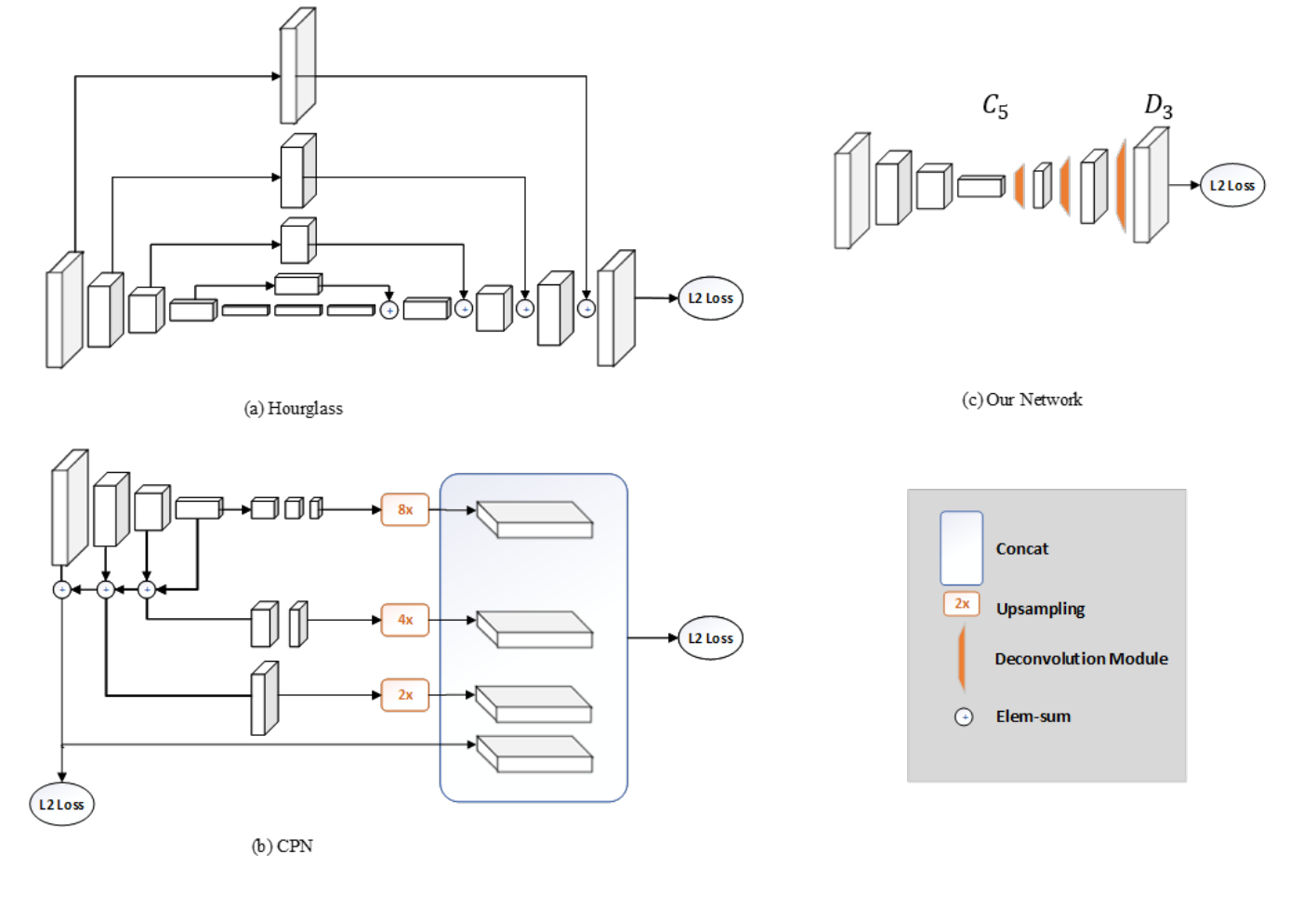
圖片來源: [9], arXiv:1804.06208v2, PDF 第 3 頁. 原始 PDF.
方法
取 ImageNet 預訓練的 ResNet,什麼都不拿掉,在最後階段之上加三層反卷積層(含批次正規化與 ReLU);用 卷積預測 張熱圖;以 MSE 對高斯目標訓練。使用標準的由上而下流程,搭配 Faster R-CNN 人物偵測器、翻轉測試與四分之一偏移解碼器。追蹤時,用光流把每個人的關鍵點傳播到下一個影格以產生額外的框,並用基於光流的 OKS 相似度做貪婪配對,連結跨影格的人。
結果
這個簡單的網路在 COCO 上與當時較複雜的模型不相上下,甚至更好;論文最佳的單一模型在 COCO test-dev 上達到 73.7 AP,其追蹤系統在發表時是 PoseTrack 基準上的最先進。
判讀證據
消融實驗(表 2)在 COCO val2017 上一次只改變一個因素:熱圖解析度(三層反卷積得到 的圖,比兩層得到 的圖高 2.5 AP)、反卷積核大小(影響很小,核大小 4 與 2 之間差 0.3 AP)、骨幹深度(越深的 ResNet 穩定地越有幫助)與輸入尺寸。與 Hourglass 和 CPN 的比較(表 3)使用的數字是引自 CPN 論文,而不是重新實作的;作者明說了這一點,並指出差異可能來自實作細節。在比較任何由上而下的數字之前,還有兩個設定必須一致:人物偵測器(論文的偵測器在 COCO val2017 上的人物 AP 為 56.4,Hourglass 與 CPN 使用的偵測器為 55.3)與輸入尺寸( 對 )。
限制與問題
它是由上而下的方法,所以繼承了偵測器所有的失敗,成本也隨人數成長。它的熱圖仍是步幅 4,所以解碼精度取決於本篇所述的後處理。HRNet(其中一些作者相同)後來證明,讓高解析度貫穿整個網路,比到最後才恢復它更好 [15]。
結論
它是現代由上而下姿態估計器的範本,ViTPose 等後續系統也明確保留了它簡單的反卷積解碼器 [16]。
參考文獻
- A. Mathis, P. Mamidanna, K. M. Cury, T. Abe, V. N. Murthy, M. W. Mathis and M. Bethge, “DeepLabCut: Markerless pose estimation of user-defined body parts with deep learning,” Nature Neuroscience, vol. 21, no. 9, 2018. doi · arXiv
- C. Zheng, W. Wu, C. Chen, T. Yang, S. Zhu, J. Shen, N. Kehtarnavaz and M. Shah, “Deep learning-based human pose estimation: A survey,” ACM Computing Surveys, vol. 56, no. 1, 2024. doi · arXiv
- Y. Chen, Y. Tian and M. He, “Monocular human pose estimation: A survey of deep learning-based methods,” Computer Vision and Image Understanding, vol. 192, 102897, 2020. doi · arXiv
- COCO Consortium, “Keypoint evaluation,” COCO dataset official documentation (accessed 2026-11-01). cocodataset.org
- Y. Tian, H. Zhang, Y. Liu and L. Wang, “Recovering 3D human mesh from monocular images: A survey,” IEEE Transactions on Pattern Analysis and Machine Intelligence, vol. 45, no. 12, 2023. doi · arXiv
- A. Toshev and C. Szegedy, “DeepPose: Human pose estimation via deep neural networks,” in Proc. IEEE Conference on Computer Vision and Pattern Recognition (CVPR), 2014. doi · arXiv
- J. Tompson, A. Jain, Y. LeCun and C. Bregler, “Joint training of a convolutional network and a graphical model for human pose estimation,” in Advances in Neural Information Processing Systems (NeurIPS), 2014. NeurIPS · arXiv
- A. Newell, K. Yang and J. Deng, “Stacked hourglass networks for human pose estimation,” in Proc. European Conference on Computer Vision (ECCV), LNCS, 2016. doi · arXiv
- B. Xiao, H. Wu and Y. Wei, “Simple baselines for human pose estimation and tracking,” in Proc. European Conference on Computer Vision (ECCV), LNCS, 2018. doi · arXiv
- F. Zhang, X. Zhu, H. Dai, M. Ye and C. Zhu, “Distribution-aware coordinate representation for human pose estimation,” in Proc. IEEE/CVF Conference on Computer Vision and Pattern Recognition (CVPR), 2020. doi · arXiv
- X. Sun, B. Xiao, F. Wei, S. Liang and Y. Wei, “Integral human pose regression,” in Proc. European Conference on Computer Vision (ECCV), LNCS, 2018. doi · arXiv
- Y. Li, S. Yang, P. Liu, S. Zhang, Y. Wang, Z. Wang, W. Yang and S.-T. Xia, “SimCC: A simple coordinate classification perspective for human pose estimation,” in Proc. European Conference on Computer Vision (ECCV), LNCS, 2022. doi · arXiv
- J. Li, S. Bian, A. Zeng, C. Wang, B. Pang, W. Liu and C. Lu, “Human pose regression with residual log-likelihood estimation,” in Proc. IEEE/CVF International Conference on Computer Vision (ICCV), 2021. doi · arXiv
- S.-E. Wei, V. Ramakrishna, T. Kanade and Y. Sheikh, “Convolutional pose machines,” in Proc. IEEE Conference on Computer Vision and Pattern Recognition (CVPR), 2016. doi · arXiv
- K. Sun, B. Xiao, D. Liu and J. Wang, “Deep high-resolution representation learning for human pose estimation,” in Proc. IEEE/CVF Conference on Computer Vision and Pattern Recognition (CVPR), 2019. doi · arXiv
- Y. Xu, J. Zhang, Q. Zhang and D. Tao, “ViTPose: Simple vision transformer baselines for human pose estimation,” in Advances in Neural Information Processing Systems (NeurIPS), 2022. NeurIPS · arXiv
- K. He, G. Gkioxari, P. Dollár and R. Girshick, “Mask R-CNN,” in Proc. IEEE International Conference on Computer Vision (ICCV), 2017. doi · arXiv
- Z. Cao, T. Simon, S.-E. Wei and Y. Sheikh, “Realtime multi-person 2D pose estimation using part affinity fields,” in Proc. IEEE Conference on Computer Vision and Pattern Recognition (CVPR), 2017. doi · arXiv
- A. Newell, Z. Huang and J. Deng, “Associative embedding: End-to-end learning for joint detection and grouping,” in Advances in Neural Information Processing Systems (NeurIPS), 2017. NeurIPS · arXiv
- B. Cheng, B. Xiao, J. Wang, H. Shi, T. S. Huang and L. Zhang, “HigherHRNet: Scale-aware representation learning for bottom-up human pose estimation,” in Proc. IEEE/CVF Conference on Computer Vision and Pattern Recognition (CVPR), 2020. doi · arXiv
- Z. Geng, K. Sun, B. Xiao, Z. Zhang and J. Wang, “Bottom-up human pose estimation via disentangled keypoint regression,” in Proc. IEEE/CVF Conference on Computer Vision and Pattern Recognition (CVPR), 2021. doi · arXiv
- X. Zhou, D. Wang and P. Krähenbühl, “Objects as points,” arXiv:1904.07850, 2019. arXiv
- P. Lu, T. Jiang, Y. Li, X. Li, K. Chen and W. Yang, “RTMO: Towards high-performance one-stage real-time multi-person pose estimation,” in Proc. IEEE/CVF Conference on Computer Vision and Pattern Recognition (CVPR), 2024. doi · arXiv
- J. Yang, A. Zeng, S. Liu, F. Li, R. Zhang and L. Zhang, “Explicit box detection unifies end-to-end multi-person pose estimation,” in Proc. International Conference on Learning Representations (ICLR), 2023. OpenReview · arXiv
- Y. Yang and D. Ramanan, “Articulated human detection with flexible mixtures of parts,” IEEE Transactions on Pattern Analysis and Machine Intelligence, vol. 35, no. 12, 2013. doi
- M. Andriluka, L. Pishchulin, P. Gehler and B. Schiele, “2D human pose estimation: New benchmark and state of the art analysis,” in Proc. IEEE Conference on Computer Vision and Pattern Recognition (CVPR), 2014. doi · CVF
- COCO Consortium,
cocoeval.py(keypoint OKS computation and the per-keypoint sigmas), official COCO API source code (accessed 2026-11-01). GitHub - J. Martinez, R. Hossain, J. Romero and J. J. Little, “A simple yet effective baseline for 3d human pose estimation,” in Proc. IEEE International Conference on Computer Vision (ICCV), 2017. doi · arXiv
- M. R. Ronchi and P. Perona, “Benchmarking and error diagnosis in multi-instance pose estimation,” in Proc. IEEE International Conference on Computer Vision (ICCV), 2017. doi · arXiv
- T.-Y. Lin, M. Maire, S. Belongie, J. Hays, P. Perona, D. Ramanan, P. Dollár and C. L. Zitnick, “Microsoft COCO: Common objects in context,” in Proc. European Conference on Computer Vision (ECCV), LNCS, 2014. doi · arXiv
- J. Li, C. Wang, H. Zhu, Y. Mao, H.-S. Fang and C. Lu, “CrowdPose: Efficient crowded scenes pose estimation and a new benchmark,” in Proc. IEEE/CVF Conference on Computer Vision and Pattern Recognition (CVPR), 2019. doi · arXiv
- S. Jin, L. Xu, J. Xu, C. Wang, W. Liu, C. Qian, W. Ouyang and P. Luo, “Whole-body human pose estimation in the wild,” in Proc. European Conference on Computer Vision (ECCV), LNCS, 2020. doi · arXiv
- M. Andriluka, U. Iqbal, E. Insafutdinov, L. Pishchulin, A. Milan, J. Gall and B. Schiele, “PoseTrack: A benchmark for human pose estimation and tracking,” in Proc. IEEE/CVF Conference on Computer Vision and Pattern Recognition (CVPR), 2018. doi · arXiv
- C. Ionescu, D. Papava, V. Olaru and C. Sminchisescu, “Human3.6M: Large scale datasets and predictive methods for 3D human sensing in natural environments,” IEEE Transactions on Pattern Analysis and Machine Intelligence, vol. 36, no. 7, 2014. doi · project page
- H. Yu, Y. Xu, J. Zhang, W. Zhao, Z. Guan and D. Tao, “AP-10K: A benchmark for animal pose estimation in the wild,” in Advances in Neural Information Processing Systems (NeurIPS) Datasets and Benchmarks Track, 2021. NeurIPS · arXiv
- Z. Cao, G. Hidalgo, T. Simon, S.-E. Wei and Y. Sheikh, “OpenPose: Realtime multi-person 2D pose estimation using part affinity fields,” IEEE Transactions on Pattern Analysis and Machine Intelligence, vol. 43, no. 1, 2021. doi · arXiv
- D. Pavllo, C. Feichtenhofer, D. Grangier and M. Auli, “3D human pose estimation in video with temporal convolutions and semi-supervised training,” in Proc. IEEE/CVF Conference on Computer Vision and Pattern Recognition (CVPR), 2019. doi · arXiv
- K. Iskakov, E. Burkov, V. Lempitsky and Y. Malkov, “Learnable triangulation of human pose,” in Proc. IEEE/CVF International Conference on Computer Vision (ICCV), 2019. doi · arXiv
- M. Loper, N. Mahmood, J. Romero, G. Pons-Moll and M. J. Black, “SMPL: A skinned multi-person linear model,” ACM Transactions on Graphics (Proc. SIGGRAPH Asia), vol. 34, no. 6, 2015. doi
- A. Kanazawa, M. J. Black, D. W. Jacobs and J. Malik, “End-to-end recovery of human shape and pose,” in Proc. IEEE/CVF Conference on Computer Vision and Pattern Recognition (CVPR), 2018. doi · arXiv
- S. Goel, G. Pavlakos, J. Rajasegaran, A. Kanazawa and J. Malik, “Humans in 4D: Reconstructing and tracking humans with transformers,” in Proc. IEEE/CVF International Conference on Computer Vision (ICCV), 2023. doi · arXiv
- R. Khirodkar, T. Bagautdinov, J. Martinez, S. Zhaoen, A. James, P. Selednik, S. Anderson and S. Saito, “Sapiens: Foundation for human vision models,” in Proc. European Conference on Computer Vision (ECCV), LNCS, 2024. doi · arXiv
- T. Jiang, P. Lu, L. Zhang, N. Ma, R. Han, C. Lyu, Y. Li and K. Chen, “RTMPose: Real-time multi-person pose estimation based on MMPose,” arXiv:2303.07399, 2023. arXiv